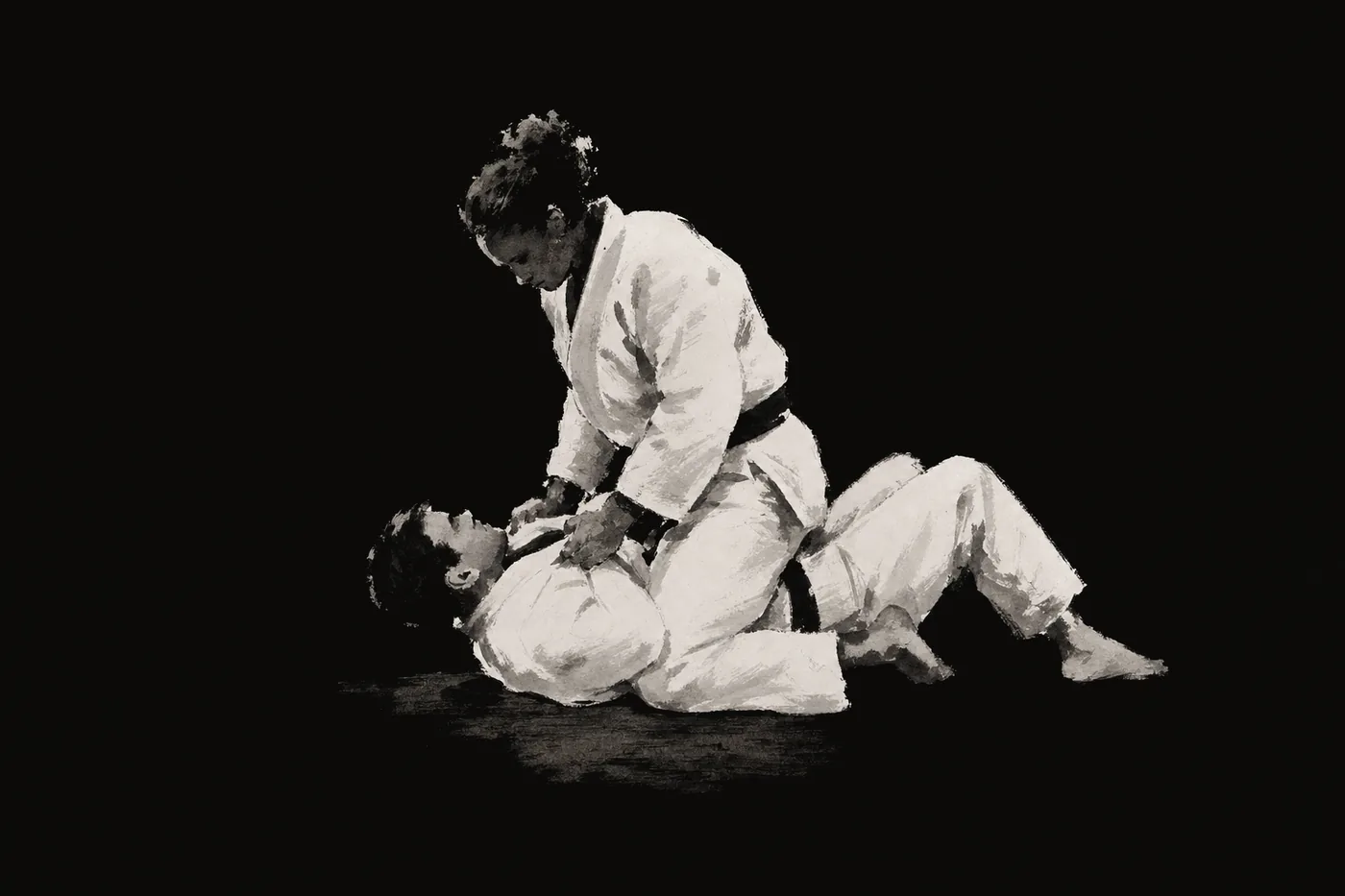
Learn / Jiu Jitsu / Systems / Escaping the mount, in the gi
Mount · escape it · gi
Escaping the mount, in the gi
Mounted low with his feet locked and his cross face on: the frame with the fingers down, the single-shoulder bridge Danaher calls the power shrimp, the hand inside his knee, the inverted knee in front of his, and the sliding shrimp to the half guard. You are mounted low with your elbows already in, and he holds it the way people who can hold a mount hold it: his feet locked under you, his cross face on, one hand posted wide. Everything you try fails: you hunt for his ankle with your heel while his feet are locked, you shrimp flat with both feet and his knees close behind you, you push with your hands and his knees walk up. The spine below is John Danaher's escape in the gi, one coach and one lesson in his own orientation: the box frame, the right forearm across his belt line and the left elbow inside his knee, one bridge over the left shoulder with the foot turned out, the left hand inside his right knee with the fingers down, the left knee inverted and put in front of his knee, the second frame, the left hand to his shoulder with the right forearm kept on his belt line, the right foot planted and a sliding shrimp that puts your left leg in front of his: the half guard, held three seconds, with a second sliding shrimp to the closed guard as the route's finish. The route card in section 1 carries every side. The bridge and roll, the hands on the hips and the kip, the crossed feet and the grapevine, the other knee-elbow escapes and survival before escape are references; the underhook dug under your frame, the knees walked up, the back given by turning too far, the locked feet and the collar choke are the threat map. 37 gi clips, 21 no-gi clips, two mixed-kit clips and one podcast are cited, the no-gi and mixed ones cued as such; thirteen clips were considered and excluded.
Key takeaways
- Success means The half guard recovered and held three seconds, the frame kept.
- The spine is 6 steps after the gate, the box frame: right forearm across his belt line, hand at his right hip; left hand locks it, then left elbow inside his right knee, turn the left foot out and bridge over the left shoulder in one motion: the power shrimp, left hand inside his right knee, heel of the hand, fingers down, elbow tight; the right forearm keeps his belt line, invert the left knee and put it in front of his right knee: left hand, knee and elbow join, the second frame: left hand to his shoulder, right forearm kept on his belt line; plant the right foot and slide: the half guard held, right hand up to his far collar, left hand to his near upper arm; plant the left foot, turn the hips back and slide again: the right knee in front of his left leg, the closed guard.
- When it breaks there are 6 named branches; learn the triggers, the responses are short.
- Evidence: 61 clips from 30 channels (35 clips from a coach's own channel, 14 from a gym's, 12 from an instructional publisher's), every timestamp checked against the spoken transcript. Sentences marked synthesis are the editors', not a coach's.
the frame before any escape: elbows in, his hips kept at your hips
He sits on your belly, your elbows drift out to push him, and his knees walk up under your armpits; every escape you try starts from a high mount and ends in an armbar. Danaher forms a solid frame before anything and says the two shrimps are useless without it: the forearm across his belt line and the second arm's elbow inside his knee, the box. Two checks beside it change what you do: Machado's rule that the elbows touch his thigh in front of his leg and his hips never pass your belt line, because above it your hips stop working and your arms are exposed; and Glick's rule that the elbow pushes on the far hip, since inside position without the push is not a frame. Chewjitsu's warning finishes the check: the elbows push, not the hands bench-pressing with the elbows out.
 11:30John Danaher · Bernardo Faria BJJ Fanaticsgiwe have an opponent on top of us; we form a good solid frame; he's probably gonna have a cross face on and probably an arm out wide for base; that's how most people hold a mounted position9:20John Danaher · Bernardo Faria BJJ Fanaticsgione excellent frame is to bring my hand and forearm across my opponent's belt; I take my second hand, I put my elbow inside my training partner's knee; we formed a box frame
 0:03Jean Jacques Machadogievery time somebody mounts you and my elbows are not close to my body it's very big risk; I want to make sure that I always maintain his hip on top of my belt because anytime he goes above my belt my hip now has no function1:07Jean Jacques Machadoginumber one if somebody mounted, keep your elbows here; my elbows must touch his thigh
 0:00Jean Jacques Machadogikeep your elbows in front of his leg, not on top; anytime he squeezes me so much in the knee I turn
 3:25Brian Glick · BJJ Fanaticsno-gino-gi: the power of our frame across our partner's hip; the emphasis is on your elbow pushing against your partner's hip; if your elbow's not pushing you're always going to get your partner sliding their right knee forward up to your shoulder line
 2:42Nick Albin · Chewjitsugiif you try to push with your hands it's not going to work; my hands go here, I'm keeping my elbow in tight, my hands are linked together; what I'm not doing is pushing here, I'm using my elbow to push
 5:30Nick Albin · Chewjitsugiwhen you are pushing and framing it's going to be at that belly button or below; one of the mistakes that people make is that they will start to try to push with their hands; now this isn't always wrong6:32Nick Albin · Chewjitsugilay all of your weight on top of my arms here; I can support Marvin's weight all day like this; when we set up our frames we're not pushing with the hands, we're using these elbows
the turn onto one side with one leg flat on the mat
You shrimp flat on your back with both feet pushing, and his knees pinch back together behind you every time. Danaher's power shrimp is the single-shoulder bridge with the foot turned out, and the point of it is to take his weight off you in one motion so that a hand and a knee can get inside. Two checks beside it change what you do: Giles wants the bottom leg flat and never lifted again once it is flat, and Chewjitsu turns the hips all the way but keeps the shoulders where they can come back down, because the back is the price of turning too far. The other coaches' first movements from their own set-ups are in the reference index.
15:20John Danaher · Bernardo Faria BJJ Fanaticsgia power shrimp is essentially a combination of single shoulder bridge with a shrimping motion; that's what enables us to get our hand inside our opponent's knee, to get my knee inverted and inside, and join hand, knee and elbow together 3:21Lachlan Giles · Absolute MMA St KildagiI need to move aside, keep my leg out and flatten it straight; once I kick it off and flatten it straight I don't want to lift my foot up again; as soon as I lift my foot she can start to take that space again
 5:27BJJ Library (Saulo Ribeiro's Jiu-Jitsu University chapters; the coach on camera is not named in the clip)gievery time he mounts you got to have the perception of a turn on your side, flat leg on the ground; if your foot turns up your knee comes up and it's easy for him to hop the foot behind you
 3:18Nick Albin · Chewjitsugiturn all the way to the side; if my back is exposed, like the logo on my back, it's an easy setup to take the back3:38Nick Albin · Chewjitsugiwe're turning our hips all the way over but we're staying like this; at any point I can always bring my shoulders back down
the knee, not the ankle: where the escape enters against a tight mount
You hunt for his ankle with your heel while his feet are locked tight under you, and nothing moves. Danaher's contention is the whole document: the classical elbow escape enters under the ankle and works when he is naive and his feet are apart, but a man who knows anything locks his feet tight and cross-faces you, so the entry is at the knee, with the hand inside the knee first and the inverted knee penetrating in front of his. Two checks beside it: Akins says the toes decide where the knee goes, pointed to the ground so the knee bends toward the mat and scrapes under a tight leg instead of sliding up the ramp of his toes; Giles's aim is the knee past the line of the foot, and when he is heavy on that leg the other leg is light.
19:14John Danaher · Bernardo Faria BJJ Fanaticsgiwhat's gonna work with a six-time world champion on top with proper heat? it's penetrating not at the ankle but at the knee; we start with that single shoulder bridge, we put our hand inside our training partner's knee, now I focus on my knee coming through18:11John Danaher · Bernardo Faria BJJ Fanaticsgino one who knows anything about jiu-jitsu is ever going to give you that kind of opportunity once they are mounted; he is not going to leave his ankles in a vulnerable position for me to simply penetrate underneath his ankle with my knee 6:07Henry Akins · Bernardo Faria BJJ Fanaticsgithe direction my toes point dictates which direction my knee bends; if my toes are pointed up when I bend my knee I go over your leg; I actually want to turn my toes to the ground because now my knee goes towards the ground9:53Henry Akins · Bernardo Faria BJJ Fanaticsgiby turning my knee to the ground I take away this gap which allows people to get their toes underneath; when I do it I'm actually scraping the ground so it slides underneath
 3:25Lachlan Giles · Absolute MMA St Kildano-gino-gi: what I want to get with my legs is inside leg positioning; I want my left knee past the line of his ankle; there's nowhere he can put his foot that's safe6:15Lachlan Giles · Absolute MMA St Kildano-gino-gi: he has to be really heavy on that leg which means this one is light, so we're going to attack this one; I push my lower back into his calf as I hip escape; my inside leg comes through
an endpoint that is a guard, not a hold
You get your knee in and stop, flat, holding his leg, and he squares back up and remounts. Danaher's route does not stop at the knee in front: the second frame goes on at his shoulder and hips, two sliding shrimps follow, and the opponent is back in the closed guard, or the butterfly guard, whichever you prefer; what he calls the first leg in front is what this document names the half guard. Two checks beside it: Glick prefers the half guard with the underhook to the closed guard because it is quicker against resistance, and Giles finishes squared up and facing him with a frame, and says the trapped foot alone is not a good position yet.
13:38John Danaher · Bernardo Faria BJJ Fanaticsgilook how we form a second frame, shoulder and hips; we slide shrimp this time and we put a knee in front; now a sliding shrimp a second time and we have the option now of putting him back in closed guard, butterfly guard, whatever you prefer15:41John Danaher · Bernardo Faria BJJ Fanaticsgiput them back to get my first leg in front of my opponent; then we shrimp, a sliding shrimp, a second sliding shrimp, and we put our opponent back in guard11:16Brian Glick · BJJ Fanaticsno-gino-gi: don't try to go back all the way to the closed guard; it's a little time-consuming and especially when you're working no-gi and your partner is really resistant you want to get as much control and connection as quickly as you can, and the half guard is a great way to do that4:29Lachlan Giles · Absolute MMA St Kildano-gino-gi: once we got that we can square up and finish with frame; don't stop when you just trap this, this is not that good of a position yet; I need to hip out, frame and get facing himsuccess means
synthesis The half guard held three seconds with the second frame on: your left leg in front of his right leg, his right leg between yours, your left forearm at his chest and shoulder and your right forearm on his belt line, your head on the mat and your shoulders where they can come back down. The count is the author's rule and the name half guard is the author's for what Danaher calls the first leg in front; he does not stop there and goes on to the closed guard, which the session drills and does not count. In the rounds the count is earned against a partner who follows and pulls the leg back, and those reps are counted apart from the cooperative ones.
14:59John Danaher · Bernardo Faria BJJ Fanaticsgithere's no need for a power shrimp now; he doesn't really have a strong connection to me anymore, so a sliding shrimp will be more than sufficient to put my leg in15:20John Danaher · Bernardo Faria BJJ Fanaticsgijoin hand, knee and elbow together and put them back to get my first leg in front of my opponentthe situation
You are on your back in the gi, mounted low on your hips by a partner who holds the mount the way people who can hold it do: his feet locked or close together under you, his cross face on, one hand posted wide; your elbows are already in; the high mount with your elbows trapped, the grapevine on both legs and the arms pinned are references (B3) and resets, the bridge and roll (B1) and the kip (B2) are references, and the guard you land in is another document's; a hand that reaches your collar or an arm that isolates yours in the rounds is a named stop, because no defence to it is drilled here
the endpoint
The half guard held three seconds: your left leg in front of his right leg with his right leg between yours, the second frame on, your left forearm at his chest and shoulder and your right forearm on his belt line, your shoulders where they can come back down; the route continues with the right hand to his far collar, the left hand to his near upper arm and a second sliding shrimp to the closed guard, drilled and not counted
you start with
- Your back on the mat, his mount low on your hips
not solved here · cooperative resets
- A high mount with your elbows already trapped, the arms pinned, or a grapevine on both legs (B3, references; resets)
- The bridge and roll when he has no post (B1, a reference)
- The hands on the hips and the kip when his hips lift (B2, a reference)
- The outside knee-elbow escape, the foot slide, the shield, the pants grip and the hook drag (B4, references)
- The back taken as you turn (a reset; the back escape is another document's)
- The half guard, the deep half and the closed guard after the escape (other documents)
Sides. One orientation throughout, Danaher's own, mirrored when he cross-faces with the right arm; the route card in section 1 and the grip notes carry every side. In short: his left arm cross-faces over your right shoulder and his right hand posts wide on your left; your right forearm lies across his belt line with the hand at his right hip and the elbow toward his left hip, your left hand locks over it and then drops so the left elbow sits inside his right knee, the box frame; you turn your left foot out and bridge over your left shoulder, the power shrimp, and his weight goes to his right knee and posted hand, the side your right hand frames; your left hand goes inside his right knee, fingers down, elbow at your ribs, while your right forearm keeps his belt line; your left knee inverts and slides in front of his right knee; the second frame goes on, your left hand from his knee to his shoulder while your right forearm keeps his belt line; your right foot plants and a sliding shrimp puts your left leg in front of his right leg, the half guard; your right hand comes up to his far collar and your left hand drops to his near upper arm, your left foot plants, the hips turn back and a second sliding shrimp puts the right knee in front of his left leg and closes the guard. Which forearm, which hand, which foot and which knee are read from stills and tighter crops of his clip, with the camera side settled by where each man's head lies and which way he faces, a hidden forearm read as the far arm and a forearm seen in front of the partner's body as the near arm, and each limb traced from the hip or the shoulder; rounds 1 to 3 each had a hand or a time wrong and the limitations say so.
what it is worth
The mount is 4 points against you once he is on top, clear of the half guard, sitting on your torso and facing your head, with two knees or a knee and a foot down and at most one of your arms trapped under his leg, for 3 seconds (article 4.4.1); a mount lost and retaken scores again only after that stabilisation. The escape itself scores nothing: the half guard held at the endpoint ends his mount, because the mount is scored only clear of the half guard, and puts him back in a guard where a pass would be 3 (4.2: past the legs or the half guard, then side control or north-south held 3 seconds). A sweep from the half guard is another document's. Stalling: lack of combativeness is not declared while an athlete defends attacks from the mount (6.2.1 D), so a bottom man framing under a held mount is not stalling by the rule; the rulebook's examples of stalling are the top of side control, the top and bottom of the closed guard and the standing belt grip, not the bottom of the mount; the referee's count is 7.3.1. None of this is a referee's call in training: the session's success is the half guard held three seconds.
4.4.1: the mount, 4 points, on top clear of the half guard, sitting on the torso, facing the head, two knees or one foot and one knee down, at most one arm trapped under the leg and the trapping leg not past the shoulder, for 3 seconds; 4.2: the guard pass, 3 points, past the guard or the half guard with side control or north-south held for 3 seconds; 6.2.1 D: no lack of combativeness while defending attacks from the mount, back control, side control or north-south; 7.3.1: the referee's count
Source: IBJJF Rule Book v6.1 (2024), articles 4.2, 4.4.1, 6.2.1 and 7.3.1, read from the PDF (mirror: https://www.ligabjj.com/ibjjfrules/2024JUN_IBJJF_Rules_EN.pdf)
ADCC scoring is not stated here: the queue's note gives a number but the ADCC rules page was not read for this document and no scoring period, stabilisation or positional condition could be checked.
Not read
Source: the ADCC rules page was not retrieved; the queue's note is not rules evidence
— the spine · learn this week
John Danaher's power shrimp to the knee
One coach's escape from a held mount to the guard, in his own orientation: the frame with the fingers down, one bridge over one shoulder with the foot turned out, the hand inside his knee, the inverted knee in front of his, and two sliding shrimps. Step 2 is the only bridge and step 5 is the endpoint; Machado, Akins, Giles, Glick and Roger Gracie supply checks on the frame, the side, the toes and the timing, never a step. B1 to B5 are references from their own set-ups and B6 is the reset list.
-
GATE
Read it: mounted low, his feet locked, his cross face on, his hand posted wide; your elbows in
You are on your back, mounted low, and he holds it the way people who know how to hold a mount hold it: his feet locked or close together under you, his left arm cross-facing over your right shoulder, his right hand posted wide on your left side. Your elbows are already in. The route starts here, before he walks his knees up.
Stills (.frames/route-EMEueexp9zU-4..5.png at three seconds; .frames/zd3-EMEueexp9zU-1..2.png at half seconds from 13:05): Faria kneels astride Danaher with his chest down, his left arm wrapped under Danaher's head from Danaher's right side at 13:11 to 13:12.5 and his right hand, the one with the black wrist support, posted on the mat on Danaher's left side (13:13 to 13:32); at 13:59 to 14:19 Danaher names it: a really strong mounted position, his feet very close together, even crossed, and a good healthy cross face, and you can hear in his voice that the cross face is a strong one. His words for what the escape must beat: once your opponent gets mounted the first thing they do is lock their feet tight, and people do not politely put their hands on the mat, they cross face you. synthesis The session starts here with the partner's cross face on and his hand posted; a partner who sits up tall with his hands on your chest is a different mount and a reset, and a high mount with your elbows already trapped is a threat, not a start.
13:59John Danaher · Bernardo Faria BJJ Fanaticsgiwe've got an opponent coming on this side in the mounted position and he's got a really strong mounted position; his feet are very close together, even crossed, and at the same time he's got a good healthy cross face18:32John Danaher · Bernardo Faria BJJ Fanaticsgithe reality of competition is this: once your opponent gets mounted the first thing they're gonna do is lock their feet tight; when you try to bring your knees underneath their ankle it feels absolutely hopeless18:53John Danaher · Bernardo Faria BJJ Fanaticsgipeople don't just politely put their hands on the mat, they cross face you; with that strong cross face you can hear my voice being compromised and their feet are locked in tight0:24Jean Jacques Machadogias the person on the bottom I want to use my elbow; make sure that he does not pass the elbow line -
1
The box frame: right forearm across his belt line, hand at his right hip; left hand locks it, then left elbow inside his right knee
Lay your right forearm across his belt line with the hand at his right hip, the side you will turn toward, and the elbow toward his left hip, close to your own ribs. Lock it with your left hand over the right, then let the left hand drop so your left elbow sits inside his right knee: a box, the forearm across the belt and the elbow inside the knee. Fingers point down, never up: fingers up on his knee hand him the underhook.
Half-second stills and crops (.frames/zd3-EMEueexp9zU-1..5.png; the xhand crops at 13:13 to 13:23 and the xmid crops at 13:23 to 13:41 listed in qualification.json): Danaher's right hand is closed on Faria's belt at Faria's right hip, the near one, from 13:13, its forearm hidden behind Faria's body as it crosses from Danaher's far side; his left hand, the near one, is held up beside it with the fingers up and then turned down while he explains the fingers (13:13.5 to 13:18.5), closes over the right hand at 13:19 to 13:20.5, and drops toward Faria's right knee at 13:21.5 to 13:23; from 13:29 to 13:32 the right hand stays at the belt and the left hand lies low beside Faria's right knee. In the solo demonstration the right forearm lies across an imaginary belt line with the hand toward the near hip and the left hand comes over it at 12:38.5 to 12:43.5, before the bridge (.frames/zsolo-EMEueexp9zU-1.png); in the first demonstration the bridge comes first, at 10:57, and the left hand reaches Faria's near knee, his right, after it at 11:03.5 to 11:07 (.frames/zd1-EMEueexp9zU-3..4.png), so the order of the box frame's second arm is the solo demonstration's and the tight one's, not the first one's. His words: one excellent frame is to bring my hand and forearm across my opponent's belt; I take my second hand, I put my elbow inside my training partner's knee; we formed a box frame; we put the forearm across and we lock a frame; the fingers of my hands always point downwards so that my elbow is very close to my own body; if my fingers point upwards and I push on my opponent's knee I give them an easy underhook. synthesis Which forearm lies across is read from the crops: the hand on the belt is the one whose forearm is hidden behind Faria, the far arm, Danaher's right, and the hand that explains the fingers and drops to the knee is the near one, his left; round 1 read the belt forearm as the right with its hand at the far hip, round 2 read it as the left, and both readings are withdrawn for this one. The lock is his word; the crops show the left hand closing over the right, not a named grip.
9:20John Danaher · Bernardo Faria BJJ Fanaticsgione excellent frame is to bring my hand and forearm across my opponent's belt; I take my second hand, I put my elbow inside my training partner's knee; we formed a box frame12:34John Danaher · Bernardo Faria BJJ Fanaticsgiwe have an imaginary opponent on top of us in the mount; we put the forearm across and we lock a frame12:56John Danaher · Bernardo Faria BJJ Fanaticsgiyou will notice my fingers point downwards; if I'm naive and I have my fingers point upwards and I push on my opponent's knee I give them an easy underhook and now they can walk my arms up and cause all kinds of problems13:18John Danaher · Bernardo Faria BJJ Fanaticsgiwhen we hit that single shoulder bridge the fingers of my hands always point downwards so that my elbow is very close to my own body; when Bernardo tries to dig into an underhook it's just not there2:23Brian Glick · BJJ Fanaticsno-gino-gi: the primacy of your forearm frame; if you don't frame your partner can walk forward, so the higher he goes the more difficult it's going to be for you to get your elbows to the inside position 2:06Adam Wardzinski · BIG OSS Jiu-Jitsu ChannelgiI'm going to frame his hips; I want to go through his belly, elbow pointing to the far hip, never crossing the central line of the body because then I'm exposing the back
 -
2
Turn the left foot out and bridge over the left shoulder in one motion: the power shrimp
Turn your left foot out and, in one motion, bridge over your left shoulder, the single-shoulder bridge: one knee points out, the other points up, and you come up onto your left side. That is the power shrimp, and it takes his weight off you: everything goes to his right knee and his posted right hand, the side your right hand frames. It is the only bridge in the route and it is your movement, not a reaction to his; the shrimps after it slide.
Half-second stills and crops: in the tight demonstration Faria's posture drops forward and to Danaher's left at 13:20.5 to 13:21.5 and by 13:23 Danaher lies on his left side with his belly toward the camera, his right knee up, Faria's chest down on him and Faria's right hand posted (.frames/zd3-EMEueexp9zU-3..4.png; the xhand and xmid crops); the lift itself falls between the half-second samples at 13:20.5 and 13:21.5. From there to 13:35 the box frame is held on the side while Faria, still cross-facing, digs for the underhook with his right hand at 13:26 to 13:27 and again at 13:32.5 to 13:34.5, his head dropping to the mat, and finds nothing. In the first demonstration the bridge is at 10:57, with Danaher on his left side by 10:57.5 to 10:58 (.frames/zd1-EMEueexp9zU-3.png); rounds 1 to 4 read the movement at 11:25.5 to 11:27 as this bridge, and it is a later slide, so that claim is withdrawn; in the head-end demonstration Faria tips toward the viewer's left, Danaher's left, as the hips rise at 14:29 to 14:32 (.frames/zd4-EMEueexp9zU-4.png); the solo demonstration shows the foot turned out and the lift at 12:48 to 12:50 and the finished shape on the left side at 12:50 to 12:53 (.frames/zsolo-EMEueexp9zU-2..3.png). His words: I'm going to turn my foot out, and in one motion I'm gonna hit a bridge over one shoulder, the so-called single shoulder bridge; we hit a single shoulder bridge so one knee points outwards, one points upwards, and we come up like so; that brings everything to my right hand, to Bernardo's right hand side; when Bernardo tries to dig into an underhook it's just not there. synthesis The side is read from the stills: the foot turned out is the left, the shoulder bridged over is the left, and the weight goes onto Faria's right knee and posted right hand, the side you turn toward and the side the right hand frames, which is what his words at 14:19 say. Rounds 2 and 3 placed this bridge at 13:39.5 and at 13:32.5; both were later movements, the first slide and Faria's underhook dig.
10:45John Danaher · Bernardo Faria BJJ FanaticsgiI'm going to turn my foot out and in one motion I'm gonna hit a bridge over one shoulder, the so-called single shoulder bridge; as a result I now get a chance to invert my knee, and as a result I can do something with this hand12:34John Danaher · Bernardo Faria BJJ Fanaticsgiwe hit a single shoulder bridge so one knee points outwards, one points upwards, and we come up like so14:19John Danaher · Bernardo Faria BJJ Fanaticsgiwe start off by forming our initial grips, that frame inside my opponent's body; now we hit that single shoulder bridge that brings everything to my right hand, to Bernardo's right hand side13:18John Danaher · Bernardo Faria BJJ Fanaticsgiwhen we hit that single shoulder bridge the fingers of my hands always point downwards so that my elbow is very close to my own body; when Bernardo tries to dig into an underhook it's just not there20:17John Danaher · Bernardo Faria BJJ Fanaticsgitwo clearly different kinds of shrimp: a sliding shrimp that all of you are familiar with, and the power shrimp which starts with a bridge and creates a situation where I can get my hand inside my training partner's knee -
3
Left hand inside his right knee, heel of the hand, fingers down, elbow tight; the right forearm keeps his belt line
Now the hand can do something: your left hand, already beside his knee as the box frame's second arm, goes inside his right knee with the heel of the hand on the inside of the knee, the fingers pointing down at the mat and the elbow tight to your ribs; your right forearm stays across his belt line. Fingers up is the naive version and hands him the underhook.
Half-second crops: in the tight demonstration Danaher's left hand lies low beside Faria's right knee, the near one, from 13:23 to 13:32 and reaches inside the knee at 13:35 to 13:36 while his right forearm stays at Faria's belly (the xmid crops; .frames/zd3-EMEueexp9zU-4..6.png); in the first demonstration the left hand is at Faria's right knee at 11:03.5 to 11:07, after the bridge at 10:57 (.frames/zd1-EMEueexp9zU-3..4.png); in the solo demonstration, on his left side at 12:51.5 to 12:53.5, the lower hand, the left, is extended toward the camera palm up and then turned fingers down to show the contact while the right hand stays at the belt line above it (.frames/zsolo-EMEueexp9zU-3.png); in the head-end demonstration the left hand is at Faria's right knee at 14:36.5 (.frames/zd4-EMEueexp9zU-5.png). His words: I take my hand and I put it here inside my training partner's knee, that's been on his feet locked tight; I take my hand and I put the heel of my hand inside his knee; you will notice my fingers point downwards. synthesis Which hand is read from the stills: on the left side the left hand is the lower one, the one that was already beside the knee, and the right forearm is the one still on the belt; round 1 read the knee hand as the right and that reading is withdrawn.
11:08John Danaher · Bernardo Faria BJJ Fanaticsgiinside my training partner's knee, that's been on his feet locked tight, tight, tight12:34John Danaher · Bernardo Faria BJJ FanaticsgiI take my hand and I put the heel of my hand inside his knee; you will notice my fingers point downwards14:39John Danaher · Bernardo Faria BJJ Fanaticsgithen my fingers pointing down, my hand goes inside the knee; there's been added lots of speed, as tight as he can, strong, strong, strong; from here look, I just invert my knee and everything goes inside 2:28Matt Arroyono-gino-gi: this elbow will never cross his center line of his chest; if it ever gets to here he's going to just pop it over, drop his weight, and now my arms are trapped
 -
4
Invert the left knee and put it in front of his right knee: left hand, knee and elbow join
Turn your left knee inward toward the mat, the inverted knee, and slide it in front of his right knee: now you have penetrated through his knee, and your left hand, your left knee and your left elbow come together on that one leg. The classical escape goes under his ankle and fails against locked feet; this goes in at the knee.
Half-second crops: in the tight demonstration the left knee is turned inward and lies in front of Faria's right knee by 13:36 to 13:37.5, the right foot behind it on the mat (the xmid and xhands crops; .frames/zd3-EMEueexp9zU-6.png); in the first demonstration the left knee works through in front of Faria's right thigh at 11:16.5 to 11:17.5, with the left hand pointing at Faria's near shoulder by 11:18 to 11:19.5 (.frames/zd1-EMEueexp9zU-6.png); the 11:26 to 11:29.5 range cited in earlier rounds is a later slide and that claim is withdrawn; in the head-end demonstration, where Danaher's right is on the viewer's right and Faria's right on the viewer's left, the left leg turns inward at 14:33 to 14:36.5 and the knee is inside by 14:41 to 14:46.5 with Danaher on his left side and Faria's right hand posted on Danaher's left (.frames/zd4-EMEueexp9zU-4..6.png). His words: I now use that inverted knee to insert my knee behind his, sorry, in front of his, and now you've penetrated through your opponent's knee; join hand, knee and elbow together. synthesis The knee is placed in front of his knee, not levered against it; the leg it enters on is his right, the side you turned toward; the elbow that joins is the left, the elbow of the hand on his knee.
11:08John Danaher · Bernardo Faria BJJ FanaticsgiI now use that inverted knee to insert my knee behind his, sorry, in front of his, and now you've penetrated through your opponent's knee; from here it's all about a planting motion15:20John Danaher · Bernardo Faria BJJ Fanaticsgito get my knee inverted and inside and join hand, knee and elbow together and put them back to get my first leg in front of my opponent16:44John Danaher · Bernardo Faria BJJ Fanaticsgithe way I'm sure all of you got taught to hit an elbow escape: bring your knee underneath the ankle, reach across, lock the figure of four, shift, put his knee up; there's nothing wrong with that, it can work if your opponent is a little naive and has his feet far apart19:57John Danaher · Bernardo Faria BJJ Fanaticsgithe proper way to go into the elbow escape is not to penetrate your opponent's ankle as it's done in the classical version but rather behind the knee6:47Henry Akins · Bernardo Faria BJJ Fanaticsgias my knee starts to come up you see how your leg starts to come out; there's a certain point where you lose mobility and I start to come underneath; as my leg starts underneath all we do is elbow and knee together -
5
The second frame: left hand to his shoulder, right forearm kept on his belt line; plant the right foot and slide: the half guard held
His head comes up off yours as the knee goes through. Then change the frame: your left hand leaves his knee and goes to his near shoulder, forearm across his chest, while your right forearm stays on his belt line. Plant your right foot, push through the frame and slide your hips away from him, a sliding shrimp, not a bridge, until your left leg lies in front of his right leg and his right leg is between yours. That is the half guard, the endpoint that counts: hold it three seconds with the left forearm at his chest, the right forearm on his belt line and your shoulders where they can come back down.
Half-second crops (the xhands crops at 13:36 to 13:47; .frames/zd3-EMEueexp9zU-6..8.png): Faria's head lifts off Danaher's at 13:37 with his right hand still posted, the cross face gone, while Danaher's left hand is still low and points toward Faria's near shoulder, the right; the left hand's contact at that shoulder is readable at 13:39.5 to 13:40, as Danaher's right foot plants wide behind him and his hips begin to slide, his right hand still low at Faria's belt on the near side; the claim that the frame was on at 13:36.5 to 13:38.5 is withdrawn, the head lift precedes the contact; at 13:41 to 13:44.5 the left leg, knee down, works through in front of Faria's right thigh with its foot beside Faria's posted hand at 13:44 to 13:44.5, the left forearm lying across Faria's chest and the right hand at Faria's right hip; at 13:45 to 13:46.5 the left leg lies in front of Faria's right leg with Faria's right knee behind it, the left forearm at his chest and the right forearm at his belt line; the first demonstration shows Faria's right leg straight along the mat at 11:34 to 11:36 with Danaher's leg over the front of it (.frames/zd1-EMEueexp9zU-9.png) and the head-end demonstration the left foot coming through at 14:49 to 14:50.5 (.frames/zd4-EMEueexp9zU-7.png). His words: look how we form a second frame, shoulder and hips; we slide shrimp this time and we put a knee in front; from here it's all about a planting motion, and what did we just do, a sliding shrimp; there's no need for a power shrimp now, he doesn't really have a strong connection to me anymore. synthesis Which hand goes to the shoulder, the planting foot, the direction of the hips and the cross face coming off are read from the crops; Danaher names the second frame, shoulder and hips, and the planting motion, and does not name the hands or the foot. Rounds 2 and 3 wrote the right hand at the shoulder and the left at the hip; the crops show the left at the shoulder and the right still on the belt line, and that is the frame held at the endpoint. What he calls the first leg in front is what this document names the half guard, and the three-second hold is the queue's endpoint and the author's count; Danaher does not stop here.
13:38John Danaher · Bernardo Faria BJJ Fanaticsginow from this position look how we form a second frame, shoulder and hips; we slide shrimp this time and we put a knee in front11:08John Danaher · Bernardo Faria BJJ Fanaticsgifrom here it's all about a planting motion; and what did we just do, a sliding shrimp12:13John Danaher · Bernardo Faria BJJ FanaticsgiI take my foot and bring my knee inside like so; now we push out, we hit a sliding shrimp14:59John Danaher · Bernardo Faria BJJ Fanaticsgithere's no need for a power shrimp now; he doesn't really have a strong connection to me anymore, so a sliding shrimp will be more than sufficient to put my leg in4:29Lachlan Giles · Absolute MMA St Kildano-gino-gi: don't stop when you just trap this; I need to hip out, frame and get facing him and have good positioning -
6
Right hand up to his far collar, left hand to his near upper arm; plant the left foot, turn the hips back and slide again: the right knee in front of his left leg, the closed guard
Bring your right hand up from his belt line to his far shoulder and collar, and drop your left hand from his near shoulder to his near upper arm; plant your left foot, turn your hips back toward flat and slide-shrimp a second time so your right knee comes across in front of his left leg; your feet come out and you close the guard. Butterfly guard is his alternative and a reference; tonight's continuation is the closed guard, drilled and not counted, because the count was taken at the half guard.
Half-second stills and crops (.frames/zd3-EMEueexp9zU-8..9.png; the xhands and xturn crops): at 13:46.5 to 13:47 Danaher's left foot is on the mat as his hips turn back toward flat, his right hand is already at Faria's far shoulder and collar, Faria's left, and his left hand opens beside Faria's near upper arm, Faria's right, and grips that sleeve by 13:47.5; at 13:47 to 13:48.5 the right leg comes across in front of Faria's left thigh with those two contacts held, Faria's left knee lifting at the top left of the crops; the legs are around Faria by 13:48.5 to 13:49 and the guard is closed and held to 13:52.5 with the right hand at the far collar and the left hand on the near upper arm, not both hands at the collar as earlier rounds wrote; at 13:53 to 13:55 Faria kneels up and they come apart. The head-end demonstration shows the same at 14:51 to 14:52.5 (.frames/zd4-EMEueexp9zU-7.png). His words: I hit another sliding shrimp and as a result we're in perfect position to put our opponent back in guard; we hit a second sliding shrimp and our feet come out just like so; a second sliding shrimp and we're back in guard; closed guard, butterfly guard, whatever you prefer, I demonstrate the closed guard. synthesis The two contacts and their order, the right hand at the far collar by 13:47 and the left hand on the near upper arm by 13:47.5, the planting foot and the turn of the hips are read from the stills, not named by him; the right hand leaves the belt line only here, when the leg that was framed is already behind yours; how each hand travels between samples is inferred.
11:30John Danaher · Bernardo Faria BJJ Fanaticsgisliding shrimp; I hit another sliding shrimp and as a result we're in perfect position to put our opponent back in guard12:13John Danaher · Bernardo Faria BJJ Fanaticsgiwe hit a sliding shrimp, we hit a second sliding shrimp and our feet come out just like so; I'm gonna do it just by myself so you can see the body movements13:38John Danaher · Bernardo Faria BJJ Fanaticsginow a sliding shrimp a second time and we have the option now of putting him back in closed guard, butterfly guard, whatever you prefer; I demonstrate the closed guard16:22John Danaher · Bernardo Faria BJJ Fanaticsgiit gets my hand inside; now my knee beats his knee; we slide, slide again, and as a result we're back in guard
— grip notes
- Which forearm, which foot, which knee, and how the sides were settled.
Danaher speaks in forearm across the belt, second hand, elbow inside his knee, box frame, lock a frame, turn my foot out, bridge over one shoulder, invert my knee, my hand inside his knee, fingers pointing down, insert my knee in front of his, second frame, shoulder and hips, planting motion, sliding shrimp, second sliding shrimp, back in guard. He names a side three times: at 8:15 to 8:36, explaining alone from the first camera position, he inverts his right knee, the mirror of the demonstrations with Faria; at 9:42 he says Faria cross-faces with his left arm; and at 14:19 the bridge brings everything to my right hand, to Bernardo's right hand side, which the stills bear out once the right hand is read on the belt at Faria's right hip. Everything else is read from 1080p stills and crops of his clip: in the demonstrations at 10:44 to 11:36 and 13:05 to 13:56 the camera is on Danaher's left side, his head on the viewer's right, so his right side is away from the camera and his left toward it, and Faria, kneeling to face Danaher's head, has his right hand toward the camera and his left arm away from it; at 14:11 to 15:17 the camera is at Danaher's head end, so Danaher's right is on the viewer's right and Faria's, since he faces the camera, on the viewer's left. Each limb is traced from the hip or the shoulder; a forearm hidden behind Faria's body with only its hand showing is the far arm, and a forearm seen in front of Faria's body with its elbow low on the near side is the near arm. From that: Faria's cross face is his left arm over Danaher's right shoulder and his posted hand is his right, on Danaher's left side (13:11 to 13:32); the belt-line forearm is Danaher's right, its hand closed on Faria's belt at Faria's right hip from 13:13 with the forearm hidden behind Faria, and the near hand, the left, explains the fingers, closes over the right at 13:19 to 13:20.5 and drops beside Faria's right knee by 13:29 (before the bridge in the solo demonstration at 12:38.5 to 12:43.5, after it in the first demonstration at 11:03.5 to 11:07); the foot turned out and the shoulder bridged over are the left (10:57, 13:20.5 to 13:23, 14:29 to 14:32), and the movements at 13:26 and 13:32.5 are Faria's underhook digs against the frame held on the side; the hand inside the knee is the left, on Faria's right knee (13:23 to 13:36, 12:51.5 to 12:53.5, 14:36.5), with the right forearm still on the belt; the knee inverted and inserted is the left, in front of Faria's right knee (13:36 to 13:37.5, 11:16.5 to 11:17.5, 14:33 to 14:46.5); the second frame is the left hand at Faria's near shoulder with the right forearm kept on his belt line (readable at 13:39.5 to 13:40 and held through 13:46.5), after Faria's head lifts at 13:37, and the left hand pointing at that shoulder at 11:18 to 11:19.5 in the first demonstration is a pointing, not a contact; the right foot plants for the first slide and the left leg is the first in front (13:39.5 to 13:46.5, 14:49 to 14:50.5); the right hand comes up to Faria's far collar and the left hand drops to Faria's near upper arm (13:47 to 13:47.5), and those two contacts hold through the closed guard; the left foot plants and the hips turn back for the second slide and the right leg is the second (13:46.5 to 13:49, 14:51 to 14:52.5). Round 4 placed the first demonstration's bridge at 11:25.5, the second frame at 13:36.5 and both hands at the collar for the second slide; the stills show the bridge at 10:57, the shoulder contact at 13:39.5 and two separate contacts, and those claims are withdrawn. Round 1 read the belt forearm and the knee hand as the right; round 2 read both as the left and placed the bridge at 13:39.5; round 3 placed it at 13:32.5 and put the right hand at the shoulder; the crops at 13:13 to 13:47, listed in qualification.json, settle the right forearm on the belt throughout, the left hand at the knee and then at the shoulder, and the bridge at 13:20.5 to 13:23, and every side and time above was re-traced. The convention: a step marked transcript reproduces the cited speech; a step marked frames reproduces the speech and adds those assignments. The stills settle which limb is where at the sampled moments and the order, not the pressure and not the moments between samples; a side the reviewer reads differently is adopted.
8:15John Danaher · Bernardo Faria BJJ Fanaticsgias you go into a single shoulder bridge his weight will go off you; as a result you have now an inverted knee; watch my right knee, it's inverted pointing down to the floor9:42John Danaher · Bernardo Faria BJJ FanaticsgiI put my forearm across his belt line; now lock your feet nice and tight; from this position he puts on a cross face with his left arm14:19John Danaher · Bernardo Faria BJJ Fanaticsginow we hit that single shoulder bridge that brings everything to my right hand, to Bernardo's right hand side- The two shrimps, in Danaher's own definitions.
Danaher separates a sliding shrimp, the one everyone knows, from a power shrimp, which starts with a bridge: the single-shoulder bridge with the foot turned out is the power shrimp, and it is used once, to take his weight off and get the hand and the knee inside; after that his connection is weak and the two shrimps that put the legs in are sliding shrimps. He says the classical escape started with the wrong body movement, a sliding shrimp against a man who just moves with you. synthesis The session uses Danaher's two words: power for the bridge, sliding for the shrimps after it.
10:05John Danaher · Bernardo Faria BJJ Fanaticsgihow many times have you seen someone jumping and going, coach I can't get out, I'm shrimping like you told me but I can't; he stays on top; what's going wrong? you started with the wrong body movement, you started with a sliding shrimp20:39John Danaher · Bernardo Faria BJJ Fanaticsgionce we've done that now you can go to a sliding shrimp, one on one side, another on the other, and you can put your opponent back in guard
— when the spine breaks
6 branches
Each one names the trigger you will feel, then the response. Learn the triggers; the responses are short.
- He has no post on the side you turn to, or his head is between your shoulders: the bridge and rollreference onlythe top of his closed guard when the roll lands, or, when he posts or settles, Avellan's walk-out or the knees brought in to the butterfly guard; in Henry Akins's, Lachlan Giles's, Jean Jacques Machado's, Brandon McCaghren's, Tom Davey's, David Avellan's, Miha Perhavec's, Adam Wardzinski's, Danny Fung's and the gym coaches' words; their own ends
Akins says the upa properly learned is the only escape you need: elbows on the ground so he cannot walk the knees up, feet close to the buttocks, the arm controlled at the elbow rather than the wrist because the pull comes from the elbow, the ear brought to the opposite shoulder so the head clears the way, and the drive between twelve and one o'clock with the hips staying engaged over the top instead of breaking to turn; his short clip adds the answer to a shoulder in the face, drive through the neck and move the head to the free side. Giles's foundations version blocks the leg, bridges to put his hands on the mat, traps the elbow and the head so he cannot posture, steps the foot just outside his foot, and bridges back over the shoulder in one movement, not up and then sideways. Machado's rule is that it only works when his head is between your shoulders, so you lock, look away and wait for the moment he moves; and when he will not move, the foot left out and the hip make him step. McCaghren traps both limbs, shifts the hip to trap the foot and looks back over the shoulder. Davey rolls him once the hip is past the patella and finishes with the leg swing. Avellan's Damian Maia version bridges with the elbow inside the far hip so the back is covered, and reverses him, walks out when he posts, or brings the knees in; Perhavec teaches the same escape from the same frame. Wardzinski, Fung, the Chess Club, Clark Gracie Allegiance and Gracie Ohio coaches and Louis at Gracie Barra Harrogate each show a version from their own set-up. synthesis Danaher's route does not use the roll; a partner who leaves no post is the reference's night, and in the session a partner whose post is gone has left the declared start: a reset.
 2:42Henry Akins · Bernardo Faria BJJ Fanaticsgianytime I get mounted I have my elbows on the ground; it prevents you from walking your knees up and I'm right on top of your hip; I want to have my feet as close as I can to my butt3:22Henry Akins · Bernardo Faria BJJ FanaticsgiI want to have my feet as close as I can to my butt to create as much leverage as possible; the closer my feet are to my butt the higher I can lift3:42Henry Akins · Bernardo Faria BJJ Fanaticsgiif you pull your hand out the energy comes from the back of your elbow; so I want to control your elbow4:44Henry Akins · Bernardo Faria BJJ Fanaticsgithe angle is in between 12 and 1 o'clock; the first thing I need to do is move my head out of the way; I bring my ear to my opposite shoulder and I look in the direction I'm going5:26Henry Akins · Bernardo Faria BJJ FanaticsgiI want to look in the direction I'm going; I clear my head; there's all these angles, there's all this space6:28Henry Akins · Bernardo Faria BJJ Fanaticsgionce they get to the top of the bridge their hips break and they try to turn on their knee; when I drive my hip stays engaged; the energy keeps going with my hips
 0:41Henry Akins · Hidden Jiu Jitsugiit's really important that I'm not driving into my head, I'm actually driving through my neck; if he's shoulder smashing my face I move my head to the side; there's nothing blocking my head over to my left side
 1:41Lachlan Giles · Absolute MMA St Kildano-gino-gi: I lift my hips in the air with a bridge and that brings his weight forward forcing his hands to the mat; try not to let your opponent go too high in the mount3:25Lachlan Giles · Absolute MMA St Kildano-gino-gi: I'm going to come over the top chopping into the elbow; I like to grip around the head as well to keep the posture broken; you just need to step your foot just outside the foot6:33Lachlan Giles · Absolute MMA St Kildano-gino-gi: you need to bridge and then roll but in one continuous movement; I see a lot of people do a bridge up and then a bridge to the side, that won't work
 1:22Jean Jacques MachadogiI can lock his arm pretty good, control the hand, and the same side I lock the foot; but that technique will only work if his face is on the same line as my face2:02Jean Jacques MachadogiI put my chin down over here and wait; at the moment he moves his arm to try to get his head on the same line, that's when I go3:04Jean Jacques MachadogiI'll keep my foot out and now I'm pretending I'm gonna throw him to the side; my goal is to make his leg step out; once I have the hook I raise the hook and at the same time block and move away3:46Jean Jacques Machadogiraise the hook and at the same time block and move away; I knew what he would do and I use his movement as my counter movement
 0:41Jean Jacques MachadogiI never look towards the person, I always look away; I would not be able to make him fall unless his head is between my shoulders; the moment he goes to attack, that's when I go and roll
 0:00Jean Jacques Machadogiif somebody holds my collar the last thing I want to do is look at him; I'm locking his arm but I got to keep my elbows close to me; once his head is between my shoulders that's when I raise my head, or from here just pivot myself1:27Jean Jacques MachadogiI hold his arm and block his elbow and trap the foot; if my elbow is out of position he moves his knee forward and I have no way to get his foot; I cannot and should not move until his head is between my shoulders2:09Jean Jacques Machadogiuntil his head is between my shoulders, and if he doesn't do that I will make it happen for him; I pivot just a little bit, now he's right between my frames
 0:48Eli Knight · Knight Jiu-Jitsugithe bridging escape or upa or trap and roll; rather than reaching up and grabbing on his arm I want to push my head to the outside of his arms; this arm has to get light and I'm gonna chop it against his body; I trap the leg on the same side
 0:21Brandon McCaghrenno-gino-gi: a trap on both his limbs on this side of his body, a bridge, and then a look back over my shoulder; a simple little shift with your hip over and you can turn your knees toward it and pull your heel to your butt1:02Brandon McCaghrenno-gino-gi: a simple little shift with your hip over and then you can turn your knees toward it and pull your heel to your butt; a much more effective trap against his leg
 7:37Tom Davey · The Grappling Academyno-gimixed kit: whenever I go to roll someone over it's about getting this hip past this patella; my goal is to get his hip just one degree past his support and he's gonna fall
 0:23David Avellanno-gino-gi: I'm going to get an elbow in tight, block the hip and I'm hooking this far pocket of the hip; this elbow is on the far hip, very important; I'm going to bridge and roll this way3:13David Avellanno-gino-gi: if he posts really wide to defend getting swept, very easy hip escape now because he had to lift the leg up; or he settled his weight, just bring my knees in and I can recover into a butterfly guard
 1:43Miha Perhavecno-gino-gi: I put this hand on his hip and the frame of the forearm is right across his belt line with the elbow staying on this side; what I cannot allow to happen is the elbow to slip across, my back is going to get taken1:02Adam Wardzinski · BIG OSS Jiu-Jitsu ChannelgiI'm going to just tuck his elbow to my chest; then I'm stepping over his leg; whenever the whole side is blocked I'm going to bridge diagonally, hips up, head to the mat, through one of my shoulders1:45Adam Wardzinski · BIG OSS Jiu-Jitsu ChannelgiI'm going through one of my shoulders and I'm going up on top to end up in his guard; I escaped and I'm back on top
 2:27Danny FunggiI'm going to slide the arm underneath, circle his arm and swim my arm underneath the opposite side, palm to palm; as soon as I hug him I use the same side foot, trap his foot, and up
 0:00Danny Funggigrab the sleeve, one cross grip; this hand climbs its way to the back; make a nice tight grip and close this elbow on your hand; I frame them in, I trap his foot and I'm gone
 1:43Chess Club Jiu-Jitsu (coach not named in the clip)giI bridge towards the top, he's gonna post; I'm gonna take advantage of this post and I'm gonna start trapping his arm; I want to touch my elbow with his elbow3:45Chess Club Jiu-Jitsu (coach not named in the clip)giI don't want to bridge towards the side; I want to bridge the diagonal, over my shoulder
 0:02Clark Gracie Allegiance (coach not named in the clip)giwe're going to trap his arm and keep my elbows right on top of his legs; with my other leg I'm going to hook his leg, whichever side I grab, the same side leg; bridge and roll him over
 0:42Gracie Ohio Jiu-Jitsu Academy (coach not named in the clip)giwiggle till her hips are right underneath mine; you're going to bridge at the same time you take your hands down; either my head's going to hit the ground or I have to let go
 1:01Louis · Gracie Barra Harrogate (surname not given)giI'm gonna win the elbow position, connect my hands, S grip; I trap the foot; I'm going to look over my shoulder and do a big bridge over my shoulder in this direction
- He lifts his hips forward off your hips, or locks his feet so tightly that no knee gets in: the hands on the hips and the kipreference onlythe butterfly guard or the knees inside, in Brian Glick's, Matt Arroyo's, Gordon Ryan's, Tom Davey's, Adam Wardzinski's, Eli Knight's, Brandon McCaghren's, Nick Albin's and Jean Jacques Machado's words; their own ends
Glick's rule for choosing, not always but in most cases: heavy hips on your hips, the knee-elbow escape; hips coming forward and up to escape your pressure, the kip, with the legs swung to one side and the arms extended to put his weight on one knee. Arroyo, no-gi: hands on the hip bones, elbows inside the thighs, a bump and a lift on the forearms, then the heels to the buttocks and the kip until a knee is under his thigh, rocking him side to side if the legs will not come out. Gordon Ryan, no-gi: the hand inside his hip and the elbow inside his knee, the bridge to put his weight on one knee, the kip to bring the knees inside, then the cross face cleared and straight into attacks; and when the arm is trapped over the head, the hip post or the cross hip post decided by who wins the inside knee. Davey: hands on his hips when he is flat and low, feet to the buttocks, the hips lifted and the hands doing the last bit, both knees through to the butterfly or one knee to the ashi garami. Wardzinski: several small bridges with the hands on the hips until the hooks go in. Knight and Chewjitsu kip with the frame kept and the shoulders down; McCaghren keeps the far-hip frame and the elbow inside and bumps with the bottom knee. Machado's version holds the belt and pops one knee. synthesis The kip is a reference here; Danaher's power shrimp answers locked feet with the hips kept down, and in the session a partner whose hips lift off yours has left the declared start: a reset, not a promise.
 0:21Brian Glickno-gino-gi: if our partner is heavy hips then we're going to go for a knee elbow escape, not always but in most cases; when our partner starts to bring their hips forward and coming up, that's a time to start to look to kip2:26Brian Glickno-gino-gi: we'll take our legs out starting on our left side, we'll swing them out to our right side, at the same time a little bit of an extension with our arms to put our partner's weight onto their left knee; start the action of kipping and slip our legs in7:59Matt Arroyono-gino-gi: my hands on his hip bones, my elbows inside of his thighs; if I have these two things I have it; if he has an arm under my arm we stop it9:21Matt Arroyono-gino-gi: hands on the hips, elbows inside the thighs, a bump and a lift; my feet come together and I throw my heels to my butt and I kick it up until my legs come inside for a butterfly guard
 6:53Gordon Ryan · Bernardo Faria BJJ Fanaticsno-gino-gi: I take my left hand inside Bernardo's hip and I take my left elbow inside Bernardo's right knee; this gives me the ability to start bridging and off balancing out to my right7:15Gordon Ryan · Bernardo Faria BJJ Fanaticsno-gino-gi: I get him off balance with weight onto one of his knees and now the kipping motion brings my knees to the inside position; my right arm is still stuck to the outside so I have to clear the cross face
 1:03Gordon Ryanno-gino-gi: whoever wins the battle for inside knee or elbow position will determine where I'm going to place my hand; if my right elbow can get inside my partner's knee, then I go with the hip post; if my partner's knee is inside my elbow, I have to go to a cross hip post1:46Gordon Ryanno-gino-gi: I want to start giving a bridge up and over my left shoulder; as I bridge to one side it puts all of my partner's weight onto one of his knees; now we either start kipping or we go into inside elbow escapes where we shrimp away2:29Gordon Ryanno-gino-gi: we can either start kipping to bring my knees back to the inside position or we can go into inside elbow escapes where we shrimp away and bring our knee to the inside position1:23Tom Davey · The Grappling Academyno-gimixed kit: when his upper torso is flat and his spine is parallel to the mat it gives me a purchase on his hips; feet close to your butt, lift your hip, and now do the very last bit with your hands2:26Tom Davey · The Grappling Academyno-gimixed kit: I bring both knees through, sit him back for my butterfly; however if I can only get one knee in, I frame on the armpit, bring my foot around and extend them away, an ashi garami situation3:51Adam Wardzinski · BIG OSS Jiu-Jitsu ChannelgiI'm going to put my hands on my opponent's hips; I push the hips up together with bridging motion; it's not one motion, I want to do a couple little bridges to build a space so I'm able to bring my hooks in
 7:58Eli Knight · Knight Jiu-Jitsuno-gino-gi: I'm going to get my hands here to her hips; I want to stick my two legs together and bring my legs up so that my quads come to the back of her butt, and I'm going to start hopping my butt up off the ground7:31Nick Albin · Chewjitsugithe flipper, a lot of times it gets called the kipping escape; when you feel the person's knee staying pinched on you, you'll start to use the bottom part of your leg with your frames to kick through3:27Brandon McCaghrenno-gino-gi: with the kipping escape a lot of times it's done with both of the hands on the hips; I keep the same survival posture with the frame across the far hip and the elbow on the inside; I bump him forward with my bottom knee and pull that one knee to the inside4:08Brandon McCaghrenno-gino-gi: I'm gonna try to pull that one knee to the inside and now my guard is back right here; maybe you can pull both butterfly hooks in6:17Jean Jacques Machadogihold the belt right here, one or even two; whichever side you decide, if I move my feet this way my hip goes this way; I get one knee out right away
- His feet are crossed under you, his legs grapevine yours, your arms are pinned or trapped over your head, or he is already high: freeing the legs and the arms firstreference onlythe frame and the leg flat, in Stephan Kesting's, Lachlan Giles's, Henry Akins's, Eli Knight's, Nick Albin's, Gordon Ryan's, Matt Arroyo's, Jean Jacques Machado's, Roger Gracie's and the Gracie Ohio coach's words; their own ends
Kesting, when the ankles are crossed under you: bring a foot up, find his feet and step on them, and hit the escape in the moment they uncross. Giles: find the back of the heel with the opposite foot and kick it, pummel the other leg under and flatten it, and never lift it again; against the grapevine, heels back, feet turned out, kick and curl until one foot gets inside; from the three-quarter mount, the frame on the hip with the elbow outside it, and the sideways butterfly hook when he scoots back. Akins: a grapevine is a gift, because heavy hips make light knees; a hand under one knee and the leg kicked straight. Knight extends to relieve the grapevine and pushes through the heel rather than lifting, and hugs the lower back when the arm cannot get across. Chewjitsu's order against grapevines and an isolated arm: free the legs so the bridge works, bridge to make him post, bring the hands back inside, then set the frames. Gordon Ryan, with an arm trapped over the head: bridge over the shoulder of the trapped arm so his elbow bases out, take the elbow back inside, then two hands to the hips or hand over hand. Arroyo, when the leg lifts to the modified mount: double under the leg and move yourself under him. Machado, when his foot rests on your knee: move the feet forward and stretch. Roger Gracie, already high: do not bridge; push yourself up, headward, so his mount sits lower on your torso, then escape. The Gracie Ohio coach, arms pinned: walk the shoulders until the hips are under his, then bridge and pull the hands down together. synthesis In the session the partner starts with his feet locked, which the route answers, and does not grapevine or pin the arms; those are references and resets.
 0:41Stephan Kestinggithe main thing that you have to do here is to uncross his legs; I'm going to bring my foot up and try and find his feet and step on them; there's often a moment when they're uncrossed, this is when I hit my bridge escape
 3:08Lachlan Giles · Absolute MMA St Kildano-gino-gi: people crossing their feet; I can feel that this leg's on top and this leg's on the bottom; taking my right leg, try to find the back of the heel and kick it; once I've blocked that I can now come with my foot inside and drop my knee down to the mat8:19Lachlan Giles · Absolute MMA St Kildano-gino-gi: I want to take my left foot and trap it onto his left foot; once I find that heel I can kick and free that; my other leg will pummel underneath and flatten; once that's flat, keep it flat, do not let it recover
 0:20Lachlan Giles · Absolute MMA St Kildano-gino-gi: I'll pull my legs in as close as I can, take my heels backwards and then I'm gonna kick out; I turn my feet out, kick out, and then I try to lock in nice and tight, heels towards butt, and try to get inside position
 0:16Lachlan Giles · Absolute MMA St Kildano-gino-gi: underneath three-quarter mount; the frame on the hip has to be with the elbow on the outside of the hip; don't expose your tricep, he will take my back for sure1:58Lachlan Giles · Absolute MMA St Kildano-gino-gi: I free the leg; as Tim goes back I push that way with my elbow and I get my right butterfly hook in; it's going to be facing sideways at first; as he starts to scoot back I flare it out and lift
 3:18Lachlan Giles · Absolute MMA St Kildano-gino-gi: I'm just going to try and get onto my side; I'm going to bring my top arm through the gap and down to block the hip; if your elbow ends up past the hip this is great for Brad to take your back
 0:00Henry Akins · Hidden Jiu Jitsugiwhen the person on top is grapevining usually they're putting their hips in which makes their knees light; their ankles are not stronger than your legs1:22Henry Akins · Hidden Jiu Jitsugimy hand just places underneath one knee and as I kick my leg it's automatically straight and I just use it to support the leg
 0:21Henry Akins · Hidden Jiu Jitsugiso anytime they grapevine you it's basically a gift to help you be able to get out using your elbow escape3:26Eli Knight · Knight Jiu-Jitsuno-gino-gi: if she's really stressing the grapevine it's not too difficult for me to extend out to relieve one of those; I'm not trying to lift my leg up because she's going to stay stuck; instead I'm pushing through the heel6:33Eli Knight · Knight Jiu-Jitsuno-gino-gi: if I can't get my arm in there even when I'm turned up onto my side, I'm going to hug around her lower back; this is also pretty good for a striking context
 1:24Nick Albin · Chewjitsuno-gino-gi: first things first, I want to start getting these legs free; turn the toes to the side, kick out, bring your legs in; from this position I need to bring my hands back together; I would try to bridge to get his hand to post and then start to bring things back in4:10Nick Albin · Chewjitsuno-gino-gi: think about the sequence: get the bridge, get the arms together, set the frames and then work your escape0:43Gordon Ryanno-gino-gi: my hand is trapped over my head where my arm gets isolated; we're either going to go with a hip post or a cross hip post6:18Matt Arroyono-gino-gi: he's going to lift that leg up and put that foot in the hip, we call this the modified mount; as it comes up my hands are going to go double under; I'm going to move myself under him and out the back door11:13Jean Jacques Machadogimany times they put their foot on your knee12:15Jean Jacques MachadogiI move my feet forward; as soon as I move my feet this way my objective now is to touch my inside elbow on the mat
 1:47Roger Gracie · BJJ Fanatics podcast (Ryan Ford asking)no-giif you're in a very high mount on me I'm not going to try to bridge, I'm going to try to push myself up and get into a lower mount, stopping you crushing my arms so high, and then I will try to escape0:21Gracie Ohio Jiu-Jitsu Academy (coach not named in the clip)gimy knees are up underneath of her armpits and her arms are pinned out here; what she can do to thin my base as well as position her hips is walk her shoulders till her hips are right underneath mine
- The other knee-elbow escapes: the outside version, the foot slide, the shield, the pants grip and the hook dragreference onlythe half guard, the deep half, the knee shield, the single leg X or the closed guard, in Brian Glick's, Lachlan Giles's, Jean Jacques Machado's, Xande Ribeiro's, Pedro Sauer's, Thomas Rozdzynski's, Bernardo Faria's, Eli Knight's, Nick Albin's, Tom Davey's, Danny Fung's, Adam Wardzinski's, Placido Santos's, Gordon Ryan's, Coach Brian's, Eric Burdo's and the Revolution BJJ, BJJ Library, Jiu-Jitsu Magazine and Tarik BJJ coaches' words; their own ends
Glick's outside knee-elbow escape: the forearm frame with the elbow pushing on the far hip, one shoulder off the mat, the elbow taken inside the knee before anything, the leg put on the floor between his feet, the ankle taken outside the line of his knee, both knees pointed to the sky to lift his knee when he weights it, then the V grip on the shoulder to turn, and the half guard with the underhook rather than the closed guard. Giles's foundations version: the forearm across the hip with the tricep hidden, the elbow shimmied inside the knee, the leg flat, the hip escape until the knee passes the ankle, the foot scooped up into the half guard; and when he is heavy on that leg, the lower back pushed into his calf and the inside leg through to the single leg X. Machado: the knee as a shield first, the head to your own knee, and the elbow on the mat. Xande's diamond: create space first, work from the head where you are strongest, elbow to the knee, the hip switch. Sauer collects the foot before bridging. Rozdzynski hooks shoelace to shoelace and drags the leg across. Faria takes the pants and slides to the deep half, and from an underhook and head control the same slide with the hook. Knight's standard version stacks the hands across the hip points and separates knee and shoulder; when the knee will not fit, scrape or dig with the shoelaces and lift with the elbow too. Chewjitsu's foot slide and the knee in with the elbow frame and the bridge to one side; his X guard entry; and, from the top, how he stops the foot slide by latching the other leg and windshield-wipering to the back. Davey's snag and drag. Fung's elbow escape through the butterfly to the closed guard. Wardzinski's straight leg and the knee past his leg. Placido's switch of sides when the cross face stops the bridge. Gordon Ryan's inside elbow escape with the elbow never across the centre line and the knee behind his hamstring. Coach Brian's leg to the mat, not given back except to a cross face, and the butterfly hook. The Richmond coach's reinforcement foot when the ankle hides; the Revolution coach's heel drag and step under; the BJJ Library coach's turn before he settles; the Tarik coach's heel hook of the ankle and the step on the floor; the Jiu-Jitsu Magazine coach's recovery to the guard, the leg straightened down the middle and the body turned, the hip blocked with the cross hand and the elbow framing his thigh, a bridge, and the turn all the way to the other side with the elbow to the floor as his leg comes out. synthesis References from their own set-ups; none read from stills here, and the session drills Danaher's entry at the knee.
4:26Brian Glick · BJJ Fanaticsno-gino-gi: we will not begin a knee elbow escape with our elbow outside our partner's knee; we're going to begin by creating a strong frame, rounding our body and then taking this elbow to the inside position; we're going to put our leg on the floor in between our partner's feet5:07Brian Glick · BJJ Fanaticsno-gino-gi: your key detail with the lower body is getting your partner's ankle outside the line of their knee; use your bottom knee to take your partner's ankle outside the line of their knee6:47Brian Glick · BJJ Fanaticsno-gino-gi: take your two knees, point them towards the sky; that's going to lift your partner's knee up long enough so that you can use your forearm to push that knee and then capture7:09Brian Glick · BJJ Fanaticsno-gino-gi: take your inside arm and take a V grip against your partner's shoulder; that's going to give you enough space to shift your hips out; we're not going to go back to the guard, we're going to go back to the half guard1:43Lachlan Giles · Absolute MMA St Kildagimake sure my top arm blocks the hip; my forearm goes right across the hip; I do not want to give access to my tricep2:25Lachlan Giles · Absolute MMA St KildagiI move my body away and I drop my elbow by my side and then I move my body back and it'll land inside the knee; once I have my elbow inside that knee I can use it to frame outwards4:03Lachlan Giles · Absolute MMA St KildagiI put my right foot on the ground, move my hips away; my knee went from below the line of her ankle to above the line of her ankle; my right foot is going to scoop the leg up and I push the knee through, trapping the half guard5:26Lachlan Giles · Absolute MMA St Kildagiwhen they go to hip escape they do it with both feet, and then she puts her foot underneath my leg again; I need to get my leg flat, this one stays flat as my other leg moves my hips1:00Lachlan Giles · Absolute MMA St Kildano-gino-gi: when I block I want to have my elbow bent and always have this elbow on the far side of the hip2:03Lachlan Giles · Absolute MMA St Kildano-gino-gi: shimmy my shoulders away, tuck my elbow and then shimmy back and I'll get my elbow to the inside of the thigh7:18Lachlan Giles · Absolute MMA St Kildano-gino-gi: the most common mistake people make is they escape their hips; if I just escape my hips past, I'll never get to his leg; I want my hips still below the line of his leg; single leg X1:42Lachlan Giles · Absolute MMA St Kildano-gino-gi: pummel your foot inside, open that foot out a little bit; once you've opened that foot straighten your leg down to the mat; when you straighten your leg keep it straight 1:31Jean Jacques MachadogiI want a frame, the arm right into my body; instead of moving away I want to get my forehead to touch my own knee2:48Jean Jacques Machadogimy head goes towards the person's leg; I want to block the hip and lower; bring your knee as a shield, don't try to bring your leg out for half guard; as soon as I raise he loses his balance, then I can get my second leg out3:28Jean Jacques Machadogithe most common thing that almost every time I do this is the person cross faces; now I right away look at my legs, the shin; once I have the shin no matter what he does I'm out
 1:44Xande Ribeiro · Bernardo Faria BJJ Fanaticsgifirst thing I want to do is I want to create a little space here; now he's already working some dilemmas; he wants to work my elbow but my elbow doesn't matter; now I have this side to do my whole escape3:30Xande Ribeiro · Bernardo Faria BJJ Fanaticsgiforget about your elbow, just close your fist, stretch your arm, switch your arm, head down; start to look for this leg on the ground; connect elbow to the knee4:14Xande Ribeiro · Bernardo Faria BJJ Fanaticsgihip escape; head down, super strong; a little bump, hip switch, now you go back into the guard
 3:31Xande Ribeirogiwhat I'm trying to do with this elbow here is what I call the short diamond; I'm bringing my forearm towards my own hip; elbow to the knee; if I go here I can get the half guard and start my escape
 4:30Pedro Sauer · Bernardo Faria BJJ Fanaticsgiwhen you try to catch a heel, I just move myself close to you, I move myself further, bring my leg over and I turn and I cup it; from here I hide this other leg and I just collected this
 2:42Thomas Rozdzynski · Bernardo Faria BJJ Fanaticsgiexposing the heel and I'm actually using my knee to pin you, push your foot away a little bit, but as I'm hooking I'm going to remove my knee to have that shoelace to shoelace motion; now I'm using my hip to drag you off completely to the side
 2:04Bernardo Faria · BIG OSS Jiu-Jitsu Channelgiinstead of using my elbow I'm going to control his pants with my hand; I'm gonna give him a little bump and slide my leg under his foot and my hand under his leg; I'm on the deep half guard4:06Bernardo Faria · BIG OSS Jiu-Jitsu Channelgihow to get up from mount when they get the underhook and he's holding my head; I'm going to control his pants and stretch my arm; I slide this leg underneath his leg; I use my elbow versus his knee, push, and I place a hook over here1:50Eli Knight · Knight Jiu-Jitsugiif he's low and wide this one works a little better; I turn on my side and I brace my forearm across his hip points; there's gonna be two insertion points, my elbow is gonna go inside his thigh, my knee is gonna go down1:22Eli Knight · Knight Jiu-Jitsuno-gino-gi: I want one foot extremely close to my butt so that she's not grapevining me, and on the other side I want this leg as flat to the floor as possible; my hands directly across her hips, framing this brace of my forearm across both her hip points; my second arm stacks on top5:31Eli Knight · Knight Jiu-Jitsuno-gino-gi: I'm going to dig with my shoelaces underneath her ankle; as I go to lift I'm going to use my elbow to lift as well; now her knee is off the floor and now I can start bringing this leg out2:42Nick Albin · Chewjitsugiwhen you try to push on the person, do not push with your hands; you're going to push with the frame of your elbow; use your bridge and use that elbow, and I want you to push the person into that wall4:25Nick Albin · Chewjitsugiwe're going to be sliding the knee in rather than really focusing on the shrimp; I'm putting my elbows in front and this frame is keeping this space open; I have just enough to bring that knee through5:29Nick Albin · Chewjitsugithe foot slide escape; I'm going to take my bottom knee and start pushing against his leg; push the knee out against their ankle and then we can use our heel to hook and bring it in1:14Nick Albin · Chewjitsugisometimes I have trouble hooking with the heel; I'm going to take the foot and go on the inside, use that foot and lift up, and then take this bottom leg out from underneath of them
 0:44Nick Albin · ChewjitsugiI start by pushing the hip and doing my basic hip escape; not just turn on your side but push and hip escape; I'm going to bring my bottom leg through; I continue to cup the front of his knee1:25Nick Albin · Chewjitsugireach back here for the achilles and pull this leg for my shoulder; now I make enough space so I get my top leg in for the X guard1:43Nick Albin · ChewjitsugiI set up my frame, I try to off balance him to shrimp but I can't move him all the way across; so maybe I push this knee out to hook the foot; you want to do that same thing with mount
 0:21Nick Albin · Chewjitsuno-gino-gi: (top view) as soon as I feel someone turning over and I can feel their hips, I'm going to take this other leg and latch it right in place; this is creating a block so that he can't actually pull my leg in, and then I'm gonna dismount and take the back3:28Tom Davey · The Grappling Academyno-gimixed kit: one on the hip, two on the knee, and I turn; my left leg flat on the mat, nice and straight; this allows my right heel to come and scoop right here and I drag his leg across as my left knee drives through1:24Danny Funggihe's going to start to drive my leg away so that creates space to slide his knee in between2:07Danny Funggihe frames me with his ankle, does the same thing on the opposite side, creates more space, and now he could just get back into recovering the closed guard2:28Adam Wardzinski · BIG OSS Jiu-Jitsu Channelgiwhenever I go sideways this leg gets straight and I'm going to push his knee down together with bringing my knee up; my knee eventually will pass the line of his leg; I'm able to switch my hips, frame, and I'm ending up in a nice half guard
 1:24Placido Santosno-gino-gi: as I go off to the side I encounter the cross face; the moment you feel this cross face stop fighting; my secondary hand will now become my primary hand on the hip; I'll hit a successful off balance off to the right hand side
 1:04Gordon Ryanno-gino-gi: we take our right elbow inside of our partner's knees and we post here on our own hand so we have a reinforced wedge on our frame across our partner's hip; a slight secondary bridge out to the side and then we start shrimping away2:45Gordon Ryanno-gino-gi: when she goes to sprawl her leg back I just bring my knee behind my partner's knee; two knees together as a two on one around our partner's hip
 0:00Coach Brian · TeachMeGrapplingno-gino-gi: when you're escaping the mount, get to your side; get your leg connected to the mat; once my leg is to the mat now he's never allowed back in; my elbow stays in; if he cross-faces me, then he puts it back in
 1:30Eric Burdo · Richmond BJJ Academy (heard as Berto in the captions)gisometimes they'll stick their foot on the bottom of your thigh; that's where you bring in the reinforcement, the foot that's bridging is going to step to the outside and I use my heel to pick up his instep, I pull it on top of my thigh
 0:00Revolution BJJ (coach not named in the clip)gidepending on how much leg you can get you can either step or use the heel to drag back; I drag back here and then use my elbow to push so I open space and move my hip underneath; if I feel that I have enough leg I could step underneath4:22BJJ Library (Saulo Ribeiro's Jiu-Jitsu University chapters; the coach on camera is not named in the clip)gias soon as you feel that the leg is going to mount you, you got to choose a side; when I see that he's mounting I'm already turning with him
 1:03Tarik BJJ (the coach is named only by the channel)no-gino-gi: your leg has to be first straight behind his leg; once I'm getting this heel hooked on his ankle I'm going to pull it over my thigh, and step on the floor; you're going to turn your hips and bring his knee off the floor2:04Brandon McCaghrenno-gino-gi: the knee elbow escape happens when his weight is here; I should have a frame on his opposite hip and a frame on the inside; I'm not pushing him away with my hands; I want his weight up here because that makes his leg light
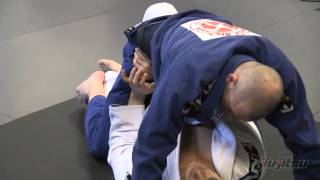 0:35Jiu-Jitsu Magazine (coach not named in the clip)gifirst thing I want to do, I want to straighten this leg down the middle and turn my body; block the hip with my cross hand, the elbow is framing his thigh1:59Jiu-Jitsu Magazine (coach not named in the clip)giI turn, this foot on the floor as an anchor, and as I turn my body my right elbow comes to the floor and blocks his hip and I have to go all the way to my other side
- Survival before escape: the shell, the breathing and the frame that ends his attacksreference onlya safe bottom mount, in Priit Mihkelson's, Nick Albin's, Pedro Sauer's, Roger Gracie's and the BJJ Library coach's words; their own ends
Mihkelson's camp class says the escapes are not the point: the position where they cannot attack you is, a hand on the hip, the elbow in, the boxing shoulders, never flat, and from there sitting up, turtling from the mount or the knee-elbow escape as the tools, with the back take accepted as a transition in his own system, which is his reference and not tonight's rule, since the session still stops when the back is exposed; his frame, he says, is a punch, not a hold. Chewjitsu's first order of business is not panicking: arms in tight, one forearm across the chest so the weight lands on it, and a drill of simply surviving under the mount without escaping until the clock says you can. Sauer's praying position and the rule that survival comes first. Roger Gracie's rule that the escape waits for the moment he adjusts. The BJJ Library coach's perfect world: the side chosen and the leg flat before he settles. synthesis These are the reading of the position before the route; the session's first block starts from a mount the partner already holds, with the athlete's elbows already in.
 1:12Priit Mihkelson · BJJ Globetrotters in Actionno-gimixed kit: it's not mount escapes, it's just like mount and they cannot do anything and you can do everything; I don't care about the escapes; the important one is they cannot attack you, and then you can pick whatever you want to do3:20Priit Mihkelson · BJJ Globetrotters in Actionno-gimixed kit: I'll show you the point position; this position, grabbing the hip; my claim is you can be here and they cannot attack you efficiently4:02Priit Mihkelson · BJJ Globetrotters in Actionno-gimixed kit: my claim is you can be here and they cannot attack you efficiently, that you would tap12:35Priit Mihkelson · BJJ Globetrotters in Actionno-gimixed kit: doing the boxing shoulders and keeping my elbows and fighting for those; that's what I do in mount14:02Priit Mihkelson · BJJ Globetrotters in Actionno-gimixed kit: go, take the back; if this happens, that's a mount escape; back escapes, so I'm fine with that11:10Priit Mihkelson · BJJ Globetrotters in Actionno-gimixed kit: main thing, just don't be flat; I'm always turning away from opponents or turning in opponents, I'm never flat25:13Priit Mihkelson · BJJ Globetrotters in Actionno-gimixed kit: frames are very like a punch, you can't keep them long because they're stripped; think this as a punch, you just go, and it's a body coordination thing
 5:38Nick Albin · Chewjitsugiif you panic in mount, your goal before you even worry about escapes is to learn how to not panic; get your arms in really tight and then don't even worry about escaping; see how long you can last2:24Nick Albin · Chewjitsugibring your arms in tight; I like putting one of my arms across the middle of my chest right above my solar plexus; if he puts all of his weight down on me it just sort of puts a frame across my chest1:01Pedro Sauer · Bernardo Faria BJJ Fanaticsgiif you can stay on the bottom and nobody can touch your neck, nobody can touch your arm, the escape is going to come after; get a good training partner, be on the bottom and try to stay alive a little bit longer0:21Roger Gracie · BJJ Fanatics podcast (Ryan Ford asking)no-giusually when you mount someone you're not in the best position in the mount; you're just holding while the person is trying to escape and slowly you will adjust your mount position0:09BJJ Library (Saulo Ribeiro's Jiu-Jitsu University chapters; the coach on camera is not named in the clip)githis is called perfect world, because here I'm in the perfect situation to survive the mount position and in the perfect space to escape the mount position
- The cooperative resets: a hand in your collar or an arm isolated, the back taken as you turn, the mount retaken after the half guard, the grapevine that kills the bridge, a retreat to knee on belly or side controlcooperative resetrestart from the start position, or stop
synthesis Five ends that are not this document's. A hand that reaches your collar or an arm that isolates yours: the named stop, both release at once, restart; the partner attacks nothing in the blocks or the rounds, because no defence to it is drilled here, and a tap, if one ever comes, stops everything. The back taken because you turned past your shoulders: Chewjitsu's, Giles's and Wardzinski's warnings are in the threats; reset. The mount retaken after the half guard is held: the half guard is another document's; reset. The grapevine that pins both legs so no bridge is possible: B3's references; reset. The knee on belly or the side control he retreats to when the knee goes in: other documents; reset. A neck or a knee that complains stops everything.
3:18Nick Albin · Chewjitsugiif my back is exposed, if the logo on my back is exposed, it's an easy setup right here to go to this more side mount or gift wrap position and take the back0:16Lachlan Giles · Absolute MMA St Kildano-gino-gi: don't expose your tricep; he will take my back for sure3:48Pedro Sauer · Bernardo Faria BJJ Fanaticsgianytime you put your hand over there, somebody catch your heels, you trapped yourself; stay here, don't do anything until you can find the space
— negate first
Threat map
Some of the clips on the left show the coach performing the attack; watch them once so you recognise it. The answer on the right is a spine step, a branch, or marked as synthesis.
- The underhook dug under your frame arm, and the arms walked up
-
what they are doing
12:56John Danaher · Bernardo Faria BJJ Fanaticsgiif my fingers point upwards and I push on my opponent's knee I give them an easy underhook and now they can walk my arms up and cause all kinds of problems, and now a bad situation just got worse1:03Matt Arroyono-gino-gi: nothing I show you is going to work if he gets his arm underneath my arm; it's walking it up; I don't have any other escapes now4:25Henry Akins · Bernardo Faria BJJ Fanaticsgiif my arm is stuck on this side of the body you can feel it's super hard even if I create a crunch; the second that my hand comes through the middle I can create a little bit more of an angle1:21Lachlan Giles · Absolute MMA St Kildano-gino-gi: what I don't want is for the arm to get stuck above my head; if I push with my elbow flared it's easy for him to get an underhook and open my arm out; I want my elbow tight to my ribsyour answer
Recognise it: his hand sliding under your forearm, your elbow lifting away from your ribs, his weight coming forward onto your chest. Danaher's answer is built into step 1: the fingers point down so the elbow stays close to the body and there is nothing to dig under; Arroyo bridges toward the side of the arm he has under you to make his hand base, then gets the hands back; Giles keeps the elbow tight and shimmies the shoulders to get it inside the knee. synthesis In the session a partner who wins the underhook and walks the arm up is a reset, not a fight.
13:18John Danaher · Bernardo Faria BJJ Fanaticsgiwhen Bernardo tries to dig into an underhook it's just not there; as a result we can easily get a knee in front8:20Matt Arroyono-gino-gi: you have to bridge your body over to that side where their hand has your underhook to make his hand base, and once his hand bases, get my hands back to where it needs to go4:12Gordon Ryanno-gino-gi: never do this where you just place your hand around your partner's back and hug them as tight as you can; it is completely and utterly useless - The knees walked up and the high mount
-
what they are doing
0:24Jean Jacques Machadogianytime he goes above my belt my hip now has no function; my arms are exposed and anytime you want to get the choke now very hard for me to defend0:42Roger Gracie · BJJ Fanatics podcast (Ryan Ford asking)no-gione of my main goals when I'm on top before I do any attack, I want to get into a slightly higher mount; if I'm sitting very low on your hips I'm not in a strong position to attack11:42Nick Albin · Chewjitsugias soon as they're getting to that position, this is the moment that you really have to fight hard to get your grips together; they'll have an arm secured or they'll immediately try to work for oneyour answer
Recognise it: his knees sliding past your elbows, his hips over your belt line, your hands drifting up to your neck. The frame of step 1 is the answer while there is time: elbows in front of his thighs and the forearm across his belt line; Roger Gracie's answer once it is late is to push yourself up, headward, so his mount sits lower on your torso before anything else. synthesis In the session the partner holds a low mount and does not walk up; a high mount with the elbows trapped is a reset.
5:06Henry Akins · Bernardo Faria BJJ FanaticsgiI need my elbow here; it doesn't allow you to walk your knees up1:47Roger Gracie · BJJ Fanatics podcast (Ryan Ford asking)no-giif you're in a very high mount on me I'm not going to try to bridge, I'm going to try to push myself up and get into a lower mount - The back given by turning past the shoulders, or by an elbow across the centre line
-
what they are doing
3:18Nick Albin · Chewjitsugiturn all the way to the side; if my back is exposed, like the logo on my back, it's an easy setup to take the back2:06Adam Wardzinski · BIG OSS Jiu-Jitsu Channelgielbow pointing to the far hip, never crossing the central line of the body because then I'm exposing the back; he's starting to attack my back0:44Gordon Ryanno-gino-gi: making sure that our elbow never crosses our partner's center line; if our elbow crosses our partner's center line now our back's exposed2:03Miha Perhavecno-gino-gi: what I cannot allow to happen is the elbow to slip across; my back is going to get taken, all of those submissions will happenyour answer
Recognise it: your top shoulder rolling past vertical, his chest sliding onto your back, your frame elbow slipping across his hips. Danaher's bridge is over one shoulder, not a roll onto the belly, and the frame forearm stays on his belt line and its elbow never crosses his centre line; Chewjitsu turns the hips fully but keeps the shoulders where they can come back down. synthesis In the session a partner who gets behind your shoulder is a reset; the back escape is another document's.
12:34John Danaher · Bernardo Faria BJJ Fanaticsgiwe hit a single shoulder bridge so one knee points outwards, one points upwards3:38Nick Albin · Chewjitsugiwe're turning our hips all the way over but we're staying like this; at any point if I don't feel it I can always bring my shoulders back down and I'm not at risk of having my back taken - His feet locked or crossed, the grapevine, and the foot that hides
-
what they are doing
18:32John Danaher · Bernardo Faria BJJ Fanaticsgiwhen you try to bring your knees underneath their ankle it feels absolutely hopeless; when Bernardo locks those ankles tight it's impossible for me; you spend five minutes just trying to uncross his feet0:00Stephan Kestinggiwhen he crosses his ankles underneath your hips he can really drive pressure down; he's not as mobile for things like arm bars but he's really hard to dislodge3:21Lachlan Giles · Absolute MMA St Kildagiher foot is underneath my thigh and it's hard to get my leg inside the leg0:21Nick Albin · Chewjitsuno-gino-gi: (top view) as soon as I feel someone turning over I'm going to take this other leg and latch it right in place so that he can't actually pull my leg inyour answer
Recognise it: your heel finding nothing but his ankle, his toes tucked under your thigh, or a second leg latching yours as you turn. The route's answer is the entry at the knee, which does not need his feet apart; against a true grapevine Akins, Giles, Knight and Chewjitsu free the legs first, and Kesting steps on the crossed feet until the moment they uncross. synthesis In the session his feet start locked, which the route answers; a grapevine on both legs is a reset.
19:36John Danaher · Bernardo Faria BJJ Fanaticsgiwe're gonna put our hand inside our training partner's knee; now I'm gonna focus on my knee coming through; as a result we can hit two sliding shrimp motions and put our opponent back in guard0:41Henry Akins · Hidden Jiu Jitsugionce their knees are light it's super easy to get your leg underneath their leg - The collar choke and the armbar while you build the frame
-
what they are doing
0:20Danny Funggiwhen the opponent starts to slide one hand inside your jacket, the hand is already palm up inside your collar; that means the second hand is waiting to attack as well8:04Jean Jacques Machadogihe's mounting, he's not holding my collar yet; 99% of people use their right hand in the collar; if I already know that, I block and I move my head this way2:14BJJ Library (Saulo Ribeiro's Jiu-Jitsu University chapters; the coach on camera is not named in the clip)giI don't want to try to push him; pushing him is going to get yourself in trouble, setting up for armbars; it's easy for him to go for your collar for the chokeyour answer
Recognise it: one hand already in your collar, the second hand coming, or your elbow drifting out as you push. Fung blocks the second hand, because one hand does not choke, and swims the arm under to comb the hair; Machado looks away from the collar and keeps the elbows in; the BJJ Library coach's rule is never to push. synthesis In the session the partner attacks nothing, in the blocks or the rounds: a hand that reaches your collar or an arm that isolates yours is a named stop, both release, restart, and a tap, if one ever comes, stops everything at once.
0:42Danny FunggiI want to prevent the second hand; with one hand he's not going to choke me; if he attempts, I know his hand is coming here or across top and I'm ready to stop it2:26Jean Jacques Machadogiwhat is the reason for looking away? you can't reach the collar; I can make it difficult for the arm that's going to go in
— 20 minutes · gi
Tonight
synthesis The session is the author's; the mechanics are Danaher's, from one exact start: on your back, mounted low, his feet locked or close together, his left arm cross-facing over your right shoulder, his right hand posted wide on your left, your elbows already in. One orientation tonight, the turn to your left; the mirror is another night. The first block stops at the shape of the power shrimp; the second runs the route through the second frame to the half guard and takes the count there; the third runs it to the closed guard; the rounds run it against bounded resistance. In the blocks the partner holds and attacks nothing and moves only as the route moves him; in the rounds he may follow your hips and, once your knee is in front of his, pull that leg back and try to re-mount at half effort, and he still attacks nothing: a hand that reaches your collar or an arm that isolates yours is a named stop, both release, restart, because no defence to it is drilled tonight. The first movement is yours, the bridge; the partner does not have to attack for the route to start, and a stall of ten seconds is a reset. Two kinds of stop: the block's own reset, cooperative and named under each block, and the hard boundaries the scope lists (the back taken, the knees walked above your elbows and held, a grapevine on both legs, his hips lifted off yours, a knee or the neck complaining), which stop everything; both restart only after the partner releases every control.
safety · stop here
No submission is attacked by the escaper, and none is held. In the blocks the partner attacks nothing: he holds a low mount with his feet locked and his cross face on and moves only as the route moves him. In the rounds he attacks nothing either: a hand that reaches your collar or an arm that isolates yours is a named stop, both release, restart, because no defence to it is drilled here; a tap, physical or spoken, for any reason, stops everything at once. The bridge is over one shoulder and never off the neck: a partner whose weight lands on your head or neck as you bridge stops the rep, and the neck is never used to lift. The inverted knee is placed in front of his knee, not levered against it, and a knee that complains, his or yours, stops the rep. The back is not fought for: a partner who gets behind your shoulder is a reset. The tap, physical or verbal, ends every rep. The release rules are the author's.
- The bridge under a partner posted on your head or neck. Stop at once; the bridge is over the shoulder, never the neck, and the partner posts on the mat, not on your head
- The inverted knee levered against his knee. The knee is placed in front of his knee and slides; if his knee is pulled or twisted, or either knee complains, stop and reset
- A hand that reaches your collar or an arm that isolates yours, in the blocks or the rounds. The named stop: both release everything and restart; the partner attacks nothing and no submission is attempted at any effort, because no defence to it is drilled here; a tap for any reason stops everything at once
- The back taken as you turn past your shoulders. A reset, not a fight; the back escape is another document's
- 1
The box frame and the power shrimp
5 minOne orientation tonight, Danaher's: he cross-faces with his left arm and posts his right hand, and you turn to your left. From the exact start, at half speed, say the contacts as you make them: right forearm across his belt line, hand at his right hip, elbow close; left hand locks over it, then drops so the left elbow is inside his right knee, fingers down. Turn the left foot out; bridge over the left shoulder in one motion, your movement and not a reaction to his, and stop there: feel that one knee points out and one points up, that his weight has gone to his right knee and his posted hand, the side your right hand frames, and that your right elbow is still close. Come down, reset, alternate one rep each, as many as fit in the five minutes; quality, not a count.
9:20John Danaher · Bernardo Faria BJJ Fanaticsgione excellent frame is to bring my hand and forearm across my opponent's belt; I take my second hand, I put my elbow inside my training partner's knee; we formed a box frame10:45John Danaher · Bernardo Faria BJJ FanaticsgiI'm going to turn my foot out and in one motion I'm gonna hit a bridge over one shoulder, the so-called single shoulder bridge - 2
The hand inside the knee, the knee inverted, the second frame: the half guard, counted
6 minThe same start and the same power shrimp, then the block's emphasis: the left hand pushes inside his right knee with the heel of the hand, the fingers down and the elbow tight, the right forearm still on his belt line; the left knee turns inward to the mat and slides in front of his right knee, left hand, knee and elbow together on that leg; his head comes up as the knee goes through; then the frame changes, the left hand from his knee to his near shoulder with the forearm across his chest while the right forearm keeps his belt line; plant the right foot and push out with a sliding shrimp, not a bridge, until your left leg lies in front of his right leg and his right leg is between yours; hold the half guard three seconds with the second frame on, your head on the mat and your shoulders where they can come back down. He keeps his feet locked and his cross face on until the knee is in front, lets his head come up as the knee goes through, then follows without fighting it until you count three. Reset after the count. Alternate one rep each for the six minutes.
12:34John Danaher · Bernardo Faria BJJ FanaticsgiI take my hand and I put the heel of my hand inside his knee; you will notice my fingers point downwards13:38John Danaher · Bernardo Faria BJJ Fanaticsgilook how we form a second frame, shoulder and hips; we slide shrimp this time and we put a knee in front - 3
The second sliding shrimp: the closed guard
5 minFrom the exact start, the whole route at half speed: box frame, power shrimp, left hand inside the knee, left knee inverted and in front, second frame, the left hand to his shoulder with the right forearm kept on his belt line, right foot planted and the sliding shrimp to the half guard, count three; then the right hand up to his far collar and the left hand down to his near upper arm, plant the left foot, turn the hips back and slide again so the right knee comes across in front of his left leg, the feet come out and the guard closes. Say each as you make it: frame; bridge; hand; knee; shoulder; slide; collar and arm; slide; guard. He holds a real low mount with the feet locked and the cross face on, moves only as the route moves him, and lets his head come up as the knee goes through. Alternate one rep each for the five minutes.
14:59John Danaher · Bernardo Faria BJJ Fanaticsgithere's no need for a power shrimp now; a sliding shrimp will be more than sufficient to put my leg in; a second sliding shrimp and we're back in guard13:38John Danaher · Bernardo Faria BJJ Fanaticsgia sliding shrimp a second time and we have the option now of putting him back in closed guard, butterfly guard, whatever you prefer; I demonstrate the closed guard - 4
Positional rounds with bounded resistance
4 minFour one-minute rounds from the exact start, alternating who is on the bottom. He holds a low mount with the feet locked and the cross face on and his hand posted; he may follow your hips as you turn, and once your knee is in front of his he may pull that leg back and try to re-establish the mount at half effort until you have held the half guard three seconds. He does not attack: a collar reached for or an arm isolated stops the rep, because no defence to it is drilled tonight. You play the route only: the box frame, the power shrimp over the left shoulder, the left hand inside his knee, the inverted knee in front of his, the second frame, the right foot planted and the sliding shrimp to the half guard, and, after the count, the right hand to his far collar, the left hand to his near arm and the second shrimp to the closed guard. A mount you cannot answer with the route is a reset, not a struggle; a mount he re-establishes after your knee went in is a rep that did not earn the count.
— after the round
Check first
synthesis The author's table. Outcomes have more than one cause; check these in order.
| It happened | Check first |
|---|---|
| He walked his knees up and your elbows were trapped | In order, and no one of them is proved by the result: first the frame, whether the right forearm was across his belt line with the elbow close before he moved, or your hands were on his chest; then the second arm, whether the left elbow was inside his knee with the fingers down or the hand was pushing fingers up and gave him the underhook; then the timing, whether you bridged from a low mount or waited until he was already high, which Roger Gracie says is the moment the top man wants. |
| The bridge lifted him and nothing changed | First the foot: was the left foot turned out, or flat, so the bridge went straight up instead of over one shoulder? Then the shoulder: did you come up onto your left side with one knee out and one up, or lift and fall back flat? Then his weight: did it go onto his right knee and his posted hand, the side your right hand frames, or stay centred because you bridged before the frame was set? |
| The hand went inside the knee and he dug the underhook | First the fingers: pointing down with the heel of the hand on the knee, or up? Then the elbow of that hand: tight to your ribs, or away from the body? Then, separately, the framing arm: was the right elbow still close with the forearm on his belt line, or had it slipped past his centre line, which is what gives the back? |
| The knee would not go in | First the entry: in front of his knee, or under his ankle, which his locked feet close? Then the knee: inverted toward the mat, or pointing up so it slid over his leg, which Akins says the toes decide? Then the order: hand inside the knee before the knee moved, or the knee first with nothing holding his leg? A knee that will not go in proves none of these alone. |
| You got the knee in and he remounted | First the frame: did the left hand go from his knee to his shoulder before the slide, with the right forearm kept on his belt line, or did both stay low so he could drop his chest back onto you? Then the shrimp: the right foot planted and a sliding shrimp that put the whole leg in front of his, or a stop at the knee? Then the count: three seconds in the half guard with the second frame on, or the frame released to grab? Then the shoulders: where they could come back down, or rolled past vertical so he had your back instead? |
| The rep became a hold | His feet locked, your frame set, nothing moving. Danaher's route starts with your bridge, your movement and not his; Sauer's rule is survive first and Roger Gracie's is move when he adjusts, so the session's rule is a reset after ten seconds of a stall, and the partner in the rounds follows and contests the leg, which is what the count is for. |
— the other doors · keep for later
Reference
Everything else read for this situation, grouped by door: the position and the escape from the coaches in the gi, and the no-gi and mixed-kit clips kept for their principles, cued as such.
The position and the escape, from the coacheswhat a held mount is and how the escape is made; in the gi unless a cue says no-gi
- John Danaher, with Bernardo Faria
The whole route in one lesson filmed for Faria's channel: the frame with the fingers down, the single-shoulder bridge with the foot turned out that he calls the power shrimp, the hand inside the knee, the inverted knee penetrating in front of his knee, and two sliding shrimps to the guard; the classical ankle version shown as the naive alternative; his contention that a real mount means locked feet and a cross face; and Faria's remark that it joins the two most basic escapes.
10:25John Danaher · Bernardo Faria BJJ Fanaticsgilet's contrast this with beginning with a power shrimp; I'm gonna put my elbow inside his knee17:27John Danaher · Bernardo Faria BJJ Fanaticsgiin the case of the classical elbow escape the insertion point of my knee is underneath my opponent's ankle21:19John Danaher · Bernardo Faria BJJ Fanaticsgiyou put together the two most basic escapes, the bridge and the elbow escape, you combine both and you created this super escape - Henry Akins, with Bernardo Faria and on his own channel
His own set-ups: the elbow escape as the leg getting under the leg, the upa learned properly, the grapevine as a gift (B1, B3, B4); no step of the route is his.
1:44Henry Akins · Bernardo Faria BJJ Fanaticsgiwith a hip escape a lot of times what we're doing is shrimping, and the goal is for me to bring my knee through the middle; this normally works really well against people that are not pinching their knees tight10:34Henry Akins · Bernardo Faria BJJ Fanaticsgiit's pretty much the same principle gi and no-gi; I don't have to have a gi, I don't need a grip2:22Henry Akins · Bernardo Faria BJJ Fanaticsgiif you actually learn how to do it properly it's the only escape you'll ever need from the mount; I let guys mount me and I only allow myself to get out with that one technique1:22Henry Akins · Hidden Jiu Jitsugibecause his hips are heavy his knees are light so my hand just places underneath one knee and as I kick my leg it's automatically straight - Jean Jacques Machado
Six class clips from the floor: the elbows in front of his leg, the shield, the leg turned sideways, the upa timed to his head between your shoulders, the belt hold, the foot on the knee (B1, B2, B3, B4); checks on the frame and the timing, no step.
0:21Jean Jacques Machadogianytime I move my hip his body has to move; block the hip to move away; now my legs are between his body and my body, now I consider I'm escaped15:28Jean Jacques Machadogievery round of our training starts from the mount18:21Jean Jacques Machadogithe only way for us to learn how to defend ourselves from the mount is somebody mounting you; I let them mount me 100 times, then I keep practicing my escape3:48Jean Jacques MachadogiI'm blocking his hip, I would shrug, I'm using one of my knees; I want his weight to be in his hands, that's all I want; and when I do that I slide0:04Jean Jacques Machadogiif my elbows are not in place everything becomes more physical, and if I'm not physical enough I'll be stuck over here14:45Jean Jacques MachadogiI want to make sure that hand is being watched15:28Jean Jacques Machadogithe moment he can use the hand to get out to go after me, that's whenever I need to wait for their hand to get off the floor0:41Jean Jacques Machadogifor my movement I would have my second counter movement; you always have two techniques to escape someone0:41Jean Jacques Machadogivery important, before I raise my head I block that arm, because if I go up like this he's going to arm bar me - Lachlan Giles
Seven clips, no-gi and gi: the frame with the tricep hidden, the leg flat and the knee past the ankle, the scoop to the half guard, the single leg X, the crossed feet, the grapevine, the three-quarter mount, the bridge and roll (B1, B3, B4); checks on the leg and the endpoint, no step.
2:43Lachlan Giles · Absolute MMA St Kildano-gino-gi: if I put my hands together here this is a weak motion to open his knees out; if I can turn more on my side and have my hand pointing out this is a stronger action3:48Lachlan Giles · Absolute MMA St Kildano-gino-gi: once my legs are inside they know they're in trouble, so they tend to step their foot up, they try to go almost to like an S mount, but that's tough to do because they don't have the right upper body positioning; I'm still on my frame against the hip6:46Lachlan Giles · Absolute MMA St Kildano-gino-gi: I'm going to bridge off my left leg and lift my arm towards the roof; that lets me get on my side, because at the moment I've got half guard but I'm actually flat on my back, which is not ideal3:20Lachlan Giles · Absolute MMA St Kildano-gino-gi: a lot of people teach frames like this where both hands are together; what I want is my elbow down with my hand pointing this way; now I can actually use my core and my elbow1:20Lachlan Giles · Absolute MMA St Kildano-gino-gi: don't turn your back; if I give my back which is considered a worse position and exposes me to a choke0:22Lachlan Giles · Absolute MMA St Kildagiearlier we covered the bridge and roll; this one's actually higher percentage, it's more likely to achieve this particular one1:22Lachlan Giles · Absolute MMA St Kildano-gino-gi: I'm going to pull my knees tight first, back heel, so it's hard for him to follow; then I'm going to extend out, point one leg up and the other leg hooked against my foot - Brian Glick
No-gi: the outside knee-elbow escape and the choice between it and the kip, not always but in most cases (B2, B4); a check on the frame, no step.
0:00Brian Glick · BJJ Fanaticsno-gino-gi: the knee elbow escape is the king of escapes in jiu-jitsu; there have been a couple of small details that make a huge difference when it comes to implementing against resistance10:56Brian Glick · BJJ Fanaticsno-gino-gi: creating a strong forearm frame is going to be a theme that we come back to again and again; the bottom of the mount starting with your elbow on the inside position; concave shoulders, chin in3:27Brian Glickno-gino-gi: it's not just is it the right tool, it's is it the right tool at the right time; if it's the knee elbow escape you better make sure your partner's hips are heavy on you, and if you want to kip you got to make sure that your partner is coming a little bit forward - Xande Ribeiro, Pedro Sauer, Thomas Rozdzynski, Roger Gracie and the BJJ Library coach
Xande's diamond, Sauer's praying position and collected foot, Rozdzynski's hook and drag, Roger Gracie's timing, the BJJ Library survival chapters (B3, B4, B5); their own set-ups and ends.
0:42Xande Ribeiro · Bernardo Faria BJJ Fanaticsgione of the things that I always like to talk about when I escape something is how I prepare my escape7:01Xande Ribeiro · Bernardo Faria BJJ Fanaticsgithe escape itself is always going to be about the dilemma; my intention is to work that connection and turn the connection into a movement1:03Xande Ribeirogikeep those elbow positions low; I want to keep my opponent as close as possible to my hip, because when I start to use bumps I can create way more reaction from them5:14Pedro Sauer · Bernardo Faria BJJ Fanaticsgia lot of people like to bridge really up high; I like to go halfway here and from here I bring my pelvis; I make my right leg heavy, just the weight of my leg1:01Thomas Rozdzynski · Bernardo Faria BJJ Fanaticsgias we get older we don't want to be pushing; the important part is that I don't allow you to climb up; if you get really high here I'm going to have a hard time hooking2:29Roger Gracie · BJJ Fanatics podcast (Ryan Ford asking)no-gifor me to escape I need to use the arms, so eventually they go away from my body; the moment that I bridge, that's the space you need, the attack will come2:56BJJ Library (Saulo Ribeiro's Jiu-Jitsu University chapters; the coach on camera is not named in the clip)gisome guys like to hold here because they have the idea that they are protected, but this is a sport, you can't hold somebody and try to escape because you are holding yourself - Nick Albin, Eli Knight, Tom Davey, Danny Fung, Adam Wardzinski, Bernardo Faria, Brandon McCaghren and the gym coaches
Chewjitsu's five escapes and five mistakes, Knight's, Davey's, Fung's, Wardzinski's, Faria's, McCaghren's and the gyms' clips from their own set-ups (B1 to B5); words only, no step.
0:20Nick Albin · Chewjitsugithese are the five that I use really for the most part most of the time even as a black belt9:35Nick Albin · ChewjitsugiI really don't even use the trap and roll as I said; mostly it's the framing and the bridging and everything else4:57Nick Albin · Chewjitsugithink about submissions for the person on top; where do they start? they start when the arms get extended; when your arms are here there are no arm lock submissions and it's really hard to get into the collar0:42Nick Albin · Chewjitsugiyou panic and freak out and you do all kinds of crazy stuff that you were never shown8:57Nick Albin · Chewjitsugiwhen I bridge I don't just bridge straight up; I will bridge trying to go off to a side because I want his hands to reach out to where his weight shifts from directly onto me onto the mat 1:06Nick Albin · Chewjitsugiif your partner's been training then they're going to know what's going on; we're in a good position here: elbows, everything's flat on our legs, elbows are down0:21Eli Knight · Knight Jiu-Jitsuno-gino-gi: if they're high and tight that means she's probably more in a bridging category; if she goes low and wide the bridging is not going to be as effective, this is when we're going to access our elbow escape8:41Tom Davey · The Grappling Academyno-gimixed kit: the defense of the bridge and roll is a widening of the base; if he widens his base this will make for easy elbow escapes; he's going to start to squeeze his knees, in which case the bridge and roll works a treat; it's all about action reaction9:21Tom Davey · The Grappling Academyno-gimixed kit: it's all about action reaction; getting that isn't easy0:41Danny Funggihe puts one hand inside; I have to frame here; I don't want him to post this arm or the elbow onto my chest; go inside and swim0:21Adam Wardzinski · BIG OSS Jiu-Jitsu Channelgiescapes are very important because they give you courage to experiment with the positions; the way they work the best is when you're actually chaining them0:00Brandon McCaghrenno-gino-gi: the first three mount escapes that every beginner needs; it's going to take a lot of skill to hit this on good people, but when you're rolling with other beginners this is going to be the easiest way to get out2:32Eric Burdo · Richmond BJJ Academy (heard as Berto in the captions)giI want to be off my tailbone onto my side and most importantly I want to block this inside cross face; wherever his hand goes my elbow follows, my elbow's like a windshield wiper3:25Louis · Gracie Barra Harrogate (surname not given)githis is going to be when they're trying to choke us, so they put one hand in the collar; we're gonna trap the hand; it's a thumb up grip; the escape is identical to the one we just learned4:27Louis · Gracie Barra Harrogate (surname not given)gielbow in, trap the foot, and then the escape is identical to the one we just learned; plant my feet, bridge, come all the way up1:59Jiu-Jitsu Magazine (coach not named in the clip)gias I turn my body my right elbow gonna come to the floor and block his hip and I have to go all the way to my other side1:23Coach Brian · TeachMeGrapplingno-gino-gi: bump, and then which knee is up? it's going to be the rear; if the left knee goes down when I shrimp it's going to be real simple; he's not going to get a gift wrap
No-gi and mixed kit, kept for the principlesthe same escape filmed without the gi, or in a room with both kits, cued as such
- Gordon Ryan, Matt Arroyo, David Avellan, Miha Perhavec and Placido Santos
No-gi: Gordon Ryan's inside position game from the mount on Faria's channel, his inside elbow escape and his answer to a trapped arm; Arroyo's belt frame, his elbow escape with the leg flattened, the modified mount and the kip; Avellan's and Perhavec's Damian Maia frame and bridge; Placido's switch of sides against the cross face.
2:23Gordon Ryan · Bernardo Faria BJJ Fanaticsno-gino-gi: this is going to be a game based around separation of your partner from your head and shoulders; how can I incrementally fight my hands, my elbows, my knees and my feet back to the inside position3:05Gordon Ryan · Bernardo Faria BJJ Fanaticsno-gino-gi: how can I incrementally fight my hands, my elbows, my knees and my feet back to the inside position11:26Gordon Ryan · Bernardo Faria BJJ Fanaticsno-gino-gi: if you can cut out the middleman and just go from a defensive cycle right into an offensive cycle it's much better1:45Gordon Ryanno-gino-gi: an inside elbow escape doesn't lead us into half guard; what it does do is give us the opportunity to go into leg locks on our partner2:49Matt Arroyono-gino-gi: I want my knee, this knee, to be flat to the ground as if it were a spatula, and the spatula is going to come underneath the pancake, and the pancake is his foot3:51Matt Arroyono-gino-gi: three motions at the same time: lift, push, and bring your knee up; the second it passes my inner thigh I have to make a turn really fast, lock my feet and get an underhook1:06David Avellanno-gino-gi: because I have this elbow inside the hip when I bridge hard, even if he tries to get behind me you see how that elbow is protecting my back2:24Miha Perhavecno-gino-gi: I'll keep this elbow nice and tight and I'm going to start rotating; everything after this point depends on the reaction of the opponent0:42Placido Santosno-gino-gi: a crossface will completely shut down the power of your bridge; when you're going against good guys never expect the first move to work - Priit Mihkelson's camp class, and Chewjitsu's no-gi clips
Mixed kit: Mihkelson on the position where they cannot attack you, the frame as a punch, sitting up, turtling from the mount and pushing the correct hip when you shrimp. No-gi: Chewjitsu on the sequence against hooks and arm control, and the top man's counter to the foot slide.
23:48Priit Mihkelson · BJJ Globetrotters in Actionno-gimixed kit: he's pushing the wrong hip; this frame, this situation would be good for a foot lift, foot drag, some versions, not for shrimping the hip out; if he pushes the correct hip then the hip slides out28:20Priit Mihkelson · BJJ Globetrotters in Actionno-gimixed kit: don't think that guard pulling is a must; I want to sit up actually; if they push me down that lightens their legs and that means I can pull guard29:01Priit Mihkelson · BJJ Globetrotters in Actionno-gimixed kit: if they push me down that lightens their legs and that means I can pull guard3:07Nick Albin · Chewjitsuno-gino-gi: guys, when you push in mount don't push with your hands; I built a frame with my hands but I'm actually using my forearms and elbows for the bulk of it and it sequences up with a bridge1:54Nick Albin · Chewjitsuno-gino-gi: (top view) that little foot fighting thing that you do when the person turns over; you can use it to take the back or just simply to stop them from being able to pull your leg back into the half guard
— 61 clips · verified 2026-09-11
Ledger
Every clip on this page. Each was resolved on YouTube, its uploader channel recorded and reviewed, and its transcript read before a second was cited. Source names whose channel it is: the coach's own, the coach's gym, or the instructional publisher that filmed them.
| Coach | Channel | Source | Kit | Video | Uploaded | Length |
|---|---|---|---|---|---|---|
| Jean Jacques Machado | JeanJacquesMachado | coach | gi | Always worth re-learning: mount escape | 2024-02-14 | 18:55 |
| Jean Jacques Machado | JeanJacquesMachado | coach | gi | Always worth re-learning: mount escape | 2025-06-04 | 6:48 |
| Jean Jacques Machado | JeanJacquesMachado | coach | gi | The tried and true head-to-knee mount escape | 2024-01-22 | 4:07 |
| Jean Jacques Machado | JeanJacquesMachado | coach | gi | How to Escape the Mount - Why your UPA fails | 2021-12-14 | 5:10 |
| Jean Jacques Machado | JeanJacquesMachado | coach | gi | The complete mount escape series | 2023-06-07 | 16:33 |
| Jean Jacques Machado | JeanJacquesMachado | coach | gi | Mount Escape - Drilling Sequence | 2022-03-04 | 1:58 |
| Nick Albin · Chewjitsu | Chewjitsu | coach | gi | The BJJ Position Where White Belts Go to Die | 2023-06-09 | 7:32 |
| Nick Albin · Chewjitsu | Chewjitsu | coach | no-gi | Fix Your BJJ Mount Escape with These Step-by-Step Position Tips | 2020-01-29 | 5:18 |
| Nick Albin · Chewjitsu | Chewjitsu | coach | gi | The First 5 Mount Escapes You Need to Know in BJJ | 2026-05-16 | 10:23 |
| Nick Albin · Chewjitsu | Chewjitsu | coach | gi | Effective Mount Escape is a Lifesaver against Bigger People in BJJ | 2021-09-13 | 5:00 |
| Nick Albin · Chewjitsu | Chewjitsu | coach | gi | 5 Reasons You’re Mount Escapes Suck in BJJ | 2026-01-11 | 14:09 |
| Nick Albin · Chewjitsu | Chewjitsu | coach | no-gi | Simple Foot Fighting Trick to Stop this Common BJJ Mount Escape | 2018-05-21 | 2:32 |
| Nick Albin · Chewjitsu | Chewjitsu | coach | gi | Improve this BJJ Mount Escape with Better Timing | 2017-01-02 | 3:45 |
| Nick Albin · Chewjitsu | Chewjitsu | coach | gi | Mount Escape to X Guard | 2013-10-04 | 3:02 |
| Bernardo Faria · BIG OSS Jiu-Jitsu Channel | BIG OSS Jiu-Jitsu Channel | coach | gi | Every BJJ White Belt Must Know These 3 Escapes – by 5x World Champion Bernardo Faria | 2025-06-15 | 7:57 |
| Adam Wardzinski · BIG OSS Jiu-Jitsu Channel | BIG OSS Jiu-Jitsu Channel | coach | gi | Every BJJ White Belt Must Know These 3 Mount ESCAPES (by 2x World Champ Adam Wardzinski) | 2025-06-08 | 5:51 |
| Brandon McCaghren | Brandon Mccaghren | coach | no-gi | The First 3 Mount Escapes You Need To Know in BJJ | 2022-07-26 | 4:44 |
| Brian Glick | Brian Glick | coach | no-gi | Escaping the Mount NO GI - Knee Elbow or Kip Escape? | 2023-12-22 | 3:57 |
| Danny Fung | Danny Fung | coach | gi | Jiu-Jitsu Fundamentals | Escaping the Mount & the Cross Collar Attempt | 2020-03-04 | 3:16 |
| Danny Fung | Danny Fung | coach | gi | Jiu-Jitsu Fundamentals | Choke Prevention & Mount Escapes | 2022-04-05 | 4:23 |
| David Avellan | David Avellan | coach | no-gi | Hip Frame Bridge Mount Escape | 2025-04-02 | 8:48 |
| Gordon Ryan | Gordon Ryan | coach | no-gi | Mount Escapes for Blue Belts and ADCC Champions by Gordon Ryan | 2025-04-20 | 4:51 |
| Gordon Ryan | Gordon Ryan | coach | no-gi | The Mount Escape EVERYONE Should Know by Gordon Ryan | 2025-03-10 | 16:32 |
| Henry Akins · Hidden Jiu Jitsu | Henry Akins' Hidden Jiu-Jitsu | coach | gi | Mount Escape when they just insist on smashing your face | 2023-01-17 | 1:57 |
| Henry Akins · Hidden Jiu Jitsu | Henry Akins' Hidden Jiu-Jitsu | coach | gi | Grapevine Mount... Easy Escape | 2023-01-10 | 1:42 |
| Henry Akins · Hidden Jiu Jitsu | Henry Akins' Hidden Jiu-Jitsu | coach | gi | How To Escape Mount When They Grapevine Your Legs - Henry Akins BJJ | 2023-01-06 | 1:01 |
| Eli Knight · Knight Jiu-Jitsu | Knight Jiu-Jitsu | coach | gi | First Five Escapes You Need to Know | Jiu-Jitsu Basics | 2019-08-02 | 8:41 |
| Eli Knight · Knight Jiu-Jitsu | Knight Jiu-Jitsu | coach | no-gi | Mastering The Elbow Escape - Jiu-Jitsu Fundamentals | 2023-01-12 | 12:01 |
| Matt Arroyo | Matt Arroyo Jiu Jitsu | coach | no-gi | The Secret Black Belt Framework to Escape the Mount Every Time | 2026-06-08 | 11:04 |
| Stephan Kesting | Stephan Kesting | coach | gi | How to Escape Mount When His Ankles Are Crossed Under You | 2017-12-23 | 2:02 |
| Tarik BJJ (the coach is named only by the channel) | Tarik BJJ | coach | no-gi | Master the Elbow Escape to Break Free from Mount! | 2023-07-04 | 3:36 |
| Tom Davey · The Grappling Academy | The Grappling Academy | coach | no-gi | 4 Ways To Escape Mount - For White Belts | 2019-10-06 | 10:27 |
| Xande Ribeiro | XANDE RIBEIRO | coach | gi | Escaping the Mount Position. | 2025-03-05 | 4:46 |
| Lachlan Giles · Absolute MMA St Kilda | Absolute MMA St Kilda - Melbourne | gym | no-gi | Escaping The Mount | 2023-05-09 | 8:37 |
| Lachlan Giles · Absolute MMA St Kilda | Absolute MMA St Kilda - Melbourne | gym | no-gi | Escaping 3/4 Mount (Lachlan Giles) | 2016-12-14 | 9:15 |
| Lachlan Giles · Absolute MMA St Kilda | Absolute MMA St Kilda - Melbourne | gym | no-gi | Recovering from 3/4 mount. Hooks recovery (Lachlan Giles) | 2018-11-29 | 4:00 |
| Lachlan Giles · Absolute MMA St Kilda | Absolute MMA St Kilda - Melbourne | gym | no-gi | Removing the mount grapevine (a common sticking point - Lachlan Giles) | 2020-01-27 | 2:42 |
| Lachlan Giles · Absolute MMA St Kilda | Absolute MMA St Kilda - Melbourne | gym | no-gi | Escaping the mount Choosing the escape based on where their weight is placed | 2019-01-09 | 9:53 |
| Lachlan Giles · Absolute MMA St Kilda | Absolute MMA St Kilda - Melbourne | gym | no-gi | Mount escape: The most important battle to win + live examples (Lachlan Giles) | 2020-03-18 | 5:05 |
| Lachlan Giles · Absolute MMA St Kilda | Absolute MMA St Kilda - Melbourne | gym | gi | Escaping The Mount | 2023-05-09 | 8:10 |
| Chess Club Jiu-Jitsu (coach not named in the clip) | Chess Club Jiu-Jitsu | gym | gi | BJJ Beginners Tutorial - Mount Escape (Bridge & Roll) | 2023-07-19 | 4:16 |
| Clark Gracie Allegiance (coach not named in the clip) | Clark Gracie Allegiance Jiu Jitsu | gym | gi | Bridge/Upa Escape from Mount | 2020-04-20 | 1:21 |
| Gracie Ohio Jiu-Jitsu Academy (coach not named in the clip) | Gracie Ohio Jiu-Jitsu Academy | gym | gi | Mount Escape with Arms Pinned | 2024-03-01 | 2:40 |
| Coach Brian · TeachMeGrappling | TeachMeGrappling Coach Brian | gym | no-gi | TMG Clips #39 - Mount Escape Details | 2020-12-14 | 2:08 |
| John Danaher · Bernardo Faria BJJ Fanatics | Bernardo Faria BJJ Fanatics | publisher | gi | How To Do The Perfect BJJ Mount Escape by John Danaher | 2019-04-25 | 26:39 |
| Henry Akins · Bernardo Faria BJJ Fanatics | Bernardo Faria BJJ Fanatics | publisher | gi | Perfect Elbow Escape From Mount by Henry Akins | 2023-04-25 | 16:59 |
| Henry Akins · Bernardo Faria BJJ Fanatics | Bernardo Faria BJJ Fanatics | publisher | gi | How To Do The Perfect Jiu Jitsu Upa (Escape From Mount) by Henry Akins | 2022-07-18 | 13:19 |
| Xande Ribeiro · Bernardo Faria BJJ Fanatics | Bernardo Faria BJJ Fanatics | publisher | gi | A Jiu Jitsu Mount Escape That Works Against Anyone by Xande Ribeiro | 2020-11-15 | 12:22 |
| Pedro Sauer · Bernardo Faria BJJ Fanatics | Bernardo Faria BJJ Fanatics | publisher | gi | A BJJ Mount Escape That You Have Never Seen by Pedro Sauer | 2020-12-26 | 12:31 |
| Thomas Rozdzynski · Bernardo Faria BJJ Fanatics | Bernardo Faria BJJ Fanatics | publisher | gi | Easy Effort Mount Escape For Older Guys with Thomas Rozdzynski | 2022-03-23 | 5:04 |
| Gordon Ryan · Bernardo Faria BJJ Fanatics | Bernardo Faria BJJ Fanatics | publisher | no-gi | How To Perfectly Escape From Mount, Side Control and North South No Gi by Gordon Ryan | 2022-03-22 | 13:00 |
| Roger Gracie · BJJ Fanatics podcast (Ryan Ford asking) | BJJ Fanatics | publisher | no-gi | Roger Gracie Gives His Best Advice On Escaping Mount! | 2021-07-01 | 3:53 |
| Brian Glick · BJJ Fanatics | BJJ Fanatics | publisher | no-gi | Escaping Mount Outside Knee Elbow Escape Details by Brian Glick | 2025-01-26 | 12:04 |
| BJJ Library (Saulo Ribeiro's Jiu-Jitsu University chapters; the coach on camera is not named in the clip) | BJJLibrary | publisher | gi | Mount Survival and Mount Elbow Escape (Jiu Jitsu Univ Ch 3 and 7-1) | 2013-06-25 | 6:55 |
| Jiu-Jitsu Magazine (coach not named in the clip) | JiuJitsuMag | publisher | gi | JiuJitsu Magazine #7 - Mastering The Mount: Escape To Guard | 2012-03-21 | 2:56 |
| Priit Mihkelson · BJJ Globetrotters in Action | BJJ Globetrotters in Action | publisher | no-gi | Zen Camp 2019: Mount escapes with Priit Mihkelson | 2019-11-08 | 37:09 |
| Placido Santos | Placido Santos | coach | no-gi | Troubleshooting the Knee Elbow Escape from Bottom Mount - Stop Getting Pinned on Bottom GET OUT | 2024-02-25 | 3:34 |
| Revolution BJJ (coach not named in the clip) | Revolution BJJ | gym | gi | 2 Mount Escape Options to Half Guard | 2019-04-26 | 0:53 |
| Eric Burdo · Richmond BJJ Academy (heard as Berto in the captions) | Richmond BJJ Academy | gym | gi | Mount Escape to Half-Guard Back Take - Richmond BJJ Academy - April 2012 Technique of the Month | 2012-04-01 | 4:36 |
| Louis · Gracie Barra Harrogate (surname not given) | Gracie Barra: Harrogate, Apperley Bridge & York | gym | gi | GB1 Two Mount Escapes | 2022-02-13 | 5:55 |
| Miha Perhavec | Miha Perhavec | coach | no-gi | Demian Maia Mount Escape | 2024-09-20 | 5:39 |
what was not verified
- Evidence convention: a step marked transcript reproduces the cited speech; a step marked frames reproduces the speech and adds forearm, hand, foot, knee and side assignments read from 1080p stills and tighter crops of EMEueexp9zU (Danaher in the navy gi on his back, Bernardo Faria in the white gi mounted, on Faria's channel). In the demonstrations at 10:44 to 11:36 and 13:05 to 13:56 the camera is on Danaher's left side with his head on the viewer's right, so his right side is away from the camera and his left side toward it, and Faria, kneeling to face Danaher's head, has his right hand toward the camera and his left arm away from it; in the head-end demonstration at 14:11 to 15:17 Danaher's head is toward the camera, so his right is on the viewer's right, and Faria faces the camera, so his right is on the viewer's left. Each limb is traced from the hip or the shoulder; a forearm hidden behind Faria's body with only its hand showing is Danaher's far arm, his right, and a forearm seen in front of Faria's body with its elbow low on the near side is his near arm, his left. The crops that settled the arms and the timing (13:13 to 13:23 for the hands at the belt and the bridge, 13:23 to 13:41 for the box frame held on the side, Faria's underhook digs, the knee hand, the inverted knee and the second frame, 13:36 to 13:47 for the hands of the second frame and the first slide, 13:38 to 13:47 for the slides, 12:38 to 12:44 for the solo frame, 14:26 to 14:38 from the head end) are listed in qualification.json.
- Danaher names a side three times, his right knee in the solo explanation at 8:15 to 8:36 (the mirror of the demonstrations), Faria's left-arm cross face at 9:42, and my right hand, to Bernardo's right hand side at 14:19, which the stills bear out once the right hand is read on the belt at Faria's right hip; every other side is read from stills. Round 1 read the belt forearm as the right with its hand at the far hip and the knee hand as the right; round 2 read the belt forearm and the knee hand as the left and placed the bridge at 13:39.5; round 3 placed the bridge at 13:32.5 and put the right hand at the shoulder for the second frame; round 4's crops show the bridge between 13:20.5 and 13:23, Faria's underhook digs at 13:26 and 13:32.5 against the frame held on the side, the left hand beside and then inside Faria's right knee, the left hand rising to Faria's near shoulder for the second frame while the right forearm stays on the belt line, and the right hand joining at the shoulder only at 13:47.5 for the second slide; and round 5 withdrew three more claims the stills contradicted: the first demonstration's bridge is at 10:57 with the knee hand after it and the knee entry at 11:16.5 to 11:17.5 (the movements at 11:25.5 and 11:26 are later slides), the second frame's shoulder contact is readable at 13:39.5 to 13:40 after Faria's head lift at 13:37, and the continuation's contacts are the right hand at Faria's far collar and the left hand on his near upper arm from 13:47 to 13:47.5 through the closed guard, not both hands at the collar. Still inferred rather than seen: the left hand's exact hold when it locks over the right (13:19 to 13:20.5), the lift itself between the samples at 13:20.5 and 13:21.5, the pressure, and the moments between samples.
- The endpoint is the half guard held three seconds, the queue's endpoint and the author's count; the name is the author's too, for what Danaher calls the first leg in front, and he does not stop there: the clip shows the second frame going on before the slides and the route continuing to the closed guard, visible by 13:48.5 and held to 13:52.5, and again at 14:51 to 14:52.5. The frame at the endpoint is the second frame as the crops show it at 13:41 to 13:46.5: the left forearm at Faria's chest and shoulder and the right forearm on his belt line; the knee contact is released when the left hand rises, and the right hand leaves the belt line only for the second slide, going to his far collar while the left hand drops to his near upper arm (13:47 to 13:47.5); how each hand travels between samples is inferred. No count, no resistance and no held position are shown in the clip; the three seconds are the session's test, cooperative in the blocks and against a partner who follows and pulls the leg back in the rounds, and the two are counted apart.
- The spine range covers Danaher's lesson from the contrast with the sliding shrimp at 10:25 to the end of the head-end demonstration at 16:35, with the classical elbow escape shown as the naive alternative at 16:44 to 18:11 and his contention at 18:11 to 20:59 cited from the same clip; the clip is a promotion for a BJJ Fanatics instructional on Faria's channel and Faria's remarks are credited to Faria per window, with the turns read from the captions' content and not verified from audio. Speaker attribution in the BIG OSS interview (ZBESkqGYxoE) follows the transcript's turns, which the reviewer read the same way; the audio was not inspected, and the host's closing remark is not cited.
- The start assumes his feet locked or close together, his cross face on and one hand posted, which is what Danaher names as a real mount and what Faria holds at 13:05 to 13:32 and 14:11 to 14:28; a mount held with the hands on your chest and the feet apart is the classical escape's case and a reset here, and a high mount with the elbows trapped is a threat, not a start.
- The spine is one lesson by one coach on a publisher's channel (Bernardo Faria BJJ Fanatics; the title names John Danaher and Faria introduces him on camera). B1 to B5 are references and B6 is the reset list: Akins's, Giles's, Machado's, Glick's, Xande's, Sauer's, Rozdzynski's, Faria's, Wardzinski's, Knight's, Albin's, Davey's, Fung's, McCaghren's, Arroyo's, Avellan's, Perhavec's, Santos's, Kesting's, Gordon Ryan's, Roger Gracie's, Mihkelson's and the gym coaches' sides and exchanges are not read from stills, and the session rehearses the spine alone; the limitation is said in each. Where a publisher's or a host's clip is cited (Bernardo Faria BJJ Fanatics, BJJ Fanatics, BJJ Library, Jiu-Jitsu Magazine, BIG OSS, BJJ Globetrotters), the instructor is named and credited when the clip or its title names him, the emitter credits the host's own remarks to the host per window, and the credit stays with the channel where the coach is not named (the BJJ Library, Jiu-Jitsu Magazine, Chess Club, Clark Gracie Allegiance, Gracie Ohio, Revolution BJJ and Tarik BJJ clips).
- Danaher's captions are automatic and clean apart from his partner's name and a few words (a knee pull is heard as a knee pole, the guard as God); the cues quote them with the obvious word restored. Machado's class clips are recorded from the floor and cued where legible. Mihkelson's camp class runs 37 minutes in mixed kit and is cited at several legible passages as a reference; accepting the back take is his own system's rule, named as his and not the session's. The Roger Gracie clip is a podcast with no mat footage and is cited for his words alone, the interviewer's turns credited to Ryan Ford.
- Kit was read from frames for every clip: 37 gi, 21 no-gi, two mixed (Tom Davey's four ways, the top man in a gi and the bottom man in a rashguard, and Mihkelson's camp class, gi and no-gi participants in one room, both cued mixed kit:) and one podcast with no mat footage among the cited clips; the no-gi clips are listed in NOGI and every cue from them begins no-gi:. Chewjitsu's clip on stopping the foot slide shows the top man and its cues begin top view:. Thirteen clips were considered and excluded, with the reasons in the ledger: one without captions (Machado's 2006 principles), ten on refused channels (no coach, rank or academy stated), and two off the situation (Gordon Ryan's chaining of side control escapes with a gi partner and the RVV BJJ frame-and-hip-escape lesson, which is guard retention).
- Boundaries that are cooperative resets because no answer is qualified here: the back taken as you turn, the mount retaken after the half guard, a high mount with the elbows trapped, the arms pinned, a grapevine on both legs, a hand in the collar or an arm isolated, and a retreat to knee on belly or side control. B6 is the reset list, not a branch to play.
- Coverage: the harness check is a screening test, not a verification; it takes the words of each cue longer than three letters, stopwords aside, and warns only when none of them appears in the transcript from 25 seconds before to 45 seconds after the cited second, and a cue that begins with a kit or view prefix is exempt from that warning. What the screen does not do, the reading did: the cited transcripts were read in full by the author; the reviewer's rounds are recorded in reviews/. Pressure, the bridge under a real cross face and the knee's entry against a resisting partner have not been tested.
- The system has not been tested on the mat by its editors.
- Round 5 left no blocker and no major and four minors, applied after the round: the first demonstration's pointing at 11:18 to 11:19.5 is no longer counted as second-frame evidence and Faria's head lift at 13:37 is decoupled from the shoulder contact at 13:39.5 in the card, the drills and the reactions record; eight composite cues in the branches and the reference index are cut to their own chunks with the later material left on its own citations; Faria's pants grip to the deep half carries its 2:04 citation; the Move With Cesar exclusion says the author states a purple belt. No route claim, side or time changed.
Compiled and checked by the Randori editors at Way of Yawara: every citation read against the spoken transcript, sources reviewed , last reviewed 2026-09-11.
In the library
Last updated 2026-09-11.
Framework: Ribeiro & Howell, Jiu-Jitsu University · the shipped learn-graph