Learn / Jiu Jitsu / Systems / Escaping side control in the gi
Side Control · escape it · gi
Escaping side control in the gi
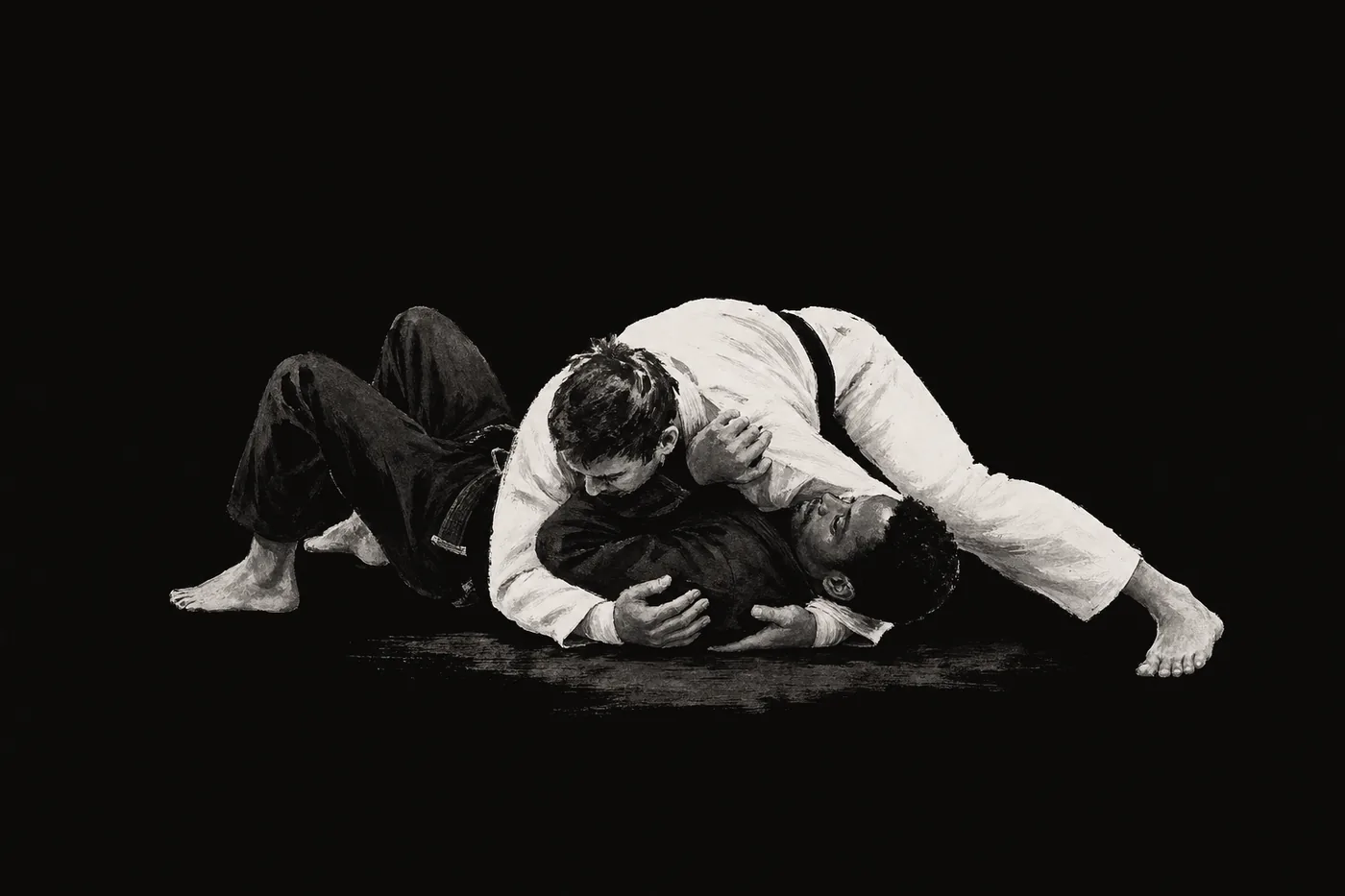
Near knee up, two forearm frames, hip escape sideways, knee through to block the hip, hips out again, closed guard. You are flat under side control with the crossface on and you cannot get your elbow back. The spine below is Lachlan Giles's escape to closed guard from his foundations course, one coach and one route in his own orientation, with her on your right: the near knee up so she cannot mount, a forearm against her head and a forearm near the elbow on her hip, a hip escape sideways with her head tilted in line, the knee through the gap and turned to block her hip, a second hip escape and the far leg over her back into the closed guard. His class version, Jon Thomas, Machado and Danaher supply checks on the same mechanics. Her hip switch and her weight on her elbow are drilled tonight from their own starts; the underhook to the knees, the hand under your hip and the arm over your head are described and kept for other nights; the clasp, the isolated arms, the armlock, Roger's placement and the pinned wrist are named resets. Twenty-six gi clips and three no-gi ones for the principles, every no-gi cue marked, transcripts read and cited to the transcript chunk, one orientation written out below.
Key takeaways
- Success means Your legs back in front of her and the closed guard locked, before she can settle again.
- The spine is 4 steps after the gate, two frames, forearms near the elbow: her head and her hip, hip escape: step the left foot out, hips away sideways, tilt her head in line, drive the right knee through the gap and point it to block her hip, right foot on the mat, hips out again, left leg over her back: closed guard.
- When it breaks there are 6 named branches; learn the triggers, the responses are short.
- Evidence: 29 clips from 13 channels (18 clips from a coach's own channel, 9 from a gym's, 2 from an instructional publisher's), every timestamp checked against the spoken transcript. Sentences marked synthesis are the editors', not a coach's.
her wedges, not her weight
She is perpendicular, past your legs, her left arm under your head, her body between your elbow and your knee. What holds you is not body weight but wedges around your body: Danaher puts close to all of his weight on Bernardo with his hands behind his back and is put back in guard at once; with wedges and almost no weight Bernardo could not put him back in guard. Your job is to get inside her wedges, one limb at a time: the elbow first, then the knee, then the hand inside the biceps.
 2:44John Danaher · Bernardo Faria BJJ Fanaticsgia hundred percent of my body weight on top of Bernardo, my hands behind my back; the easiest thing in the world for him to pull me back into guard3:25John Danaher · Bernardo Faria BJJ Fanaticsgithe basis of a pin is not body weight, the basis of a pin is the use of your body as a set of wedges around your opponent's body4:29John Danaher · Bernardo Faria BJJ Fanaticsgiwith almost a hundred percent of my body weight it was a joke for him to put me back in guard; with zero body weight he could not, because I was using wedges4:50John Danaher · Bernardo Faria BJJ Fanaticsgiyour goal in any pin is to get inside your opponent's wedges13:06John Danaher · Bernardo Faria BJJ Fanaticsgione limb, usually the elbow first and the knee, then the hand inside the biceps
your arms in, your knee up
Elbows tight to your body, no grabbing, no pushing; the near knee up beside her hip so she cannot step over to mount. Every arm that sticks out is hers to attack, and every push with the hands is a bench press she is heavier than; the escape is frames and movement, and the near leg up is what keeps the mount off you while you build them.
 1:01Lachlan Giles · Absolute MMAgihaving my near leg up, my knee closer to the hip, takes away that space; if she tries to step over my leg gets in the way2:01Lachlan Giles · Absolute MMAgiit is generally bad if you let your arms get separated away from your body3:03Lachlan Giles · Absolute MMAgiyou are not going to push your opponent off; I am going to be moving my body and using what we call frames
 1:25Jean Jacques Machadogitry not to grab the gi; grabbing is doing a bench press, and he hooks himself with me
the guard back, not just space
Your legs back in front of her: the closed guard, where your legs protect your upper body and she must pass again from the start. Space is not the escape. Her pass scores only once she has cleared your legs and held side control for three seconds; a guard recovered inside that count denies it, and a guard recovered after it denies what comes next. Get out of her control and into your own.
success means
synthesis The closed guard locked with her inside it, your legs in front of her, and held for three seconds while she postures and pushes your knee once, slowly (the attempt is the session's test; the footage shows the lock). Space is not the escape and a knee wedged in is not the escape; a guard that opens as she postures is the start of the next pass. Each branch names its own end, and none of them claims this position.
the situation
She is in side control on your right side, kneeling, past your legs and perpendicular to you, settled; her left arm is under your head as a crossface and her right arm is under your left arm as an underhook, her hands joined beside your left shoulder (the start Giles demonstrates); you are flat on your back with both arms in front of you, elbows in, and your legs down; she has not switched her hips, loaded onto her elbow, scooped a hand under your near hip, clasped her hands chest to chest or gone over your head (those are branches or resets)
the endpoint
The closed guard locked around her with your legs in front of her, her inside it; held for three seconds while she postures and pushes your knee once, slowly, which is the session's test; the footage shows the lock at 8:43 to 8:44.5 in the recap and 6:41 to 6:42 in the route section
you start with
- Your arms are free
- Your legs are free
not solved here · cooperative resets
- Both of your arms isolated away from your body
- Her elbow wrap and lean locked on one arm (the straight armlock)
- Her hands taken off your shoulder and locked around your torso, chest to chest (not the joined hands at your shoulder that the start has)
- Her hips placed over your ribs with your elbows opened (Roger's placement)
- Your wrist pinned under her hips
Sides. One orientation throughout, Giles's own, mirrored when she is on your left: she is on your right side; her left arm crossfaces under your head and her right arm underhooks your left arm with her hands joined; your right knee is the near knee and comes up beside her hip; your left forearm, the far arm, frames against her head and your right forearm, the near arm, frames her hip near the elbow; you step your left foot, the far foot, out and hip escape to your left, away from her; your left arm tilts her head in line; your right knee drives through the gap in front of her hip and turns to block it; your right foot goes to the mat and the hips escape again, away from her; your left leg comes over her back and you lock the closed guard. Giles speaks in near leg, my arm next to her head, my forearm, my left leg, my knee, my other side, my leg; which arm, which knee and which leg are read from stills of his recap, and the limitations say so.
what it is worth
Her pass scores 3 only once she has surmounted your legs and held side control or north-south for 3 seconds (article 4.2); a guard recovered inside that count denies it. After the pass, the guard recovered denies what comes next: knee on belly (2, article 4.3: the knee or shin nearest your hip on your belly, chest or ribs with her other knee off the mat), mount (4, 4.4: sitting on your torso clear of the half guard, two knees or a foot and a knee down, facing your head, at most one arm trapped and the leg trapping it not past your shoulder), back control (4, 4.5: her heels between your thighs, legs not crossed, at most one arm trapped below the shoulder line), each held 3 seconds; if she moves through positions under one continuous control, the referee counts once at the end and adds them (article 3.4: pass then mount is 7). A position reached but not held, or nearly completed, may be an advantage (5.1, 5.2). A submission you lock during her count interrupts it (3.3.2). None of this is a referee's call in training: the session's success is the lock held.
Article 4.2: 3 points when the athlete on top surmounts the legs of the opponent (pass guard or half guard) and maintains side control or north-south over him or her for 3 seconds; 4.3: knee on belly 2 points when the athlete on top and free of the guard places the knee or shin closest to the opponent's hip on the belly, chest or ribs without the opposite knee touching the ground, for 3 seconds; 4.4: mount 4 points when clear of the half guard, sitting on the torso with two knees or one foot and one knee on the ground, facing the head, with up to one arm trapped and, if it is, the leg trapping the arm not extending beyond the opponent's shoulder, for 3 seconds; 4.5: back control 4 points with the heels between the thighs, legs not crossed, up to one arm trapped and not above the shoulder line, for 3 seconds; 3.3: an athlete who arrives at a point-scoring position while caught in a submission hold is awarded points only once free of the attack and stabilised for 3 seconds, and 3.3.2 interrupts the count when the opponent locks a submission during it; 3.4: cumulative points when the athlete progresses through point-scoring positions under continuous control, counted once at the end; 5.1 and 5.2: an advantage when a point-scoring position is reached but not held for 3 seconds, or nearly completed
Source: IBJJF Rules Book v6.1 2024 (the current PDF from ibjjf.com/books-videos), articles 3.3, 3.4, 4.2, 4.3, 4.4, 4.5, 5.1, 5.2; read 2026-09-10
— the spine · learn this week
Lachlan Giles's escape to closed guard
One coach's route from flat under the crossface to the closed guard, in his own orientation: she on your right, your right knee up, your left forearm against her head and your right on her hip, the left foot out, the right knee through the gap, the left leg over her back. Giles's class version of the same escape and Thomas, Machado and Danaher supply checks on the same mechanics, never a step; Thomas's and Danaher's opponents are on their right as well, and their words are kept as spoken. No step is conditional; the situations that change the route are branches from their own starts.
-
GATE
Near knee up, elbows in, face her
Right knee up beside her hip; both elbows tight; do not grab, do not push, do not turn your back.
Before anything: your near leg, the right, comes up with the knee close to her hip, so that when she tries to step over to mount your leg is in the way (8:13 to 8:16 in the recap stills). Elbows tight to your body, hands open, no grabbing the gi; you are not going to bench press her off. And do not turn your back to get up; it is the instinct and it is the worst thing you can do. You are working to turn and face her.
1:01Lachlan Giles · Absolute MMAgihaving my near leg up, my knee closer to the hip; if she tries to step over, my leg gets in the way and blocks it2:01Lachlan Giles · Absolute MMAgiwe want our elbows tight toward our body2:42Lachlan Giles · Absolute MMAgido not turn your back; I expose my back and that is the worst thing I can do; find a way to turn and face her8:12Lachlan Giles · Absolute MMAgiput my knee up next to Liv's hip 5:34Lachlan Giles · Absolute MMAgihave my knee up nice and high, close to your chest, near the hip, so they try to go to mount and it blocks
 1:00Jean Jacques Machadogijust the fact that you raise the leg makes it very challenging for him to mount
 -
1
Two frames, forearms near the elbow: her head and her hip
Left forearm across against her head, under the jaw; shimmy the shoulders away and drop the right forearm, near the elbow, into her hip; not the hands.
Frames block her from following you and from closing the gap; they are not a push. Your left arm, the far arm, comes across against her head; your right forearm, the near arm, goes into her hip: shimmy your shoulders away for a moment and drop the forearm in, near the elbow, and push into the hip (8:19 to 8:23 in the recap stills: the left forearm at her head and upper back, the right forearm at her hip; the same at 8:33 to 8:34 from the other camera, where the foreground arm is the right). Never the hand when the arm is bent: if she pushes against a hand it collapses, and if she drops her hip on a bent wrist it bends the wrist back. The hip frame takes her forward drive off the crossface; the head frame stops her running around to the angle she wants.
3:25Lachlan Giles · Absolute MMAgistart to get my arm framing against her hip; she has a crossface, when I get a good frame against the hip I take some of her forward drive off4:05Lachlan Giles · Absolute MMAgiusing my arm against the head and the arm against the hip to stop her reclaiming that angle4:26Lachlan Giles · Absolute MMAgiuse my forearm near the elbow to push on the hip; if you go to your hand she can collapse that arm, and you risk injuring your hand4:46Lachlan Giles · Absolute MMAgishimmy away a little bit and get our forearm near the elbow pressuring into the hip8:12Lachlan Giles · Absolute MMAgiput my arm next to her head; I move away and I frame against the hip with my forearm4:32Lachlan Giles · Absolute MMAgishimmy my shoulders away and drop my arm, then actively push into the hips 1:01Jon Thomasgipush with your forearm, the spot right above the elbow, at a slightly obtuse angle; from elbow to shoulder will not bend6:32John Danaher · Bernardo Faria BJJ Fanaticsgithe number one place to start is the near side hip, in the vast majority of side escapes
 -
2
Hip escape: step the left foot out, hips away sideways, tilt her head in line
Left foot, the far foot, steps out to the side; move your hips laterally to your left, away from hers, not backwards; the left arm tilts her head toward your line.
With the frames on, hip escape: step your left foot out to the side and move your hips laterally away from hers, to your left (8:23 to 8:28 in the recap stills: the left foot planted wide and the hips shifting away from her). The hip frame means she cannot follow and close the gap. As you step out, put a little pressure on her head with the left arm and bridge slightly to tilt her more in line with you; a passer wants to be perpendicular, and in line with you it is easier to recover. Move sideways, not backwards: pushing back with both feet does not make space, moving the hips laterally does.
5:07Lachlan Giles · Absolute MMAgionce I have my frame I am looking to hip escape; if she is forward that knee is blocked, so I step to the side and move my hips away, and that gives me space5:28Lachlan Giles · Absolute MMAgimy frame stops her hips coming closer, so when I move my hips away she cannot follow and close that gap5:48Lachlan Giles · Absolute MMAgiI step my left leg out, I bridge a little to tilt her more in line with me6:08Lachlan Giles · Absolute MMAgiI push her head in, her hip down, I move my hips away7:30Lachlan Giles · Absolute MMAgipushing backwards with both feet does not help me make space; I am moving laterally8:12Lachlan Giles · Absolute MMAgiI step my foot out to the side, I move my hips laterally, a hip escape, and I start to turn her head5:56Lachlan Giles · Absolute MMAgiwhen I hip escape the space is created and she cannot follow it because of my forearm; my knee drops in that gap2:24Jean Jacques Machadogiinstead of pushing him straight to his hip I am moving him this way, sideways -
3
Drive the right knee through the gap and point it to block her hip
The right knee jams through the gap in front of her hip and turns to block it, just like the forearm did; in front of the hip, not down on the mat.
Jam your right knee through the gap in front of her hip (8:29 to 8:34 in the recap stills). Once it is in, point the knee and push it against that hip so it blocks her exactly as the forearm frame did: when she tries to move laterally she is blocked. Do not leave the knee down, and do not slide the whole leg through toward closed guard; a knee left down lets her run back, and a leg that goes all the way through gets trapped.
6:08Lachlan Giles · Absolute MMAgijam my knee through into this gap; my aim is to put my knee to block that hip just like I was with my forearm frame7:52Lachlan Giles · Absolute MMAgileaving the knee down allows her to run back; bring it in front of the hip on the side, so when she tries to move laterally she is blocked8:32Lachlan Giles · Absolute MMAgiputting my knee to the outside of the hip, blocking the hip7:20Lachlan Giles · Absolute MMAgithe mistake is trying to bring the knee as far across as possible; that lets her jam my hips; extend the leg and maximise the distance4:46Jon Thomasgiif you go all the way through with this knee you end up trapped; push with the top of the knee5:27Jon Thomasgifocus on getting my knee high to his chest; from my knee to my hip will not bend7:55John Danaher · Bernardo Faria BJJ FanaticsgiI cannot bring my knee along the floor, his knee wedges mine; I place my knee at the hip, the hip is my entry point -
4
Right foot on the mat, hips out again, left leg over her back: closed guard
Right foot to the mat, a second hip escape away from her, the left leg out and over her back, and lock the closed guard.
With the knee blocking her hip, put your right foot on the mat and do the hip escape again, moving your hips out and away from her. That frees the far leg: your left leg comes out and over her back, and you lock the closed guard. In the recap stills (8:33 to 8:41) the right foot is planted by her hip with the knee turned across it. The hands, read from the same stills and not spoken: the left hand is at her upper back from the head frame and stays there; the right hand is at her hip at 8:33 to 8:34, comes off her at 8:36 to 8:38 (Giles gestures at his own knee while he talks, an explanation, not a contact), and goes to her upper back or shoulder at 8:39 to 8:40, before the left leg clears; the left leg comes over her back at 8:39 to 8:41 and the ankles cross at 8:43 to 8:44.5 (and at 6:41 to 6:42 in the route section). So the transfer is: keep the left hand at her upper back, and once the knee blocks her hip let the right hand leave the hip and join it at her upper back or shoulder; both hands hold her back at the lock, not pushing. She is in front of your legs now and has to pass again from the start; your legs protect your upper body.
6:28Lachlan Giles · Absolute MMAgiI put my foot on the mat and I move my hips out this side; from here I can take my leg out and lock the closed guard8:32Lachlan Giles · Absolute MMAgigetting out on my other side, and then freeing my leg into the closed guard1:41Lachlan Giles · Absolute MMAgiinto the closed guard; now my legs are in front, it is much more difficult to be attacked9:46Lachlan Giles · Absolute MMAgido not bring your knee across; keep your hips away, bring your foot across and pull yourself into an open guard or closed guard6:09Jon Thomasgiuse the outside leg to recompose: a lasso on the shoulder or a foot on the hip, and I centre up7:11Jon Thomasgithrow my foot over my own hand, press, and I am out
— grip notes
- Which arm and which leg, and what was read from the footage.
Giles says near leg, my arm next to her head, my forearm on her hip, my left leg out, my knee through the gap, my other side, my leg over. The stills add the rest: she is on your right side with her left arm crossfacing and her right arm under your left as an underhook, her hands joined beside your left shoulder; the near knee is your right; the head frame is your left forearm, the far arm, and the hip frame your right forearm, the near arm; the foot that steps out is your left, the far foot; the knee that drives through is your right; the leg that comes over her back is your left. The convention: a step marked transcript reproduces the cited speech; a step marked frames reproduces the speech and adds those assignments, read from 480p stills at half-second steps through the full recap (8:12 to 8:46) and one-second steps through the route section (5:18 to 6:58). Thomas's clips show his opponent on his right as well (the far leg he lifts is his left), and so does Danaher's (for every inch he shrimps with his left foot his right knee goes in); both keep their own words.
8:12Lachlan Giles · Absolute MMAgiput my knee up next to Liv's hip, my arm next to her head, I move away and frame against the hip with my forearm, I step my foot out to the side5:48Lachlan Giles · Absolute MMAgiI step my left leg out3:04Jon Thomasgithe biggest mistake is leaving your left foot on the floor; as soon as I lift my left leg high my knee naturally comes in10:40John Danaher · Bernardo Faria BJJ Fanaticsgifor every inch that I shrimp outwards with my left foot my right knee goes in an inch- Whichever frame comes first.
Giles teaches an order but says whichever frame is available is the one to take: sometimes her head is up and the head frame comes first, sometimes the hip; each frame you get makes the next one easier, and once you have one you must keep fighting to hold it while you build the next.
- Breathe, and wait for her to move.
Machado's rule for the moment she has you tight: if you are safe and can breathe, nothing she is doing is hurting you, and nothing she can do to improve her position happens without her changing how she holds you; every change is your door.
— when the spine breaks
6 branches
Each one names the trigger you will feel, then the response. Learn the triggers; the responses are short.
- She switches her hips toward your head, into the modified scarf hold, her hip on your ribs, as you start to frameits own drillthe knee in, then the outside leg recomposing to open guard, Thomas's own end (one hand on each shoulder, knee in, lasso or foot on the hip); a partner who does not post on the bridge gets rolled, and that is also an end
Jon Thomas's answer to the hip switch, from its own start, in his own words. It happens when she is higher on you; if she is low, the normal escape still works. The danger is your elbow getting stuck outside when she switches: if your elbow is already low, blocking the far side, it tracks the inside as she switches and your forearm blocks her ribcage or far hip; grab fabric or the belt there if you can and keep it wedged. Two cases. Her weight on the floor: a bridge does nothing, so forward shrimp: turn the hip away, small toes on the floor, pull the hip away, the elbow like a jack so she cannot follow; two or three times, then lift the core tight, bring the knee in, and work out. Her weight loaded on you: the shrimp goes nowhere, so bring the toes close to your butt and bridge, flaring her up with the elbow; experienced people post a hand, and that post gives your hips room to work back to the knee-in escape; the ones who stay tight get rolled. Finish as Thomas finishes: one hand on each shoulder so you can lasso (a double push on one side lets his shoulder or his club come at you), the knee in, a lasso or a foot on the hip, and out to open guard.
 0:00Jon Thomasgihe switches into a control like this and the escape pattern is completely different; usually when they are a little bit higher on you0:21Jon Thomasgithe real problem with the hip switch is your elbow gets stuck out; if my elbows out I have no way to fight0:41Jon Thomasgias he switches I want my elbow to track on the inside, my forearm blocking his rib cage or his far hip1:22Jon Thomasgiif his body weight is on the floor a bridge will not do anything; the forward shrimp, turn the hip away, small toes on the floor, pull the hip away, my elbow blocks him from following like a jack2:05Jon Thomasgias I do this he loads his body weight on me; this is where the bridge works, as long as I keep my elbow in the right spot2:45Jon Thomasgitoes close to my butt, bridge up, use my elbow to flare him up; most people catch their balance and post, and that gives you the room for your hips
 2:46Jon Thomasgithe forward shrimp goes from sideways to flat; a regular shrimp is centred, foot on the floor, then turning to the side, which does not get space here3:27Jon ThomasgiI like to go one hand on each shoulder so I can lasso; if you double push here his shoulder can come at me, or he can club me3:47Jon Thomasgione on each shoulder, knee in, lasso or foot on hip, and then come out
- Your frames are in and she runs away from your legs, toward your head, so the legs cannot come back acrossits own drillup on your knees facing her, Giles's own end; the front headlock she may catch on the way up is the next problem, and a stop tonight
Giles's underhook escape, from its own start, in his own words. It starts the same: arm and leg frames first, never a reach for the underhook with no space, because the crossface kills it. The underhook is the gap under her arm; deal with the crossface first with the pillow defence: hand inside and on top of your own head, elbow open across, then the top of your head attached to your arm and that arm on the ground like a pillow, staying on your side, which is very hard to drive back. Then pummel the hand through the gap as an underhook, scoot the hips away, turn a full 180 degrees belly down with your feet behind you, and build your base backwards to your knees; moving away, not rolling over toward her, is what gets you up, and the 180 is what keeps your back away. synthesis Which hand is the pillow and which one pummels is not read from stills at this sampling; the branch is described in Giles's words and is not drilled tonight. Come up with your head next to hers, or she catches the head.
 1:25Lachlan Giles · Absolute MMAgiif I just get an underhook here it is not going to be very effective; get your frames first and good position, then shoot for it1:46Lachlan Giles · Absolute MMAgiI get my arm and leg frames and I am going to work under the shoulder; Liv is running away from me and it is going to be very hard to bring my feet back across2:06Lachlan Giles · Absolute MMAgithere is a gap under this arm, so I look to pummel my hand through that gap as an underhook; the crossface kills that2:26Lachlan Giles · Absolute MMAgiwe use the pillow defence: hand inside and on top of my head, open my elbow2:48Lachlan Giles · Absolute MMAgiattach the top of my head to my arm and put my arm on the ground3:09Lachlan Giles · Absolute MMAgias long as you can stay on your side it is very hard to get you back4:37Lachlan Giles · Absolute MMAgiscoot along the mat moving my hips away, 180 degrees, belly down, and build my base backwards to my knees; side on, the back take is available5:42Lachlan Giles · Absolute MMAgiI get to my knees by moving my feet away, sprawling out and building my base backwards; there is nothing to drive against
 6:17Lachlan Giles · Absolute MMAno-gino-gi: head next to theirs so they cannot catch a guillotine choke6:38Lachlan Giles · Absolute MMAno-gino-gi: the front headlock position is better than being stuck in side control; be ready to defend the neck
- Her hand is scooped under your near hip and no shrimp will get the knee inits own drillthe foot fed into her armpit with the knee wedged and her pressure lifting, Thomas's own end; what connects that to the guard is not in the footage, so it resets there
Jon Thomas's answer to the near-hip hand, from its own start, in his own words. If she is not tight, frame and bring the knee directly in front of her biceps, extend it down and feed the foot. When she is tight, frame the neck, bring your near arm around in front of her without committing far, and use that elbow for support; bring the knee tight to it on the outside, small toes on the floor, and forward shrimp until the knee is back in front of the biceps. Then, if she stays crossfaced, extend the knee down and feed the other foot into her armpit; it is sticky, and the more she pulls her arm back the more she lifts and loses pressure. Thomas says he risks a back take or a kimura when the arm comes around; synthesis if she isolates that arm or turns toward your back, stop. Not tonight.
 12:38Jon Thomasgithey put their hand on the near side hip; no amount of shrimping and bridging is going to get that in13:19Jon Thomasgiif he is not tight I frame and bring my knee directly in front of the biceps, extend it downward and feed this foot13:39Jon Thomasgitake my arm and come around in front, not too far, because I do risk a back take or maybe a kimura; use this elbow for support13:59Jon Thomasgibring this knee really tight to my elbow, on the outside; small toes on the floor, forward shrimp14:20Jon Thomasgionce I get the knee back in the biceps I extend it down and feed this left foot into the armpit; the more he brings it back the more he elevates and loses his pressure
- She shifts her top arm over your head toward north-southits own drillboth elbows framing her shoulders with one knee between your chests and the foot fed, then a pivot out to open guard, Thomas's own end
Jon Thomas's answer to the arm over the head, from its own start, in his own words. Catch it early: as she shifts the arm over, your hand feeds under into her armpit and your arm slides deeper until her weight rests on your own forearm near your elbow, never the wrist, so she cannot drop her weight; the other hand races to her shoulder. Now both elbows block her shoulders, forearms slightly above ninety degrees, her weight loaded in front of them. Forward shrimp and lunge out so she cannot get her weight down; lift the legs to keep her off; make one leg straight and slide the other knee between your chest and hers, feed that foot, and pivot out to open guard. Two knees in is a mistake; you need one foot to escape. Not tonight.
16:02Jon Thomasgias he starts to do that shift my hand feeds under into the armpit16:22Jon Thomasgislide up to the forearm, a little more towards the elbow; you cannot push with the wrist17:02Jon Thomasgias he goes I race to the shoulder; both elbows blocking the shoulders; as he drops his weight I have a frame17:44Jon ThomasgiI do a forward shrimp and I even lunge out more so that he cannot get his weight down; the knee comes in 7:28Jon Thomasgikeep my forearms slightly above ninety, his weight loaded in front of the shoulder; I lift my legs in the air so he cannot get all the way in7:48Jon Thomasgimake one leg straight and slide the other knee in between my chest and his; you cannot go with two knees in; feed the foot and pivot out
- Her weight is on her upper body with her elbow on the floor past your head, and moving along the ground gets nothingits own drillher elbow off the floor and your knee in the space between her elbow and the mat, Machado's own end
Machado's up-and-out, from its own start, in his own words. When her weight is on her upper body and her elbow is on the floor, moving along the ground is all energy; instead, with the frame kept on her hip, feet close to you, bridge straight up and out at the same time, not up and down, to lift her elbow off the floor, and put your body in the space between her elbow and the mat: the knee goes in there. Without the hip frame the bridge gives her the mount. It ends with the knee in; the rest is a reset tonight.
 1:04Jean Jacques Machadogikeep your feet on the ground close to you; raise your hip up and out at the same time; you eliminate his weight1:24Jean Jacques Machadogithis is the frame, not your hand4:15Jean Jacques Machadogigo out, up and out, do not go up and down7:04Jean Jacques Machadogiwhen the weight is on his upper body I want to get the elbow off the floor and put my body between his elbow and the floor; that is why I go up and out7:45Jean Jacques MachadogiI must have my frame on his hip, because if I do not have the frame on his hip when I go up, mount
- Both of your arms are isolated away from your body; or her armlock grip is locked; or her hands are clasped chest to chest; or her hips are placed over your ribs and your elbows are opened; or your wrist is pinned under her hipscooperative reset
synthesis Of these, only the clasped hands has a taught recovery in this set: Thomas's clasped-head-control escape (the knee or shin on the bottom hip, the hand on the other hip, the side of the foot in, the head dipped out under his arm), which is not installed or qualified tonight. The rest have no recovery here. Thomas says the isolated arms come from framing too late; Roger's clip shows how fast the lean finishes, and his placement is built so that a hip escape drags him with you; Giles teaches the top to pin the wrist under the hips. In the session each of these is a hard boundary: stop, partner releases, restart from the entry; the armlock is a tap, not a fight.
2:01Jon Thomasgiwhen his hands are clasped and he is staying really tight I put my right knee on the bottom side of the hip2:43Jon ThomasgiI cannot just break this grip; I use this hand to come up and I dip my head out underneath; the foot on the hip makes space to bring this leg all the way through7:51Jon Thomasgihe is still keeping his hands clasped; my right hand goes under his tricep, I lift my head up and dip my head under18:25Jon Thomasgiboth of my arms are fully isolated; most of the time these positions occur because people do not accept they are getting passed early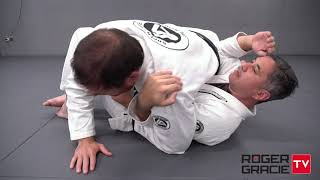 0:43Roger Gracie · Roger Gracie TVgiI start turning and lean, I push all my weight; I want my hips over the arm
 2:44Roger Gracie · Roger Gracie TVgiI want to be over him in a way that if he tries to move his hips again he is dragging me
 3:25Lachlan Giles · Absolute MMAgigrab the wrist and put my hips on top of it; you cannot frame
— negate first
Threat map
Some of the clips on the left show the coach performing the attack; watch them once so you recognise it. The answer on the right is a spine step, a branch, or marked as synthesis.
- The crossface that twists your neck
-
what they are doing
your answer
Recognise it: she needs your head turned away and your shoulders pinned. Cal MacDonald, on Kesting's channel, teaches three different things. Prevention, before it is on: on your side, based on your foot, facing her, block the crossface with your forearm or elbow on her collarbone. Relief, once it is on: do not let the neck twist with the shoulders pinned; allow yourself to turn a little so the shoulder comes off the mat, and walk the fingers up your own head to make a frame. This document starts with the crossface already on: its head frame (step 1) is the left forearm against her head, which is a frame for the hip escape, not MacDonald's block. synthesis In the session the top applies the crossface at half pressure and releases on a tap.
 1:21Cal MacDonald · Grapplearts (Stephan Kesting)giI do not want my neck twisted with my shoulders pinned; I allow myself to turn away a little so my shoulder is no longer on the mat2:03Cal MacDonald · Grapplearts (Stephan Kesting)giwalk my fingers up like slicking my hands through my hair, creating frames so he cannot affect the alignment of my neck3:03Cal MacDonald · Grapplearts (Stephan Kesting)gias he goes to grab my head I am blocking the crossface, I am on my side, facing him, based with my foot3:23Cal MacDonald · Grapplearts (Stephan Kesting)giframing his collarbone with my left forearm or my elbow; elbows as tight as possible
 - Chest pressure that keeps your shoulder blades pinned
-
what they are doing
your answer
Recognise it: the passer's own answer is what tells you the frame she fears. Thomas on top says the elbow on his near hip is easy to follow but the elbow on his ribcage wedges him out; Giles's hip frame near the elbow sits there (step 1).
- Her hips placed over your ribs, opening your elbows
-
what they are doing
0:00Roger Gracie · Roger Gracie TVgiwhen the person keeps both of his arms up front; your attack depends on the position of the person's arms2:24Roger Gracie · Roger Gracie TVgiif the hip moves away he already gained some space; I have to close the gap5:34Roger Gracie · Roger Gracie TVgiget his elbow popping out and a strong hand on top of his shoulder; my stomach goes as high as his elbow allowsyour answer
Recognise it: Roger's positioning starts with both of your arms in front of you, the same start as this document, and is built so that a hip escape drags him with you and so that your elbows get opened. synthesis No clip here shows the escape working against that placement; it is one of the declared resets (B6) and the live block stops on it rather than fighting it.
- The mount when the near leg is down
-
what they are doing
your answer
The near knee up by her hip (G) and the foot down only when you are ready to move; the bridge in B5 is up and out with the hip frame on, or it gives the mount.
- The straight armlock from side control
-
what they are doing
your answer
Elbows in and no reaching (G). synthesis Once the wrap and the lean are on, it is a tap.
- What the top does to your near-arm frame
-
what they are doing
0:59Lachlan Giles · Absolute MMAgireach to the elbow, lift the elbow up off the ground, and shoot your hips underneath past the line of the elbow2:23Lachlan Giles · Absolute MMAgiwalk my hips further back toward his legs; a longer lever to lift2:44Lachlan Giles · Absolute MMAgior pummel underneath with an underhook, grabbing the shoulder and flaring the elbow3:25Lachlan Giles · Absolute MMAgiif he keeps the elbow tucked, grab the wrist and put my hips on top of it; you cannot frame3:46Lachlan Giles · Absolute MMAgiswing the elbow around the head as deep as possible, ribs low, and turn his head awayyour answer
Recognise the answers Giles teaches the top: lift your elbow and pass the hips beyond it, walk toward your legs to lengthen the lever or pummel an underhook, or pin your wrist under the hips and go around the head. The frame Giles teaches you is near the elbow and pushing (step 1), which is what she is trying to lift. synthesis No clip here escapes the wrist pinned under her hips; it is a reset (B6).
— 20 minutes · gi
Tonight
synthesis The session is the author's; the mechanics are Giles's, from one exact start: she has settled. Every route rep ends at the closed guard locked and held for three seconds against one slow attempt to open it; the reaction reps start from the frames and end where each coach ends them, then reset. Two kinds of stop: the block's own reset, cooperative and named under each block, and the hard boundaries the scope lists (both arms isolated; the armlock; the clasp; her hips over your ribs with your elbows opened; the wrist pinned), which stop everything; both restart only after the partner releases every control. Reaching your knees or the top is a reset in this session, not a success.
safety · stop here
No submission is attacked in this document. The crossface loads your neck: MacDonald's rule, on Kesting's channel, is never to let the neck twist with the shoulders pinned, and the session applies the crossface at half pressure and releases on a tap. Roger's elbow wrap and lean is a tap, not a fight. Bridges are up and out with the hip frame on, never a bridge over the head under her weight. Three catches in the other coaches' routes have their own stops and are not drilled tonight. The release rules are the author's.
- The crossface twisting the neck (start of every block). The top applies it at half pressure; the bottom taps and the partner releases at once; turn a little rather than take it
- The straight armlock from side control (the reset B6). Tap early; once the wrap and the lean are on, the drill is over
- A bridge under her weight (B5). Up and out with the hip frame on, feet close; a bridge over the head with her on your chest is a stop
- The wristlock on an arm extended across her face (Marcelo's route, reference only). Not drilled; if it is ever tried, the hand stays strong and short in front of her face and any pressure on the wrist is a tap at once
- The back take or the kimura on the arm that comes around (B3, not tonight). If she isolates that arm or turns toward your back, stop and reset
- The front headlock as you come up (B2, not tonight). Head next to hers on the way up; if she catches the head, stop and reset rather than fight the choke
- 1
The knee up and the two frames: before she settles, then after
3 minTwo halves. Prevention first, five reps: as she comes into side control and before she settles, the right knee comes up beside her hip and the two frames go in. Then the established pin, five reps: she settles fully, crossface at half pressure, her right arm under your left with her hands joined; only then the knee up, the shimmy of the shoulders and the right forearm into her hip near the elbow, the left forearm across against her head; hands open. Say the two frames out loud. Swap.
- 2
The route, to the closed guard every time
7 minFrom the exact start, cooperatively, after she has settled: knee up; the two frames; step the left foot out and hip escape to your left, tilting her head in line; the right knee through the gap and turned to block her hip; right foot down, hips out again, the left leg over her back, lock the closed guard. synthesis Then the test, both players scripted: you keep the ankles crossed, both hands holding her upper back, heels pulling her hips to yours; she sits up tall and puts both hands on your thighs just above the knees and pushes down slowly for a count of three, no more than that; if the lock holds through the count, the rep counts; if it opens, she releases at once, you reset, and it does not. Ten reps, swap, then the mirror side (her on your left, her right arm crossfacing, her left arm the underhook) with every hand and foot swapped.
- 3
Two reactions, each from the frames, each to its own end
5 minEvery rep starts with the knee up and the two frames built from the settled start (G and 1). Then the partner gives one change on cue, said out loud. B1: she switches her hips toward your head into the modified scarf hold, her hip on your ribs; your elbow tracks inside to her ribs or far hip, forward shrimp two or three times while her weight is on the floor, or bridge with the toes close when she loads on you, the knee in, a lasso or a foot on the hip, out to open guard. B5: she loads her weight onto her elbow on the floor past your head; hip frame kept, feet close, bridge up and out, the knee into the space between her elbow and the mat. Each rep ends there and resets. Alternate the two, then swap.
- 4
Positional rounds
5 minFive one-minute rounds from the exact start, alternating who is on top. She holds with the crossface and follows your hips; she may switch to the modified scarf hold (B1) or load onto her elbow (B5); she keeps her hands joined beside your left shoulder as at the start; she does not lock her hands around your torso chest to chest, scoop the near hip, go over the head or to north-south, or attack a submission, because none of those is installed tonight. You escape by the route and the two reactions. Success is the lock held through her one slow attempt to open it; a reset otherwise. The hard boundaries are a stop, not a round to fight.
— after the round
Check first
synthesis The author's table. Outcomes have more than one cause; check these in order.
| It happened | Check first |
|---|---|
| She followed your hip escape and closed the gap | Was the right forearm on her hip near the elbow before you moved, or was it the hand? Did you move sideways, to your left, or push backwards with both feet? Did the left arm tilt her head in line? |
| The knee would not go in | Was the right knee up beside her hip before you moved? Did you step the left foot out first and move the hips, or only bridge? Did she switch her hips (B1), scoop under your near hip (B3, not tonight), or load onto her elbow (B5)? |
| The knee went in and she passed again | Did you leave the knee down, or slide the whole leg through toward closed guard instead of turning it to block her hip and escaping again? Did the left leg come over her back before the lock, or did you square up first? |
| She mounted | Was the right knee up? Did you bridge with the foot down and the hip frame off (B5's mistake)? |
| Your neck got twisted or you got armlocked | Did your shoulder stay pinned while your head was turned, instead of turning a little and framing (the crossface threat)? Did an arm reach out or push with the hand (G)? |
| The lock opened in the test | Were the ankles crossed behind her before you counted? Were your hands on her, or pushing her away? Was she inside your legs, or already past one of them? |
— the other doors · keep for later
Reference
Everything else read for this situation, grouped by door: the principle of a pin and the escapes' two principles, the other gi routes through the same door, and the no-gi clips kept for their principles, cued as such.
The principlewhat a pin is
- John Danaher
Perpendicular is the most stable pin; the escape is the story of going from perpendicular to parallel. A pin is wedges, reinforced by weight: get inside them one limb at a time, the elbow first (turn away briefly if you must to get it in), then the knee at the hip because the floor is wedged, forming a V frame of elbow and knee that denies the mount; then the feet together push, the hand inside the biceps, the forward shift to sit up, and do not sit up too early. Fundamentals level: open hands, pushing with elbows and forearms, not grips. Bernardo is on his right, the same side Liv is on for Giles; his words are kept.
0:40John Danaher · Bernardo Faria BJJ Fanaticsgithe single most stable position for pinning is perpendicular body position7:35John Danaher · Bernardo Faria BJJ Fanaticsgiif I physically cannot get my elbow in, I turn what seems to be the wrong way, briefly, to get the elbow inside8:37John Danaher · Bernardo Faria BJJ Fanaticsgia V-shaped frame between my elbow and my knee; if he tries to mount from here it is impossible9:19John Danaher · Bernardo Faria BJJ Fanaticsgijoin my two feet together and push with both legs; get our hand inside the wedge of his biceps11:42John Danaher · Bernardo Faria BJJ Fanaticsgithere is a danger if I sit up too early14:08John Danaher · Bernardo Faria BJJ Fanaticsgiat fundamentals level, bottom athletes working with open hands, pushing with elbows and forearms rather than hands - Jon Thomas
Two principles for every side escape: the bowl, pull the body tight so there is a gap under you instead of a book lying flat; and hip attachment, wherever one hip goes the other goes, so lift the far leg straight when the near knee comes in, and if you cannot quite get the knee in, lift the leg and kick in the air with the elbow framed. Then a map of the controls, high and low, the hip switch, the head-and-arm, the hand on the near hip, the arm over the head, each with its own escape; against the low side control push her below the hips with a hand on the chin and a frame on the near hip, both feet on the floor, scooting out; isolate the controls one at a time with a partner who is not allowed to shift, then put them together.
0:40Jon Thomasgithe bowl concept: a sheet of paper over a bowl leaves a huge gap; pull my body tight like a bowl1:22Jon Thomasgihip attachment: wherever one side of your hip goes the other side goes; lift this leg up in the air straight3:45Jon Thomasgiif I cannot quite get it in, I lift my leg in the air and kick, that little hip jump, as long as my elbow is framed5:54Jon Thomasgithe low side control: instead of scraping him above the shoulders we push him below the hips6:14Jon Thomasgihand on the head, on the chin, a nice downward push6:34Jon Thomasgiframe on his near side hip; both feet on the floor and I start scooting out19:47Jon Thomasgitell your partner to only stay in one particular side control; isolate the exact shifts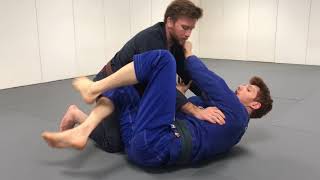 2:05Jon Thomasgiblock the far side; I need to block him from following me so when I stretch out there is a frame
 - Jean Jacques Machado
Arms close to the body, elbows below his shoulder line; hands touching him, never grabbing; the leg touching his leg so the mount is closed; be able to breathe and wait, he has to change his hold to improve and every change is a door. The arm under the chin is the escape: raise the elbows above the head, step out, hip out, knee in, and move him sideways, not into his hip. Move the head first, then the hip, when the hip frame is stuck. When he switches base and pulls your arm up, turn your hip before anything, keep the elbow connected to your body, and force only his arm, not his body.
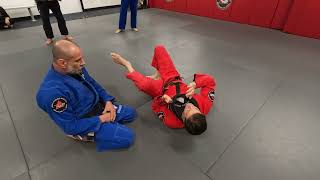 1:44Jean Jacques Machadogiget under his chin; my hands are never grabbing the gi, touching his body; turn my body toward him to get my knee to touch my elbow, a wall3:24Jean Jacques MachadogiI want to make sure my elbow is below his shoulder, because now any control he tries to do, hold my arm, it is hard4:05Jean Jacques Machadoginever push the hip; I move the head first, then the hip; the head, then the hip1:22Jean Jacques Machadogistepping out, raise my elbows above my head and move my hip out; once I come in, keep moving
 1:46Jean Jacques Machadogiget my elbows close to me again, one shoulder at a time; close the gate5:16Jean Jacques Machadogiif I am able to have my forearm under his chin I will escape; I am just raising my elbow and moving my hip at the same time
 0:21Jean Jacques Machadogimy hip has to turn before I do anything; my object is to bring the elbow close to my body0:42Jean Jacques Machadogiforce that arm only, not against his body; most important, did you escape
Other gi routesthe same door, other coaches
- Marcelo Garcia
From his own channel: the arm windshield-wipers over his face, hand strong in front of it, not held long because of the wristlock; connect the hands to push, get the hook and bridge, get on your side and go low to the leg, come up on the knees, then step behind his leg for the single or push on the hook and drag. If he holds the distance and follows, bridge side to side until a side opens. The two frames you fight for are against his neck and against the arm over your head. From the GRACIEMAG clip: pass her arm over your head, get your head out of the way, rock the hips, and grip with the arm next to her legs.
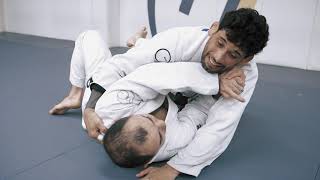 1:04Marcelo Garciagiwindshield my arm over his face; this hand has to be very strong in front of his face, I do not want to take too long, I can get a wristlock2:09Marcelo Garciagiget the hook, bridge, go low on his leg, get on my knees as soon as possible2:51Marcelo GarciagiI can start walking, step behind his leg, single; or I can push on the hook and drag, and he has to come up8:25Marcelo Garciagitwo frames: framing against his neck, framing against the arm over your head10:08Marcelo Garciagibridge back, bridge back, the side that he does not follow, you get out
 2:14Marcelo Garcia · GRACIEMAGgiwhen I pass his arm I open my hand and get my head out of the way; with the arm that is next to his legs I make a grip
 - Clark Gracie Allegiance
Hands in front, forearm under his chin and handcuff on his hip, toes close to the hips, then a big explosive bridge first, then the hip escape, knee inside, take his arm with you as you close.
- Gracie Barra Aliso Viejo
Frames under the neck and on the hip, foot up until you are ready; bridge and throw him over your shoulder, keep the frame, turn to your side, hip escape, bottom knee across his hip, other leg over, squeeze the knees, square up, a second hip escape if the leg is stuck.
 0:22Gracie Barra Aliso ViejogiI have my frames, one under the neck, one on the hip0:42Gracie Barra Aliso ViejogiI need my foot up if I am not moving actively; my foot goes down only when I am ready to go1:22Gracie Barra Aliso Viejogibridge, keep the frame, and then hip escape; if I do not keep the frame he brings me back down2:23Gracie Barra Aliso Viejogithrow him over my shoulder; my elbow under his neck helps; bottom knee frames on his hip as I throw the leg over
 - Matt Arroyo
Against a bigger, stronger squeeze: do not buck; elbow inside his thigh, flatten the leg to entice the mount, and as his knee comes over, slide yours under to half guard with the underhook. synthesis The clip shows it only when the top takes the bait; nothing is shown if he does not, so it is a reference here and is not drilled.
- Jon Thomas, kesa gatame
Hook the leg he leaves available and peel toward the back, or when he circles high, chase, bridge and roll over the shoulder.


No-gi, for the principlescued as such
- Lachlan Giles, the three escapes
No-gi: the decision tree, frames to re-guard, the underhook to the knees, the sit-up when he switches base; when the frames escape stalls, swim under for your own underhook and turn on your side; when he switches base to stop your knee, block the bottom hip, grab your own head and open the elbow, stiff arm, and build up on your arm.
 1:23Lachlan Giles · Absolute MMAno-gino-gi: forearm frames, anchoring my hand and using my elbow to lift; the force relays back through him3:26Lachlan Giles · Absolute MMAno-gino-gi: frames to escape back to guard: swim underneath, hip escape by stepping out, extend with the shin5:31Lachlan Giles · Absolute MMAno-gino-gi: I might feel like I am never going to get my legs in, but I might be able to change to an underhook and turn on my side7:16Lachlan Giles · Absolute MMAno-gino-gi: his answer is to switch his hips; now there is no way I am going to get my knee through; I still try to block the bottom hip7:56Lachlan Giles · Absolute MMAno-gino-gi: change my frame, grab my own head and open out at the elbow; my left hand grabs with a stiff arm8:18Lachlan Giles · Absolute MMAno-gino-gi: I can usually build up on my arm, swinging my arm above my head, and start standing up
 - Andre Galvao
No-gi: bridge to put the elbow inside, hip escape and the bottom shin under his leg, then trap the outside leg before anything, put the foot to the floor and the shin in front of his groin, bring his elbow away from his knee and close the guard; a forearm inside his leg, never the hand on the hip.
 3:12Andre Galvao · Atosno-gino-gi: bridge this way and when I come back put my elbow inside; keep the elbow connected to my body4:56Andre Galvao · Atosno-gino-gi: once I put my knee inside I need my outside leg trapping his leg, or he beats your knees again5:39Andre Galvao · Atosno-gino-gi: I put my foot to the floor, bring my shin in the front of his groin, and bring his elbow far from his knee5:59Andre Galvao · Atosno-gino-gi: now I can easily close the guard8:48Andre Galvao · Atosno-gino-gi: use the forearm inside his leg but not the hand, do not push his hips like this
— 29 clips · verified 2026-09-10
Ledger
Every clip on this page. Each was resolved on YouTube, its uploader channel recorded and reviewed, and its transcript read before a second was cited. Source names whose channel it is: the coach's own, the coach's gym, or the instructional publisher that filmed them.
| Coach | Channel | Source | Kit | Video | Uploaded | Length |
|---|---|---|---|---|---|---|
| Marcelo Garcia | Marcelo Garcia Jiu-Jitsu | coach | gi | Marcelo Garcia: Escaping Side Control | 2020-04-06 | 13:11 |
| Jean Jacques Machado | JeanJacquesMachado | coach | gi | CONCEPTS in escaping side control | 2023-06-14 | 7:04 |
| Jean Jacques Machado | JeanJacquesMachado | coach | gi | The 1% missing detail that ruins 99% of side control escape | 2022-03-22 | 2:56 |
| Jean Jacques Machado | JeanJacquesMachado | coach | gi | Let's escape side control. | 2024-05-08 | 12:27 |
| Jean Jacques Machado | JeanJacquesMachado | coach | gi | Escaping Side Control - Opponent Switches Base | 2022-12-04 | 2:15 |
| Jean Jacques Machado | JeanJacquesMachado | coach | gi | Escaping Side Control - Concepts & Principles | 2022-12-12 | 4:40 |
| Jean Jacques Machado | JeanJacquesMachado | coach | gi | Side control escape for the often neglected bigger players (2022 Affiliate Camp) | 2022-10-27 | 4:25 |
| Jon Thomas | JonThomasBJJ | coach | gi | This One Principle Completely Changes Side Control Escape | 2023-03-22 | 21:26 |
| Jon Thomas | JonThomasBJJ | coach | gi | The Easy Way to Learn Side Control Escape | 2024-09-27 | 10:06 |
| Jon Thomas | JonThomasBJJ | coach | gi | Side Control Escape - These Small Details Change Everything | 2022-01-16 | 8:50 |
| Jon Thomas | JonThomasBJJ | coach | gi | Side Control Escape - Most common mistakes | 2018-02-22 | 5:48 |
| Jon Thomas | JonThomasBJJ | coach | gi | Side Control Escape - Kesa Gatame | 2018-02-24 | 5:33 |
| Jon Thomas | JonThomasBJJ | coach | gi | The Secret to a World Class Side Control | 2022-07-16 | 10:11 |
| Jon Thomas | JonThomasBJJ Plus | coach | gi | How to Escape Side Control When Your Opponent Switches Their Hips! ( Kuzure Kesa Gatame) | 2023-12-21 | 3:34 |
| Matt Arroyo | Matt Arroyo Jiu Jitsu | coach | gi | How to get out of SIDE CONTROL (against a bigger stronger opponent!) | 2023-10-06 | 1:08 |
| Roger Gracie · Roger Gracie TV | Roger Gracie TV | coach | gi | Roger Gracie's Side Control Pressure | 2025-09-27 | 9:14 |
| Roger Gracie · Roger Gracie TV | Roger Gracie TV | coach | gi | Straight Armlock From Side Control: I Get Everyone With This! | 2020-10-28 | 3:18 |
| Cal MacDonald · Grapplearts (Stephan Kesting) | Stephan Kesting | coach | gi | How to Make Side Control BRUTAL with the Crossface | 2023-06-05 | 4:44 |
| Lachlan Giles · Absolute MMA | Absolute MMA St Kilda - Melbourne | gym | no-gi | 3 MUST-KNOW Side Control Escapes (Lachlan Giles) | 2025-03-10 | 9:47 |
| Lachlan Giles · Absolute MMA | Absolute MMA St Kilda - Melbourne | gym | gi | Escape side control fundamentals part1: Prevention and frames escape | 2020-05-11 | 15:32 |
| Lachlan Giles · Absolute MMA | Absolute MMA St Kilda - Melbourne | gym | gi | Escape side control fundamentals part 2: Underhook escape (Lachlan Giles) | 2020-05-17 | 12:05 |
| Lachlan Giles · Absolute MMA | Absolute MMA St Kilda - Melbourne | gym | gi | Finishing from side control depending on the reaction of the near arm (Lachlan Giles) | 2018-09-08 | 11:24 |
| Lachlan Giles · Absolute MMA | Absolute MMA St Kilda - Melbourne | gym | gi | Escaping Side Control | 2023-05-09 | 9:48 |
| Lachlan Giles · Absolute MMA | Absolute MMA St Kilda - Melbourne | gym | no-gi | The Best Way To Escape Side Control Part 2 (Lachlan Giles) | 2019-04-26 | 7:28 |
| Andre Galvao · Atos | Atos Jiu-Jitsu HQ | gym | no-gi | Basic Guard Recover - Andre Galvao | 2021-10-12 | 11:56 |
| John Danaher · Bernardo Faria BJJ Fanatics | Bernardo Faria BJJ Fanatics | publisher | gi | How To Do The Perfect BJJ Side Control Escape by John Danaher | 2019-04-10 | 15:44 |
| Clark Gracie Allegiance Jiu Jitsu | Clark Gracie Allegiance Jiu Jitsu | gym | gi | Side Control Escape - Fundamental Guard Recovery | 2020-03-23 | 2:36 |
| Gracie Barra Aliso Viejo | Gracie Barra Aliso Viejo | gym | gi | Recovering guard from side control — this is how you get free | 2026-01-05 | 3:20 |
| Marcelo Garcia · GRACIEMAG | GRACIEMAG - The original BJJ magazine. | publisher | gi | Escape side control with Marcelo Garcia | 2013-11-08 | 3:31 |
what was not verified
- Evidence convention: a step marked transcript reproduces the cited speech; a step marked frames reproduces the speech and adds arm, knee and leg assignments read from 480p stills. G and steps 1 to 4 are marked frames for: her on your right with her left arm crossfacing and her right arm underhooking your left with the hands joined, the right knee as the near knee, the left (far) forearm against her head and the right (near) forearm on her hip, the left foot stepping out and the hips moving to your left, the right knee through the gap, the right foot planted and the left leg over her back (CA1uP2THJdY at half-second steps through the recap 8:12 to 8:46, .frames/recap2-CA1uP2THJdY-1..3.png, two-times zooms .frames/zoom-start-CA1uP2THJdY.png and .frames/zoom-hands-CA1uP2THJdY.png, and one-second steps through the route section 5:18 to 6:58, .frames/route2-CA1uP2THJdY-1..4.png).
- The first draft of this document had the orientation mirrored (her on your left) and mixed Giles's spoken left leg into that mirror; the second draft had the legs right and the framing arms reversed (right to the head, left to the hip). Both readings were the reviewer's and are adopted: the left, far forearm frames her head and the right, near forearm her hip (8:19 to 8:23; 8:33 to 8:34, where the foreground arm is his right); every assignment was re-read from the recap stills.
- The endpoint is the closed guard locked in the stills at 8:43 to 8:44.5 (the ankles cross) and 6:41 to 6:42; the earlier claim of a lock at 6:44 to 6:54 was wrong (that passage is Giles talking with a foot planted) and is withdrawn. The recap is an edited sequence: it begins at about 8:13.5 (8:12 to 8:13 still shows the preceding recovery), ends before the cut at 8:45, and changes view at about 8:21.5, 8:25 and 8:33; the stills show the order of the contacts, not proof of one uninterrupted execution. The partner's attempt to open the guard is the session's test and is not in the footage. Stills at this rate show the order and the contacts, not the pressure.
- The hands through the leg change are read from stills, not spoken: the left hand is at her upper back from the head frame and stays there; the right hand is at her hip at 8:33 to 8:34, off her at 8:36 to 8:38 while Giles gestures at his own knee (an explanation, not a contact), and at her upper back or shoulder from 8:39 to 8:40, before the left leg clears; both hands hold her back at the lock. The right foot on the mat for the second hip escape and the direction of that escape (away from her) are read from the same stills and from Giles's words at 6:28 and 8:32.
- The spine range covers Giles's course instruction, 1:01 to 8:46; the recap, an edited sequence from about 8:13.5 to the cut at 8:45 with view changes at about 8:21.5, 8:25 and 8:33, is the demonstration of the whole route in order and is the qualified sequence; the earlier passages demonstrate the steps one at a time. Neither proves one uninterrupted execution.
- Thomas's clips show his opponent on his right, the same side as Giles's (the far leg he lifts is his left, DYUaYue-6BU 3:04); Danaher's too (cuXq-k__9lQ 10:40: with my left foot my right knee goes in). Their checks and branches keep their own words and are not transposed. Machado and Marcelo do not speak sides and are not transposed either.
- B2 (Giles's underhook) is described in his words; which hand is the pillow and which pummels is not read from stills at this sampling, and the branch is not drilled tonight. B3 ends at Thomas's foot in the armpit and B4 at his pivot to open guard; neither is connected to the spine in the footage, so each resets there. B5 ends at Machado's knee in.
- Marcelo Garcia's BJJ Joe uploads (the sit-up, the elbow push against clasped hands, the hip roll) carry MGinaction branding in the stills and are republished lessons, not the uploader's own instruction; ownership is not established, so they are excluded and the clasped hands became a named reset instead of a branch. Marcelo's own channel and the GRACIEMAG production are cited in the reference. The crossface clip on Kesting's channel is Cal MacDonald's instruction and is credited to him.
- Three no-gi clips are cited (Giles's three escapes, Giles's no-gi part 2 for the head next to hers, Galvao's guard recovery), in B2 and the reference, every cue prefixed no-gi; twenty-six gi clips are cited. The rest of the forty-four clips considered are excluded with reasons.
- The ADCC sidebar was removed: this is a gi document and the ADCC page's pass and mount conditions were not re-read for it.
- The system has not been tested on the mat by its editors.
- Approved by review at round 3 (hash 74016797fd35); the three round-3 minors (the recap wording, the mount's trapping-leg condition, and the clasp wording reconciled with the joined hands at the start) were applied after approval and are the only edits since.
Compiled and checked by the Randori editors at Way of Yawara: every citation read against the spoken transcript, sources reviewed 2026-09-10, last reviewed 2026-09-10.
In the library
Last updated 2026-09-10.
Framework: Ribeiro & Howell, Jiu-Jitsu University · the shipped learn-graph