Learn / Jiu Jitsu / Systems / Finishing from the back no-gi: the rear naked choke against the hand fight
Back Control · finish it · no-gi
Finishing from the back no-gi: the rear naked choke against the hand fight
This is the no-gi system. The gi version has its own clips and its own spine.
Back control with one arm under and one over, the strangle fist covered, and his two hands on your strangle wrist: the top hand stripped by the pinky line, the thumb line or the screwdriver, his hand punched down and the arm deep, the strangle hand anchored behind his far shoulder or in the goose neck and covered by your head, the second hand extracted hand over hand into the figure four, the wrist caught answered by the finger walk and the hand caught by his hands jacked high, and the elbow rotated toward the hip to the tap. You have his back with one arm over his shoulder, and he has done what everyone does: both his hands are on your strangle wrist, pulling it down, and every push burns you out. The spine below is the South Boston BJJ coach's class on exactly that fight, one coach and one clip in his own orientation: the strangle fist covered by the other hand and the elbows on his shoulders before his hands arrive; three grip breaks matched to what his hand does, the pinky line, the thumb line and the screwdriver, each ending with his hand punched down to his belly and your arm deep; the hand covered behind his far shoulder or in the goose neck, then by your head; the second hand extracted along your own hand, wrist and bicep into the figure four; the two things he does next, the wrist caught and the hand caught, answered by the finger walk to his centre line and by his hands jacked above his chest line; and a finish that is the elbow rotated toward your hip, gradual, not a squeeze. The route card in section 1 carries every side. The other coaches' hand fights, the short choke and the one-arm finishes, Danaher's thin edge under a tucked chin, the sides of the back and the body triangle, and his escape are references; a hidden hand he peels is a failed rep, and the back lost, the forearm on the jaw and a head turned by the rotation are resets.
Key takeaways
- Success means The tap on the rear naked strangle, caught and released; the figure four locked three seconds in the second block.
- The spine is 3 steps after the gate, the trilemma: strip his top hand by the pinky line, the thumb line or the screwdriver, punch the arm across and his hand down, and get the arm deep, anchor the strangle hand behind his far shoulder or in the goose neck, cover it with your head while your left hand still holds his stripped hand down, then lift the left elbow, extract hand over hand, wrist over hand, bicep over hand, and lock the figure four, the finish: not a squeeze but the right elbow rotated toward your hip, the chest out, the pressure gradual, to the tap, with 3 conditional steps: when he catches your wrist after the strip: finger walk across his body until your elbow is on his centre line, punch his hand away over the top, cover, and from the cover lift and extract into the figure four; when he catches your hand at the thumb line: let go of his primary hand, take his other wrist and jack both hands above his chest line, then punch inside past the high hand, cover, and punch the returning hands down until the full hand comes through and locks; the coach's own version with the hooks, on the overhook side: the strangle arm underneath, your head up on the opposite side from that elbow, and the same sequence.
- When it breaks there are 6 named branches; learn the triggers, the responses are short.
- Evidence: 51 clips from 28 channels (25 clips from a coach's own channel, 20 from a gym's, 6 from an instructional publisher's), every timestamp checked against the spoken transcript. Sentences marked synthesis are the editors', not a coach's.
his two hands on your strangle wrist before the neck: a strip that matches what his hand does
You have the back and the arm over his shoulder, and both his hands are on your wrist pulling it down; you push up against them and burn out, or you rip at the fingers and he re-grips before the arm moves. The coach does not push: his secondary hand takes top hand position and he breaks the grip three ways depending on what the hand does, the pinky line rolled up and peeled, the thumb line peeled with the heel of the hand, or the screwdriver of the elbow lifted and pulled, and every strip ends with his hand punched down to his belly so he has one hand left. Bodoni names the primary defensive hand, the one opposite the strangle arm, and says whoever has his hand on top wins; Santos attacks the pinky knuckle or the thumb with three fingers; the Serafin coach takes the wrist by the pad of the pinky; Chewjitsu grabs the defending hand at its knife edge for control.
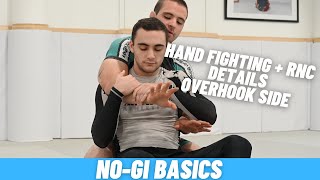 1:21South Boston BJJno-giwe're going to do a trilemma; I'm going to do three different grip breaks depending on what he does; my secondary hand is going to take top hand position, so I'm going to grab on top of his hand2:43South Boston BJJno-giin the event that he defends the pinky, he defends the thumb, we use the screwdriver method where I just hold his hand and I lift my elbow and pull it, lift and pull, until my hand is free
 0:22Giancarlo Bodonino-gihe has a primary and he has a secondary defensive hand, and the most important is going to be the primary; that's always going to be the one opposite of my strangle arm, the arm that's going over the shoulder1:23Giancarlo Bodonino-giwhoever's hands are on top is winning in this situation; if I have my hand on top of his hand I am in control of the hand fight
 3:06Placido Santosno-gimy second hand comes over the top, I take these three fingers and with those three fingers I attack that pinky knuckle; my wrist bends like I'm flexing in a bodybuilding show, and I go down and away from the grip
 2:01Serafin BJJno-githe bottom arm is gonna slide in and I'm gonna control his wrist, grabbing by the pinky at the pad of the finger
 1:20Nick Albin · Chewjitsuno-gias soon as we touch they come up to grab and I can grab the arm; when you grab here you're grabbing right at the knife hand to have better control
the strangle hand where his hands can reach it: on the shoulder, on the skull, in the open
The arm gets round the neck and a second later his hand is on yours, peeling it off the shoulder; or you go for the second hand and he catches the first while it floats. The coach's rule is that something must cover the strangle hand at every moment: anchored behind the far shoulder or bent into the goose neck behind the neck, then the head on it while the other hand still holds the stripped hand down, then the extracted hand over it. Danaher takes the whole hand behind the nape of the neck and never leaves it on the shoulder or on top of the skull; Bodoni hides the hand tight behind the shoulder with the chin covering the thumb; Giles anchors the fingers on the back of the shoulder blade, a spot the defender cannot reach; Saunders puts the secondary hand over the primary so the hand available to him is the wrong one.
4:47South Boston BJJno-giif you have long arms you want to grab behind his shoulder and cover your hand always; if you have shorter hands we do what's called a goose neck, which is where I make a fist and I cover the back of his neck and I also cover my hand5:09South Boston BJJno-githere needs to always be something covering my hand; once I cover my hand with my own head I'm now going to pull my elbow up and then extract my hand 10:49John Danaher · Bernardo Faria BJJ Fanaticsno-giI take my whole hand behind the nape of his neck here; I never put my hand here on the shoulder where he can reach up and peel my hand; I want to hide my hand from his
 5:11Giancarlo Bodonino-giI want to make sure that this hand is hidden, so it's nice and tight behind his shoulder, and my chin covers my hand to prevent this hand from coming in and grabbing my thumb
 2:56Lachlan Giles · Absolute MMA St Kildano-giI'm going to reach my hand deep and grab the back of his shoulder, that little bony part of your shoulder blade that you can grab, hook your fingers up; when Steve tries to remove my hand it's a really difficult spot for him to get to
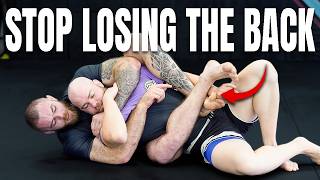 1:22Josh Saundersno-giif I leave my strangle hand available he can start to grab onto that hand; if I have my secondary hand over my primary hand, the one that he has available is the wrong one
the second hand extracted where he can catch it, or reached for the bicep and intercepted
The first arm is round the neck and you pull the second hand out low, or stick it out, or reach back for your bicep: he catches it on the way, or drives his head down while it floats, and the lock never closes. The coach lifts the elbow first so the hand has the shortest path, and extracts it over his own hand, wrist over hand, bicep over hand, so at no point does the defender have access to it; a hand stuck out is the beginner's mistake he names. Danaher crosses the wrists and passes the hand behind the head to his own shoulder, never to the bicep and never onto the skull; Giles found the bicep first too easy to intercept and punches a fist into the neck as a block; the Absolute lesson feeds the back of the hand behind the neck and brings the shoulder to it; Santos calls wrist over wrist with the knuckles on the back of the head the version that works against a skilled opponent; Garcia walks the second hand in like a tightrope.
5:29South Boston BJJno-giI lift my elbow and now when I extract I have a shorter distance to travel, and now my hand covers my hand, then my wrist covers my wrist, then my bicep covers my hand, and so at no point did he have access to my hand5:50South Boston BJJno-giin a beginner's class I see people extract and they stick their hand out here; if you do that he's just going to pull my hand; the way we avoid this is by lifting at the elbow, pulling hand over hand, wrist over hand, bicep over hand11:13John Danaher · Bernardo Faria BJJ Fanaticsno-ginow it's time for me to take the control hand down and I want to cross my wrists; a common mistake here is people grab their bicep; I've now exposed my hand to my opponent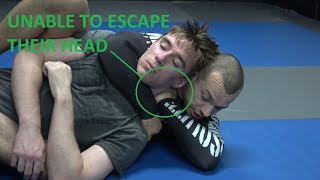 1:18Lachlan Giles · Absolute MMA St Kildano-gihow I used to do it was I'd almost go to reach for my bicep first and then go here, but it's too easy to intercept that hand; then I changed it where I would swim my hand behind first and then go to lock off
 4:39Absolute MMA St Kildano-giwe see people reach to their bicep first and then they can't get their second hand in; this is very easy to intercept; instead put just the back of your hand behind his neck, bring your shoulder to your hand and feed your hand from there11:07Placido Santosno-ginow it's time to rear naked: cross wrist over wrist, knuckles on the back of the head; don't do this, this works in the Hallmark Channel but it doesn't work against a really skilled opponent
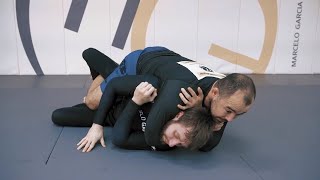 7:02Marcelo Garcia · Marcelo Garcia Jiu-Jitsuno-githis hand, I don't want to have this hand on top, I'm going to have this hand in between; he just walks in like a tightrope without having to go on your biceps
the finish that is a squeeze with the arms, which his hands can hold
Everything is locked and you squeeze: your arms burn, his two hands on the wrist hold the compression, and after thirty seconds nothing has happened. The coach does not squeeze: he rotates the elbow toward his hip, rotational force, and increases the pressure gradually, because a fast squeeze on a tucked jaw loses the move. Danaher takes the elbow over the partner's shoulder in a circle so the back strangles rather than the arms, and shows the compression failing through two defending hands; Giles gets ninety-nine percent of the power from pulling the elbow back toward the hip and proves it with one arm; the Absolute lesson rows the elbows back with the chest forward; Jordan rotates the elbow as if bringing it behind the opponent's back; Great Grappling, in the gi, moves the elbow behind the shoulder blade and nothing else.
6:55South Boston BJJno-gionce we have the figure four we don't just want to squeeze; if I squeeze it requires big biceps which I don't have, so instead I want to focus on rotating my elbow towards my hip so I can apply what's called rotational force7:16South Boston BJJno-gilike with any submission we never squeeze super hard, we start gradually and we increase our pressure so that we don't blow out our arms13:44John Danaher · Bernardo Faria BJJ Fanaticsno-giif I just try to compress, go forward, strong strong strong, I can't strangle; but the moment I use the rotational method they fight through my opponent's defensive hands and get through to an effective strangle1:14Lachlan Giles · Absolute MMA St Kildano-gi99% of the power comes from me pulling my elbow back towards my hip or towards my shoulder; you should be able to finish him with one arm, simply grab their shoulder, pull your elbow back and hold2:47Absolute MMA St Kildano-githe choke comes on by rowing backwards and pushing my chest forwards; push my chest forward, elbows tight, and roll my elbow back towards my ribs 8:01Jordan · Jordan Teaches Jiujitsuno-githe traditional way is to position your inner elbow to the middle of the neck and bring your elbows together, however the modern and more effective way is to rotate your elbow as if you're trying to bring your elbow behind your opponent's back
 1:08Great Grapplinggigi: what really chokes our opponent, there's only one thing; we set up a fulcrum and we move the elbow behind the shoulder blade, that's all it is
success means
synthesis The tap on the rear naked strangle, caught and released, from back control with his two hands on your strangle wrist: the right forearm under his chin with the hand anchored behind his far shoulder or in the goose neck, the left forearm behind his head with your right hand on your left bicep, the right elbow rotated toward your hip. In the second block the count is the figure four locked and held three seconds while his hands pull; the coach shows the lock and the rotation and releases each time, and no tap was identified in the inspected stills: the tap and the count are the session's tests.
6:55South Boston BJJno-gionce we have the figure four we don't just want to squeeze; I want to focus on rotating my elbow towards my hip so I can apply what's called rotational force7:16South Boston BJJno-gilike with any submission we never squeeze super hard, we start gradually and we increase our pressure so that we don't blow out our arms13:58South Boston BJJno-gijust like that we have a response to all three scenarios when we're hand fighting from the backthe situation
You have his back without the gi, seated behind him with your hooks in, one arm over his shoulder and the other under his arm, your strangle fist covered by the other hand, and both his hands are on your strangle wrist pulling it down; he defends with the hands and does not yet turn inside your arms or your hooks; the hand fight that clears your control, the escape that turns him to face you, the body triangle, the arm traps, the short choke and the crucifix are references or resets
the endpoint
The tap on the rear naked strangle, caught and released: your right forearm under his chin with the hand anchored behind his far shoulder or in the goose neck, your left forearm behind his head with your right hand on your left bicep, and your right elbow rotated toward your hip until he taps; the figure four locked and held three seconds with his hands still pulling is the intermediate stop the second block counts
you start with
- Back control with the hooks in, his hands on your strangle wrist
not solved here · cooperative resets
- The other coaches' hand fights: the inside thumb, the cross wrists glued to the torso, the arm switch, the leg traps (B1, references)
- The short choke, the one-arm and the palm-to-palm finishes (B2, references)
- The tucked chin answered otherwise: Danaher's thin edge, the chin lift, the pummel, the mandible (B3, references)
- The underhook side, the body triangle and the entries in transition (B4, references)
- His escape (B5, the partner's script in the rounds; the escape itself is another document's)
- The rear triangle, the armbar, the kimura and the crucifix from the back (other documents)
Sides. One orientation throughout, the coach's own, mirrored when the strangle arm is the left; the route card in section 1 and the grip notes carry every side. In short: your right arm is over his right shoulder, the strangle arm, and your left arm under his left armpit, the control hand; your left hand covers your right fist at his sternum and your elbows cover his shoulders; his two hands are on your right wrist; your left hand takes top hand position on his top hand and strips it by the pinky line, the thumb line or the screwdriver while your right arm punches across toward his left shoulder and his hand goes down to his belly under your left hand; your right hand anchors behind his left shoulder or bends into the goose neck behind his neck, and your head covers it on his left side while your left hand still holds his stripped hand down; then your left elbow lifts and your left hand comes out over your own hand, wrist and bicep to behind his head and your own right shoulder, and your right hand closes on your left bicep; if he catches the wrist you finger walk across his body toward his left shoulder until your elbow is on his centre line, punch his hand away with the left and cover; if he catches the hand you take his other wrist with your left and jack both hands above his chest line, then punch inside; the finish rotates your right elbow toward your hip. Which hand, which arm and how the sides were settled is set out in the grip notes under the spine.
what it is worth
Back control is 4 points once your heels are between his thighs without your legs crossed, with at most one of his arms trapped and not above the shoulder line, held 3 seconds (article 4.5); a single arm trapped inside those limits still scores, while both arms trapped, crossed feet, a figure four around the waist or one heel only earn an advantage instead (5.6.5), and under 5.5 the advantage is awarded only once the scoring attempt has ended. The tap ends the match (2.1: two taps of the hand on him, the ground or yourself, two taps of the foot when the arms are trapped, or a spoken withdrawal). The rulebook lists the choke with a spinal lock and the spinal lock without a choke among its prohibited techniques (6.2.3, items 2 and 22), applied by division in a table this document did not verify from the text copy, so no claim is made here about which divisions forbid a crank; the rulebook escalates serious fouls under 7.2 and disqualifies for severe ones under 7.1. Tonight's no-crank rule is the session's own and does not rest on competition legality. None of this is a referee's call in training: the session's success is the tap, caught and released.
4.5: back control, 4 points, heels between the thighs without crossing the legs, up to one arm trapped and not above the shoulder line, for 3 seconds; 5.6.5: an advantage instead when both arms are trapped, or the legs crossed, a figure four around the waist or one heel only; 5.5: the advantage awarded once the scoring attempt ends; 2.1: the submission by two taps or a verbal withdrawal; 6.2.3 items 2 and 22: the choke with a spinal lock and the spinal lock without a choke listed as prohibited, with the division columns unverified from the text copy; 7.1 and 7.2: severe fouls disqualify, serious fouls escalate
Source: IBJJF Rule Book v6.1 (2024), articles 2.1, 4.5, 5.5, 5.6.5, 6.2.3, 7.1 and 7.2, read from the PDF (mirror: https://www.ligabjj.com/ibjjfrules/2024JUN_IBJJF_Rules_EN.pdf)
Not stated: the ADCC rules were not read for this document; the no-gi coaches cited who mention ruleset differences (Energia on two hooks in sub-only) are quoted as their own view.
Not read
Source: not retrieved
— the spine · learn this week
The South Boston coach's rear naked strangle against two defensive hands
One coach's finish from back control to the tap, in his own orientation: the strangle fist covered and the elbows on his shoulders, three grip breaks matched to what his hand does, the arm deep and the strangle hand anchored behind his far shoulder or in the goose neck and covered by your head before the other hand lets go of his, the second hand extracted along your own hand, wrist and bicep into the figure four, the wrist caught answered by the finger walk and the hand caught by his hands jacked high, and the elbow rotated toward the hip. Step 1 is the first block's work; step 2 is the second block's count; steps 3 and 4 are the reactions the third block and the rounds give; step 5 is the tap; step 6 is the coach's own version with the hooks, not played tonight. Danaher, Giles, Bodoni, Santos and Saunders supply checks on the hidden hand, the anchor, the entry under the chin and the finish, never a step. B1 to B5 are references from their own set-ups and B6 is the reset list.
-
GATE
Read it: the seatbelt with the strangle fist covered, your elbows on his shoulders, and his two hands on your strangle wrist
You are behind him with one arm under and one over: your right arm over his right shoulder, the strangle arm, and your left arm under his left armpit, the control hand, your left hand covering your right fist at his sternum and your elbows covering his shoulders so he cannot turn. He has done what everyone does: both his hands are on your right wrist, pulling it down. Nothing about the neck starts until that grip is dealt with.
Four-second stills and one-second crops (.frames/sb-route-KbPZ9VC8WIc-1.png, 0:00 to 1:00; .frames/sb-z1-KbPZ9VC8WIc-1.png, 1:44 to 1:59, cropped to the pair): the coach, in a teal and black rashguard with bare forearms, kneels behind a seated partner in a grey rashguard with black sleeves, both facing the camera; at 0:20 the coach's right arm is over the partner's right shoulder; from 0:24 to 1:20 he teaches the seatbelt, the covered fist and the elbows with his left arm over the partner's left shoulder, on the viewer's right, the mirror of the route, the left fist covered by the right hand at 0:44 to 1:00, the mirror of the drill's left over right and the elbows on the shoulders with the turn stopped at 1:04 to 1:16; the right overhook returns at 1:24, and the route's hold, the bare right arm over the partner's right shoulder with the left arm under the partner's left arm, is read from 1:24 to 1:59; at 1:44 to 1:51 the partner's two black-sleeved hands are on the coach's right wrist at his chest. His words: one hand underneath and one hand over, we call this our seat belt; we always want to cover the top hand, the strangle arm; I always want to hide my strangle arm, because if I ever give him control of my actual hand it's very hard to punch a strangle; my elbow position, I want to cover the shoulder; my opponent is going to take two defensive hands in place. synthesis The session starts here with his two hands already on the wrist: kneeling for the two preparation blocks as he teaches it, seated with both hooks in for the full-route block and the rounds; the strangle arm is the right in every drill tonight, his own.
0:00South Boston BJJno-giI'm gonna start on my two knees, he's gonna start seated and I'm gonna start with one hand underneath and one hand over; we call this our seat belt0:21South Boston BJJno-gigenerally we always want to cover the top hand; the top hand we want to call this the strangle arm or the choking arm, and we usually call this the control hand or the secondary hand0:41South Boston BJJno-giI always want to try to hide my strangle arm, because if I ever give him control of my actual hand it's very hard to punch a strangle; generally we always want to cover it and we want to make sure that our hands are by the sternum1:01South Boston BJJno-gimy elbow position, I generally want to cover the shoulder, because when I unlock my hands I should be able to control him without locking; if he tries to turn to the right my elbow stops him, if he tries to turn to the left my forearm stops him1:21South Boston BJJno-gias always my opponent is going to take two defensive hands in place just like so, and hopefully I'm doing a good job of covering my fist -
1
The trilemma: strip his top hand by the pinky line, the thumb line or the screwdriver, punch the arm across and his hand down, and get the arm deep
Three grip breaks, one for each thing his hand does. Your left hand takes top hand position on his top hand. Roll your right pinky up to expose his pinky line, dig your left fingers under it, peel and strip, and as you strip punch your right arm across his chest and his hand down to his belly. If he turns his hand down to protect the pinky, the heel of your left hand goes to his thumb line, peels, and you punch away and up instead. If he protects both, the screwdriver: hold his hand with your left and lift your right elbow and pull, lift and pull, until the hand is free. Every strip ends the same way: his hand pulled down to his belly and kept there by your left hand so he has one hand left, and your right arm as deep round his neck as it goes.
One-second crops (.frames/sb-z1-KbPZ9VC8WIc-1..6.png, 1:44 to 3:12): at 1:52 to 1:55 the coach's left hand comes over the top of the partner's top hand; at 1:56 the right fist rolls so the pinky comes up and at 1:57 to 1:59 the left hand digs under and peels the hand while the bare right arm punches across the chest toward the partner's left shoulder, on the viewer's right; at 2:00 the right arm is across the throat. At 2:04 to 2:07 the partner's hand is turned down; at 2:08 the heel of the left hand is at the thumb line and at 2:09 the right arm punches away and up; the same at 2:17 to 2:19 and 2:22 to 2:23, and at 2:32 the arm is round the neck. At 2:37 to 2:43 the left hand holds the partner's hand while the right elbow lifts and pulls, and at 2:45 to 2:47 the right hand comes free and wraps the neck. At 2:48 to 2:51 the arm is deep with the left hand on the partner's chest over his stripped hand, and the summary at 2:52 to 3:12 runs the three again. His words: my secondary hand is going to take top hand position; I roll my pinky up so that I can expose his pinky line, I dig my fingers right underneath, I peel and strip; as soon as I strip I get in the habit of punching my arm across and punching his hand down; he turns his hand down to defend the pinky grab, I use the heel of my hand at the thumb line and I peel it off, and this time instead of punching down I punch away and up; he defends the pinky, he defends the thumb, we use the screwdriver method, I just hold his hand and I lift my elbow and pull it, lift and pull, until my hand is free; each time after I strip the grip I'm pulling it down to his belly so that he only has one hand to defend, and I can easily access his neck as deep as I can. synthesis Which hand strips and which arm punches are read from the crops: the left hand strips, the right arm punches.
1:21South Boston BJJno-giwe're going to do a trilemma; I'm going to do three different grip breaks depending on what he does; my secondary hand is going to take top hand position, so I'm going to grab on top of his hand1:42South Boston BJJno-giI'm going to roll my pinky up so that I can expose his pinky line, and from here I dig my fingers right underneath, I peel and strip; as soon as I strip I get in the habit of punching my arm across and punching his hand down2:02South Boston BJJno-githe second part: let's say he turns his hand down to defend the pinky grab; when I say pinky don't grab the pinky, grab where the pinky line is2:22South Boston BJJno-giI use the heel of my hand at the thumb line and I peel it off, and this time instead of punching down I punch away and up, and now it makes it very easy to punch across2:43South Boston BJJno-giin the event that he defends the pinky, he defends the thumb, we use the screwdriver method where I just hold his hand and I lift my elbow and pull it, lift and pull, until my hand is free, and now I can come through and wrap around his neck3:04South Boston BJJno-gieach time you'll notice that after I strip the grip I'm pulling it down to his belly, so that he only has one hand to defend and I can easily access his neck as deep as I can; for now I get deep and I cover -
2
Anchor the strangle hand behind his far shoulder or in the goose neck, cover it with your head while your left hand still holds his stripped hand down, then lift the left elbow, extract hand over hand, wrist over hand, bicep over hand, and lock the figure four
Something must cover your strangle hand at every moment, and the first cover is your head, not your other hand: your left hand is still holding his stripped hand down at his belly. Long arms: grab behind his far shoulder. Shorter arms: the goose neck, a fist bent behind the back of his neck. Put your head down on that hand, on his left side. Only now let his hand go, lift your left elbow and bring the left hand out along the shortest path, your hand over your own hand, then your wrist over your hand, then your bicep over your hand, behind his head to your own right shoulder, never stuck out where he can find it. On the ground, round your spine so the shoulders are concave and both hands come high. Your right hand's fingers close on your left bicep: the figure four. Hold it three seconds while his hands work: that is the second block's count.
One-second crops (.frames/sb-z2-KbPZ9VC8WIc-1..7.png, 4:32 to 6:23): at 4:36 to 4:43 the right arm is round the neck with the hand behind the partner's left shoulder, on the viewer's right, and the left hand on the partner's chest; at 4:45 to 4:51 the right fist sits bent behind the back of the neck, the goose neck; at 4:52 to 5:07 the coach's head comes down onto that hand on the partner's left side while his left hand stays low on the partner's hand; at 5:08 to 5:11 the left elbow lifts and the left hand rises from the chest; at 5:12 to 5:15 and 5:20 to 5:35 the mistake, the left hand left low and the partner's black-sleeved arm reaching up and finding it; at 5:36 to 5:39 the coach's left hand is out in front of the partner's chest and the partner's hand finds it; at 5:40 to 5:48 the head is down on the anchored hand on the partner's left side while the coach's left arm moves and the partner's black-sleeved left arm follows it, his right hand at his lap; at 5:49 to 5:55 the left forearm comes across the partner's upper chest and over the right hand and the left elbow lifts; at 5:56 to 5:59 the figure four is locked, the left forearm behind the partner's head and the right hand on the left bicep; at 6:00 to 6:03 the lock is opened and the cover shown again; at 6:04 to 6:11 the mistake, the left arm stuck out across the partner's chest and caught in his two hands; at 6:12 to 6:21 the cover and the lift once more; at 6:22 to 6:24 the lock closed again. Four-second stills (.frames/sb-route-KbPZ9VC8WIc-7.png, 6:24 to 7:24): the lock opened for the explanation at 6:28 to 6:36, the hand fed again at 6:40 to 6:44 and the lock closed at 6:48; the rounded spine shown on the ground at 6:56 to 7:11; seated again, the lock by 7:20. One-second crops (.frames/sb-z6-KbPZ9VC8WIc-1..5.png, 6:52 to 8:00): the figure four at 7:16 to 7:23 and the right elbow lowered toward the hip with the partner's head following at 7:24 to 7:35. His words: if you have long arms you want to grab behind his shoulder and cover your hand always; if you have shorter hands we do what's called a goose neck, where I make a fist and I cover the back of his neck and I also cover my hand; there needs to always be something covering my hand; once I cover my hand with my own head I'm going to pull my elbow up and then extract my hand; my hand covers my hand, then my wrist covers my wrist, then my bicep covers my hand, and so at no point did he have access to my hand; when I extract I want to round my spine, concave shoulders, and now I have easy access to my own shoulder. synthesis The order of the releases is read from the crops: his stripped hand is held down until the head is on the strangle hand, and only then does the left hand leave it; the three-second count is the session's, taken at the lock because that is where his hands attack.
4:47South Boston BJJno-giif you have long arms you want to grab behind his shoulder and cover your hand always; if you have shorter hands we do what's called a goose neck, which is where I make a fist and I cover the back of his neck and I also cover my hand5:09South Boston BJJno-githere needs to always be something covering my hand; once I cover my hand with my own head I'm now going to pull my elbow up and then extract my hand; a common mistake I see is they leave their hand down here, and as I go to extract he can bring his hand and find my hand before I can get to it5:29South Boston BJJno-giI lift my elbow and now when I extract I have a shorter distance to travel, and now my hand covers my hand, then my wrist covers my wrist, then my bicep covers my hand, and so at no point did he have access to my hand5:50South Boston BJJno-giin a beginner's class I see people extract and they stick their hand out here; if you do that he's just going to pull my hand; the way we avoid this is by lifting at the elbow, pulling hand over hand, wrist over hand, bicep over hand6:34South Boston BJJno-gias I bring my hand to my own chin I round, it's called concave shoulders, and now I have easy access to my own shoulder; you'll notice how high both of my hands are -
3only if: he catches your wrist after the strip
When he catches your wrist after the strip: finger walk across his body until your elbow is on his centre line, punch his hand away over the top, cover, and from the cover lift and extract into the figure four
He has your wrist but not your elbow. Do not walk up against his pull; walk your right fingers across his body toward his far shoulder, as far as it takes to put your elbow in line with his nose, the tricep as the cue. Then the switch: bring the left hand up and use it to punch his hand away, over the top, so the right hand goes deeper, and cover at once, because his other hand will come to find it. If it does, repeat; as long as you are goosenecked or holding behind his shoulder, the process holds. In this branch your left hand has let go of his stripped hand to make the punch, so the cover is your left hand on the strangle hand, not your head: from that cover, lift the left elbow and extract as before, hand over hand, wrist over hand, bicep over hand, behind his head to your own right shoulder, the right hand closing on the left bicep, and only then the count.
One-second crops (.frames/sb-z3-KbPZ9VC8WIc-1..5.png, 8:32 to 9:50): at 8:36 to 8:39 the partner's hand catches the coach's right wrist as the arm crosses; at 8:40 to 8:54 the fingers walk across the chest toward the partner's left shoulder with the hand still on the wrist, and at 8:57 to 9:07 the elbow sits on the partner's centre line; at 9:08 to 9:23 the supporting left hand is still low while he is still on the finger walk; the switch is said at 9:24 and the cover at 9:44; at 9:25 to 9:29 the coach's left arm lifts while the partner's left hand stays at his lap, and at 9:32 to 9:35 that hand reaches; at 9:36 to 9:50 the left hand and forearm keep working across the partner's upper chest, peeling the second hand and taking the right arm deeper, and the lock is not reached in this pass. Four-second stills (.frames/sb-route-KbPZ9VC8WIc-11.png, 10:40 to 11:40): the figure four locked in the recap at 10:40, the partner's hands on the coach's right strangle wrist while the left hand stays low at 10:44 to 10:52, the left hand up over the partner's left shoulder at 10:56, and the lock again at 11:00 to 11:08. His words: he has some control of my hand but what he doesn't have control over is my elbow, so I can always line up my elbow with his centre line by finger walking; I walk my fingers across his body, I don't try to walk up because his force is pulling me down; I walk as far as I need to get my elbow directly in line with his nose; I start extracting my hand but I punch his hand away, over the top of the hand, and I get my other hand deeper; I immediately go to cover, because I let go of the other hand, expect this hand to come up and try to find your hand. synthesis The join to the lock is the coach's recap (from here I can extract, lift and punch my strangle) and the extraction is step 2's, taken from the hand cover instead of the head cover; in the session this is a reaction the partner gives in the third block and the rounds, and the wrist caught is not a reset.
8:41South Boston BJJno-gihe has some control of my hand, but what he doesn't have control over is my elbow, so I can always line up my elbow with his center line, and the way I do this is what's called finger walking9:02South Boston BJJno-giI walk my fingers across his body; I don't try to walk up because his force is pulling me down; when I walk across his body I can always accomplish this; I walk as far as I need to get my elbow directly in this line of his nose9:24South Boston BJJno-giI'm going to make a switch: I'm actually going to now start extracting my hand but I'm going to punch his hand away, and I go over the top of the hand and I'm able to punch and get my other hand deeper9:44South Boston BJJno-giI immediately go to cover, because I let go of the other hand, expect this hand to come up and try to find your hand; if he successfully does I just repeat the process10:28South Boston BJJno-giI just finger walk until I can get to his tricep, that's a good cue; from here I can extract, lift and punch my strangle; when we're punching I'm rounding my shoulders, but once I lock I'm extending my shoulders back -
4only if: he catches your hand at the thumb line
When he catches your hand at the thumb line: let go of his primary hand, take his other wrist and jack both hands above his chest line, then punch inside past the high hand, cover, and punch the returning hands down until the full hand comes through and locks
If he has your hand itself, at the thumb line, you will not win by punching up or by walking. Make his grip weak by putting his hands where he does not want them: release his primary defensive hand, grab his other wrist with your left hand and jack it above his chest line, above the nipples. His primary hand comes back to your strangle hand, but with the hands that high his elbow is compromised and the hand only works at his centre line or lower. Punch inside: with his hands jacked high, the right arm punches past his high hand and round his neck; shrug the shoulders, pull the hands up, and cover the strangle hand with your left. His freed hand will come back for it: punch it down with the left hand and cover again, and when the second hand comes back punch that too, as many times as it takes, until your full hand comes through behind his head and both hands lock with the fingertips on your own shoulders and your chest out.
One-second crops (.frames/sb-z4-KbPZ9VC8WIc-1..4.png, 11:44 to 12:47): at 11:44 to 11:46 the partner's hand grips the coach's right hand at the chest; at 11:47 to 11:51 the coach's left hand takes the partner's other wrist and lifts both his hands high on the arm near the partner's shoulder; at 12:00 to 12:03 the right arm punches across the chest to the neck with the partner's hand riding too high to stop it; at 12:05 to 12:11 the repeat, the wrist jacked and the arm across; at 12:12 to 12:15 and 12:20 to 12:23 the left hand punches the high hand down and the arm goes deeper; at 12:32 to 12:43 the left hand controls the partner's wrist while the right arm stays round the neck, and at 12:44 to 12:47 the chest extends and the partner's face strains. Four-second stills (.frames/sb-route-KbPZ9VC8WIc-13.png, 12:48 to 13:48): at 12:52 to 13:08 the coach's left forearm rises with the partner's wrist control, and at 13:12 to 13:24 it is low, controlling a defensive hand, while the right arm stays round the neck, the high elbow at 13:20 being the partner's black-sleeved left arm; at 13:28 to 13:36 the punch and the cover; at 13:40 to 13:48 the figure four is locked. His words: whenever this happens we want to make his grip weaker by getting his hands higher than he wants; I'm going to release his primary defensive hand and I'm going to grab his secondary wrist; when I grab this wrist I want to jack his hands above his chest line; because I walked his hand high his elbow position is compromised, so when he tries to push my hand down he won't be able to; the only way his primary hand is going to be effective is if it's at his center line or further; I release and go over the top of his wrist and I shrug my shoulders and pull my hands up; his hand is free so I can start stripping this hand and his other hand will come and replace it; his hand is too high, I can always punch inside; I either cover my hand or if he does find my hand we go back to punching the hand down, and we're punching until we can punch our full hands and lock them in. synthesis In the session this is the second reaction the partner gives in the third block and the rounds; the hand caught is not a reset.
11:10South Boston BJJno-githis time I have a smart defensive hand fighter and he grabs my thumb or hand line; when I try to punch up I'll never win this battle, when I try to finger walk I can't finger walk, he has complete control of my arm11:32South Boston BJJno-giwhenever this happens we want to make his grip weaker by getting his hands higher than he wants; I'm going to release his primary defensive hand and I'm going to grab his secondary wrist11:53South Boston BJJno-giwhen I grab this wrist I want to jack his hands above his chest line; because I walked his hand high his elbow position is compromised, so when he tries to push my hand down he won't be able to12:13South Boston BJJno-githe only way his primary hand is going to be effective is if it's at his center line or further; if his hand is this high it doesn't matter12:55South Boston BJJno-giI release and go over the top of his wrist and I shrug my shoulders and pull my hands up; his hand is free so I can start stripping this hand and his other hand will come and replace it13:16South Boston BJJno-gihis hand is too high, try to stop me, I can always punch inside; I either cover my hand or if he does find my hand we go back to punching the hand down, and as we're punching he might bring the second one back and we're punching13:37South Boston BJJno-giwe're punching until we can punch our full hands and lock them in; both my fingertips are on my shoulders here, I'm extending my chest and I squeeze -
5
The finish: not a squeeze but the right elbow rotated toward your hip, the chest out, the pressure gradual, to the tap
With the figure four locked, do not just squeeze; that takes biceps and burns out. Rotate your right elbow toward your hip, rotational force, with the chest extended, and increase the pressure gradually: fast pressure on a tucked jaw loses the move. Slowly, to the tap; release at once.
One-second crops (.frames/sb-z6-KbPZ9VC8WIc-1..5.png, 6:52 to 8:00): at 7:14 to 7:15 the right arm comes over the partner's right shoulder again; at 7:16 to 7:23 the figure four is locked, the right forearm under the chin and the left forearm behind the head with the hand at the coach's own right shoulder; at 7:24 to 7:35 the right elbow lowers toward the coach's hip and the partner's head follows it; at 7:48 to 7:55 the partner's chin is tucked while the lock is held; at 7:56 to 8:00 the release. His words: once we have the figure four we don't just want to squeeze; if I squeeze it requires big biceps which I don't have, so instead I want to focus on rotating my elbow towards my hip, rotational force; like with any submission we never squeeze super hard, we start gradually and we increase our pressure so that we don't blow out our arms; in the event that he tucks his jaw and I squeeze too fast I risk losing the move. synthesis The tap and the slow application are the session's rules; the coach shows the lock and the rotation and releases each time, and no tap was identified in the inspected stills.
6:55South Boston BJJno-gionce we have the figure four we don't just want to squeeze; if I squeeze it requires big biceps which I don't have, so instead I want to focus on rotating my elbow towards my hip so I can apply what's called rotational force7:16South Boston BJJno-gilike with any submission we never squeeze super hard, we start gradually and we increase our pressure so that we don't blow out our arms7:38South Boston BJJno-giin the event that maybe he tucks his jaw and he's here and I squeeze too fast I risk losing the move, so I gradually increase my pressure and little by little I get a finish -
6only if: he adds the hooks and lies on the overhook side
The coach's own version with the hooks, on the overhook side: the strangle arm underneath, your head up on the opposite side from that elbow, and the same sequence
When the coach adds the hooks he lies on the overhook side, the side of the strangle arm, so the right arm is underneath and the left is the top arm. His rule there: keep your head on the opposite side from your strangle elbow, up, and keep it active, because a head dropped to the floor is what stops the hands locking. Then it is the same fight: the pinky, the thumb, the elbow, the punch, the cover, the extraction, the lock, the rotation. When a strip puts his arm down, his arm under your top leg is a bonus, and a reference here.
Two-second stills (.frames/sb-z5-KbPZ9VC8WIc-1..4.png, 14:39 to 16:29): at 14:49 to 15:09 the pair lies on the side with the partner's head to the viewer's left and his face to the camera, so on his right side, the coach behind him on his right side with the strangle arm underneath and the left arm on top; at 15:07 the coach's head is down by the floor, the mistake he names, and at 15:09 it is up on the partner's left side; at 15:11 to 15:25 the strips and the arm in from the side; at 15:29 to 15:41 the coach's top leg first comes over the partner's top arm; at 15:43 to 16:07 the leg is thrown over the arm again and the feet cross in front of the partner's chest, the legs locked before the hand lets go; at 16:09 to 16:16 the left hand extracts with the arm trapped; at 16:20 to 16:29 the arm trap is held with the feet crossed, the lock not closed in these stills (four-second stills, .frames/sb-route-KbPZ9VC8WIc-16.png). Four-second stills of the last two minutes (.frames/sb-tail-KbPZ9VC8WIc-1..2.png, 16:28 to 18:28): the game of freeing and re-trapping the hand at 16:28 to 16:44; the pair seated for the recap at 16:48 to 17:04; the foot-lock caution shown on the other side, the pair now lying with the partner's head to the viewer's right and his face to the camera, at 17:08 to 17:48, the partner's legs crossing over the coach's ankles below the hips, the strangle hand released to push the head and the ankles freed; the ankles re-locked above the hips at 17:52 to 18:00; the arm trap with the trapping leg on the bottom and the reinforcing leg on top at 18:04 to 18:24. His words: now we're going to have our hooks and we're going to be on the overhook side, the hand that's on top; in order for me to effectively strangle someone my head needs to always be on the opposite side of my elbow; it's easy to get lazy here and let your head drop to the floor, and when this happens it's very hard to actually lock my hands; all the same concepts apply, pinky, thumb, elbow, extraction; each time I break this grip, if I can ever trap his arm with my leg this will make it even easier. synthesis The session's full-route block and rounds start seated with both hooks in and do not lie down to the side; this step is the coach's own demonstration that the hooks change nothing in the hands, and the arm trap is a reference, not tonight's drill; the foot-lock caution is his, shown on the mirrored side, and its arm is not assigned.
15:44South Boston BJJno-giif you're able to capture his hand we lock our two legs first before we let go with our hand; only once I've captured my two ankles do I extract my own hand17:07South Boston BJJno-giif my feet are above his hips he can't really foot lock me; when my feet are down here he can potentially foot lock me; if he ever locks his feet over my ankles and he starts to foot lock me I just release and I push his head17:49South Boston BJJno-gipush, free your ankles and keep them locked above the hip; if I am able to get to an arm trap look how high my legs are18:10South Boston BJJno-githe leg that's trapping is on bottom and the leg that reinforces is on top, because if you were to uppercut he can't; if my legs were the opposite way the uppercut can separate my legs14:39South Boston BJJno-ginow we're going to have our hooks and we're going to be on the overhook side; what is the overhook side? it's the hand that's on top; we're going to be on our side15:01South Boston BJJno-giin order for me to effectively strangle someone my head needs to always be on the opposite side of my elbow; it's easy to get lazy here and let your head drop to the floor; when this happens it's very hard to actually lock my hands and get to an effective strangle15:23South Boston BJJno-giall the same concepts apply from hand fighting, pinky, thumb, elbow extraction, whatever the case may be; each time I break this grip, if I can ever trap his arm with my leg this will make it even easier to strangle someone15:44South Boston BJJno-gias I punch his arm down I'm thinking about getting my knee above his elbow; if you're able to capture his hand we lock our two legs first before we let go with our hand; only once I've captured my two ankles do I extract my own hand
— grip notes
- Which arm, which hand, and how the sides were settled.
The coach speaks in the seat belt, the strangle arm, the control hand, cover the top hand, elbows cover the shoulder, top hand position, the pinky line, the thumb line, the screwdriver, punch across, punch his hand down, get deep and cover, behind his shoulder, the goose neck, hand over hand, wrist over hand, bicep over hand, concave shoulders, finger walk, the elbow on his centre line, jack his hands above his chest line, rotate my elbow towards my hip, the overhook side, head opposite my elbow. He names a side only relatively, in the sentence about his elbows: if he tries to turn to the right my elbow stops him, if he tries to turn to the left my forearm stops him (1:01). The rest is read from stills and crops of a 1920x1080 copy, with the two men told apart by their sleeves: the coach's rashguard is teal and black with short sleeves, so his forearms are bare, and the partner's is grey with black sleeves. In every seated view (0:00 to 14:32) the camera is in front of the partner, who faces it, so his right is on the viewer's left, and the coach behind him faces the camera too, so his right is also on the viewer's left; on the side (14:49 to 16:29) the partner lies with his head to the viewer's left and his face to the camera, so on his right side, with the coach behind him. Each limb is traced from its shoulder. From that: the strangle arm is the coach's RIGHT, the bare arm over the partner's RIGHT shoulder on the viewer's left (0:20 and 1:24 to 1:59; from 0:24 to 1:20 he teaches the belt, the covered fist and the elbows with the left arm over, the mirror of the route), and the control hand his LEFT under the partner's LEFT arm; the left hand covers the right fist, shown mirrored at 0:44 to 1:00 with the right covering the left, and takes top hand position on the partner's hand (1:52 to 1:55); the right arm punches across toward the partner's LEFT shoulder (1:57 to 2:00); the right hand anchors behind the partner's LEFT shoulder (4:36 to 4:43) or bends behind his neck (4:45 to 4:51), and the head covers it on the partner's left side while the left hand still holds the stripped hand low (4:52 to 5:07); the left elbow lifts and the left hand comes out over the right hand and behind the partner's head, and the right hand closes on the left bicep (5:56 to 5:59); the right elbow lowers toward the coach's hip (7:24 to 7:35); on the side the right arm is underneath and the head is up on the partner's left side, the head by the floor at 15:07 being the mistake he names (14:49 to 15:09). The round 2 card had these mirrored and put the head on the floor side; the reviewer's reading was adopted and checked against the sleeves. The convention: a step marked frames reproduces the speech and adds those assignments; the stills settle which limb is where at the sampled seconds and the order, not the pressure, the thumbs inside a grip or the moments between samples; a side the reviewer reads differently is adopted. Mirrored when the left arm strangles.
1:01South Boston BJJno-giif he tries to turn to the right my elbow stops him, if he tries to turn to the left my forearm stops him here, so you kind of have like these t-rex arms0:21South Boston BJJno-giwe always want to cover the top hand; the top hand we want to call this the strangle arm or the choking arm- What the session adds to the coach's words, and what it does not claim.
The coach teaches kneeling behind a seated partner and then on the side with the hooks, and the partner's hands are on the wrist from the first second of every repetition. The session keeps the kneeling for two preparation blocks and, for the full-route block and the rounds, sits behind the partner with both hooks in and the same two hands on the wrist, which is the queue's start and the coach's hands unchanged; the coach does not show that seated, hooks-in start himself, and the session does not lie down to the overhook side. He counts nothing; the session counts the figure four locked three seconds while the partner's hands work, in the second block, and takes the tap, caught and released, as the endpoint; he shows the lock and the rotation and releases each time, and no tap was identified in the inspected stills. He does not name himself and the channel's About text does not name him: the credit is the gym's. synthesis Danaher's thin edge under a tucked chin, his hidden hand behind the nape and his rotation over the shoulder, and Giles's shoulder-blade anchor and one-arm finish, are references and checks; a hand that peels a hidden hand in the third block or the rounds is a failed rep and a reset, not a chase; and a partner who tucks his chin so hard that the arm cannot get under it is outside this document's scope, because the coach does not teach the tucked chin apart: that rep is a reset, not a jaw finish.
3:45South Boston BJJno-gionce we strip someone's grip three things can happen: one, he doesn't do anything and he gives us free access to his neck; two, he catches our wrist in the process; and three, which is the best one, is to actually find my hand13:58South Boston BJJno-gijust like that we have a response to all three scenarios when we're hand fighting from the back
— when the spine breaks
6 branches
Each one names the trigger you will feel, then the response. Learn the triggers; the responses are short.
- The hand fight before the wrist is under: two hands on your wrist, the inside thumb, the hand you cannot free, the arm to trapreference onlythe strangle hand freed, hidden or the arm trapped, in Giancarlo Bodoni's, Placido Santos's, the South Boston coach's, the Serafin coach's, Gordon Ryan's, Josh Saunders's, Kieran Davern's, the Energia coach's, Coach Brian's, Ethan Crelinsten's, Marcelo Garcia's, Joao's, the Mastermind coach's, Jordan's, Lachlan Giles's, Liam Resov's, the Lincoln coach's and Nick Albin's own words; their own ends
The spine answers the hands with the coach's three strips and three situations; these are the other coaches' answers to the same problem. Bodoni names the primary defensive hand, the one opposite the strangle arm, and makes a habit of stripping it and keeping top hand position, because whoever has his hand on top wins; from the overhook side he takes hold of the defending hand at the knuckles, strips, finger-walks across the shoulder and covers his own fist. Santos calls the grip that stops the wrist and the elbow together the inside thumb, attacks the pinky knuckle or the thumb with three fingers, spider-walks to the tricep and defends his own hand as it advances. The South Boston coach runs a trilemma, the pinky line, the thumb line and the screwdriver, then three situations after the strip: no reaction, the wrist caught, the hand caught, with the hands jacked above the chest line for the last. The Serafin coach grabs the same-side wrist by the pad of the pinky, rolls a wrist lock and gable-grips over the wrist to push it down. Ryan strips the primary hand, switches to a cross wrist and glues both hands to the partner's own torso so the grips cannot be broken, then throws the heel over the wrist. Saunders and Davern trap the arm with the leg only below the sternum, the calf over the tricep, the foot flexed, and Davern kicks the motorbike to lock it; the Energia coach weaves the leg over the wrist with the elbow posted on the floor as a block, or passes the flared arm over his own leg. Coach Brian shows his own interpretation of what he saw Ryan do at ADCC, the straight jacket from the under wrist first, saying he has not studied Ryan's instruction, and, one on one, opens the hand as a blocker and crawls to the shoulder with the fingers protected. Crelinsten switches arms: he threatens with one strangle arm until the hands commit to it, bridges to make the caught hand weightless and replaces it with the other. Garcia holds the hand rather than the wrist, closes the head and waits for the neck to open; Joao pushes the weak-side arm away with the heel from a foot on the hip; the Mastermind coach twists the wrist behind the back like a throttle and puts his chest on it; Jordan lifts the side of the hand to peel a wrist grip. Giles covers the choking hand with the other so the hand he must remove is the wrong one; Liam Resov, in the gi, attacks the wrists before they attack his and traps two hands with one for three seconds; the Lincoln coach, in the gi, scrapes the defensive hand with the heel of the palm; Chewjitsu keeps the choking arm out of the mix until it is time. synthesis None of this is drilled here: the session drills the spine's strips and situations, a hidden hand he peels is a failed rep, and a hand fight the route cannot answer is a reset.
0:22Giancarlo Bodonino-gihe has a primary and he has a secondary defensive hand, and the most important is going to be the primary; that's always going to be the one opposite of my strangle arm, the arm that's going over the shoulder1:23Giancarlo Bodonino-giwhoever's hands are on top is winning in this situation; if I have my hand on top of his hand I am in control of the hand fight3:24Giancarlo Bodonino-gianytime I feel that this hand is on my wrist I come in and I take it off; even if he has this hand on my wrist I can often bring the hand high 1:49Giancarlo Bodonino-giwe get a hold of the knuckles and we start looking to strip that first hand off, and immediately the second my thumb becomes free we just finger walk the hand across his shoulder1:22Placido Santosno-gia high level opponent is going to take the opposite side hand, mold their thumb to your wrist and grab this grip; that's called inside thumb position3:06Placido Santosno-gimy second hand comes over the top, I take these three fingers and with those three fingers I attack that pinky knuckle; my wrist bends like I'm flexing in a bodybuilding show, and I go down and away from the grip5:55Placido Santosno-giI'm going to take my hand and I'm going to spider walk my way across his body all the way up to his tricep, and once I get to his tricep I'm good to start advancing from there6:36Placido Santosno-gias long as he doesn't have your thumb he won't be able to stop this action from occurring; you'll be able to find that tricep and your elbow will be advancing1:42South Boston BJJno-giI'm going to roll my pinky up so that I can expose his pinky line and from here I dig my fingers right underneath, I peel and strip; as soon as I strip I get in the habit of punching my arm across2:43South Boston BJJno-giin the event that he defends the pinky, he defends the thumb, we use the screwdriver method where I just hold his hand and I lift my elbow and pull it, lift and pull, until my hand is free11:53South Boston BJJno-giwhen I grab this wrist I want to jack his hands above his chest line; because I walked his hand high his elbow position is compromised, so when he tries to push my hand down he won't be able to2:01Serafin BJJno-githe bottom arm is gonna slide in and I'm gonna control his wrist, grabbing by the pinky at the pad of the finger; I'm gonna make a gable grip right over his wrist and I'm gonna push down on my left and lift with my right
 1:26Gordon Ryanno-giwe go in and we strip his primary hand off and we go in and start strangling him; when his secondary hand comes up and pulls my hand down, we switch off to a cross wrist2:07Gordon Ryanno-giwhen I split the hands, I glue his hands to his own torso, so now when he goes to strip the grips he can't do it2:27Gordon Ryanno-giwe can start taking our leg up and over, throw our heel over his wrist and start looping our foot into good position, and now we can cross the ankles, a one versus none scenario6:05Josh Saundersno-giI don't want to trap the arm when his hand's up near his chest; I need to put it down below the line of his sternum, and then I can undo my legs, bring my knee up as high as I can and feed into the crook of his elbow7:26Josh Saundersno-giI go four fingers over the far side and my hand goes in the middle, then I start to rotate; when I externally rotate his hand it's very difficult for him to go through his pinky
 0:20Kieran Davern · KD Grapplingno-githe first thing I want is a top hand position, so my hand is on top of Marie's hand; I want to avoid going to the forearm or wrist because it's easier for her to rotate her hand and get top hand position0:40Kieran Davern · KD Grapplingno-giif her hand goes down toward her belly I'm going to bring my calf over the tricep and bicep, so it wants to be above the elbow and below the shoulder, and bring the heel in towards my belly
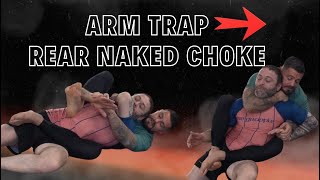 0:03Kieran Davern · KD Grapplingno-giif he pulls the hands down this allows me to pull my left hand inside here underneath, and then I do a wrist roll and I get my cross grip1:25Kieran Davern · KD Grapplingno-giwe lead with our heel, roll our foot inside, kick start the motorbike, and then lift our leg, our leg goes over our right leg, and then we're ready to start attacking
 2:47Energia Martial Artsno-githe cool thing about this cross grip is if he now tries to push the hand down it's pretty hard, because my elbow is on the floor, so there's a block here3:27Energia Martial Artsno-gimy foot comes in, I weave my leg, ballerina toes into his arm, into his wrist, and I'm going to flex my foot here, and only when I control this I'm going to extend the leg
 3:06Energia Martial Artsno-giinstead of moving my leg over his arm, I'm going to take his arm over my leg; nobody will voluntarily let me move their arm out of the way
 4:01Coach Brian · TeachMeGrapplingno-giI'm gonna make a little space and I want to come and get this under first; I want to get the one that's under first; if I can get that wrist this one's easy, roll your hand and now you have the position5:24Coach Brian · TeachMeGrapplingno-gionce my heel comes in it goes into the crook, so the one that's under is gonna chop down; now I can let it go and then I go two against one on this side
 1:46Coach Brian · TeachMeGrapplingno-giif he ever tries to peel that, I let him, I open up my hand and I use this hand as a blocking tool so that this hand cannot get to the choke arm2:27Coach Brian · TeachMeGrapplingno-gimy fingers are protected, I make a fist, I grab onto my hand and he's on my wrist; if he ever peels that one I go here, he tries to go fingers, he never can reach
 5:18Ethan Crelinsten · The B-Teamno-giyou get stuck about here, his chin's down; as you feel this happening you're going to start thinking arm switch, you tighten up your body triangle and you start to bridge; you want both of your bodies flat with the ceiling to get weight off your right hand9:06Ethan Crelinsten · The B-Teamno-githe idea is just to get him grabbing the wrong arm; I start strangling and legitimately threatening a strangle with my left, his hands go to my left, I pick him up and strangle with my right
 1:02Marcelo Garcia · BJJ Fanaticsno-giyou hold the person's hand, you not necessary to hold the wrist; I even like to hold his hand so he cannot really grab my wrist that easy; close the head and then whenever I see his neck a little bit open I go
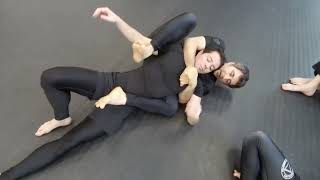 1:49Joao · Canary Wharf BJJno-gimy heel controls his arm pushing it away, my leg is going to be stronger than his arm, I'm going to peel this off and immediately come in here to get a choke
 1:02Mastermind Martial Artsno-giI'm grabbing the wrist in the hand, I'm throttling it out like a motorcycle, I'm going to bring it in and behind here and I want to put my chest on it; now I'm packing the seat belt with both arms trapped4:10Jordan · Jordan Teaches Jiujitsuno-giif they're gripping your wrist you can peel their grip off by lifting up on the side of their hand
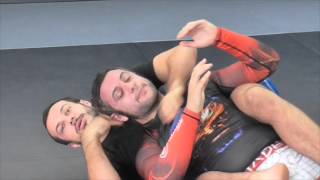 2:57Lachlan Giles · Absolute MMA St Kildano-githis is the hand that can choke, the one that goes around his neck, so I want to be covering that hand with my other hand; when he goes to remove my grips he has to remove the one that's over the top
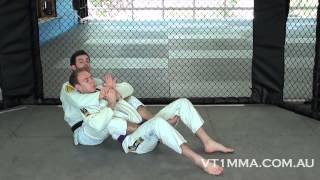 0:51VT1 Martial Artsgigi: I want to be controlling both his hands before he even thinks about grabbing my hands; snatch his hands; now I can start trapping his arm2:55VT1 Martial Artsgigi: I'm going to trap two hands with one; I press one on top and I bring the other hand over and I hook; I've only got two or three seconds where I've got both of his hands trapped and now I attack his neck straight away
 4:15Lincoln Brazilian Jiu-Jitsu Centergigi: I use the heel of my palm to scrape his hand off, grab my bicep and then I flip my hand behind his head
 1:28Nick Albin · Chewjitsuno-giyou want to fly under the radar with your grips, you don't want to bring the grips into play until it's time, because if I had my choking arm right here the whole time he knows where it is
- The short choke, the one-arm finish, the palm to palm and the finish over the jaw: the same arm, other endsreference onlya tap from the same arm by another lock, in MMA Leech's, Lachlan Giles's, Nick Albin's, the Energia coach's, Giancarlo Bodoni's, Craig Jones's, Ethan Crelinsten's, the Great Grappling coach's, Johnny's and Matt Arroyo's own words; their own ends
Leech, stalled by the hand pulling down, does not force the second hand: he controls his own hand and levers the forearm and elbow up behind the partner's back into the short choke, with the rear naked available after. Giles finishes with one arm off a grip on the back of the shoulder blade to prove the power is the elbow rowed back, and shows the punched fist working for the face choke where there is less room. Chewjitsu has a one-arm finish anchored on the shoulder, the other hand controlling the defending hand at its knife edge and pulling it into the partner's chest, the chin connected to the wrist; a one-handed choke off the traps as a handle; and a bear hug where he cuffs the shoulder and grabs his own wrist so the choking arm cannot be held. The Energia coach's straight jacket ends in a short choke by bringing the elbow toward his hip after the chin is over the hand. Bodoni, from the neck pummel, locks a figure four or goes palm to palm. Craig Jones strangles through a tucked chin, the mandible strangle, with the elbow deep on the centre line and both elbows brought to the pec with slow downward pressure. Crelinsten finishes over the jaw with less movement, the chin jamming the wrist lower and the arm shortened. The Great Grappling coach, in the gi, uses a gable grip behind the shoulder and moves the elbow behind the shoulder blade; Johnny, in the gi, chokes with one arm off the trapezius and with a short choke before the rear naked; Arroyo, in the gi, keeps the far lapel in the choking hand and adds a rear naked grip inside the elbow pit, a collar-dependent finish outside this document's options. synthesis None of these is played tonight: the finish over the jaw is a stop in this session, not a branch, and the short choke and the one-arm finishes are other nights' drills.
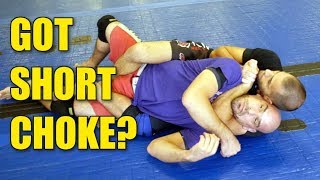 0:20MMA Leechno-giinstead of going for rear naked, because you're going to try to pull down again and I cannot even lock it, I can save myself by controlling my hand instead1:01MMA Leechno-gimy head keeps here next to your head, not allowing you to turn your head too much, working forearm behind your back, forearm wrist behind your back; usually if I get here, that's a choke already1:14Lachlan Giles · Absolute MMA St Kildano-gi99% of the power comes from me pulling my elbow back towards my hip or towards my shoulder; you should be able to finish him with one arm, simply grab their shoulder, pull your elbow back and hold3:43Lachlan Giles · Absolute MMA St Kildano-githis works really well for the face choke where there's less room; I'm around the jaw here and I punch to the neck and I still have room to reach and adjust and finish1:20Nick Albin · Chewjitsuno-gias soon as we touch they come up to grab and I can grab the arm; when you grab here you're grabbing right at the knife hand to have better control1:41Nick Albin · Chewjitsuno-giI pull it into his chest and then we cut the shoulder here; we have to have this depth on the arm; to finish we connect our chin to the wrist3:04Nick Albin · Chewjitsuno-giI'm grabbing my own wrist to secure the grip, so if he tries to grab my wrist back here he can't get a hold of it, he can't grab the actual choking arm anymore, and then put our head on the other side and squeeze
 6:07Nick Albin · Chewjitsuno-giI want to get my elbow underneath his chin like so, so that my forearm is on this carotid and the carotid on the other side is my bicep, and my hand can reach back here and grab a hold of his traps; a one-handed choke, or punch through4:27Energia Martial Artsno-giI'm going to dive underneath the chin, then I climb up, I grab my chin over my hand, weave it all the way behind his back, and then I'm going to do a short choke by bringing my elbow towards my right hip
 3:28Giancarlo Bodoni · Bernardo Faria BJJ Fanaticsno-gias I grip the chin I lifted it and I punched this hand through and that's what allowed me to go in and penetrate5:11Giancarlo Bodoni · Bernardo Faria BJJ Fanaticsno-gifrom here you can either go palm to palm
 0:40Craig Jones · BJJ Fanaticsno-giI always go as deep as I can, I'm trying to get my elbow as deep as his center line; I want to just bring both my elbows towards his pec and then I apply downwards pressure to get that submission2:03Craig Jones · BJJ Fanaticsno-giif we want to strangle them we want to use slow consistent pressure and we can strangle through the chin cleanly as long as we don't just go crazy on the squeeze24:51Ethan Crelinsten · The B-Teamno-giI'll move my chin out of the way and I'll push my wrist down with my chin; we push our wrist down, breathe, lock and then again we pull our elbow back and we look in the same direction as him1:28Great Grapplinggigi: I'm going to take that Gable grip again, no thumbs, both thumbs in, I'm going to clasp my hands together and it comes back here behind the back2:29Great Grapplinggigi: my fulcrum is that Gable grip on the far side; I can't let the Gable grip come in front of the shoulder; elbow behind the shoulder blade, there's no space for his neck
 1:04Johnny · Johnny Jitsugigi: I'm going to grab the back of the trapezius, keep my head tight controlling her head, then I'm going to pull my elbow back across her shoulder and get my one arm choke1:25Johnny · Johnny Jitsugigi: I'm just going to slide this one through, grip my hands together, keep my elbow tucked in tight, head tight, squeeze for my short choke
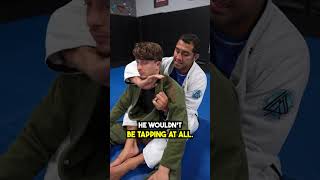 0:40Matt Arroyogigi: number two, go inside of the elbow pit, lift the arm up, and do a rear naked choke grip; to finish we just straighten both arms, so it's make a scissor
- The chin tucked and answered another way: the chin lifted, the neck pummelled, the wrist sawn, the nose, the eyesreference onlythe chin lifted or the neck opened by another route, in John Danaher's, Nick Albin's, Giancarlo Bodoni's, Coach Brian's, Kieran Davern's, Jordan's, the Thunderdome coach's, Ethan Crelinsten's, Brett's, Liam Resov's, the Lincoln coach's, Craig Jones's and Ramsey Dewey's own words; their own ends
The spine's coach gets under the chin by getting deep after the strip and does not teach the tucked chin apart. Danaher's answer is the thin edge: a flattened fist whose thumb knuckle goes in behind the ear and under the jaw where the wrist will not fit, then the fingers walked across, then the thumb, then the wrist, and the forearm follows. The other coaches lift the chin: Chewjitsu palms the chin up and in with the middle of the palm, or takes the control hand out for a chin strap; Bodoni pummels the neck, threatening one side so the chin tucks and the head turns, then lifting the chin and shooting the other hand under, and in the final gripped the chin itself as it was pulled across, lifted and punched through; Coach Brian, from Henner Gracie, saws the radial bone back and lifts the chin as he goes deeper, following it; Davern grabs the eyes, the nose or under the chin to lift the head; Jordan lifts the nose with the wrist and shoots under before the chin returns; the Thunderdome coach pulls the arm deep with the elbow in line with the chin and lifts the back of the head; Crelinsten lifts the face with the other bicep, not a nice movement, to get under the jaw; Brett pulls the tip of the chin into the arteries with the elbow kept down on the chest; Liam Resov, in the gi, attacks thumb down with the bicep and head pressed together; the Lincoln coach, in the gi, slides the hand out along the chest and flicks the wrist over. Craig Jones goes over the tucked chin with slow pressure; Ramsey Dewey chokes the chin and says plainly that it is a jaw crank and a strangle at once. synthesis The chin lift, the nose and the eyes are not played here, and the finish over the jaw is a stop: in the session a forearm on the jaw is opened and re-entered.
8:41John Danaher · Bernardo Faria BJJ Fanaticsno-giI isolate the smallest thinnest part of my hand and that thinnest part is going to be the knuckle of my thumb; I make a flattened fist, don't make a big thick clumsy fist that's even thicker than your wrist, it'll never get through9:03John Danaher · Bernardo Faria BJJ Fanaticsno-githe first point of contact is my thumb knuckle behind the ear, it digs in underneath the chin; once the thumb penetrates I go to the second thinnest part of my hand, my fingers; I extend my fingers and I finger walk across9:45John Danaher · Bernardo Faria BJJ Fanaticsno-gias I walk further and further across my wrist has penetrated; I started with the thinnest part, the thumb, and I graduated to the fingers and now I've gotten all the way to the wrist1:48Nick Albin · Chewjitsuno-gia lot of guys are going to have their chin tucked; I'll take my hand and literally take the middle of my palm right here, and palm the chin up and in5:26Nick Albin · Chewjitsuno-giwe're going to break all the rules and take our control arm out, our secondary hand, our short arm; I take this hand and I get a hold of the chin strap1:43Giancarlo Bodoni · Bernardo Faria BJJ Fanaticsno-giI start to threaten the neck one way, he tucks the chin, shrugs the shoulder, turns his head towards in the direction of the strangle, and then from here I go in and I start looking to lift the chin; as I shoot it across I pull and I lift, and then I shoot the other hand underneath4:51Giancarlo Bodoni · Bernardo Faria BJJ Fanaticsno-gias I started to pull the hand across, this hand pulled across and I grabbed the chin; once I have this grip on the chin I just curl my fingers in; we can lift and punch the hand through 0:00Coach Brian · TeachMeGrapplingno-giwhen he looks back I'm going to bring my wrist back, see how I saw my radial bone backward, I didn't give him the gap he was looking for; then I further lift his chin; as I lift his chin I go a little deeper6:05Coach Brian · TeachMeGrapplingno-giI turn my thumb down; I want to go trace the jawline thumb down and I want to sneak under the chin; if I get the chin right here I can grip and then I can pull my elbow back and get the tap1:21Kieran Davern · KD Grapplingno-giI look to get the bite on the rear naked choke; I grab the eyes, the nose, under the chin, and just look to lift the head, and then we can start to punch in our rear naked choke6:35Jordan · Jordan Teaches Jiujitsuno-gianother way I like to get underneath the chin is to lift up their nose with my wrist and shoot my hand underneath their neck before they can bring their chin back down
 0:00Thunderdome BJJno-gihe tucks his chin deep to defend; I get this hand behind the shoulder, I'm going to pull this really deep so my elbow is right in line with his chin, and instead of just squeezing down I'm trying to lift up on the back of his head
 0:23Thunderdome BJJno-giI just want to try to get a lift a little bit, get his chin up, so I want to get this straight up14:04Ethan Crelinsten · The B-Teamno-gimy right arm goes under my left and I start to walk to my elbow; I take my left bicep and I lift his face, it's not a very nice movement but it's very important to get under his jaw
 7:57Brett · Conceptual Jiu Jitsuno-giI'm going to reach deep, I can walk this hand across and then I'm going to start walking up his trap to where this elbow's still in front of his chin; what you don't want to do is lift your elbow up from his chest because now it's just going to crank his face8:17Brett · Conceptual Jiu Jitsuno-giI'm going to start pulling the tip of his chin into his carotid arteries; it's going to be the same choke, I'm just going to focus right at the tip of his chin, and if he moves it up for any reason then it just goes to a normal rear naked choke1:52VT1 Martial Artsgigi: don't attack like this, I want to attack with my thumb down, and as I attack here I press my bicep and my head together; thumb down, thumb up, look what it does to his chin0:28Lincoln Brazilian Jiu-Jitsu Centergigi: I'm gonna take my hand, turn it, come down and slide out my partner's chest until I hit their neck and then flick my wrist over; if my partner is tucking their chin this helps me to get under their chin0:20Craig Jones · BJJ Fanaticsno-giwhen he tucks his chin he is not actually protecting the carotid arteries; we can still find mechanics to finish that strangle
 1:45Ramsey Deweyno-giI'm being simultaneously strangled and jaw cranked2:25Ramsey Deweyno-githis is also a lever that we can use to move the head around; break the jaw, break the neck, things like that4:07Ramsey Deweyno-gituck your chin and I'm doing the one-armed version; if you've got no pressure to choke your opponent you've got enough pressure to dislocate their jaw and to strangle them at the same time
- Where the arm goes before it is under: the underhook side and the overhook side, the body triangle, the seatbelt that slips, the strangle caught in transitionreference onlythe strangle started from a side, a body triangle or a transition rather than from the seated control, in Giancarlo Bodoni's, Gordon Ryan's, Lachlan Giles's, Josh Saunders's, the South Boston coach's, Ethan Crelinsten's, the Energia coach's, Marcelo Garcia's, Joao's, Nick Albin's and Kieran Davern's own words; their own ends
Bodoni and Ryan prefer the underhook side, the old weak side, because the head covers the space the partner escapes into and the fist behind the ear posts so his head cannot reach the floor while the control arm comes out; Ryan drags his shoulders forward to the elbow instead of extracting it. Giles falls to the underhook side with the bottom elbow dropped to the ribs, gets up on his own elbow so the free hand can come from behind, and punches the fist into the neck as a block. Saunders keeps his head under the partner's on the underhook side; the South Boston coach, on the overhook side, keeps the head on the opposite side from the elbow and never lets it drop to the floor. Crelinsten holds the torso with a body triangle kept under tension across the floating rib, lengthens the strangle arm by putting the shoulder behind the ear and throwing the dart, and shortens it to finish. The Energia coach switches sides with the knee as a wedge and rarely uses two hooks where they score nothing; Garcia climbs back on top with the knee and hip when the seatbelt slips and takes the neck as soon as it opens; Joao moves the hooks to a foot on the hip to attack the weak side; Chewjitsu plays halfback with one hook, comes up on the elbow to pull the arm past the partner's reach, and catches the strangle in transition before both hooks are in; Davern props on the elbow with the shoulder stacked over it and brings the elbow through the centre line. synthesis The session starts seated with both hooks in and stays there; the sides, the body triangle and the transitions are other documents' doors.
2:26Giancarlo Bodonino-gifrom the overhook side it can be a little easier to finish the rear naked, versus on the underhook side it can be a little easier to trap the arm but a little bit harder to finish the rear naked8:15Giancarlo Bodonino-giwhen I first started training the underhook side was considered the weak side, but it's actually my preferred side to finish from, and a lot of really good back attackers historically prefer the underhook side5:51Giancarlo Bodonino-giI'm going to place my fist right behind his ear; now I can pull my head back, and when he tries to put his head on the floor he can't, because there's a post that starts on my fist and ends with my elbow on the mat1:03Gordon Ryanno-giwe prefer the underhook side, classically known as the weak side; the first thing is I take my head and cover the space he would escape his head and shoulders into, ear to ear4:51Gordon Ryanno-giinstead of pulling myself back to extract my elbow, I build up to my elbow and drag my shoulders forward towards my elbow, so that now I can pull my hand behind and use gravity to feed ourselves into a strangle 1:23Lachlan Giles · Bernardo Faria BJJ Fanaticsno-giwhen we fall to the underhook side my left arm is bottom arm, my elbow should drop to my ribs so that you can't fall into this space underneath me3:51Lachlan Giles · Bernardo Faria BJJ Fanaticsno-gionce I've got this position I actually get up on my elbow and sit forward, because now once I'm up like this he still can't fight this hand and my left hand can come from the back, which it couldn't do before2:20Lachlan Giles · Absolute MMA St Kildano-giinstead of going all the way behind the neck with the hand, which allows him to move across, I'm going to make a fist and punch the side of the neck, side and a little bit to the back4:44Josh Saundersno-giwhen I'm on the underhook side I always want to maintain my head underneath their head, because if I don't the likelihood they get their shoulders to the mat is quite high14:39South Boston BJJno-giin order for me to effectively strangle someone my head needs to always be on the opposite side of my elbow; it's easy to get lazy here and let your head drop to the floor2:50Ethan Crelinsten · The B-Teamno-giclosing my body triangle nice and tight across the guy's lower floating rib to his top far hip; just enough tension so that if he tries to pull his top hip forward he's going to run into my right shin9:28Ethan Crelinsten · The B-Teamno-giI need my left arm to be as long as possible, so I have to take a bit of an angle; I need that starting part of your arm to be right here behind his ear; you flick like you're throwing a dart, you flick your elbow and now your arm is much longer0:20Energia Martial Artsno-gihaving two hooks in, especially in nogi, if it scores points it's a good position, but if there are no points, if it's sub only, if it's MMA, I rarely use two hooks4:49Energia Martial Artsno-giI catch his shoulder's tricep and just keep his chest-back connection; from here I switch my hips and wedge him all the way over to this side2:29Marcelo Garcia · Marcelo Garcia Jiu-Jitsuno-giI have a seat belt but I'm off to the side, his back is not covered, the seat belt is not doing much it's supposed to do, so I have to get on top quick6:40Marcelo Garcia · Marcelo Garcia Jiu-Jitsuno-giafter you get on top and the person is in that mode, you see the neck open and just go forward0:42Joao · Canary Wharf BJJno-giI want to get the choke but I cannot because it's controlling here, so I'm going to move my hooks, putting one foot on his hip pushing him down, the other comes here
 3:22Nick Albin · Chewjitsuno-githe back mount is the chest to back connection, everything else is sort of arbitrary and secondary; you can have a body triangle, you can have hooks, I play half back a lot with one hook in one hook out4:04Nick Albin · Chewjitsuno-giI'm going to come up to my elbow, use my hips to extend, and I'm going to pull this arm past his reach; unless he has some superhuman grip to reach back, his arms aren't going all the way back there
 4:26Nick Albin · Chewjitsuno-gicatching chokes before you have the full two hooks seatbelt grip established; catching in the moment, catching in the transition as you're going to the back5:07Kieran Davern · KD Grapplingno-giI put weight on my left elbow and I think about coming forward with my head here and I stack my shoulder over my elbow; your shoulder joint should be over your elbow joint4:07Kieran Davern · KD Grapplingno-giour main focus is to try to bring our right elbow through the center line as deep as we can, because the further this elbow is away from the center line the less likely it is for us to get the finish
- His escape: what the partner will try, in the escape coaches' words and the finishers' warningsreference onlythe partner's script for the rounds; the escape itself is another document's
Arroyo, in the gi, does not get choked first: a baseball bat grip on the choking wrist with two arms against one, the elbow clamped on the bottom arm, then a fall to the underhook side, the bottom hook kicked out and the back scraped flat, because a back flat on the floor cannot be strangled and the choke points the way to the escape. Bodoni, from the bottom of a body triangle, pummels to double underhooks so there is no strangle, walks the shoulders higher than the top man's head and reaches over the shoulder to turn. Priit Mihkelson keeps the wrestler's posture, turning to face rather than putting the back on the mat first, controls the hooks with his legs, and says he is against protecting the choke with the hands as a rule: with a good position you need not react at first, and the hands come to help only if the arm gets deeper. Giles lists what goes wrong for the finisher: the hand peeled away, the head moved down toward the mat, the second hand intercepted, and a pushed head giving the peel. Saunders's partner jacks the shoulder up under the quad; Crelinsten's goes into turning escapes through the body triangle; Santos's takes the inside thumb; the South Boston coach's foot-locks crossed ankles below the hips. synthesis In the preparation blocks the partner fights only with the hands on the wrist; from the third block on he may peel any hand he can reach with the whole hand or the wrist, and a covered hand he peels is a failed rep; he never turns inside the hooks, never rolls and never bends a finger: the escapes above are the other document's, and a back lost is a reset here.
 0:20Matt Arroyogigi: first step before any escape thoughts come into your brain is do not get choked, protect your neck; how I'm going to do that is with a baseball grip1:24Matt Arroyogigi: step one, baseball bat grip on this hand, the choke hand, the one that's over your shoulder; step two, elbow clamp on the bottom arm; I don't want him to be able to get this arm out4:31Matt Arroyogigi: once my back is completely flat on the wall or the floor, the choke is gone; he can't get his arm around my neck anymore because the floor is in the way
 3:06Giancarlo Bodonino-giregardless of whether the seatbelt's on top or on bottom, what I want to do is turn this into a double underhook situation; it eliminates the threat of the submission7:56Giancarlo Bodonino-giI reach out and away from him, I hit a big reach over my left shoulder; once I get that angle with that bridge, when I turn my shoulders it's easier to get around the head
 0:29Priit Mihkelson · BJJ Globetrotters in Actionno-giusually only putting their backs on a mat, that's the most common way of escaping back; I'm against that, I think it's a wonderful escape but it also leads you where mostly they want7:25Priit Mihkelson · BJJ Globetrotters in Actionno-giI'm gonna control the hooks later, I'm gonna mess with their legs; if you do it this way they can lean on that, it's kind of dangerous, so you want to always turn around because the idea is they want to face them21:58Priit Mihkelson · BJJ Globetrotters in Actionno-giI'm actually against that word; you have to protect the choke all the time, not if you have a good position22:19Priit Mihkelson · BJJ Globetrotters in Actionno-giyou can be relaxed, and then if he gets deeper yes you have to come help, but at first you don't have to0:38Lachlan Giles · Absolute MMA St Kildano-giif he's able to peel this hand away I miss the choke, if he's able to move his head down towards the mat I don't get the choke, or if he's able to intercept this he gets to move his head across0:54Lachlan Giles · Absolute MMA St Kildano-giwhen I start trying to push the head like this, Steve can start peeling that arm off; you see this so often, they go for the choke, they push the head, and that happens11:16Josh Saundersno-githey'll try and jack their shoulder up on the left hand side up underneath your quad1:45Ethan Crelinsten · The B-Teamno-giguys these days are very good at turning escapes, belly down escapes where they go into rotations and they end up either in bottom mount or closed guard on top of you1:43Placido Santosno-githe reason this grip is so effective in stopping my strangle is because it stops both my wrist and my elbow17:07South Boston BJJno-giif my feet are above his hips he can't really foot lock me; when my feet are down here he can potentially foot lock me; if he ever locks his feet over my ankles I just release and I push his head
- The cooperative resets: the back lost, the hidden hand stripped, the forearm on the jaw, the head turned by the circle, the stallcooperative resetthe exact start, restarted
Five things end a rep in this session because no answer to them is qualified here. The back lost: he turns inside your arms or your hooks, or faces you; stop, both release, restart from the exact start. The covered hand peeled: a hand that was anchored behind his shoulder or in the goose neck and covered by your head, or your second hand once it was behind his head, is peeled off; the rep has failed: both release, restart, and note which hand it was for the check-first table. The chin tucked so hard the arm cannot get under it: the coach does not teach that apart; reset, never a finish on the jaw. The forearm on the jaw: the strangle lands across the jaw or the face instead of under the chin; open the hand and re-enter, never tighten, and if it happens twice in a rep restart. The head turned by the circle: the rotation bends his head sideways instead of taking your elbow over his shoulder; stop at once. The stall: ten seconds with nothing changing, his hands on the wrist and your fist waiting; restart rather than squeeze. synthesis The coach's route does not wait: the strip starts as the second hand arrives.
1:01South Boston BJJno-giwhen I unlock my hands I should be able to control him without locking; if he tries to turn to the right my elbow stops him, if he tries to turn to the left my forearm stops him5:09South Boston BJJno-githere needs to always be something covering my hand10:49John Danaher · Bernardo Faria BJJ Fanaticsno-giI never put my hand here on the shoulder where he can reach up and peel my hand; I want to hide my hand from his 1:44Nick Albin · Chewjitsuno-gi100 percent of the time in training I'm going to go underneath the neck, because if someone's chin's tucked it doesn't take a rocket doctor to take your forearm and just crank it across2:46Nick Albin · Chewjitsuno-giif I'm wrenching my partner's neck and jacking their neck up, they might not be able to train as hard tomorrow3:28Nick Albin · Chewjitsuno-giI have to value their safety as much as I do my own
— negate first
Threat map
Some of the clips on the left show the coach performing the attack; watch them once so you recognise it. The answer on the right is a spine step, a branch, or marked as synthesis.
- His hand peels the strangle hand off the shoulder
-
what they are doing
10:49John Danaher · Bernardo Faria BJJ Fanaticsno-giI never put my hand here on the shoulder where he can reach up and peel my hand0:38Lachlan Giles · Absolute MMA St Kildano-giif he's able to peel this hand away I miss the choke1:21Absolute MMA St Kildano-giif he tries to peel my hand away now it's a little too far; any shallower than that and he will be able to peel the arm off0:54Lachlan Giles · Absolute MMA St Kildano-githey go for the choke, they push the head, and that happensyour answer
Recognise it: your hand resting on the top of his shoulder or on his skull, a gap between your chest and his back, his hand climbing your forearm to the fingers. The coach's answer is that something covers the hand at every moment: the hand itself anchored behind his far shoulder or bent into the goose neck, then your head on it while your left hand keeps his stripped hand down, and only then the left hand released, lifted at the elbow and extracted over it, hand, wrist and bicep; in the reaction branches, where the left hand has already let go to punch or to jack a wrist, the left hand covers the strangle hand and the extraction follows from that cover; Danaher hides the hand behind the nape where it cannot be reached; Giles anchors the fingers on the back of the shoulder blade and never pushes the head; Bodoni hides the hand behind the shoulder with the chin covering the thumb. synthesis In the session a hand peeled after it was hidden is a failed rep and a reset, not a chase.
4:47South Boston BJJno-giif you have long arms you want to grab behind his shoulder and cover your hand always; if you have shorter hands we do what's called a goose neck10:49John Danaher · Bernardo Faria BJJ Fanaticsno-giI take my whole hand behind the nape of his neck here; there's no way he can make effective contact2:56Lachlan Giles · Absolute MMA St Kildano-gihook your fingers up; when Steve tries to remove my hand it's a really difficult spot for him to get to5:11Giancarlo Bodonino-ginice and tight behind his shoulder, and my chin covers my hand to prevent this hand from coming in and grabbing my thumb5:50South Boston BJJno-gimy hand covers my hand, then my wrist covers my wrist, then my bicep covers my hand, and so at no point did he have access to my hand - The second hand intercepted, or his head driven to the mat while it travels
-
what they are doing
11:13John Danaher · Bernardo Faria BJJ Fanaticsno-gia common mistake here is people grab their bicep; I've now exposed my hand to my opponent1:40Lachlan Giles · Absolute MMA St Kildano-giwhen I swim behind and I go to lock it up, if he starts to move his head at this point it can make it too hard to lock it up2:53Lincoln Brazilian Jiu-Jitsu Centergigi: one common mistake is people try to connect their hands, grab their bicep; if I do that he catches my hand and now I can't complete the choke3:28Giancarlo Bodonino-gias soon as they go to pull out the arm and bring the hand in, he puts the head on the floor and I lose ityour answer
Recognise it: the second hand reaching for the bicep in the open, his hand waiting for it, or his head dropping toward the mat as your control hand lets go. The coach's answer is the elbow lifted first and the hand extracted over his own hand, wrist and bicep, never stuck out; Danaher crosses the wrists, takes the elbow forward over the shoulder and passes the hand behind his head to his own shoulder; Giles punches a fist into the side and back of the neck first, a block the head cannot pass; Bodoni posts the fist behind the ear with the elbow on the mat; the Absolute lesson feeds the back of the hand behind the neck and brings the shoulder to it. synthesis In the session's free-neck path and its placement block the second hand travels only after the first is covered by the head, and in the reaction branches it travels from the hand cover, as steps 3 and 4 say; a partner whose head reaches the mat is not part of the drills.
5:50South Boston BJJno-githe way we avoid this is by lifting at the elbow, pulling hand over hand, wrist over hand, bicep over hand11:34John Danaher · Bernardo Faria BJJ Fanaticsno-giI can take my elbow forward over his shoulder and pass my hand across; I always want to put my hand on my own shoulder so that my hands are not exposed2:40Lachlan Giles · Absolute MMA St Kildano-giit's a physical block, so if he tries to put his head down towards the mat he can't; if you get it just past that side-on part, a little bit towards the back with good pressure, now it's going to be stuck6:12Giancarlo Bodonino-gimy entire forearm is now posted on the floor, so when he goes to put his head down it's super tough, and that gives me time to punch the hand through1:43Absolute MMA St Kildano-giI put the back of my hand just behind the neck, so my fingers behind the neck, I put my elbow forwards, and then the hand that was anchored to the shoulder reaches on to my bicep - He turns inside your arms and the back is lost
-
what they are doing
4:31John Danaher · Bernardo Faria BJJ Fanaticsno-giI don't have any ability to control Bernardo's rotation from here and so he could easily turn towards me0:20Marcelo Garcia · Marcelo Garcia Jiu-Jitsuno-giwhen the seat belt starts to become loose and off, then you have to adjust; if you start losing it and you just hold that position you're going to lose it5:38Ethan Crelinsten · The B-Teamno-giyou're taking all of your control connection to the mat out of this pocket of space right here where he can turn belly up and get his back to the mat5:34Matt Arroyogigi: his choke is going to show the way of your escape; the choke will point the way to the escapeyour answer
Recognise it: his shoulder turning into the space in front of your elbow, his back coming off your chest, his hips squaring to yours. The coach's answer comes first: the elbows covering his shoulders so that even with the hands unlocked the elbow stops one turn and the forearm the other; Danaher's is the same, one arm under and one over with an elbow in front of each shoulder, and the hooks doing the lower half; Garcia climbs back on top with the knee and hip before the seatbelt is gone; Crelinsten keeps the body triangle under tension so the top hip cannot go forward. synthesis In the session the partner does not turn inside the hooks, and a back lost is a reset.
4:51John Danaher · Bernardo Faria BJJ Fanaticsno-giif Bernardo rotates to our right my left hand will make it very difficult; I put my elbow in front of his shoulder; when he goes to rotate in the opposite direction it's very difficult18:34John Danaher · Bernardo Faria BJJ Fanaticsno-giyour lower body control is between two knees and your upper body control is between two elbows, and if you play both of those effectively I can't turn for anything1:01South Boston BJJno-giwhen I unlock my hands I should be able to control him without locking; if he tries to turn to the right my elbow stops him, if he tries to turn to the left my forearm stops him3:13Marcelo Garcia · Marcelo Garcia Jiu-Jitsuno-gimy knee posts, my hip is on it; I just put my foot on the first side to push up and I put my knee quick on the floor at the same time that I continue with the seatbelt3:13Ethan Crelinsten · The B-Teamno-giif you have no tension here and he starts to push that hip forward they're going to start to go into turning escapes - The forearm lands on the jaw and the strangle becomes a crank
-
what they are doing
0:24Nick Albin · Chewjitsuno-githe one that some of you may have seen during matches where they'll literally just take that forearm across the face and just wrench it back until the person taps1:04Ramsey Deweyno-githe jaw would have been dislocated and you still would have got choked7:57Brett · Conceptual Jiu Jitsuno-giwhat you don't want to do is lift your elbow up from his chest because now it's just going to crank his face, it's not going to be a blood chokeyour answer
Recognise it: the forearm across the mouth or the chin instead of under it, his face pulled sideways, pain rather than pressure. Danaher gets under the chin with the thumb knuckle before the wrist; Chewjitsu goes under the neck every time in training and says why; Craig Jones strangles through the chin only with the elbow deep and slow pressure; Brett keeps the elbow down on the chest. synthesis In the session a forearm on the jaw is opened and re-entered, never tightened, and a head bent by the circle is a stop.
9:03John Danaher · Bernardo Faria BJJ Fanaticsno-githe first point of contact is my thumb knuckle behind the ear, it digs in underneath the chin2:05Nick Albin · Chewjitsuno-githere's nothing more beautiful than hand fighting and getting grips and then getting that arm right up underneath, and you feel it slide all the way underneath the neck, the elbow perfectly underneath the chin2:03Craig Jones · BJJ Fanaticsno-giwe apply steady pressure and pressure down and we're gonna find a clean strangle despite mandible being in the way4:08Brett · Conceptual Jiu Jitsuno-giI want to make sure my elbow is in line with this chin; this is going to make sure that I get both carotids - Everything locked and the squeeze that burns out
-
what they are doing
13:44John Danaher · Bernardo Faria BJJ Fanaticsno-giif I just try to compress, go forward, strong strong strong, I can't strangle 0:42Mastermind Martial Artsno-giif the guy's tough, resilient, has a strong neck, he might be squeezing for a while and possibly burn your arms out3:28Brett · Conceptual Jiu Jitsuno-gia big problem that a lot of people have with their chokes is they start squeezing too early before they have a full lock on the choke, so they're squeezing to take space out of the choke7:16South Boston BJJno-giif I squeeze it requires big biceps which I don't have
your answer
Recognise it: your forearms burning, his hands holding the compression, nothing tightening. The coach rotates the elbow toward the hip and increases the pressure gradually; Danaher rotates the elbow over the shoulder so the back strangles, not the arms; Giles rows the elbow back to the hip; Brett walks both hands up to the shoulders to take out the slack before any squeeze; Crelinsten breathes in, shortens the arm and looks the same way his partner looks; the Mastermind coach inhales to expand the chest against his back. synthesis In the session the finish is the rotation toward the hip, gradual, and a rep that becomes a squeeze is restarted.
6:55South Boston BJJno-giI want to focus on rotating my elbow towards my hip so I can apply what's called rotational force16:10John Danaher · Bernardo Faria BJJ Fanaticsno-giI rotate my elbow in a circle so I can employ the strength of my back to strangle, rather than just squeezing with my arms and exhausting myself4:20Lachlan Giles · Absolute MMA St Kildano-giif you just put your forearm into the neck it'll cut off their arteries and they'll tap, and they'll tap because of the artery, not because they're not breathing7:38South Boston BJJno-giwe never squeeze super hard, we start gradually and we increase our pressure so that we don't blow out our arms3:07Brett · Conceptual Jiu Jitsuno-giif I walk my fingers further this way and up this hole gets smaller; if I take this top arm and I start walking this across here it pretty much eliminates this space23:28Ethan Crelinsten · The B-Teamno-gitake a deep breath so your lungs are filled, it's going to take up more space in your rib cage behind his back, and now you start to turn down towards the mat; I'm shortening my right arm1:02Mastermind Martial Artsno-gitake a big inhale of air; it expands my chest and creates like a pocket that sucks his body
— 20 minutes · no-gi
Tonight
synthesis The session is the author's; the mechanics are the South Boston coach's, from one exact start with his two hands on your right wrist from the first second. The first two blocks are isolated preparation and are labelled as such: kneeling behind him seated, as the coach teaches the mechanics, the first takes the seatbelt and the three strips and the second is a placement drill in which he pulls but does not peel a hand once your head is on it, so that the order of the releases can be learned and the figure four counted three seconds. The third block and the rounds begin from the queue's start, seated behind him with both hooks in and the same two hands on the wrist, and from there on his hands are free to peel anything they can reach with the whole hand or the wrist; in the third block he gives the three situations in turn, the free neck, the wrist caught and the hand caught, while the route runs to the tap, and in the rounds he chooses. One orientation tonight, the right arm strangling; the mirror is another night. A hand he peels after it was covered is a failed rep, both release and reset; a chin tucked so hard that the arm cannot get under it is a reset, not a jaw finish, because the coach does not teach the tucked chin apart. He never turns inside the hooks, never rolls, never bends a finger and attacks nothing. The strangle comes on gradually and the tap ends everything at once.
safety · stop here
The strangle is applied slowly and released at once: Danaher says the blood supply cut produces unconsciousness in five to ten seconds, so nobody holds a locked strangle to test it and the partner taps at the first pressure, with a hand on the arm or the mat, a foot when both hands are busy, or a word. The forearm goes under the chin and across the front of the throat; a forearm that lands on the jaw is outside tonight's under-chin target and is opened and re-entered, not tightened. The strips are grip breaks at the pinky line, the thumb line and the elbow, never finger pulls; a finger bent back is a stop. The finish is the elbow rotated toward the hip; a head bent sideways or a jaw wrenched by it is a stop. The hooks stay uncrossed below his hips and no leg attacks are played from the back. A neck that complains, a light head or a partner who cannot answer stops the session.
- The tap, physical or spoken. Release every grip at once
- The forearm across the jaw or the face. Open the hand and re-enter, never tighten
- A finger bent back in a strip. Release the hand, restart
- The head turned or bent sideways by the rotation. Stop the rotation, release
- A light head, a strangle held after the tap, or a partner who does not answer. Everything stops; the session ends
- The back lost, he turns inside your hooks or faces you. Stop, restart from the exact start
- 1
Preparation, kneeling: the seatbelt and the three strips
5 minOne orientation tonight, the coach's: the right arm strangles and the left hand strips. This block and the next are isolated preparation, kneeling behind him seated as the coach teaches the mechanics; the full route starts seated with the hooks in the third block. From the preparation start, at half speed, he gives the three defences in turn, one per rep: the plain grip, the hand turned down, and both defended. Say the strip as you make it: top hand; pinky line, peel, punch across, his hand down; or thumb line, peel, punch away and up; or screwdriver, lift and pull. End every rep with the arm deep and his hand held down, release everything, reset. Alternate one rep each, as many as fit in the five minutes; quality, not a count.
1:42South Boston BJJno-giI roll my pinky up so that I can expose his pinky line; I dig my fingers right underneath, I peel and strip; as soon as I strip I get in the habit of punching my arm across and punching his hand down3:04South Boston BJJno-giafter I strip the grip I'm pulling it down to his belly so that he only has one hand to defend, and I can easily access his neck as deep as I can - 2
Preparation, kneeling: the hand covered and the extraction, the lock counted (a placement drill)
5 minThis block is a placement drill and is labelled as one: he keeps two hands on the arm and pulls, but he does not peel the hand once your head is on it, so that the order of the releases can be learned. The preparation start and any one of the strips, then the block's emphasis: the right hand behind his far shoulder or the goose neck; your left hand still holding his stripped hand down; your head down on the strangle hand; only then the left hand let go, the left elbow lifted and the left hand out over your own hand, wrist over hand, bicep over hand, behind his head to your own shoulder; the right hand on the left bicep. Hold three seconds while he pulls, without squeezing. Release, reset, alternate one rep each for the five minutes.
5:09South Boston BJJno-githere needs to always be something covering my hand; once I cover my hand with my own head I'm now going to pull my elbow up and then extract my hand5:29South Boston BJJno-gimy hand covers my hand, then my wrist covers my wrist, then my bicep covers my hand, and so at no point did he have access to my hand - 3
The full route, seated with the hooks: the three situations and the finish to the tap
5 minFrom the exact start, seated with both hooks in, the whole route at half speed, and now his hands are free to do anything with the grip: after the strip he does nothing, or catches the wrist, or catches the hand, one per rep in turn, and from here on he may peel any hand he can reach with the whole hand or the wrist, never the fingers. You answer with the route: the free neck gets the deep arm, the head on the hand and the extraction; the wrist caught gets the finger walk to the centre line, the punch away and the cover; the hand caught gets his other wrist jacked above the chest line, the strip and the punch inside. Then the lock, and the finish the coach describes, the right elbow rotated toward your hip with the chest out, gradual, until he taps, and every grip open at once. A hand he peels after it was covered ends the rep. Alternate one rep each for the five minutes; the hooks stay in and nobody lies down.
9:02South Boston BJJno-giI walk my fingers across his body; I don't try to walk up because his force is pulling me down; I walk as far as I need to get my elbow directly in this line of his nose6:55South Boston BJJno-giwe don't just want to squeeze; I want to focus on rotating my elbow towards my hip so I can apply what's called rotational force - 4
Positional rounds, seated with the hooks
5 minFive one-minute rounds seated with both hooks in, alternating who has the back. He fights with his hands from the list: two hands on the wrist, the hand turned down, the wrist caught, the hand caught, and any hand he can reach peeled by the whole hand or the wrist, at half effort; he never turns inside the hooks, never rolls and never bends a finger. You play the route only: the strip, the arm deep, then the head on the hand and the extraction when his hands stay off, or the branch's own punch, cover and extraction when he catches the wrist or the hand, then the lock and the rotation, slowly, to the tap. A hand fight the route cannot answer is a reset, not a struggle, and a covered hand he peels is a failed rep, counted as such.
— after the round
Check first
synthesis The author's table. Outcomes have more than one cause; check these in order.
| It happened | Check first |
|---|---|
| He took your hand before you did anything | In order, and no one of them is proved by the result: first the cover, whether your left hand was over your right fist at the sternum before his hands arrived, or the fist was open where he could find it; then the elbows, whether they covered his shoulders; then the hooks or the seat, whether you were square behind him or already turned. |
| The strip would not come | First the grip: were you on his pinky line with the pinky rolled up, or pulling at his fingers? Then the match: did he turn the hand down, which asks for the thumb line and the punch away and up, or defend both, which asks for the screwdriver? Then the order: the strip, the punch across and his hand down to the belly, or the punch before the strip? |
| The arm went round and he peeled the hand off | First the cover: behind his far shoulder or in the goose neck, with your head on it before your left hand let go of his stripped hand on the free-neck path, or with your left hand on it in the wrist and hand branches, or left on top of his shoulder uncovered? Then the extraction: hand over hand, wrist over hand, bicep over hand with the elbow lifted, or the left hand stuck out where he found it? Then the repeat: did you cover again and repeat, or chase the hand? |
| He caught the wrist and everything stopped | First the walk: across his body toward the far shoulder, or up against his pull? Then the elbow: on his centre line, in line with his nose, before the switch? Then the switch: the left hand punching his hand away over the top as the right went deeper, and the cover at once? |
| He caught the hand itself and nothing moved | First the release: did you let go of his primary hand and take his other wrist? Then the height: were his hands jacked above the chest line, above the nipples, or left at his centre where the primary hand works? Then the punch: inside, and again, until both hands locked with the fingertips on your shoulders? |
| Everything was locked and it never tightened | First the method: the right elbow rotated toward your hip with the chest out, or a straight squeeze with the arms? Then the entry: was the forearm under the chin, or across the jaw, which is outside tonight's under-chin target and is released and re-entered? Then the pressure: gradual, or fast onto a tucked jaw, which loses the move? |
| The rep became a hold | His hands on the wrist, your fist covered, nothing moving. The coach's route does not wait: the strip starts the moment the second hand arrives, and the session's rule is a reset after ten seconds of a stall; a chin tucked so hard the arm cannot get under it is a reset too, and the arm trap with the leg, which he calls the bonus, is a reference, not tonight's answer. |
— the other doors · keep for later
Reference
Everything else read for this situation, grouped by door: the hand fight, the entry under the chin, the hidden hands and the finish from the no-gi coaches, and the gi clips and the talk kept for their principles, cued as such.
The hand fight, the entry and the finish, from the no-gi coachesthe rear naked strangle and its neighbours, no-gi unless a cue says gi
- John Danaher, on Faria's channel.
The strangle mechanics against a tucked chin, taught kneeling behind a seated Faria: the control of one arm under and one over with an elbow in front of each shoulder, the thin edge of the thumb knuckle where the wrist will not fit, the hand hidden behind the nape, the wrists crossed and the second hand passed behind the head to his own shoulder and locked by the chin, and the rotational finish over the shoulder shown through two hands on the wrist after the lock; the principles summarised at 14:25 to 16:51 and the rep with the hooks in at 18:36 to 19:16 performed by Faria under his count (B3, B4, and the threat map); checks on the hidden hand and the finish, no step.
4:51John Danaher · Bernardo Faria BJJ Fanaticsno-githe way we do this is by putting one arm under and one arm over; if Bernardo rotates to our right my left hand will make it very difficult; I put my elbow in front of his shoulder11:54John Danaher · Bernardo Faria BJJ Fanaticsno-gito actually finish the strangle I use a rotational method where I take my right elbow over my training partner's right shoulder and as a result we get a very powerful strangle18:34John Danaher · Bernardo Faria BJJ Fanaticsno-giif you sit down behind me and put two hooks in, your lower body control is between two knees and your upper body control is between two elbows, and if you play both of those effectively I can't turn for anything14:25John Danaher · Bernardo Faria BJJ Fanaticsno-gito strangle someone who's got good defensive arms, that's a trick, and the idea of using the power of rotation to go through your opponent's defensive hands is very important15:07John Danaher · Bernardo Faria BJJ Fanaticsno-gijust as a knife has a very thin edge which separates first until the thick spine can follow and you can cut an object in half, but you could never do it in the reverse order15:28John Danaher · Bernardo Faria BJJ Fanaticsno-giwe use the very thin but quite robust thumb knuckle to first penetrate underneath the jaw line, then we extend fingers, then we get the whole thumb - Lachlan Giles.
Five clips: the one-arm finish and the elbow rowed back, the shoulder-blade anchor, the second hand snaked close to the body and the shoulders grabbed rather than the elbows; the choking hand covered and the arms pulled back rather than the head pushed; the fist punched into the neck as a block and the face choke; the underhook side with the elbow to the ribs and the dig from the outside of the chin; and the seatbelt as the control that starts the choke while switching to the armbar (B1, B2, B4, B5); checks on the anchor and the second hand, no step.
2:15Lachlan Giles · Absolute MMA St Kildano-giwhile my hands are connected I just walk my elbows back, back, back, and I want to get my right elbow over the top of his shoulder, and I want to get my head next to his head as well, because this stops him turning away5:01Lachlan Giles · Absolute MMA St Kildano-giI take my other hand out and I want to keep it close to my body and snake it behind, because if I try to reach behind his head and he intercepts that hand it's going to be hard for me to finish5:21Lachlan Giles · Absolute MMA St Kildano-giI grab my shoulder, so I'm pretty much grabbing both my shoulders here; try and reach for the shoulders, not the elbows, elbows are looser5:20Lachlan Giles · Absolute MMA St Kildano-giI'm going to take my left hand all the way through under the chin, I'm going to grab the back of the shoulder here, I'm going to take my right hand out so I can grab7:32Lachlan Giles · Absolute MMA St Kildano-githe power of the choke doesn't come from pushing the head, it comes from pulling my arms back towards me2:00Lachlan Giles · Absolute MMA St Kildano-gifirst off I want to bring my hand as far behind the shoulder as possible, so it's helping to pull his head across, almost like a hook to prevent his head going down towards the mat, and I'm going to use my head next to his head3:22Lachlan Giles · Absolute MMA St Kildano-giwith this angle now I bring my elbow over the arm and that will give me plenty of room to connect my hand, and then the last bit is to slide my hand through all the way behind, and we can finish2:25Lachlan Giles · Bernardo Faria BJJ Fanaticsno-giI need to dig with my hand like this, with my thumb coming from the outside of the chin, pressuring tight, my head's counter-pressure against that, and I slide it through until I get all the way4:13Lachlan Giles · Bernardo Faria BJJ Fanaticsno-giI basically put my fist in the neck and then I bring my elbow over the top so that my hand can connect; now my right hand connects to my bicep, top of the shoulder, lifts and can shoot through 1:18Lachlan Giles · Absolute MMA St Kildano-giI want one hand underneath the arm and the other one over the top around the neck; this stops him being able to turn to this side, and this arm being around the neck can start the choke7:20Lachlan Giles · Absolute MMA St Kildano-giwe come behind the shoulder, we pull up like that, I'm holding him in place while I change my hands and take a seatbelt again, and from there you can get straight into your choke
 - Giancarlo Bodoni.
Five clips: the primary defensive hand and top hand position, the constant threat that keeps the back; the fist behind the ear as a post on the underhook side; the overhook-side strip, finger walk and both hands punched through together with a rotation after; the neck pummel and the chin gripped, from the ADCC final, on Faria's channel; and his body triangle escape, the partner's script (B1, B3, B4, B5); checks on the hidden hand and the hand fight, no step.
2:04Giancarlo Bodonino-giif you can keep a constant threat of your opponent's neck you will have a much higher success rate on not only keeping the back but finishing from the back7:31Giancarlo Bodonino-giat some point we have to start using this pattern to start trapping one of my opponent's arms with our legs, and this is how we create those one versus none situations7:13Giancarlo Bodonino-giI keep that secondary hand control and I start digging my hand under the chin, I get it nice and deep, and now I have my hand covered by my chin, I'm ready to finish this guy2:09Giancarlo Bodonino-gionce my fingers are behind his shoulder we just walk, walk, and we bring it behind the neck, and we'll just cover our own thumb with our chin2:49Giancarlo Bodonino-gidon't try to go to one and then leave this hand underneath; I cover and I punch both hands through, and after we have to start a rotation2:25Giancarlo Bodoni · Bernardo Faria BJJ Fanaticsno-giI would pull the neck across, lift my elbow and try to create space to get the hand underneath the jaw; going back and forth with this a couple of times, a lot of times you can go in and you can actually penetrate underneath the neck4:27Giancarlo Bodonino-giat the very least I want to take my two thumbs, put them inside of his hands, and start looking to shimmy my body and the lock of his hands down low; the lower the lock, the more I can access his thumb and split hands - Nick Albin (Chewjitsu).
Five no-gi clips and a talk: the halfback with the choking hand hidden and the chin palmed up; the depth of the elbow and the hand to the far shoulder, the knife hand, the strangle caught in transition; three variations including the one-arm finish anchored on the shoulder with the defending hand controlled, and the bear hug; the chin strap with the control hand and the traps as a handle against a big partner; the transition chokes before the hooks; and the talk on face cranks against a tucked chin, the session's safety line (B1, B2, B3, B4, B6).
2:09Nick Albin · Chewjitsuno-githen we take this hand and shoot it through, and notice how I did that, I really go through with my elbow and get to the position, and I can go for my rear naked choke3:56Nick Albin · Chewjitsuno-gia lot of people try to go under with this forearm; if the person's chin is down this is not going to work; take your thumb, pull it out and saw that sucker in, even if it's not quite there1:40Nick Albin · Chewjitsuno-githe issue is we're straight on the front, we don't have this carotid cut off and he can easily come up to defend; you really want to think about shooting your elbow forward here and almost reaching out with your lat2:00Nick Albin · Chewjitsuno-giwith the depth I can get back here and grab his shoulder and trap, so if Adam tries to reach back and defend it's very easy for me to block0:40Nick Albin · Chewjitsuno-giif I punch and I get my elbow through, my hand can get all the way back here and secure on the shoulder, which makes it a lot harder for him to grab1:00Nick Albin · Chewjitsuno-gidon't do like the Macarena with your hand to try to bring it out; go palm over top of the knuckles and slide it right into position, or push the head and take your elbow over top5:46Nick Albin · Chewjitsuno-gilook at where my elbow is, this is where a lot of people mess up, they get here and stop and try to finish here; if someone gets into your hand and pulls your hand down, you're probably not going deep enough8:10Nick Albin · Chewjitsuno-ginotice how my left pec is almost facing the ceiling here; this is going to allow me to engage my lat and get this strong squeeze; get that arm all the way through2:23Nick Albin · Chewjitsuno-gimy percentage rate with a transitional rear naked choke is so much higher, and I think it's because a lot of times people aren't thinking about the neck, they're still thinking about the position with the hooks5:11Nick Albin · Chewjitsuno-gieven if he was big and strong with a big old thick neck and I couldn't face crank him, when I got underneath of his neck that was it; all the muscle in the world is not going to help you when I get that arm around - Gordon Ryan.
The underhook side preferred, the cross wrist grips glued to the partner's torso, the leg over the wrist to a one versus none, and the shoulders dragged to the elbow rather than the elbow extracted (B1, B4).
0:20Gordon Ryanno-giwe have the overhook side where my hand is over our partner's shoulder; that makes it easier for us to lock a figure four and go in and start strangling, but it will make it harder for me to start reliably trapping hands4:30Gordon Ryanno-giif I try taking my elbow out and pulling my elbow in this direction, now my ear's not connected to his ear, so he can take his shoulders out and you lose the whole thing; don't make the mistake of extracting your elbow - Ethan Crelinsten (The B-Team).
The arm switch: threaten with one arm, bridge until the caught hand is weightless, replace it with the other; the fingers anchored on the rashguard, a fabric grip, where the anchor without one is the back of the neck or the shoulder blade as Giles and Bodoni take it; the body triangle under tension; the shoulder behind the ear and the dart thrown to lengthen the arm; the lock behind the skull; the breath, the arm shortened and the eyes aligned with the partner's to finish, under or over the jaw (B1, B2, B4, B5).
4:36Ethan Crelinsten · The B-Teamno-gionce I have my fingers far enough behind his neck I anchor them on his rashguard and I glue my chin and my chest over my hand7:02Ethan Crelinsten · The B-Teamno-giI take my left out of the way and in one motion I move my head with my hand over to this side; grab your elbow with your left hand, rest your head on his, extract your left hand, push the shoulder and then get your hands in21:42Ethan Crelinsten · The B-Teamno-giyou want to get your arm as long as possible so you can lock here behind his head; you put your knuckles, your secondary arm, here behind his head, behind his skull24:11Ethan Crelinsten · The B-Teamno-giyou want to breathe and look forward, you relock your body triangle and see how I'm pulling my right arm back, I'm shortening my right arm - Placido Santos.
A class without the straight jacket: the inside thumb named, the pinky knuckle and the thumb stripped, the tricep anchor reached by a spider walk, the hand defended as it advances, wrist over wrist with the knuckles on the back of the head, and the grip that loses its strength on the near shoulder, a release he teaches seated and on the underhook side, where nothing stops the elbow retracting, and says the mat blocks on the overhook side (B1, B5).
9:21Placido Santosno-giwhen I grab this tricep and he tries to reach with that hand it's out of the question; when I'm on the trap he can reach that hand, so now it's two of his hands versus one of mine10:25Placido Santosno-giI take my thumb, strip inside his knuckles, and then I come back and I defend my hand; so as my hand advances he tries to go back to my hand, I defend my hand, and my hand keeps advancing13:32Placido Santosno-githis inside thumb grip is very strong from the center line off to the far shoulder, but the grip starts to lose a lot of strength on the near shoulder, so all I do is retract and the grip comes off16:00Placido Santosno-giworks really well when we are on the underhook side; there's nothing inhibiting my right elbow, so as I strip and he grabs my inside thumb I can pull back and go right back for my attack; that's not true if we are on the overhook side16:21Placido Santosno-giwhat I just taught you of retracting your elbow, you can't retract your elbow; the mat is physically in my way - Josh Saunders.
Back control from the ground up: the secondary hand over the primary, the hand tucked under the chin, the head under his on the underhook side, the arm trapped below the sternum, the knuckles rotated to break a grip, the thumb wedged where the jaw meets the neck, and a rolling shoulder-to-shoulder finish rather than a squeeze at the bicep (B1, B3, B4, B5).
2:02Josh Saundersno-giif I tuck my hand underneath my chin here, now when he goes searching, it's going to be extremely difficult to reach this hand8:30Josh Saundersno-gionce I've got my wrist bone underneath his neck I'm in a very good position to start to strangle; I use my head to turn his head in and make this gap a little bigger as I put my hand behind his shoulder8:50Josh Saundersno-giwiden my elbow, prop up, throw my secondary hand in behind; I'm going to go shoulder to shoulder; most people go down at the bicep and start to squeeze, but it's a rolling of my elbow down into his chest - Kieran Davern (KD Grappling).
Two classes: three arm traps from top hand position, the thumb rotated to free the hand, the eyes, nose and chin lifted; and the cross grip by wrist roll, the calf on the elbow, the motorbike, the elbow through the centre line, the shoulder stacked over the elbow, the thumb knuckle behind the ear and the chin on the hand (B1, B3, B4).
1:00Kieran Davern · KD Grapplingno-gia little trick here for freeing your hand: I'm going to rotate my thumb up towards the ceiling and then I just slide my hand out here2:48Kieran Davern · KD Grapplingno-giif she brings the hand outside we have an arm trap; I pull her hand up toward my hip, flaring my knee to create space, and I pull the hand up towards the shoulder blade4:27Kieran Davern · KD Grapplingno-giI'm looking to bring my chin in front of his shoulder and I start to lift the palm of my hand inside, and then we can go into our finish5:28Kieran Davern · KD Grapplingno-giI'm going to start to get my elbow in good position by walking my elbow up and walking my hand as deep as I can6:30Kieran Davern · KD Grapplingno-giwe take weight off our left elbow so we can take out the second hand, lock it up and finish - Jordan (Jordan Teaches Jiujitsu).
A narrated system: the straight jacket to trap both arms with the hooks, the feet crossed above the hips with a warning, the wrist grip peeled by lifting the side of the hand, the thumb under the chin, the nose lifted, the hand behind the head as the bicep is gripped, and the modern rotation of the elbow (B1, B3).
2:25Jordan · Jordan Teaches Jiujitsuno-giyou grip their top arm with your bottom arm and their bottom arm with your top arm; using your bottom arm you pass off their top arm to your top hook3:27Jordan · Jordan Teaches Jiujitsuno-giyou can cross your feet, which is my preferred method of control; you just have to be careful not to cross your feet in the middle below your opponent's hips6:35Jordan · Jordan Teaches Jiujitsuno-gionce you're under the chin you can take your underarm out and slide the hand behind their head as you grip your bicep; to make the transition of your grip safer you can bring your opponent to the other side first - Marcelo Garcia, on his channel and on BJJ Fanatics.
The seatbelt that slips and the climb back on top; the neck taken as soon as it opens; the second hand walked in like a tightrope; and, from double wrist control, the hand held rather than the wrist, the finger dug on the shoulder blade, and the second hand connected quickly because the defending hand is coming (B1, B4).
5:37Marcelo Garcia · Marcelo Garcia Jiu-Jitsuno-githe most important is to be sure that he cannot come up, I need to keep working pressure on this shoulder, don't let the shoulder come up6:18Marcelo Garcia · Marcelo Garcia Jiu-Jitsuno-giI don't really need this seatbelt, I have his neck; as long as his back doesn't go on the mat I'll be good3:05Marcelo Garcia · BJJ Fanaticsno-gias soon as my hand makes sure his neck, I have my finger dug right on his shoulder blade and I make sure he's not pulling my underhook; I release, I know the hand's gonna come, so I bring the hand at the same time, that's quick4:08Marcelo Garcia · BJJ Fanaticsno-giI'm not in a rush and I'm controlling the time; I know he's resisting; I released, he stops fighting that one - Craig Jones, on BJJ Fanatics and at Energia.
The mandible strangle through a tucked chin with the elbow deep and slow pressure; and a guest clip that is an arm triangle escape from the bottom, not the back, read and set aside: its one principle, that the direction of the trapped thumb decides whether the bottom man can turn, is not used here (B2, B3).
1:01Craig Jones · BJJ Fanaticsno-giinstead of thinking of pulling two elbows to my body I want to just bring both my elbows towards his pec and then I apply downwards pressure to get that submission 0:20Craig Jones · Energia Martial Artsno-giI have a theory about all arm-in chokes, and that is that basically it's the direction of the thumb that's going to determine whether they complete the choke or we have enough space to breathe
 - The Energia coach.
Two clips crediting Danaher and Musumeci: the straight jacket with the cross grip, the elbow posted as a block, the leg woven over the wrist, the knuckle and pinky grip on the second hand, the short choke and the fist on the back; and the flared arm passed over the leg with a side switch into a body triangle (B1, B2, B4).
1:46Energia Martial Artsno-giusually the stronger hand to defend the choking hand is the cross side, so this hand, if he blocks the choke from coming in, is way stronger as opposed to the other hand4:48Energia Martial Artsno-giwhat I really like to do here is put the fist on the back, so if he tries to get his shoulders to the mat he's stuck, and then punch through to get the choke5:30Energia Martial Artsno-ginow the arm is really stuck, which gives me a two-on-one on this arm, and then I'm going to extend this one away and start looking for my strangle here; I really like to cup his shoulder and put my chin underneath - Coach Brian (TeachMeGrappling).
Three clips, two of them his own interpretation of Ryan's straight jacket seen at ADCC, which he says he has not studied on video, with Henner Gracie's wrist saw and lift, and the one-on-one hand fight: the choke arm covered thumb down, the hand opened as a blocker, the crawl to the shoulder with the fingers protected, and the head slipped back to make a gap behind the head for the second hand (B1, B3).
2:19Coach Brian · TeachMeGrapplingno-giI have not digested his techniques on video so I may screw it up a little bit; I kind of just see basically what he's doing7:07Coach Brian · TeachMeGrapplingno-giI'm gonna bring my wrist back, I saw my radial bone backward, I didn't give him the gap he was looking for; then I further lift his chin; as I lift his chin I go a little deeper, I follow his chin0:41Coach Brian · TeachMeGrapplingno-giyou saw a lot of Gordon Ryan going like this, trying to get under the chin right here, tracing along the jaw and getting to there; once you get the grip it's all over, pull that elbow back much like a gi choke1:04Coach Brian · TeachMeGrapplingno-giseatbelt goes like this, left hand grabs right hand, I cover the choke arm like this; I don't use a palm to palm, I do it like this with my thumb down9:33Coach Brian · TeachMeGrapplingno-gimy head goes back as if I'm throwing a punch and I avoid my own punch and then I'm right there10:14Coach Brian · TeachMeGrapplingno-gijust slip your head back, touch the top of the head, make a gap behind the head10:34Coach Brian · TeachMeGrapplingno-gimake a gigantic gap, we go all the way back, put your hand behind; put the hand all the way in, look at how deep you are - The gyms: the Absolute MMA beginners' lesson, the Serafin coach, Brett of Conceptual Jiu Jitsu, Joao of Canary Wharf, the Mastermind coach, the Thunderdome coach, Ramsey Dewey, Priit Mihkelson and MMA Leech.
The beginners' lesson with the thumb from the outside, the scapula anchor, the back of the hand behind the neck and the rowing finish; Serafin's wrist lock and gable grip; Brett's slack taken out and the head bent by the shoulder; Joao's weak-side attack from a foot on the hip; the Mastermind inhale and the wrist twisted behind the back; Thunderdome's lift; Dewey's choke on the chin, named here as the crank it is; Mihkelson's wrestler's posture, the partner's script; Leech's short choke when stalled (B1, B2, B3, B4, B5).
4:18Absolute MMA St Kildano-gicommon mistakes: not having the head connected, which allows his head to move out to the side; the arm being too shallow, you really need to make sure this arm gets very deep behind that shoulder blade before you start working for your second hand5:42Absolute MMA St Kildano-giwhen you grip onto your hand, it is not here but over past this corner where I can actually grip the back of my tricep; if you just grip here this will slip1:20Serafin BJJno-githis bottom arm I'm gonna come over and I'm gonna grab the same side wrist; I'm keeping my elbows pinched the whole time, and then I slide my left hand to my right hand and I'm just going to do a little wrist lock1:43Brett · Conceptual Jiu Jitsuno-giI'm going to reach through and I'm going to grab his trap; a big mistake that a lot of people make is they try to let go of this as they feed this hand behind; I can feed this arm behind his head and I still have a hold of his trap5:51Brett · Conceptual Jiu Jitsuno-giI'm going to use my shoulder and my head to drive John's chin down to his chest; if I push John's head forward it's going to drive his carotids into the choke1:26Joao · Canary Wharf BJJno-gibottom hand always controls the top hand; I need to protect as much as I can my choking arm, I control here, head close to him and I move him to the side of my underhook, my weak side, foot on his hip pushing1:43Mastermind Martial Artsno-giI'm pulling him into me, I'm making him become a part of my body which makes it a lot more powerful than just two arms on the neck3:27Mastermind Martial Artsno-giI just twist it a little bit, I'm not doing a wrist lock, but I just come here and now I'm back in the secure seat belt and I got both of his arms trapped0:42Ramsey Deweyno-gituck your chin; I'm gonna show you something, choke the chin; why did you tap out there? my jaw1:43MMA Leechno-giI want to try to fish my hand here, because if I try to get my bicep I won't get it, but my hand I can get, and then as I drive my forearm and elbow behind your back, just leverage, leverage, leverage
The gi clips, kept for the principlesthe same fight with the collar in play, cued as such
- Johnny, Matt Arroyo, the Great Grappling coach, the Lincoln coach and Liam Resov, in the gi.
Gi: Johnny's six chokes from the back, three of them off the collar and three off the neck; Arroyo's thumb to the ear and the blade turned into the throat, his rear naked grip inside the elbow pit that keeps the far lapel in the choking hand, collar-dependent, and his back escape system with the baseball bat grip; the Great Grappling short choke with the gable grip and the elbow behind the shoulder blade; the Lincoln coach's scapular spine grip, the second hand hidden and the chin on the forearm, the chest expanded; Liam Resov's wrists attacked first and two hands trapped with one (B1, B2, B3, B5).
0:00Johnny · Johnny Jitsugigi: usually we have some form of a seat belt that we're working here, we can work from our two ones, so as she goes to defend I'm going to open up the collar0:00Matt Arroyogigi: every one of these chokes requires the thumb to go at least to the ear; you can go behind it, but don't go any more shallow than the ear; turning the blade into the throat is the second most important part2:06Matt Arroyogigi: even if he got a rear naked choke grip on me, for him to get this out to finish the choke, it's going to be really tough for him to get that hand out, because all my weight's on it and I'm clamping it0:28Great Grapplinggigi: I get my blade, I bring it underneath his ear, behind his ear underneath his chin, and I'm controlling on the back of that shoulder1:09Lincoln Brazilian Jiu-Jitsu Centergigi: there's a part of my partner's scapula that is the protrusion, the scapular spine, and you can actually grip it with your fingers and it can become a good place for you to hold on3:14Lincoln Brazilian Jiu-Jitsu Centergigi: my hand just comes in sideways and I wrap myself in my own shoulder and then I put my chin on my forearm so that it's another layer that he has to get through1:11VT1 Martial Artsgigi: he grabs both hands; now I can start trapping his arm, but the problem is I'm not controlling his body, so I need a third arm, my shoulder and my head
— 51 clips · verified 2026-09-11
Ledger
Every clip on this page. Each was resolved on YouTube, its uploader channel recorded and reviewed, and its transcript read before a second was cited. Source names whose channel it is: the coach's own, the coach's gym, or the instructional publisher that filmed them.
| Coach | Channel | Source | Kit | Video | Uploaded | Length |
|---|---|---|---|---|---|---|
| Nick Albin · Chewjitsu | Chewjitsu | coach | no-gi | Effective Rear Naked Choke Finish (Hide The Kill Grip) | 2017-03-05 | 4:40 |
| Nick Albin · Chewjitsu | Chewjitsu | coach | no-gi | Learn My Secret to Finishing More Rear Naked Chokes in BJJ | 2022-04-29 | 11:08 |
| Nick Albin · Chewjitsu | Chewjitsu | coach | no-gi | 3 Effective Rear Naked Choke Variations You Should Know in BJJ | 2023-07-28 | 4:30 |
| Nick Albin · Chewjitsu | Chewjitsu | coach | no-gi | Finish Big Strong Guys with Unconventional Rear Naked Choke Setup | 2025-10-10 | 9:35 |
| Nick Albin · Chewjitsu | Chewjitsu | coach | no-gi | Unique Way to Use Rear Naked Chokes and Kimuras for More Finishes | 2023-05-05 | 5:17 |
| Nick Albin · Chewjitsu | Chewjitsu | coach | no-gi | Rear Naked Choke VS Face Cranks During a BJJ Roll in Training | 2022-01-27 | 5:39 |
| Giancarlo Bodoni | Giancarlo Bodoni | coach | no-gi | BACK CONTROL - IMPORTANT TIPS WHEN HAND FIGHTING FROM THE BACK TO SET UP THE REAR NAKED CHOKE | 2023-02-19 | 10:04 |
| Giancarlo Bodoni | Giancarlo Bodoni | coach | no-gi | MUST KNOW Rear Naked Choke Detail To Finish More People | 2021-09-17 | 9:33 |
| Giancarlo Bodoni | Giancarlo Bodoni | coach | no-gi | THE BEST WAY TO ESCAPE FROM THE BODY TRIANGLE IN JIU-JITSU BY GIANCARLO BODONI - BACK MOUNT ESCAPES! | 2023-03-26 | 13:39 |
| Giancarlo Bodoni | Giancarlo Bodoni | coach | no-gi | Back Attacks With ADCC Champion + BONUS ROLLING FOOTAGE | 2023-04-11 | 7:55 |
| Gordon Ryan | Gordon Ryan | coach | no-gi | Back Attack Secrets with Gordon Ryan | 2026-01-12 | 5:40 |
| Johnny · Johnny Jitsu | Johnny Jitsu | coach | gi | 6 MUST KNOW Chokes from Back Position | 2021-02-26 | 1:44 |
| Jordan · Jordan Teaches Jiujitsu | Jordan Teaches Jiujitsu | coach | no-gi | This Back Attack System 10x'd My Submission Rate | 2023-06-30 | 11:34 |
| Josh Saunders | Josh Saunders | coach | no-gi | The Only Back Attack System That You Need | 2025-05-01 | 16:00 |
| Kieran Davern · KD Grappling | KD Grappling | Kieran Davern | coach | no-gi | 3 Arm Trap Attacks | Rear Naked Choke | One Hand Kimura | 2023-10-12 | 5:23 |
| Kieran Davern · KD Grappling | KD Grappling | Kieran Davern | coach | no-gi | How to Arm Trap from the Back & Finish the Rear Naked Choke | 2026-03-30 | 7:21 |
| Marcelo Garcia · Marcelo Garcia Jiu-Jitsu | Marcelo Garcia Jiu-Jitsu | coach | no-gi | Marcelo Garcia: Seat Belt & Rear Naked Choke | 2020-03-26 | 7:23 |
| Matt Arroyo | Matt Arroyo Jiu Jitsu | coach | gi | How To Do My 3 Favorite Jiu Jitsu Chokes From The Back! | 2023-07-31 | 1:27 |
| Matt Arroyo | Matt Arroyo Jiu Jitsu | coach | gi | How to Escape the Back EVERY TIME | Jiu Jitsu Back Escape System | 2025-04-09 | 11:15 |
| MMA Leech | MMA Leech | coach | no-gi | WHEN & HOW TO APPLY THE SHORT CHOKE FROM THE BACK - NO GI BJJ | 2019-12-30 | 2:44 |
| Placido Santos | Placido Santos | coach | no-gi | Hit More Rear Naked Strangles / Chokes - Finishing WITHOUT The Straight Jacket System | 2024-11-28 | 18:22 |
| Lachlan Giles · Absolute MMA St Kilda | Absolute MMA St Kilda - Melbourne | gym | no-gi | The rear-naked choke is still evolving. The latest addition (Lachlan Giles) | 2019-03-18 | 6:41 |
| Absolute MMA St Kilda | Absolute MMA St Kilda - Melbourne | gym | no-gi | Rear Naked Choke (RNC) | 2023-05-09 | 7:39 |
| Lachlan Giles · Absolute MMA St Kilda | Absolute MMA St Kilda - Melbourne | gym | no-gi | Finishing the Rear Naked Choke (Lachlan Giles) | 2016-10-16 | 6:08 |
| Lachlan Giles · Absolute MMA St Kilda | Absolute MMA St Kilda - Melbourne | gym | no-gi | No Gi Back Takes and Rear Naked Choke (Lachlan Giles) | 2016-03-30 | 12:41 |
| Lachlan Giles · Absolute MMA St Kilda | Absolute MMA St Kilda - Melbourne | gym | no-gi | Transitioning between armbar and back control (Lachlan Giles) | 2018-09-17 | 11:42 |
| Energia Martial Arts | Energia Martial Arts | gym | no-gi | Straight Jacket SYSTEM | Danaher straight jacket | 2025-03-30 | 8:03 |
| Energia Martial Arts | Energia Martial Arts | gym | no-gi | Elite Back Attacks: Crazy Arm Trap Nobody Expects | No-Gi BJJ Back Control | 2026-07-05 | 7:37 |
| Craig Jones · Energia Martial Arts | Energia Martial Arts | gym | no-gi | Craig Jones guest technique | 2022-05-08 | 2:43 |
| Great Grappling | Great Grappling | gym | gi | Back Control Submission The Short Choke.mov | 2011-09-08 | 3:57 |
| Lincoln Brazilian Jiu-Jitsu Center | Lincoln Brazilian Jiu-Jitsu Center | gym | gi | Rear Naked Choke | 2020-04-12 | 4:28 |
| Coach Brian · TeachMeGrappling | TeachMeGrappling Coach Brian | gym | no-gi | Gordon Ryan's "Straight Jacket" to Finish Back Chokes @ ADCC! | 2019-10-01 | 12:20 |
| Coach Brian · TeachMeGrappling | TeachMeGrappling Coach Brian | gym | no-gi | TMG Clips #200 - Straight Jacket RNC Finish! | 2022-06-12 | 2:52 |
| Coach Brian · TeachMeGrappling | TeachMeGrappling Coach Brian | gym | no-gi | From Seatbelt to Rear Naked CHOKE! 1v1 Details! | 2020-03-15 | 11:57 |
| Ethan Crelinsten · The B-Team | The B-Team | gym | no-gi | Free Masterclass: The King of All Submissions | B-Team Technique Ethan Crelinsten | 2024-10-21 | 27:27 |
| John Danaher · Bernardo Faria BJJ Fanatics | Bernardo Faria BJJ Fanatics | publisher | no-gi | How To Perform The Perfect Rear Naked Choke by John Danaher | 2020-01-01 | 22:22 |
| Lachlan Giles · Bernardo Faria BJJ Fanatics | Bernardo Faria BJJ Fanatics | publisher | no-gi | 3 BJJ Chokes That Everybody Should Know by Lachlan Giles (Amazing Details) | 2019-10-29 | 15:21 |
| Giancarlo Bodoni · Bernardo Faria BJJ Fanatics | Bernardo Faria BJJ Fanatics | publisher | no-gi | Perfect Neck Pummeling to Rear Naked Choke by Giancarlo Bodoni | 2023-01-26 | 7:39 |
| Craig Jones · BJJ Fanatics | BJJ Fanatics | publisher | no-gi | Finishing a Mandible Rear Naked by Craig Jones | 2021-08-11 | 2:51 |
| Marcelo Garcia · BJJ Fanatics | BJJ Fanatics | publisher | no-gi | Double Wrist Control from SEAT BELT, REAR NAKED CHOKE with Wrist Wriggle by Marcelo Garcia | 2020-11-28 | 7:06 |
| Priit Mihkelson · BJJ Globetrotters in Action | BJJ Globetrotters in Action | publisher | no-gi | Zen Camp 2018: Back Escapes with Priit Mihkelson | 2018-10-25 | 39:37 |
| Serafin BJJ | Serafin BJJ | gym | no-gi | Hand fighting to finish a rear naked choke- Serafin BJJ | 2021-04-21 | 3:42 |
| VT1 Martial Arts | VT1 MARTIAL ARTS | gym | gi | BJJ Sydney - Hand Fighting to Finish the Rear Naked Choke | 2013-03-22 | 4:38 |
| South Boston BJJ | South Boston BJJ | gym | no-gi | No-Gi Basics - Hand Fighting + Strangle Details (Overhook Side) | 2022-09-14 | 18:30 |
| Brett · Conceptual Jiu Jitsu | Conceptual Jiu Jitsu | coach | no-gi | How to Finish Rear Naked Choke (RNC) - Even When Their Chin is Tucked | 2024-01-17 | 10:10 |
| Ramsey Dewey | Ramsey Dewey | coach | no-gi | Choke the chin! Finish the Rear Naked Choke when your opponent tucks their chin | 2018-11-11 | 5:23 |
| Joao · Canary Wharf BJJ | Canary Wharf BJJ | gym | no-gi | Rear naked choke with arm trap to the weak side | 2024-03-26 | 3:18 |
| Mastermind Martial Arts | Mastermind Martial Arts | gym | no-gi | Make the rear naked choke instantly tighter using this | 2022-02-04 | 3:35 |
| Mastermind Martial Arts | Mastermind Martial Arts | gym | no-gi | This arm trap makes getting the Rear Naked Choke easy | 2022-12-23 | 4:12 |
| Thunderdome BJJ | Thunderdome BJJ | coach | no-gi | Rear Naked Choke: How to Get Under the Chin | 2021-06-16 | 0:38 |
| Thunderdome BJJ | Thunderdome BJJ | coach | no-gi | RNC Finishing Details with Tucked Chin | 2021-03-11 | 0:36 |
what was not verified
- Evidence convention: a step marked transcript reproduces the cited speech; a step marked frames reproduces the speech and adds hand, arm and side assignments read from stills and crops of a 1920x1080 copy of KbPZ9VC8WIc (the coach in a teal and black rashguard with short sleeves and bare forearms, the partner in a grey rashguard with black sleeves; the sleeves tell the two men's arms apart in every crop). In every seated view (0:00 to 14:32) the camera is in front of the partner, who faces it, so his right is on the viewer's left, and the coach behind him faces the camera too, so his right is also on the viewer's left; on the side with the hooks (14:49 to 16:44) the partner lies with his head to the viewer's left and his face to the camera, on his right side, with the coach behind him on his right side; the foot-lock caution (17:08 to 18:24) is shown on the other side, the partner's head to the viewer's right, and its arms are not assigned. Each limb is traced from its shoulder; the sheets that settled the seatbelt (0:00 to 1:59), the strips (1:44 to 3:12), the anchor, the head, the two mistakes, the extraction and the lock (4:32 to 6:23), the lock and the rotation (6:52 to 8:00), the wrist caught (8:32 to 9:50), the hand caught (11:44 to 12:47) the side with the hooks (14:39 to 16:29) and the last two minutes at four seconds (16:28 to 18:28) are listed in qualification.json. Round 2 had the whole route mirrored, the coach's right arm written as the left, and put the head on the floor side on the side view; round 3 adopts the reviewer's reading, checked against the sleeves; round 4 corrects the record again where the reviewer's reading held: the lock closes at 5:56, the 6:04 to 6:11 window is the hand stuck out and caught, the first pass of the wrist branch ends without the lock, and 12:52 to 13:16 in the hand branch is not the lock; round 5 withdraws the claims the reviewer read differently and adopts his reading: the seatbelt is taught with the left arm over from 0:24 to 1:20 and the route's hold read from 1:24, the partner's left arm at 5:41 to 5:48 follows the supporting arm, 6:40 to 6:44 is the feed and 6:48 the lock, the supporting hand is low at 9:08 to 9:23, the coach's left forearm stays low at 12:52 to 13:24 with the partner's elbow high at 13:20, and 16:20 to 16:29 is the arm trap without the lock; round 6 corrects the last annotations: the mirrored cover at 0:44 is right over left, the recap's caught limb at 10:44 to 10:52 is the right strangle wrist, the low hand at 9:08 to 9:23 precedes the spoken switch, and the left forearm rises at 12:52 to 13:08 before it is low at 13:12 to 13:24. The stills settle which limb is where at the sampled seconds and the order, not the pressure, the thumbs inside a grip or the moments between samples.
- The coach names a side only relatively, in the sentence about his elbows (if he tries to turn to the right my elbow stops him, if he tries to turn to the left my forearm stops him, 1:01); every other side is read from the stills. Not settled by the stills or his words: how hard the head presses the anchored hand, which of the partner's two hands is stripped first when both are on the wrist (the top one, in his word), and the tap.
- The endpoint is the tap, the queue's endpoint and the session's; the coach locks the figure four at 5:56 to 5:59, 6:22 to 6:24, 6:48, 7:16 to 7:23, 10:40, 11:00 to 11:08 and 13:40 to 13:48, and lowers the elbow toward his hip at 7:24 to 7:35, released by him each time; no tap was identified in the inspected stills, and moving footage and audio have not established one. The figure four held three seconds is the author's count for the second block; he does not count.
- The spine range covers the class 0:00 to 18:29; the drill calls between segments and the closing count are not cited, and the last two minutes are sampled at four seconds only. The clip is on the gym's channel, whose About text describes an inside look at what the gym works on in classes, and the coach does not name himself and is not named in the title or the About text: he is credited as the South Boston BJJ coach, and a reader who needs the instructor's name must ask the gym. The captions are automatic and garble a few words, and the cues quote them with the obvious word restored.
- The declared start, back control with the hooks in and his hands on the strangle wrist, is the queue's; the coach teaches the mechanics kneeling behind a seated partner (0:00 to 14:32) and adds the hooks only lying on the overhook side (14:39 to 18:24), and never shows the seated, hooks-in start itself. The session keeps his kneeling for two labelled preparation blocks and runs the full-route block and the rounds seated with both hooks in and the same two hands on the wrist: the hands are his, the seated hooks-in start is the session's, and the session does not lie down to the side.
- The spine is one clip by one coach on a gym's channel. B1 to B5 are references and B6 is the reset list: Danaher, Giles, Bodoni, Santos, Saunders and the others supply checks on the hidden hand, the anchor, the entry under the chin, the hand fight and the finish from their own set-ups; none supplies a step. Danaher's lesson, the round 1 spine, demonstrates the strangle against a tucked chin with the two hands on the wrist added only after the lock, and is a reference here for that reason.
- Kit was read from frames for every clip: 44 no-gi, 6 gi and one talk to camera with no mat footage among the cited clips; the gi clips are listed in GI and every cue from them begins gi:. Ten clips were excluded: eight from channels the registry refused, one from a channel with no About text and no coach named, and one with no captions.
- Boundaries that are cooperative resets because no answer is qualified here: the back lost, the forearm on the jaw, a head turned sideways by the rotation, and the short choke, the arm traps and the other coaches' strips when the route stalls; a hidden hand he peels is a failed rep, counted as such, and both release. B6 is the reset list, not a branch to play.
- Coverage: the harness check is a screening test, not a verification; it takes the words of each cue longer than three letters, stopwords aside, and warns only when none of them appears in the transcript from 25 seconds before to 45 seconds after the cited second, and a cue that begins with a kit prefix is exempt from that warning. The reading did the rest: every cited transcript was read in full and each cue was placed at the chunk it quotes, with the composite cues of round 1 split to their own chunks.
- The system has not been tested on the mat by its editors.
- Round 6 approved with no blocker, no major and one minor, applied after the round: the wrist branch's 9:25 to 9:29 stills are the coach's left arm lifting while the partner's left hand stays at his lap, and the partner's reach for the covering hand is at 9:32 to 9:35, in the step body and the qualification.
Compiled and checked by the Randori editors at Way of Yawara: every citation read against the spoken transcript, sources reviewed , last reviewed 2026-09-11.
In the library
Last updated 2026-09-11.
Framework: Ribeiro & Howell, Jiu-Jitsu University · the shipped learn-graph