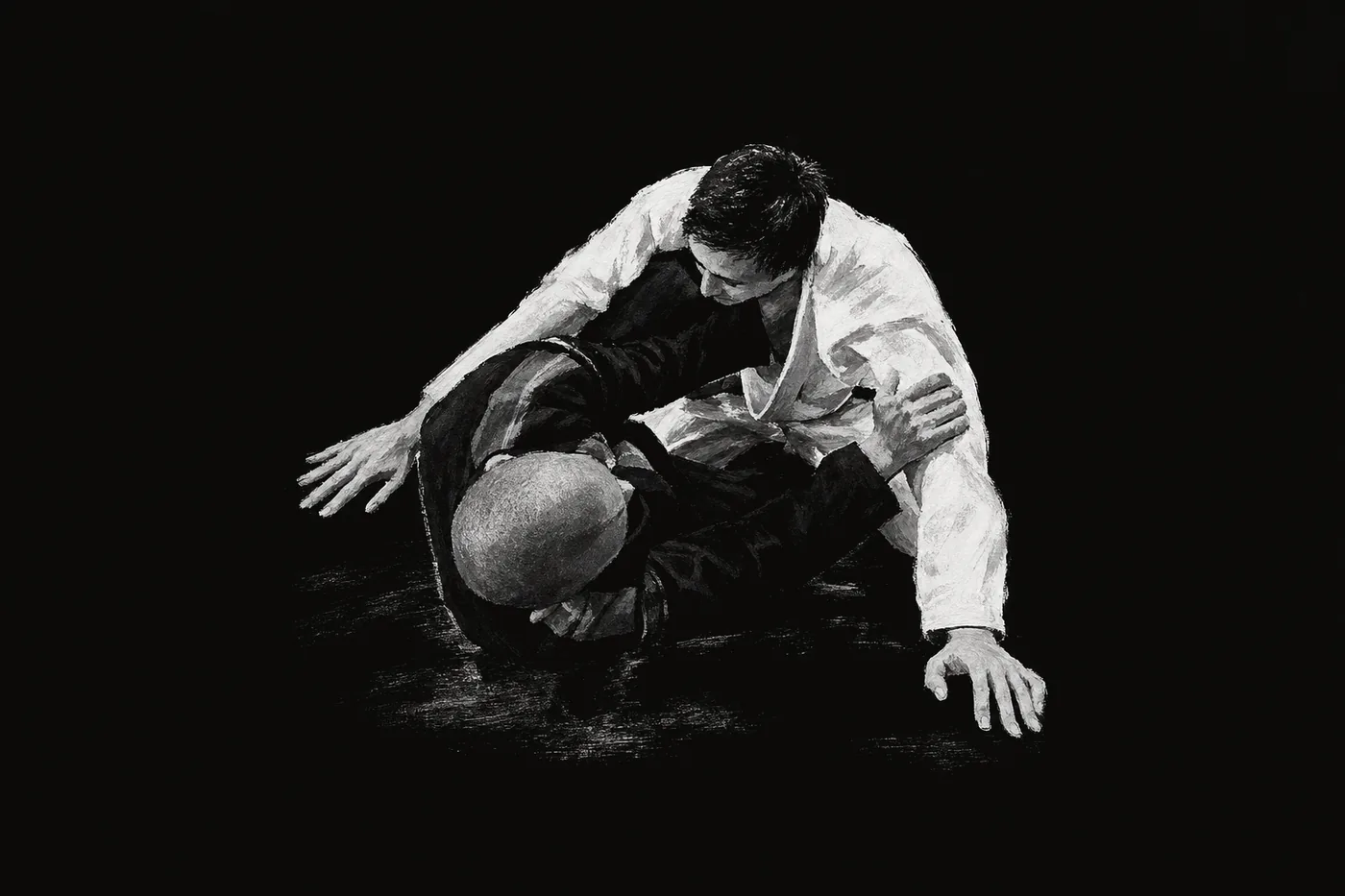
Learn / Jiu Jitsu / Systems / Recovering guard from flattened half guard, in the gi
Half Guard · retain it · gi
Recovering guard from flattened half guard, in the gi
Pull his shoulder down, the lockdown and push, the fist under his jaw, the arm back under, lift him with the knees, turn to your side. They have the crossface and the underhook in half guard and you are flat on your back. The spine below is Gustavo Gasperin's recovery of the underhook in the gi, one coach and one route in his own orientation: cup the ball of his crossface shoulder and pull it down, the lockdown and extend your legs to push his head down, frame his forehead and put your fist under his jaw, shoot the arm back under for the underhook, both arms under him and lift him with your knees, and turn to your side. Bellingham's frames route, Chad Hardy's make-him-post and Chewjitsu's go-with-the-pressure are references from the same start, described for other nights, and so is Gasperin's own butterfly route, filmed no-gi; the sweeps from this position are references too. Sixteen gi clips, the spine clip in mixed kit (Gasperin in a gi, his partner in a rashguard and shorts) and three no-gi ones for the principles, every no-gi cue marked, transcripts read and cited to the transcript chunk, one orientation written out below.
Key takeaways
- Success means Off your back and onto your side with the underhook, his weight off your chest.
- The spine is 5 steps after the gate, cup the ball of his crossface shoulder and pull it down, the lockdown, and extend your legs to push him down, frame his forehead with the underhooked arm, then your right fist under his jaw, shoot the left arm under his right arm: the underhook back, both arms under him, knees to your chest, lift him up; then turn to your side.
- When it breaks there are 6 named branches; learn the triggers, the responses are short.
- Evidence: 20 clips from 18 channels (11 clips from a coach's own channel, 7 from a gym's, 2 from an instructional publisher's), every timestamp checked against the spoken transcript. Sentences marked synthesis are the editors', not a coach's.
what he has, and what it does
His arm under your head with his shoulder in your jaw, his other arm under your arm, your back flat, your face turned away. Danaher's account of the position: with a crossface and an underhook he can bend both of your shoulders to the mat, and that is what makes bottom half guard miserable; his three protections are the knee shield for distance, your own arm underneath his so he cannot pin your outside shoulder, and control of his crossface hand, and you have lost all three. Gasperin's account: there is no space, it is too tight, and it is very hard to go to your side and play your half guard.
 11:09Bernardo Faria BJJ Fanaticsgiif he can get a crossface and an underhook he can bend both of my shoulders to the mat and make my life miserable from bottom half guard10:06Bernardo Faria BJJ Fanaticsgiif I get my arm underneath his arm, when he tries to control my head and shoulders it is almost impossible10:28Bernardo Faria BJJ FanaticsgiI can stay up propped on an elbow; if I go down to the floor he has no capacity to put on a crossface or lock his hands around my head and shoulders
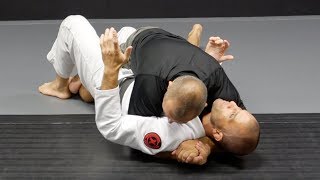 0:21MMA Leechno-gihe beats me to the punch, the crossface, he gets his underhook and I am stuck; very hard to go to my side and play my half guard0:42MMA Leechno-giso I am flat here; right now there is no space, it is too tight
space before anything
His shoulder off your jaw, his head pushed down and away, a frame under his jaw: room to move your head, then your arm. Gasperin's route makes the space in three small pieces before the arm goes back under: if his shoulder pressure is on your jaw, pull the shoulder down half an inch; push him down with your legs; frame under his jaw. The frames are forearm and fist, not a push with the hands. synthesis The order is his; that nothing else works before the shoulder is off is the author's reading of why he starts there.
1:02MMA Leechno-giif the guy has a really nice shoulder pressure I take care of this first: control the ball of his shoulder, connect my elbow against him and pull down; half an inch already helps me1:46MMA Leechno-gipushing the guy, his head is going to go down and the shoulder that is crossfacing me is going to go down; now I can move my head, there is more space for my underhook 1:06JeanJacquesMachadogiwhenever somebody crossfaces me I move my shoulders first
a half guard you can play
The underhook back and you on your side, his chest off yours; his leg still between yours is what Gasperin means by playing his half guard from there, and the session asks the partner to keep it there. That is the endpoint: not the sweep, not the pass denied for a moment, but the half guard Gasperin can play from, which Bellingham's coach describes as three things together, one leg trapped, on your side, and frames or the underhook. synthesis Being on your side with the underhook is a better position than flat, not a guarantee against the pass; what you do from there is another document.
2:52MMA Leechno-gibring my knees close to my chest, lift the guy all the way up; now I can start turning to my side and playing my half guard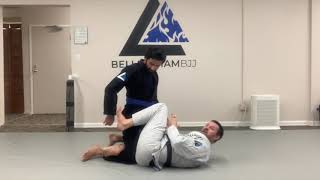 0:42Bellingham BJJgiI need three things to make half guard worthwhile: one of his legs trapped, I need to be on my side, and I need frames or an underhook1:24Bellingham BJJgiif he gets a hold of my head and my arm and puts me flat on my back, this is not half guard, this is half mount
success means
synthesis On your right side with the underhook back and on top and his chest off yours, held for three seconds (the count is the session's test; the footage shows the lift and the turn), his leg kept between yours by the partner's agreement (the footage does not show it). Space under his shoulder is not the recovery; the underhook regained with you still flat is not the recovery; a knee wedged in with your shoulders on the mat is not the recovery; your side reached with his leg gone is a different position and a reset. B1 and B3 end where their coaches end them and do not claim this position.
the situation
You are flat on your back in half guard and he has both controls: chest to chest, his head beside your left shoulder, his left arm the crossface under your head with his shoulder in your jaw turning your face to your right, his right arm under your left arm as the underhook, your legs holding his left leg; your right hand is free; he has not yet cleared your leg, isolated your framing arm or switched his base (those are branches, threats and resets)
the endpoint
On your right side with your left underhook in and on top and his chest off yours, held for three seconds; the count is the session's test, the footage shows the lift onto the knees at 3:14 to 3:17.75, the turn onto the right side at 3:18 to 3:18.75 and the side reached at 3:19 to 3:20.25; his leg between your legs after the turn is not shown and is the session's cooperative condition
you start with
- Your right hand is free
- Your legs hold his leg
not solved here · cooperative resets
- The mount completed after he clears your leg
- Your framing arm wrapped for the kimura
- Your back given by turning away
- The crossface driven as a choke past half pressure (a tap, not a defence)
- A belt or pants grip of his that the frames cannot open
Sides. One orientation throughout, Gasperin's own, mirrored when his head is at your right shoulder: he is chest to chest with his head beside your left shoulder; his left arm is the crossface under your head and his right arm the underhook under your left arm; his left leg is the leg your legs hold; your right hand is free and cups the ball of his left shoulder; your right leg is the inside leg under his left leg and holds it while your outside left leg crosses over his thigh to the inside, then your right lower leg crosses over your left and your right instep catches under his left ankle, for the lockdown; your left hand, the underhooked arm, frames his forehead and your right fist frames under his jaw; your left arm shoots back under his right arm for the underhook; both arms go under him and your knees lift him; you turn onto your right side with the underhook arm on top. Gasperin speaks in the ball of his shoulder, my elbow, the outside leg, his ankle, my ankles, the arm that is getting underhooked, my other hand, my wrist, my fist, my knees, my side; which arm, which leg and which side are read from stills of his clip, and the limitations say so.
what it is worth
Nothing scores for the recovery; it denies his pass. His pass scores 3 only once he has surmounted your legs and held side control or north-south for 3 seconds (article 4.2), and a half guard that still holds his leg blocks that count (4.2, note 2); the mount he is walking toward scores 4 once he is clear of the half guard, sitting on your torso facing your head, held 3 seconds (4.4). A position reached but not held may be an advantage (5.1, 5.2). None of this is a referee's call in training: the session's success is your side with the underhook back.
Article 4.2: 3 points when the athlete on top surmounts the legs of the opponent (pass guard or half guard) and maintains side control or north-south for 3 seconds; note 2: half guard is the guard where the athlete on bottom has one of the top athlete's legs trapped, blocking side or north-south control for 3 seconds; 4.4: mount 4 points when clear of the half guard, sitting on the torso with two knees or one foot and one knee on the ground, facing the head, with up to one arm trapped and the trapping leg not beyond the shoulder, for 3 seconds; 5.1 and 5.2: advantages for positions reached but not held or nearly completed
Source: IBJJF Rules Book v6.1 2024 (the current PDF from ibjjf.com/books-videos), articles 4.2 with its notes, 4.4, 5.1, 5.2; read 2026-09-10
— the spine · learn this week
Gustavo Gasperin's recovery of the underhook
One coach's route from flat under the crossface and underhook to your side with the underhook back, in his own orientation: his head at your left shoulder, your right hand on his shoulder, the lockdown (your left leg over his thigh, your right instep under his ankle), the left hand on his forehead and the right fist under his jaw, the left arm back under, both arms under him and the knees lifting, the turn onto your right side with the underhook on top. Machado, the Bellingham coach and Danaher supply checks on what the position is and how to move under it, never a step. No step is conditional; the other routes are branches from the same start.
-
GATE
Read what he has: the crossface, the underhook, and no space
His left arm under your head, his right arm under your left arm, your back flat and your face turned to your right; your right hand is the free one.
This is the position after he beat you to the punch: you escaped the mount to half guard, shot for the underhook and blocked the crossface, and he got both anyway (0:00 to 0:42). His left arm is the crossface under your head, his shoulder in your jaw turning your face to your right; his right arm is the underhook under your left arm; his head is beside your left shoulder; your legs hold his left leg. There is no space and it is too tight to go to your side. Your right hand is free; your left arm is the one he has. Nothing here is a push with the hands.
0:00MMA Leechno-giI escape the mount with my elbow escape, I go to my half guard shooting my underhook and blocking his crossface, but he beats me to the punch0:21MMA Leechno-gihe gets the crossface and his underhook and I am stuck; very hard to go to my side now, he has the crossface turning my head that way0:42MMA Leechno-githere is no space, it is too tight11:09Bernardo Faria BJJ Fanaticsgiif he can get a crossface and an underhook he can bend both of my shoulders to the mat -
1
Cup the ball of his crossface shoulder and pull it down
Right hand on the ball of his left shoulder, your elbow connected to your body, and pull the shoulder down; half an inch is enough to move your head.
If his shoulder pressure is on your jaw, take care of that first. Your free right hand cups the ball of his left shoulder, the one crossfacing you; connect your elbow to your own body so the pull comes from your back, not your arm, and pull the shoulder down (1:06 to 1:26 in the stills, the right hand on his shoulder with the elbow in). If you pull it down half an inch it already helps: at least you can move your head a little.
1:02MMA Leechno-giif the guy has a really nice shoulder pressure here that is almost cracking my jaw, I take care of this first; control the ball of his shoulder, connect my elbow against the guy and pull down, releasing that shoulder pressure1:22MMA Leechno-giif I pull his shoulder down half an inch it already helps me; at least I can move my head a little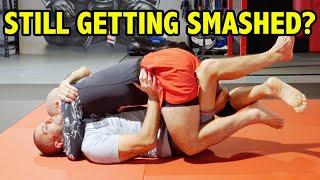 1:42MMA Leechno-gino-gi: lean this crossface down; control the ball of his shoulder, keep my elbow tight to my body so I use my back muscles to pull that shoulder down
 -
2
The lockdown, and extend your legs to push him down
Your right leg is under his left leg as the half guard hook and holds his leg while your outside left leg lifts and crosses over his thigh to the inside, taking over the clamp; then your right lower leg crosses over your left lower leg and your right instep catches under his left ankle; then extend both legs so his head and his crossface shoulder go down.
Now push him down even more, with your legs. Instead of locking a triangle to the outside, bring your outside leg to the inside and hook his ankle, then cross your ankles: that is the lockdown, and the stills say which leg does what (the wide shot at 1:41 to 1:47, .frames/lockhd-ZP6eavAmATU-1..3.png, and the close-up of the feet at quarter seconds, 1:43.5 to 1:47.25, .frames/feet-ZP6eavAmATU-1..4.png). Your right leg is the inside leg, under his left leg, and it holds his leg as the half guard hook while your outside left leg lifts (1:41 to 1:43.5) and crosses over his left thigh to the inside, taking over the clamp on his leg; then your right leg threads through: its lower leg crosses over your left lower leg and your right instep catches beneath his left ankle (1:44.5 to 1:45.25, the two feet crossing at 1:44.75). Nothing lets go during the change: his leg is held by the right leg until the left has it, then by the left while the right threads. Then extend both legs and push (1:46 to 1:52): his head goes down and the shoulder that is crossfacing you goes down with it. Now you can move your head, and there is more space for your underhook.
1:22MMA Leechno-gimy goal is going to be pushing the guy down even more, but using my legs now; I throw my lockdown: instead of locking my triangle to the outside I bring the outside leg on the inside, I hook his ankle, cross my ankles1:46MMA Leechno-giextend my legs pushing the guy; his head is going to go down and the shoulder that is crossfacing me is going to go down; now I can move my head, there is more space for my underhook -
3
Frame his forehead with the underhooked arm, then your right fist under his jaw
The left hand, the arm he has underhooked, frames his forehead while the right hand still holds his shoulder; then the right hand leaves the shoulder and helps the left lift his head; then the right hand goes to his neck, wrist and closed fist under his jaw, and the left hand pushes his head higher.
Still too tight? The hands go in this order, read at half seconds from the close-up (2:08 to 2:18, .frames/hands-ZP6eavAmATU-1..3.png; 2:19 to 2:30 at one-second steps, .frames/hands-ZP6eavAmATU-4..5.png). Your left hand, the arm he has underhooked, comes to his forehead first, at 2:10 to 2:11, while your right hand is still on the ball of his shoulder from step 1. Then the right hand leaves the shoulder (2:12.5 to 2:14.5) and joins the left on his head to help lift it (2:15 to 2:16.5: both hands at his head). Then the right hand lets go of that lift and goes to his neck: a frame under his jaw with your wrist and a closed fist, while the left hand reinforces it, first on the crown of his head pushing it higher (2:19 to 2:25), then, after lifting to gesture at 2:26 to 2:27, down beside the right fist at his jaw (2:28 to 2:30: the right fist under his jaw with the left hand beside it). The lockdown stays extended through all of it; that is what keeps his head down while the hands change. Now there is space to recover the underhook. Sometimes he breaks his grip, sometimes not; it does not matter, you only need the space.
2:08MMA Leechno-giwhen I lift his head up, the arm that is getting underhooked, I frame his forehead; I use the help of my other hand to lift his head; let go this and go to his neck, frame of his neck, my wrist, closed fist under his jaw, reinforce with this one and I push even higher1:46MMA Leechno-ginow I can move my head, there is more space for my underhook; still too tight2:31MMA Leechno-ginow I have some space to recover the underhook; sometimes he breaks his grip, sometimes not, it does not matter, I just create enough space -
4
Shoot the left arm under his right arm: the underhook back
Keep the right fist framing his jaw and shoot the left arm under his right arm to the underhook.
Keep the right hand there, framing him, as you shoot your left arm back under his right arm and take the underhook (2:30 to 2:44 in the stills: the right fist stays under his jaw while the left arm goes under his arm; his head is still down beside your left shoulder and his right arm is still around your shoulder, not above your head, .frames/arm-ZP6eavAmATU-1..2.png). Do not try to go to your side yet: he is low on your body because you pushed him low, and he is still mashing your underhook, so it is still hard to turn. The lockdown is still on.
-
5
Both arms under him, knees to your chest, lift him up; then turn to your side
The right hand off the jaw to his left lat, C-grips on his lats or armpits, knees to your chest and lift him all the way up with the lockdown still on, until his arm passes above your head; then turn onto your right side, the lockdown opening in the turn, and play half guard.
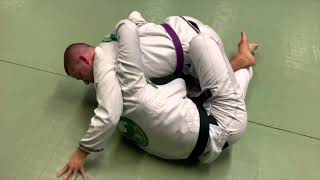
Now the right hand leaves the jaw and goes under his left armpit to his lat, so that both arms are under him with a C-grip on his lats or in his armpits (2:44 to 2:56 in the stills, .frames/arm-ZP6eavAmATU-1..2.png: the right hand off the jaw and onto his left lat while the left arm stays under his right arm; he is still low, his head down beside your left shoulder and his right arm still around your shoulder, so the frame is given up for the second arm under him, not because his head is up). Then bring your knees close to your chest and lift him all the way up: the knees draw in at 3:12 to 3:13.5, and at 3:14 to 3:17.75 his chest is off yours and his weight is on your knees with his right arm passing above your head; the lockdown stays on through the lift, his left leg still between your crossed legs (.frames/lift-ZP6eavAmATU-1..2.png, .frames/turn-ZP6eavAmATU-1.png). Take any grip you can there and run your knees under his butt to bring him all the way up; the lift begins when both hands are on him and the knees are in, not before. Then turn onto your right side, the underhook arm on top (3:18 to 3:18.75, .frames/turn-ZP6eavAmATU-2..4.png and .frames/uncross-ZP6eavAmATU-1..2.png): your left arm rides over his back as your right shoulder and hip go down, and at 3:19 to 3:20.25 your back is to the camera, you are on your right side and knees with the left underhook in and his chest off yours. The lockdown opens in that turn: the right instep lets go of his ankle and the left leg, the crossing leg, lifts off. Hold the side for three seconds before anything else. synthesis The count is the session's test; Gasperin does not count, the clip cuts at 3:22 as he comes up to his knees, and what he plays from there is not in this document. Which contact keeps his leg as the lockdown opens, and whether his leg is still between your legs after the turn, is not shown: the lower legs are hidden behind the pair, the left leg rises at 3:20.5 to 3:21.25 and comes down at 3:21.5 as he comes up (.frames/legzoom-ZP6eavAmATU-1..3.png), and Gasperin says only that he can play his half guard from there. So the session does not claim it: the partner keeps his leg between yours as you turn, by agreement, and if it comes free the rep is a reset, not the endpoint.
2:52MMA Leechno-giget my arms here under the guy, a C-grip on his lats or his armpit, and bring my knees close to my chest; lift the guy all the way up; I want his arm passing above my head; get any grip that I can, run my knees under his butt to bring the guy all the way up3:14MMA Leechno-ginow I can start turning to my side and playing my half guard here0:42Bellingham BJJgiI need to be on my side so I can move; frames or an underhook
— grip notes
- Which arm, which leg, and what was read from the footage.
Gasperin says the ball of his shoulder, my elbow, the outside leg, his ankle, my ankles, the arm that is getting underhooked, my other hand, my wrist, my fist, my knees, my side. The stills add which: his head is beside your left shoulder; his left arm is the crossface and his right the underhook; the arm he has is your left and the free hand your right; the outside leg is your left and the leg your legs hold is his left; you turn onto your right side at the end, the underhook arm on top; what your legs keep of his leg in that turn is not read, because the stills hide it. The convention: a step marked transcript reproduces the cited speech; a step marked frames reproduces the speech and adds those assignments, read from 640p stills at two-second steps through the whole route (0:40 to 3:20, .frames/route-ZP6eavAmATU-1..4.png) and, for the lockdown, the hands, the re-pummel, the lift and the turn, from 1080p stills at quarter-, half- and one-second steps (.frames/feet-, lockhd-, hands-, arm-, lift-, turn- and after-ZP6eavAmATU-*.png). The camera is at medium distance and the pair is chest to chest; the stills show which hand and which leg are where at each sampled moment and the order of the contacts, not the pressure, and any side the reviewer reads differently is adopted.
- Shoulders first, then hips.
Machado's rule for the crossface: do not try to move your hips first, it is very limited and he can free his leg while you do it; move your shoulders first, and when they move the hip goes up and the knee pops. Gasperin's first three steps are all shoulders and head; the legs push rather than shrimp. synthesis The pairing of the two coaches is the author's.
0:45JeanJacquesMachadogiif we are trying to move our hip first by bringing our shoulders down it is very limited; instead of moving my hip first, whenever somebody crossfaces me I move my shoulders first1:26JeanJacquesMachadogiwhen I move my shoulders first, instead of shooting my hip to the side I move my hip up and my knee pops up- The hand that would have stopped this.
Danaher's third protection is control of his crossface hand at the sleeve cuff: with that hand held he cannot secure the crossface even with the underhook. It is the prevention for next time, not the escape; once the crossface is on, this document starts.
11:30Bernardo Faria BJJ Fanaticsgiif I control the hand he reaches for the crossface with, it is very difficult; even if he has got an underhook he would not be able to secure it with the crossface20:38Bernardo Faria BJJ Fanaticsgiif we lost hand control at this point everything would get worse and worse; keep that sleeve control so when he reaches for a crossface he cannot
— when the spine breaks
6 branches
Each one names the trigger you will feel, then the response. Learn the triggers; the responses are short.
- You would rather rebuild the frames and the knee shield than take the underhook back (the same flat start, Bellingham's route)reference onlya playable half guard: on your side, both frames inside, your top knee in front of his hip; Bellingham's own end, and their step to closed guard after it is their own
Bellingham BJJ's recovery, from the same flat start, in the coach's words; sides are not assigned. Turn the draped foot's toes down so you stay attached if he pulls away; step the other foot on the mat as close to your butt as you can with active toes; put your biceps against him where his ear meets his head, so he is moved off line rather than fought straight on; bridge into him and bring your frame inside, the other frame too if it comes, and if not, bridge again; then move your hips out like a shrimp and put your knee right in front of his hip. The frames are not grips: one hand rests on his shoulder and the other checks his biceps with the little finger where his elbow meets the biceps, so a squeeze on your face or a strike can be checked. Now if he comes forward he cannot, and you are on your side and can move. Their closed guard after it: step on the mat or his hip, switch the hips with a shrimp, extend, and close. synthesis Which foot drapes and which hand frames which side are not assigned from stills, so this is a reference, not a drill.
1:44Bellingham BJJgiI am going to step on the mat here as close to my butt as I can, bridge into him and bring my frame inside; if I can bring my other frame inside at the same time, awesome; sometimes it takes more than one bridge2:04Bellingham BJJgimove my hips out and put my knee right in front of his hip; now if he tries to come forward he cannot, if he tries to control my face I am checking, and I can move my hips because I am on my side2:46Bellingham BJJgiturn the toes down so if he tries to pull away I am able to stay attached; I do not want to lock my legs, it keeps me flat and impedes my movement3:07Bellingham BJJgibring the foot as close to my butt as I can with active toes; if it is far away my bridge is not very powerful3:27Bellingham BJJgitake my biceps and hit him right about where his ear meets his head; I move him off line3:47Bellingham BJJgiI am not making grips here, I am just resting my hand on his shoulder and checking his biceps4:09Bellingham BJJgimy pinky finger right where his elbow meets his biceps; if he tries to squeeze my face again I can block him4:30Bellingham BJJgiswitch our hips with a shrimp motion; step, shrimp, extend, get right back to the closed guard- You choose the butterfly hook instead of the underhook, from the same flat start (Gasperin's own second route, filmed no-gi)reference onlybutterfly guard with his weight elevated and pushed away; or, when the knee will not free, the single leg X if he posts and the sweep if he does not; Gasperin's own ends
Gasperin's butterfly route, an independent alternative from the same flat start under his crossface and underhook, not a continuation of step 4; in his own words and filmed no-gi, so every cue says so; sides are not assigned, so it is a reference, not a drill. Lean the crossface down with the shoulder grip, a little hip escape and, if it will not come, a bridge first, to get the butterfly hook in; then do not stay on your side, square up under him and go flat again on purpose, because the aim is to elevate the hook straight up and free the leg that is between his legs. Keep his head low with your hand, bring him forward with the knee against his butt, control his lats or neck, step the other foot on the ground if you can, and elevate, ninety percent hook and ten percent hand; wiggle the knee free, extend the legs and push him away into butterfly guard. If the leg will not free, change the angle and drive him sideways with the hook so he has to post; if he does not post he falls, and that is the sweep; if he posts and stays on that knee, run your thigh behind his knee and put the foot in front of his hip: the single leg X.
1:42MMA Leechno-gino-gi: lean this crossface down, control the ball of his shoulder, keep my elbow tight; now I can move my head; a little hip escape, covering his leg, and I can get my butterfly hook in2:23MMA Leechno-gino-gi: sometimes I have to bridge first; when I get my butterfly hook I do not want to stay on my side, I am not trying to sweep him this way; I get my butterfly and square underneath, going flat again, because I want to elevate straight up3:26MMA Leechno-gino-gi: use my knee against his butt to bring the guy forward; the other hand controls his lats or his neck; keep the guy down, use my hand to control his hip and elevate, ninety percent my butterfly, ten percent my hand4:06MMA Leechno-gino-gi: step this foot on the ground if I can; if not I elevate anyway; wiggle this leg to pop my knee off; extend my legs pushing the guy away and now I can start playing butterfly5:49MMA Leechno-gino-gi: I cannot free my knee, so I change the angle and drive the guy this way forcing him to post his arm6:11MMA Leechno-gino-gi: if he does not post he is going to fall; he has to post his arm and a lot of times he stays on that knee; my thigh runs behind his knee so I can get my foot in front of his hip, the single leg X- His weight is driving into you so hard that you cannot bridge (Hardy's start, the same flat position)reference onlyeither the sweep, if he tips when you turn your knees, or the underhook back high with your elbow pulling you in and his foot wrapped, up on your side, if he posts; Hardy's own two ends, and his half guard after it is his own
Chad Hardy's answer, from the same flat start, in his own words; sides are not assigned, so it is a reference, not a drill. When he is pressuring so hard you cannot bridge, take the hand to his hip, keep your legs as tight as you can so he cannot slide (feet crossed if you fear the mount), tuck the elbow, push the hip and extend, and turn your knees. Two outcomes: if you can pinch and he tips, that is the sweep; with experience he posts out instead, and that gives you the space for the underhook. Then keep the underhook high, use your elbow on your knees to pull yourself in, circle the hand, wrap his foot and come up. synthesis A partner who neither tips nor posts is not shown: hold, release and reset. Hardy's own advice when one escape stalls is to chain to another rather than repeat it.
 0:30Chad The Beast Hardygiif he is pressuring it is very hard for me to bridge; I take this one to the hip and keep my legs as tight as I can so he cannot slide; you can even keep your feet crossed if you are worried about the mount0:51Chad The Beast HardygiI turn my knees; as soon as I get to this position he is going to post out, which gives me the space to get the underhook1:11Chad The Beast HardygiI keep my underhook up high and start using this and my elbow on my knees to pull myself in; now I can circle my hand and wrap his foot and come up1:34Chad The Beast Hardygituck my elbow, push his hip and extend; sometimes I can get to sweeping, sometimes he will post out and I go here, use this high and flare my elbow2:15Chad The Beast Hardygiif I am going this way and it is not working, start going back and forth and chain some different escapes together
- He is driving forward into you and you cannot drive back (Chewjitsu's start)reference only
Chewjitsu's answer, in his own words: instead of going against the power, go with it, get underneath him so he has to post, and when he posts you have a free move: fight back to the underhook, or take the cross collar and make your distance, and get back to a defensible half guard. The bottom leg pipes down to block his base on the way under. Sides are not assigned; the hand exchanges are not read from stills; a reference.
 3:07Chewjitsugiinstead of trying to go against the power driving into them, I am going to go with it; I go underneath him and he has to post; when he posts that gives me the ability to fight back for my underhook, or I can get my cross collar and make my distance3:50ChewjitsugiI take the leg that is hooking and pipe it down; this is blocking his point of base; I get under the arm for the underhook, or if I do not want to play that low position I go underneath, get the cross collar and go back to inside control4:31Chewjitsugiany time the person is posted, that means they are off balance, that means I have got initiative, a free move
- He clears your leg while you are still flat (the mount is coming)cooperative reset
synthesis No clip in this document recovers from the mount completed; the answers here are before it: Chang's rule is to cap his leg with the butterfly hook the moment your hips are out, because a leg grabbed with the hand alone lets him cut his shin over your body straight to the mount; Friedman's and the Fuse coach's passes show what he is doing (walking the toes up, dropping the hips, the knee through). In the session the mount completed is a hard boundary: stop, partner releases, restart from the entry.
 4:49Cobrinha Brazilian Jiu-Jitsu & Fitnessgiif I just go here to grab my opponent's leg he can cut his shin over my body and go straight to the mount; I take this butterfly hook and cap the top of his leg so he cannot go to the mount
 0:00Malachy Friedmangihere is how to pass the flat half: get my elbow inside pushing on his hip, drop his weight down, collect his head, head to the other side, post my hand, walk my toes up
 0:41Fuse Martial Arts & Fitnessgicup the shoulder, pressure with my lead shoulder, tripod up, pop my knee through, and now I am in quarter guard
- The crossface is being driven as a submission, or your framing arm is being isolated; or you have turned away from himcooperative reset
synthesis Three things end the drill, and each is a tap or a stop, partner releases, reset; none is fought. The crossface as a choke: the SBG coach shows the shoulder dropped straight down into the chest with the biceps against the neck, and his defence is a connection, the hand rotated thumb down to his neck and the body grabbed, not a reach for the choking hand, which only pulls your own elbow out; that defence is observation only here, and in the session the crossface is applied at half pressure and released on a tap. The arm isolated for a kimura while you frame: Giles's no-gi warning about a trapped arm belongs to his own position, after the top has switched base and climbed high, not to Gasperin's frames; the caught-arm stop here is the author's. Turning away to your stomach gives him the back and is a stop, not a scramble.
 0:40SBG PDX & Vancouver BJJ and MMA Videosgiif I want to make it more of a submission I extend my arm until my biceps is against his neck, grab his armpit, drop my shoulder down to his chest, not across his jaw, and slowly drop my weight1:43SBG PDX & Vancouver BJJ and MMA Videosgithey will panic and reach to take the pressure off this hand; that will not work, and look what happens to my elbow: without my elbow I cannot hold him in place to escape2:25SBG PDX & Vancouver BJJ and MMA VideosgiI bridge a little, rotate my hand thumb down like I am extending my arm, get a good connection to his neck, grab his body wherever to maintain that connection, and drop back down
 2:49Absolute MMA St Kilda - Melbourneno-gino-gi: if your arm is trapped you have to keep it really high under there, or he will grab the wrist and peel it up
— negate first
Threat map
Some of the clips on the left show the coach performing the attack; watch them once so you recognise it. The answer on the right is a spine step, a branch, or marked as synthesis.
- The crossface driven as a submission
-
what they are doing
your answer
Recognise it: his biceps on your neck and his shoulder sinking straight down into your chest, not across your jaw. synthesis The session's answer is a tap: stop, partner releases, reset; the SBG coach's connection defence is observation only here and is not attempted before the tap. In the route the shoulder is pulled down before it sinks (step 1). Do not reach for his choking hand.
- The mount when your leg opens
-
what they are doing
4:49Cobrinha Brazilian Jiu-Jitsu & Fitnessgiif I just grab my opponent's leg he can cut his shin over my body and go straight to the mount0:21Malachy Friedmangiwalk my toes up, get this knee through, drop my hips and use my butt as a frame to pull my leg through 0:20JeanJacquesMachadogiI raise my hip and bring my knee across, using the lower leg as a shield to pull my other leg
your answer
Recognise it: the moment your legs open to move, his knee comes across. Gasperin's lockdown (step 2) keeps his leg while the legs push; Chang caps the leg with the hook and holds it with the hand before he undoes his squeeze; Bellingham's coach turns the draped toes down instead of locking. synthesis A cleared leg with you still flat is the B5 reset.
- His switch of base once you have the knee back
-
what they are doing
0:21Absolute MMA St Kilda - Melbourneno-gino-gi: my knee should be reasonably tight to my chest and I should have an elbow frame here; where it happens is people push away with the knee shield and make a big gap0:41Absolute MMA St Kilda - Melbourneno-gino-gi: as soon as I sense he wants to switch base, my bottom knee points up off the ground; even if he clears this knee, my knee can come in front of the hipyour answer
Recognise it: once you are on your side he switches his hips to face your legs. Giles's no-gi rule is the bottom knee pointing up, ready to come in front of his hip, and no pushing away with the shield. It is the next problem, not this document's; the rep ends at the endpoint before it, and in the session a switch of base at any point is a stop and a reset.
- The kimura on the arm that frames
-
your answer
Recognise it: a frame he can wrap. Giles's warning is spoken for his own position, after the top has switched base and climbed high; synthesis the author's rule for Gasperin's frames is the same in spirit, the elbow in and the fist under the jaw rather than an arm extended across him, and a wrapped wrist is a tap and the B6 reset.
- What he wants next: the pass
-
what they are doing
your answer
Recognise the plan: the crossface and underhook exist to keep you flat while he walks the leg free. synthesis The route first moves his head and shoulder down (steps 1 and 2) and only then lifts him (step 5); on your side with the underhook you can play, which is a better position than flat, not a guarantee, and a flat man with a knee in is not there yet.
— 20 minutes · gi
Tonight
synthesis The session is the author's; the mechanics are Gasperin's, from one exact start: flat, with both of his controls on. Every full-route rep ends at the spine's endpoint, your right side with the underhook in and his chest off yours, counted to three, his leg kept between yours by agreement, or at a named reset; the first block ends at the step 2 standard and resets; no other route is played, and the other coaches' routes are references. Two kinds of stop: the block's own reset, cooperative and named under each block, and the hard boundaries the scope lists (the mount completed; a wrapped framing arm; your back turned; the crossface driven as a choke), which stop everything; both restart only after the partner releases every control.
safety · stop here
No submission is attacked in this document. The crossface loads your jaw and neck and can be driven as a choke: the session applies it at half pressure and releases on a tap, and the shoulder is pulled down (step 1) before anything else. A framing arm can be wrapped for a kimura: a caught wrist is a tap. The lockdown loads his knee if it is extended while his leg is turned out: extend straight, slowly, and release on his tap. The sweeps in the reference are observation only. The release rules are the author's.
- The crossface driven into the jaw or as a choke (every block). Half pressure; the bottom taps and the partner releases at once; the shoulder pulled down is step 1, not a fight against the pressure
- His knee under the lockdown (step 2). Extend the legs straight and slowly; if his leg is turned out or he taps, release at once; the push is to move his head down, not to crank the knee
- Your framing arm wrapped for the kimura (B6). Tap early and reset; the arm stays high under his arm or framing with the elbow in
- The sweeps in the reference (Kesting's kamikaze and twist, Chang's, McInally's, Inverted Gear's, RGA's). Not drilled; observation only
- 1
The shoulder, the lockdown and the push
4 minHe settles flat on you with the crossface at half pressure and the underhook, his hand open on your back. Right hand to the ball of his left shoulder, elbow to your body, pull down; then the lockdown: the right leg keeps his leg while the left leg lifts and crosses over his thigh to the inside, then the right lower leg crosses over the left and the right instep catches under his ankle, extend and push until his head goes down. Say the two out loud: shoulder, push. Each rep ends there, at the step 2 standard: hold the push for a breath, release, and reset. Ten reps, swap.
- 2
The route, to your side every time
6 minFrom the exact start, cooperatively: the shoulder pulled down with the right hand; the lockdown (the left leg over his thigh to the inside, the right lower leg over the left and the right instep under his ankle) and the push; the left hand to his forehead while the right still holds the shoulder; the right hand off the shoulder to help lift his head; the right hand off the lift to the fist under his jaw, the left on top pushing higher; the left arm back under his right arm with the right fist still framing; the right hand off the jaw to his left lat; knees to the chest and lift him with the lockdown still on until his arm passes above your head, knees under his hips; turn onto your right side with the underhook arm on top, the lockdown opening in the turn while he keeps his leg between yours by agreement, and count three out loud. He resists lightly only by keeping his shoulder heavy. Ten reps, swap, then the mirror side (his head at your right shoulder, his right arm the crossface, his left arm the underhook, your left hand free, the turn onto your left side) with every hand and foot swapped.
- 3
The route under resistance, in three grades
5 minEvery rep is the whole route from the same flat start with the position read; what changes is how he holds. Grade one, three reps: he keeps the shoulder heavy and his ear tight but lets the legs push him and does not chase the arm. Grade two, three reps: he keeps the shoulder heavy and resists the push with his hips, and lets the arm go under once the frame is there. Grade three, three reps: he holds as in a round, without the choke, the kimura hunt or the switch of base; the order does not change: shoulder, lockdown and push, forehead, jaw, arm under, lat, lift, turn. In every grade a lost required control is a stop, release and reset; nothing is rebuilt from what remains. The one restoration allowed is the push and the forehead contact, and only while the lockdown is installed and intact and the shoulder is still pulled down with the right hand: extend the legs again and re-place the left hand. No control is skipped and none is taken out of order. Each rep ends at the endpoint with the count. Swap after each grade.
- 4
Positional rounds
5 minFive one-minute rounds from the exact start, alternating who is on top. He keeps you flat for real with the crossface at half pressure and works to clear the leg; he does not drive the crossface as a choke, does not hunt the framing arm for a kimura, and does not switch base at any point in these rounds, because none of those is installed tonight; a switch of base before the endpoint is a stop, release and reset. The route is the only escape played; the other coaches' routes are references tonight. The spine's success is your side with the underhook, his chest off yours and his leg still held. The mount completed, a wrapped arm, the crossface driven as a choke or your back turned is a tap or a reset, not a scramble.
— after the round
Check first
synthesis The author's table. Outcomes have more than one cause; check these in order.
| It happened | Check first |
|---|---|
| You could not move your head | Was the right hand on the ball of his shoulder with your elbow connected to your body, or was it a push with the hand? Did the lockdown go on with the right leg keeping his leg, and did both legs extend before you tried the frame? |
| The frame went in and he drove through it | Was it the fist and wrist under his jaw with the other hand pushing his head higher, or an open hand on his chest? Was the shoulder already pulled down? |
| The arm would not go back under | Did the right fist stay framing while the left arm shot under, or did you let the frame go first? Was his head pushed down by the legs before you tried? Did the right hand leave the jaw for his lat only after the underhook was in? |
| You got the underhook and could not turn | Did you try to turn before lifting him? Were both arms under him with the knees to your chest, and did his arm pass above your head before you turned? |
| Your leg opened and he cleared it | Did the lockdown come off before the frame was in, or did the ankles uncross while you re-pummelled? A cleared leg while you are flat is the B5 reset. |
| Your framing arm got wrapped | Was the elbow in and the fist under his jaw, or was the arm extended across him? A wrapped wrist is a tap and the B6 reset. |
— the other doors · keep for later
Reference
Everything else read for this situation, grouped by door: the principle of the position, the other gi routes through the same door (recoveries and sweeps), and the no-gi clips kept for their principles, cued as such.
The principlewhat the position is and how to move under it
- John Danaher
The half guard bottom has three protections against the top's head-and-shoulder control: the knee shield for distance, your own arm underneath his so he cannot pin the outside shoulder, and hand control of his crossface hand at the sleeve, so that even with an underhook he cannot secure the crossface; with the crossface and the underhook he bends both shoulders to the mat. His answer to chest on chest without a crossface is the belt grip over his shoulder and the back roll sweep, which is not this document's position.
10:06Bernardo Faria BJJ Fanaticsgiif he gets the underhook he can pin my shoulder straight down to the mat; if I get my arm underneath his arm, when he tries to control my head and shoulders it is almost impossible11:09Bernardo Faria BJJ Fanaticsgiif he can get a crossface and an underhook he can bend both of my shoulders to the mat10:49Bernardo Faria BJJ Fanaticsgithe knee shield is a method of distance control; this one is a means of preventing him pinning my inside shoulder to the mat; a third method is hand control19:14Bernardo Faria BJJ Fanaticsgithe bad news is his weight is on top of you, the good news is he does not have a crossface to solidify his weight in place; my armpit goes over his shoulder and I access the belt - Jean Jacques Machado
Move the shoulders first, never the hip first; the hip goes up and the knee pops rather than shooting the hip to the side; keep the leg crossed over his without locking, always pinching; get the tip of the knee on his hip bone; when he changes base it is your head, not your hip, that is trapped, so get the head out first; and use the hook so the whole body goes with it, not a kick.
1:06JeanJacquesMachadogiwhenever somebody crossfaces me I move my shoulders first; the leg is crossed over his leg, my knees close to him, I do not need to cross1:26JeanJacquesMachadogiI move my hip up, my knee pops up, and follow your knee with your hip4:12JeanJacquesMachadogiwe never kick somebody away from you; as soon as I get my hook I do not use my leg, my whole body goes with it5:57JeanJacquesMachadogiI just want to get the tip of my knee on his hip7:18JeanJacquesMachadogithe key is use the top of the knee on his hip bone, pinch your legs8:25JeanJacquesMachadogiwhat I want to escape now is not my leg or even my hip, it is my head; the moment I can get my head in, I am out - Bellingham BJJ
A playable half guard is one leg trapped, you on your side, and frames or the underhook; flat under head-and-arm control is half mount, not half guard; the route back is the bridge with the biceps at his ear, the frames inside, the hips out and the knee in front of his hip, then the hip switch to closed guard (B1).
Other gi routesthe same door, other coaches
- Marcos Cerqueira
Fix the arms first, one elbow always inside blocking on his leg; half bridge with one foot and push him up with the head down; bring the forearm in front of his neck as a frame, elbow in front of him, steer, then the hand goes under for the underhook with the head hidden close to him; grab the belt or pass the lapel with the elbow pointing up, and stop there.
 1:09Marcos Cerqueira Brazilian Jiu-Jitsugifirst thing I need to do is fix my arms; the position I have is one elbow inside, blocking on his leg1:51Marcos Cerqueira Brazilian Jiu-Jitsugiwhen I make my half bridge, bridging using one foot, I push him all the way up with my head down and create a space2:34Marcos Cerqueira Brazilian Jiu-Jitsugiwith my forearm in front of his neck I can start making a frame3:18Marcos Cerqueira Brazilian Jiu-Jitsugimy elbow goes in front of him; it is like I am steering, and I go with my hand under and push him up with my legs; I have the underhook, my arm goes around3:59Marcos Cerqueira Brazilian Jiu-JitsugiI can grab the belt, I can open his gi and pass the lapel; I go all the way around his body with my elbow pointing up
 - Stephan Kesting
Three directions to off-balance him from the crossface, each with a recovery and a sweep version. Toward the bottom player's right in Kesting's demonstration (the top player's left), the kamikaze, for a crossface that is tight but not fully turning your head: shoulder grabbed, feet to the outside, chop the leg, club the top of the head and bridge sideways; if it does not sweep, use the room to bring the hand back to the biceps, hip out and put the knee in for the shield. Straight up, the lift, for a weight driving high: a foot hooked under his thigh, hand on the hip, plant and bridge into butterfly, drop him and throw him away; or, the aggressive version, chop the outside leg and sweep. Toward the bottom player's left, the twist: feet tight to his knee, clamp the arm, bridge a little and point the knees away; if he posts, the hand comes back across and the knee shield is recovered. Observation only here: the sweeps are not drilled in this document.
 1:26Stephan Kestinggithe kamikaze; this is if it is tight but not super crazy tight; grab the shoulder, pull this out as much as I can; move my feet to the outside2:08Stephan Kestinggithree things at once: chop down to block his leg, swing this arm up and club him at the top of the head, and bridge, sideways3:14Stephan Kestinggiif I cannot get it, the best I can hope for is to use this to make a little room to bring this hand back in front onto the biceps, bring the other knee in and re-guard4:17Stephan KestinggiI am going to take him up; put this foot under his thigh as a hook; move my hips to the outside or grab my own leg and jam it in4:59Stephan Kestinggithis hand goes on the hip, plant this foot on the ground, lift and bridge, the butterfly guard, and sit up5:44Stephan KestinggiI do this mostly if his weight is really high, driving up6:26Stephan Kestinggiwhen I have got him in the air I drop him towards the ground and then kick him away8:10Stephan Kestinggithe twist: both feet as tight as I can to his knee, bridge ever so slightly and point my knees the other way8:54Stephan Kestinggiif he releases and posts his hand, that allows this hand to come back in, push across, get this hand off my neck, and escape into the knee shield half guard
 - Brian Chang at Cobrinha
Relieve the pressure with a deep hook of the hand inside his shoulder and the elbow stapled to your abdomen; a frame under his throat; feel with the feet whether his lock is open; plant the foot, lift the hips, exit the pelvis and a small shrimp; cap his leg with the butterfly hook so he cannot go to the mount, and also grab that leg with the hand, because without the hand he can post and use the leg to free himself and mount anyway; only then undo your squeeze, lift him with the foot on the mat and the throat frame, collect his outside leg and reverse the position. A sweep from the flat start, observation only here; the cap is one part of his mount prevention, the hand on the leg is the other.
2:46Cobrinha Brazilian Jiu-Jitsu & Fitnessgia really big fish hook as deep as possible inside my opponent's shoulder; relieve the pressure by stapling my elbow down to my abdomen3:07Cobrinha Brazilian Jiu-Jitsu & Fitnessgiswim my hand underneath my opponent's throat and make a little frame right in front of his throat4:09Cobrinha Brazilian Jiu-Jitsu & Fitnessgipost my foot on the floor, drive off the floor to lift my hips up into the air and exit my pelvis outwards; a small shrimp to get my hips facing towards the opponent5:10Cobrinha Brazilian Jiu-Jitsu & FitnessgiI take this butterfly hook and cap the top of his leg so he cannot go onto the mount5:31Cobrinha Brazilian Jiu-Jitsu & FitnessgiI am already grabbing his leg with this hand; if I let it go he can post his hands on the mat and use this leg as a hook to free his leg and go to the mount again5:54Cobrinha Brazilian Jiu-Jitsu & Fitnessgimake a hook, prevent this leg from moving, grab that leg, and now I undo my squeezing lock6:36Cobrinha Brazilian Jiu-Jitsu & Fitnessgiconnect my foot to the mat, lift my opponent up, collect his outside leg with my outside leg and softly reverse the position - Michael McInally
The belt grip route: grab his belt, move the arm down his body to trap his arm against yours, the other hand posts on his hip, a big hip out, the butterfly hook under him with the knee pointing up so he cannot step over; then the hand that was on his hip passes up to keep his other arm from basing out, a second arm control separate from the one the belt grip trapped; the free foot to the ground, and elevate; if he bases out, drop into full butterfly. A sweep, observation only here.
 0:03Sticks and Stones BJJgihe has got his belt on; I get a belt grip, I move my arm down his body so I can trap that arm against my body, and my other hand posts in the hip0:44Sticks and Stones BJJgiI hip escape out from underneath and place my butterfly hook underneath him with my knee pointing in that upward direction so he cannot step over or pass1:26Sticks and Stones BJJgihe is going to reach out with his arm, so the hand that was blocking the hip is now going to pass up and keep his arm from basing out3:51Sticks and Stones BJJgiif he has an extremely good base he is going to step out with his foot, so I drop into a full butterfly
 - Inverted Gear
Grab his belt, hip out, straighten his leg and find the butterfly hook, knees to the chest, kick up and back to butterfly; the coach's own words are that the flat smashed half guard is where you switch to butterfly, not where you play.
 0:28Inverted GeargiI am going to find his belt and feed this; I hip escape a little bit, straighten his leg out and find this little butterfly hook; once I have that I have options1:09Inverted Geargiget this grab, hook goes in, get a grip, bring my knees to my chest, kick up and then back; a nice butterfly position2:30Inverted Geargithere are a few people in the world who can play this smashed half guard and not switch off to butterfly
 - RGA South Herts
The smashed position is the cardinal sin of half guard; with his weight on your upper body, trap the arm and push his armpit with a V of the hand, then use the legs to swing him over; when he shifts his weight to one side, block his leg and bridge; when he has your head with the underhook on the opposite side from the usual, the butterfly hook: turn, push, get the foot under his thigh, sit up to free the leg and bridge over; and when nothing works, the lockdown, lifting and stretching so he comes over your head, hands on his hips. Sweeps and the lockdown, observation only here.
 0:21RGA South Hertsgithe cardinal sin of all half guards is underhook head control, what we call the smashed position1:45RGA South Hertsgihe is putting all his weight on my upper body, that means his lower half is light; I trap the arm and push the armpit and use my legs to swing him2:26RGA South Hertsgitrap, push; I use a V push; under the armpit, trapping; and then I use my legs to just shove him over4:53RGA South Hertsgihe shifts his weight to that side; this leg is the weak point; if I can just block here I just bridge8:19RGA South Hertsgihe gets an underhook here, the opposite version of what we had before; a little shrimp to get this foot under his thigh; extend, sit up, this frees the right leg; a butterfly sweep12:25RGA South Hertsgithe lockdown: the outside leg goes over, the half guard leg goes over your outside leg and hooks underneath his foot; nothing happens until you lift up and stretch out13:47RGA South Hertsgilift up, hands on the hip, bring the hip line up a bit and direct his weight over
 - Carlos Machado
The cross underhook: face away as if giving the pass, one hand inside his chin and the other across your waist, stiff the leg, bump the hip, and when he takes the side, roll the elbow up, circle and roll out. A different start, observation only here.
No-gi, for the principlescued as such
- Coach Nate, BJJ4Breakfast
No-gi: the knee shield back from the smash: shoulder pulled down to breathe, undo the lock but keep the bottom foot wrapped around his shin, a big hip escape with the hand holding his hip, the bottom knee in on his hip, lock and clamp; then pummel or crossface-and-pummel.
 1:22BJJ4Breakfastno-gino-gi: grab the shoulder and pull it down, catch your breath; I can get back to the knee shield if I can get my hips out at an angle; I undo my lock but keep this bottom foot wrapped around his leg2:02BJJ4Breakfastno-gino-gi: once I get my hips out I bring this bottom knee in; I get it a little bit in and lock it, and that creates a real nice clamp on his leg2:23BJJ4Breakfastno-gino-gi: once I get that clamp I use my knee to push away and create enough space to crossface and pummel, or just pummel
 - Lachlan Giles
No-gi, bottom view: what the top does next once you are on your side, the switch of base, and the rule that the bottom knee points up and comes in front of his hip; the trapped arm stays high or the wrist is peeled for the kimura.
0:41Absolute MMA St Kilda - Melbourneno-gino-gi: my bottom knee, as soon as I sense he wants to switch base, points up off the ground; my knee can come in front of the hip3:10Absolute MMA St Kilda - Melbourneno-gino-gi: hook my right foot over the ankle, feet together, a John Wayne type movement; my knee pushes him to his knee and forces his hips up - Gustavo Gasperin, the butterfly route
No-gi: Gasperin's own second answer from the same flat start, B2 above.
— 20 clips · verified 2026-09-10
Ledger
Every clip on this page. Each was resolved on YouTube, its uploader channel recorded and reviewed, and its transcript read before a second was cited. Source names whose channel it is: the coach's own, the coach's gym, or the instructional publisher that filmed them.
| Coach | Channel | Source | Kit | Video | Uploaded | Length |
|---|---|---|---|---|---|---|
| Stephan Kesting | Stephan Kesting | coach | gi | 3 Ways to Recover from Smashed Half Guard when Your Opponent Has the Crossface and Underhook | 2019-11-20 | 11:30 |
| JeanJacquesMachado | JeanJacquesMachado | coach | gi | How to stop getting crushed in half guard bottom | 2022-05-14 | 11:32 |
| Chewjitsu | Chewjitsu | coach | gi | How To Stop Getting Smashed in Half Guard Bottom | 2019-10-30 | 6:09 |
| MMA Leech | MMA Leech | coach | no-gi | 2 Half Guard Cross Face & Underhook Counters | 2023-03-03 | 7:40 |
| MMA Leech | MMA Leech | coach | no-gi | Recovering The Underhook From Bottom Half-Guard | 2018-09-19 | 3:50 |
| Absolute MMA St Kilda - Melbourne | Absolute MMA St Kilda - Melbourne | gym | no-gi | Dealing with the switch base from half guard (Lachlan Giles). The most common half guard question | 2019-08-08 | 4:44 |
| BJJ4Breakfast | BJJ4Breakfast | coach | no-gi | Recovering Knee Shield from Bottom Half Guard Smash | BJJ for Breakfast | 2024-10-15 | 5:39 |
| Carlos Machado | Carlos Machado | coach | gi | HACK 109: Half guard cross underhook escape | 2021-06-20 | 2:15 |
| Chad The Beast Hardy | Chad The Beast Hardy | coach | gi | Reclaiming the Under Hook from Half Guard After Being Flattened Out | 2020-09-15 | 2:56 |
| Cobrinha Brazilian Jiu-Jitsu & Fitness | Cobrinha Brazilian Jiu-Jitsu & Fitness | gym | gi | How to Defend the Crossface and Escape from Half Guard| Brain Chang | Cobrinha BJJ | 2020-07-28 | 8:00 |
| Inverted Gear | Inverted Gear | publisher | gi | How To Recover When You Get Flat In Half Guard | 2022-08-08 | 4:33 |
| Marcos Cerqueira Brazilian Jiu-Jitsu | Marcos Cerqueira Brazilian Jiu-Jitsu | coach | gi | Getting pinned down in half guard? Try this one! BJJ - Half Guard under hook recovery - 1/2 | 2021-11-09 | 5:35 |
| RGA South Herts | RGA South Herts | gym | gi | Smashed Half Guard - escapes and sweeps | 2022-01-10 | 16:06 |
| SBG PDX & Vancouver BJJ and MMA Videos | SBG PDX & Vancouver BJJ and MMA Videos | gym | gi | Secret Weapon From The Cross Face Position | 2023-03-15 | 4:34 |
| Sticks and Stones BJJ | Sticks and Stones BJJ | gym | gi | Never get smashed in half guard again | Butterfly half guard escapes | 2022-03-14 | 9:09 |
| Bellingham BJJ | Bellingham BJJ | gym | gi | Fundamentals: Half Guard Recovery to Full Guard | 2022-01-01 | 5:53 |
| Bernardo Faria BJJ Fanatics | Bernardo Faria BJJ Fanatics | publisher | gi | How To Build The Perfect Half Guard Game by John Danaher | 2019-08-12 | 27:44 |
| Malachy Friedman | Malachy Friedman | coach | gi | This is how to pass the flat half! | 2023-10-18 | 1:02 |
| Fuse Martial Arts & Fitness | Fuse Martial Arts & Fitness | gym | gi | Half Guard Pass - cross face, underhook, and shoulder pressure | 2023-04-24 | 4:33 |
| JeanJacquesMachado | JeanJacquesMachado | coach | gi | Near Side Under Hook Half Guard Pass (how to properly underhook) | 2022-06-02 | 1:20 |
what was not verified
- Evidence convention: a step marked transcript reproduces the cited speech; a step marked frames reproduces the speech and adds hand, arm, leg and side assignments read from stills: 640p at two-second steps for the whole route, and 1080p at quarter-, half- and one-second steps for the lockdown, the hands, the re-pummel, the lift and the turn. G and steps 1 to 5 are marked frames for: his head at your left shoulder with his left arm the crossface and his right the underhook, your left arm underhooked and your right hand free, your left leg the outside leg of the lockdown and his left leg the leg held, the right hand on the ball of his shoulder (1:06 to 1:26), the lockdown (the right leg under his leg holding it while the left leg lifts at 1:41 to 1:43.5 and crosses over his thigh to the inside, then the right lower leg over the left lower leg and the right instep under his left ankle at 1:44.5 to 1:45.25, the extension at 1:46 to 1:52; .frames/lockhd-ZP6eavAmATU-1..3.png and .frames/feet-ZP6eavAmATU-1..4.png), the left hand to his forehead at 2:10 to 2:11 with the right hand still on his shoulder, the right hand off the shoulder at 2:12.5 to 2:14.5 and onto his head at 2:15 to 2:16.5, the right fist under his jaw with the left hand on the crown of his head at 2:19 to 2:25 and beside the fist at 2:28 to 2:30 (.frames/hands-ZP6eavAmATU-1..5.png), the left arm shot back under with his head still down and his right arm still around your shoulder (2:30 to 2:44), the right hand off the jaw to his left lat (2:44 to 2:56; .frames/arm-ZP6eavAmATU-1..2.png), the knees drawn in at 3:12 to 3:13.5 and the lift with the lockdown still on at 3:14 to 3:17.75 (.frames/lift-ZP6eavAmATU-1..2.png), the turn onto the right side with the left underhook on top at 3:18 to 3:18.75 and the side reached at 3:19 to 3:20.25 (.frames/turn-ZP6eavAmATU-1..4.png, .frames/uncross-ZP6eavAmATU-1..5.png), the lower legs hidden behind the pair after the turn and the left leg rising at 3:20.5 to 3:21.25 (.frames/legzoom-ZP6eavAmATU-1..3.png; no leg contact is read from them) (ZP6eavAmATU at two-second steps 0:40 to 3:20, .frames/route-ZP6eavAmATU-1..4.png, and close crops at those moments, .frames/zoom-ZP6eavAmATU-1..3.png). The camera is at medium distance and the pair is chest to chest, so the stills settle which hand and which leg and the order at the sampled moments, not the pressure and not the moments between samples; a side the reviewer reads differently is adopted.
- The endpoint is the right side reached at 3:19 to 3:20.25 after the lift (3:14 to 3:17.75) and the turn (3:18 to 3:18.75); the three-second hold is the session's test and is not in the footage, and the clip cuts at 3:22 as Gasperin comes up to his knees. At 3:19 to 3:20.25 his chest is off Gasperin's and he is on his own hands and knees, so 'his weight on your knees' describes the lift, not the endpoint. The second and third drafts said the turn was to the left side; the reviewer's reading of the turn sheets is adopted and checked: Gasperin's left arm rides over the partner's back and his right shoulder and hip go down, so the turn is onto the right side with the left underhook on top. Which contact keeps his leg as the lockdown opens, and whether his leg is still between Gasperin's legs after the turn, is not shown: the lower legs are hidden behind the pair, the left leg rises at 3:20.5 to 3:21.25 and comes down at 3:21.5 as he comes up, and Gasperin says only that he can play his half guard from there. The fourth draft claimed a return of the left leg over his leg at 3:20.5 to 3:21.25 and a right leg beneath it; both claims are withdrawn. The endpoint therefore claims the side and the underhook only, and the session's requirement that his leg stays between yours is a cooperative instruction, the author's, with a reset when it comes free.
- The hand transfers are read at half seconds from the 1080p close-up: the left hand frames the forehead at 2:10 to 2:11 while the right hand still holds the shoulder; the right hand leaves the shoulder at 2:12.5 to 2:14.5 and joins on his head at 2:15 to 2:16.5; the right fist is under his jaw with the left hand on the crown of his head at 2:19 to 2:25 and, after the gesture at 2:26 to 2:27, beside the fist at 2:28 to 2:30; the left arm re-pummels at 2:30 to 2:44 with his head still down and his right arm still around the shoulder; the right hand leaves the jaw for his left lat at 2:44 to 2:56. The second draft had the right hand leaving the shoulder before the forehead frame, claimed his arm above the head at 2:44 and had the session open the lockdown as the knees came in; the reviewer's readings are adopted: the lockdown is on through the lift at 3:14 to 3:17.75 and opens in the turn at 3:18, and the substantial lift and the arm clearing the head are at 3:14 to 3:17.75.
- The spine range covers Gasperin's instruction only, 0:00 to 3:22, demonstrated once with the camera moving closer at about 2:04; there is no separate recap.
- Bellingham's coach is not named on the channel or in the clip and is credited through the gym; Hardy's, Chewjitsu's and Bellingham's sides and hand exchanges are not read from stills, so B1, B3 and B4 are references, not drills, and the session rehearses the spine alone; the limitation is said in each.
- Gasperin's butterfly route (B2) is filmed no-gi; it is his own second answer from the same start and is kept as a drill for another night with every cue prefixed no-gi, because no gi clip in this set teaches the same route.
- The ADCC sidebar is omitted: this is a gi document.
- Three no-gi clips are cited (Gasperin's butterfly route, Coach Nate's knee shield, Giles's switch base), in the checks, the branches, the threats and the reference, every cue prefixed no-gi; sixteen gi clips and the spine clip in mixed kit are cited. The rest of the thirty-four clips considered are excluded with reasons.
- The system has not been tested on the mat by its editors.
- Three kit readings on excluded clips were wrong in the first draft (TvTt3cAf0RM, _XovOvE_Bwg and n9xtTZlFLfI are gi) and are corrected in the clip index; their exclusions rest on provenance or on the coach not yet being identified, not on kit. xNIGPeEUB0A carries a WHITEBELT JIU-JITSU watermark and is excluded as a suspected re-upload pending qualification.
- The first draft assigned the lockdown's ankle hook to the left foot with the right foot crossing over the left ankle; the reviewer's quarter-second reading of the close-up (1:42.75 to 1:45.25) is adopted and checked against .frames/feet-ZP6eavAmATU-1..4.png: the outside left leg crosses over his thigh first and takes over the clamp, then the right lower leg crosses over the left lower leg and the right instep catches beneath his left ankle; the two feet cross at 1:44.75.
- The Legion clip (n9xtTZlFLfI) is gi and its instructor gives his first name as Logan at 7:17 and names his partner Jason Baker; no surname is spoken in the captions or shown on the channel, so the coach is not yet identified and the clip stays excluded on that ground. The Next Generation Martial Arts channel is titled 'Jiu Jitsu | Next Generation Martial Arts Thibodaux'; the bar in the title broke the first probe (the handle, availability and subscriber fields were shifted) and the record is re-probed and corrected.
- The spine clip is mixed kit: Gasperin wears a white gi with a red patch, his partner a black short-sleeved top and gray shorts with bare knees (.frames/lift-ZP6eavAmATU-2.png, .frames/uncross-ZP6eavAmATU-5.png); the first reading of the clip index ('white gi over a black gi') was wrong and is corrected. None of Gasperin's contacts in the route is a cloth grip (the ball of the shoulder, the lockdown, the forehead and jaw frames, the underhook, the lats), so the route is the same in either kit; the document stays a gi document because Gasperin plays it in the gi and every other cited clip but the three no-gi ones is gi.
Compiled and checked by the Randori editors at Way of Yawara: every citation read against the spoken transcript, sources reviewed 2026-09-10, last reviewed 2026-09-10.
In the library
Last updated 2026-09-10.
Framework: Ribeiro & Howell, Jiu-Jitsu University · the shipped learn-graph