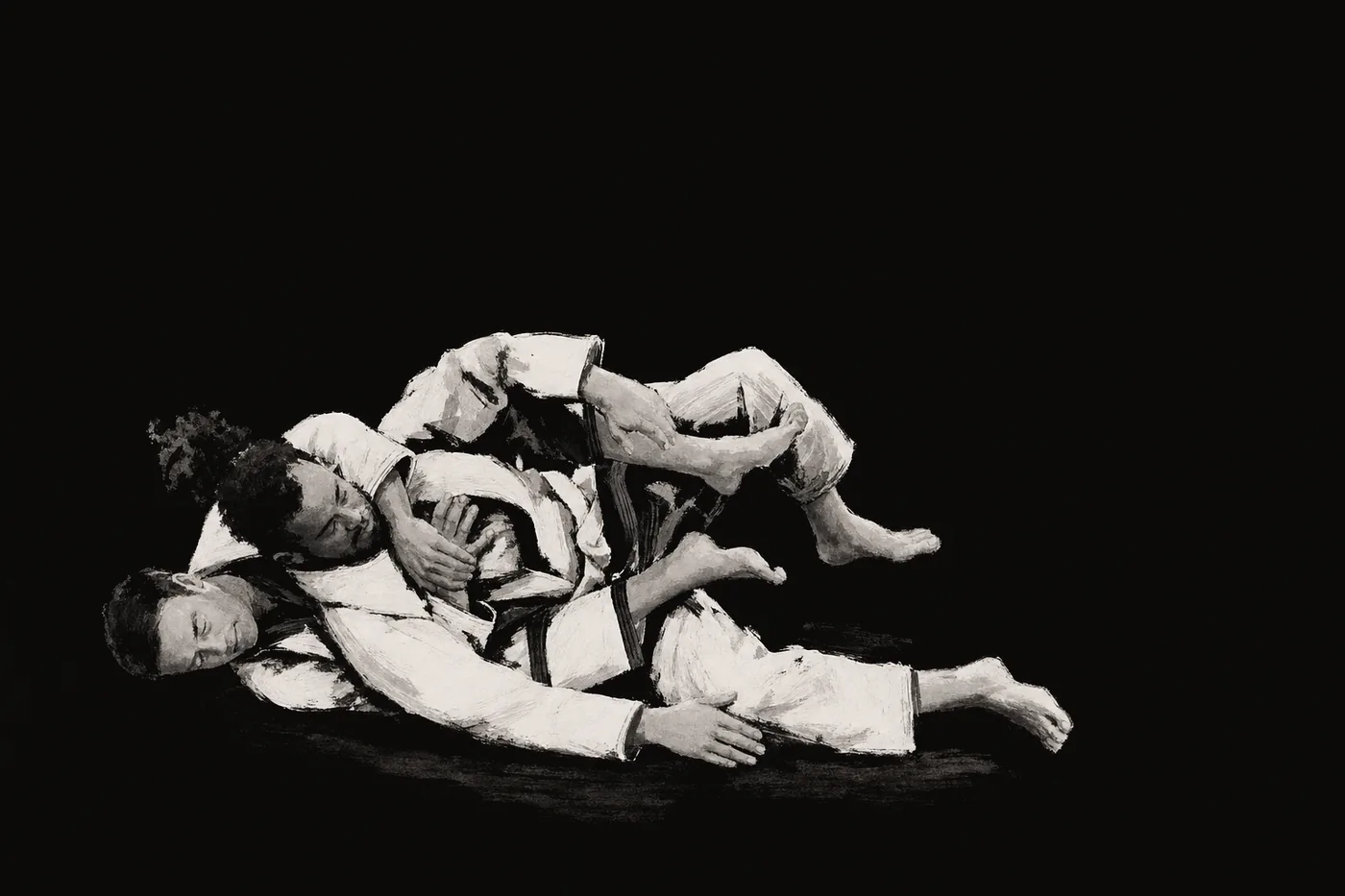
Learn / Jiu Jitsu / Systems / Taking the back when they turn away from the pass, in the gi
Turtle · back-take it · gi
Taking the back when they turn away from the pass, in the gi
Chest to his back the moment he turns away, the seatbelt locked low, drive and wait for him to try to come up, the foot through the gap, roll, the second hook, hold. You are passing and he turns to his knees instead of taking side control, and you end up chasing him round instead of taking the back. The spine below is Chewjitsu's near-side slide in the gi, one coach and one route in his own orientation: chest to his back as soon as the shoulders show, the seatbelt locked low with the right arm over his near shoulder, the left under his far armpit and the elbow on the mat, drive and wait for him to try to come up (he has to turn his hips toward you and kick the near leg back), the right foot through the gap that opens (never the knee), turn onto your right side and roll onto your back pulling with the seatbelt, the left foot the second hook, and back control held three seconds. His far-side roll for the man who beats you to the turtle, the chair sit when he hides the hook, the chokes and the crucifix when he stalls, and the back taken from the pass itself are references from their own set-ups. Seventeen gi clips and three no-gi ones for the principles, every no-gi cue marked, transcripts read and cited to the transcript chunk, one orientation written out below.
Key takeaways
- Success means Both hooks in, heels between his thighs, the seatbelt on, held three seconds.
- The spine is 5 steps after the gate, chest to back as soon as you see his shoulders, the seatbelt, locked low, your right elbow on the mat, and drive, keep driving and wait: when he tries to come up he turns his hips toward you and kicks the near leg back, the near-side slide: posted on your right elbow and left foot, your right foot through the gap, and turn onto your right side, roll to your back, the left foot hooks his left thigh, and hold.
- When it breaks there are 8 named branches; learn the triggers, the responses are short.
- Evidence: 20 clips from 12 channels (11 clips from a coach's own channel, 6 from a gym's, 3 from an instructional publisher's), every timestamp checked against the spoken transcript. Sentences marked synthesis are the editors', not a coach's.
chest to back before anything
Your chest on his back the moment his shoulders show, before the seatbelt, before a hook. Chewjitsu's rule: as soon as he can see the shoulders he wants his chest connected to the back, because that is already the back and everything else comes from it. Rob Biernacki says the same thing anatomically on Kesting's channel: the sternum slides from the side of his shoulder to behind his shoulder blade, so he cannot turn back into you. Giles, coaching the bottom, says the same from the other side: once the top has his chest behind your back with the seatbelt he gets the back nine times out of ten, so the bottom's whole job is to stop the hands connecting.
 1:23Chewjitsu (Nick Albin)giI want to get my chest connected to the back; as soon as I can see those shoulders I want to get my chest connected, because this is back now
 0:43Rob Biernacki · Grapplearts (Stephan Kesting)giI have slid my sternum from the side of your shoulder, from your deltoid, behind your scapula, where I can now prevent you from turning back into me, and establish my seat belt
 0:52Lachlan Giles · Absolute MMAno-gino-gi: bottom view, do not let them connect their seat belt; if he has got his chest behind my back with the seat belt, nine times out of ten they are going to get your back
the seatbelt low, the elbow on the mat
One arm over his near shoulder, the other under his far armpit, the hands joined low on his chest so the over-arm's elbow rests on the mat in front of him. The seatbelt is the control that lets you drive and lets you pull; Chewjitsu locks it low so his elbow is on the mat, and says the grip moves around the body as he needs it. Tinoco's detail is where you pull: over his shoulders, diagonally, not straight into you and not over his head; two knees on the mat and a pull into yourself is why beginners cannot move him.
3:04Chewjitsu (Nick Albin)gimy lock on this initial seat belt is going to be down here so I can have my elbow on the mat2:43Chewjitsu (Nick Albin)githe seat belt can move around the body depending on where I need to 0:21Marcos Tinoco · BIG OSSgiseat belt; usually seat belt is the one that gives you a good control2:07Marcos Tinoco · BIG OSSgipulling your partner over the shoulders, not over the head
the foot through the gap, not the knee
When he tries to come up he turns his hips toward you and his near leg kicks back, and the gap that opens under his thigh takes a foot, sliding in, not a knee shot in. This is the whole of the near-side slide. He cannot come up to his back with you lying on him; to get his hips to the mat he has to kick the near leg back, and that is the gap. Chewjitsu shoots the foot through it and does not like the knee: a knee shot in lets him roll up and slide out. Giles, again from the bottom, names exactly this threat: if I give a big gap as I roll up he slides his foot through and has a hook straight away.
2:03Chewjitsu (Nick Albin)gihe has to kick that leg back just a little bit so that he can get his hips to the ground, and as he does this it creates a gap that I can shoot my hook into; this is why I call it the near side slide, you are almost sliding into it2:23Chewjitsu (Nick Albin)giif he shoots at me and tries to pull me back all I can do is roll up and I can start to slide out of this, so I am not a big fan of the knee; I am actually shooting the foot through the gap4:05Lachlan Giles · Absolute MMAno-gino-gi: bottom view, if I give a big gap he might slide his foot through there and get a hook straight awaythe finish is a position, not a moment
Both heels between his thighs, the legs not crossed, the seatbelt on, and nothing happening for three seconds. Chewjitsu puts the hooks in and takes his four points before he plays anything else; Biernacki says the tournaments require the hooks held three seconds and calls it obnoxious, and holds them anyway. synthesis The three-second count is this document's test of the endpoint, the author's; the footage shows the position and how long Chewjitsu happens to hold it while he talks, not a referee.
4:06Chewjitsu (Nick Albin)giif I am competing I will put my hooks in, get my four points or whatever, and then go back and play a half back position3:47Rob Biernacki · Grapplearts (Stephan Kesting)gimost tournaments require you at this point to hold the hooks for three seconds before you get points; we want to get here firstsuccess means
synthesis Back control held: both heels between his thighs, each foot on its own side, the legs not crossed, the seatbelt locked at his chest, and nothing happening for three seconds (the count is the session's test, the author's; the stills show the position for about three and a half seconds in the first angle and two and a half in the second). One hook with the other leg outside is not the endpoint; the seatbelt with your chest on his back and no hooks is the start of the route, not its end; a foot between his legs as he rolls is a release, not a hold. B1, B3, B6 and B7 end where their coaches end them and do not claim this position.
the situation
You are passing his guard on his right side and, rather than accept side control, he turns away onto his knees with his right shoulder still down toward the mat and his knees folded to his left, his head down and his hands in front of him; you are a step ahead of him, kneeling at his right side with your hands on his back before he has settled into a square turtle; he has not yet stood up, has not yet rolled through, and has not yet balled up with the elbows tucked to the knees (those are threats, branches and resets)
the endpoint
Back control: you under him on your back with your right foot hooked inside his right thigh and your left foot inside his left thigh, both heels between his thighs and your legs not crossed, the seatbelt locked at his chest, held for three seconds; the count is the session's test, the author's; the stills show the position for about three and a half seconds at 2:12.5 to 2:16 and about two and a half seconds at 3:19.5 to 3:22
you start with
- You kneeling at his right side
not solved here · cooperative resets
- The standing scramble once he is on his feet
- The completed roll to guard before your chest is on his back
- His sit-back or hop-over once the seatbelt is on (no counter is qualified; a reset)
- A foot between his legs while he rolls over his far shoulder (released at once)
- The chokes, the crucifix and the turnovers in the references (never played)
- The far-side roll and the chair sit (references, not drilled)
Sides. One orientation throughout, Chewjitsu's own, mirrored when you pass on his left side: you are at his right side; your chest goes onto his back with your head over his far (left) shoulder and your right hand posted on the mat in front of him; the seatbelt is your right arm over his right shoulder and your left arm under his left armpit across under his chest, the hands joined low at his chest so your right elbow rests on the mat in front of him; when he tries to come up he turns his hips toward you and kicks his right leg back; posted on that right elbow and your left foot, your right foot slides through the gap into his right thigh; you turn onto your right side and roll to your back pulling the seatbelt back; your left leg comes over his left thigh and the left foot hooks inside it. Chewjitsu speaks in my chest, my seat belt, my elbow on the mat, that leg he kicks back, the gap, my foot, posted on my foot and opposite elbow, the second hook; which arm, which foot and which side are read from stills of his clip, and the limitations say so.
what it is worth
Back control scores 4 once your heels are between his thighs, your legs not crossed and at most one of his arms trapped below the shoulder line, held 3 seconds (article 4.5); that is the endpoint. The pass you were making scores 3 only if he lands in side control or north-south under you for 3 seconds (4.2), which he denies by turning away; the turtle itself scores nothing. Separately, the rulebook gives the passer an advantage when he stacks the opponent or lets him roll back to all fours and controls his back in that four-point kneeling position with at least one knee on the ground, without hooks (5.6.2), awarded on the timing rules of 5.5; the shoulder-down seatbelt in this document's start is not by itself that control. A back control reached but not held, or with the legs crossed or one heel in, is an advantage too (5.1, 5.2, 5.6.5). None of this is a referee's call in training: the session's success is the position held and counted.
Article 4.5: back control with the heels between the thighs, legs not crossed, at most one arm trapped and not above the shoulder line, 3 seconds; 4.2: the pass, surmounting the legs and holding side control or north-south for 3 seconds; 5.6.2: an advantage from the guard pass when the passer stacks the opponent or allows him to roll back, controlling his back in four-point kneeling position with at least one knee on the ground, without needing hooks; 5.6.5: an advantage from back control with both arms trapped, or with the legs crossed, a figure-four round the waist or only one heel between the thighs; 5.1 and 5.2: advantages for positions reached but not held or nearly completed
Source: IBJJF Rules Book v6.1 2024 (the current PDF from ibjjf.com/books-videos, read from the ligabjj.com mirror), articles 4.2, 4.5, 5.1, 5.2, 5.6.2, 5.6.5; read 2026-09-10
— the spine · learn this week
Chewjitsu's near-side slide
One coach's route from the moment he turns away to back control held, in his own orientation: you at his right side, the chest on his back, the seatbelt with the right arm over his right shoulder and the left under his left armpit, locked low with the right elbow on the mat, the drive and the wait for him to try to come up, the right foot through the gap posted on the right elbow and left foot, the turn onto your right side and the roll to your back, the left foot the second hook, the hold. Step 3 is his move: the route waits for it, and the session names the reset when it does not come. Biernacki, Tinoco and Giles supply checks on what the position is and why the details matter, never a step; the other routes are branches from their own set-ups.
-
GATE
Read it: he turns away from your pass onto his knees, and you are at his right side
You are coming round his legs on his right side; instead of taking side control on his back he turns away onto his knees, his right shoulder still down toward the mat and his knees folded to his left. You are ahead of him: kneeling at his right side, hands on his back, not chasing round to his front.
The situation is the pass that is about to land: you are passing on his right side and he turns away rather than accept side control (0:42 to 1:23). Chewjitsu's near-side slide is for when you are a step ahead of him, already coming round and already thinking back rather than pass. What the stills show at 1:21 to 1:27 is not a square turtle: Adam has turned away onto his knees with his right shoulder down toward the mat and his knees folded to his left, his head down and his hands in front of him, and Chewjitsu is kneeling at his right side with both hands on his back before anything else is done (.frames/start-0aoKhREb6a4.png); the same shoulder-down shape is the start of the second angle at 2:51 (.frames/angle2-0aoKhREb6a4-1.png). Nothing is grabbed yet; the first contact is the chest.
0:42Chewjitsu (Nick Albin)gifrom the turtle position, or when someone is turtling: I am passing the guard, they begin to roll up here to go to the turtle; two back takes, the near side slide and the far side roll1:02Chewjitsu (Nick Albin)giI am a step ahead of them, I am coming around for the pass, I see them turtling and I am thinking I am going to do this near side slide; as soon as he turns -
1
Chest to back as soon as you see his shoulders
Slide your chest onto his back from his right side, your body along his right, your head over his far shoulder, your right hand posted on the mat in front of him.
The moment his shoulders show, put your chest on his back; do not wait for grips. At 1:30 to 1:36 Chewjitsu's chest is across Adam's upper back from Adam's right side, his head over Adam's far (left) shoulder and his right hand posted on the mat in front of Adam's hands (.frames/start-0aoKhREb6a4.png). This is already the back, in his words: from here he has submissions and can take the back much more easily. synthesis The right hand posted is what the stills show at 1:30 to 1:36; it is a base, not a grip, and it becomes the over-arm of the seatbelt in the next step.
-
2
The seatbelt, locked low, your right elbow on the mat, and drive
Right arm over his right shoulder, left arm under his left armpit, hands joined low in front of his chest so your right elbow rests on the mat in front of him; then drive your chest into him.
Now the seatbelt. Your right arm, the outside arm on his right side, comes over his right shoulder, the near one, and its forearm hangs down beside his neck to the mat: the right elbow rests on the mat in front of his chest. Your left arm goes under his left armpit, the far one, across under his chest, and the hands join low in front of his chest (1:36 to 1:51 from the first angle, .frames/route-0aoKhREb6a4-1.png; 2:51 to 3:09 from the second, .frames/angle2-0aoKhREb6a4-1..2.png and the close crops .frames/arms-0aoKhREb6a4-1..4.png: at 3:01 to 3:06 the right sleeve comes down over Adam's near shoulder beside his neck with the elbow to the mat, and the left hand appears under Adam's chest on the near side, where Adam's upper hand, his left, grips the wrist; at 3:05.5 to 3:06.5 the left hand closes over the right fist, a cup over the fist rather than a palm-to-palm grip, low in front of his chest). Chewjitsu locks it low on purpose: the lock down at the chest is what puts his elbow on the mat, and the grip can move around the body later as he needs it. Then drive into him: if he realises he has given the back, coming back to guard is now very hard.
1:43Chewjitsu (Nick Albin)ginow I am going to get my seat belt, get the grip here, and I am going to drive into him; if he realises he made a mistake it is going to be really tough2:43Chewjitsu (Nick Albin)giI have just passed the guard, I have got my seat belt connection; the seat belt can move around the body depending on where I need to3:04Chewjitsu (Nick Albin)gimy lock on this initial seat belt is going to be down here so I can have my elbow on the mat -
3
Keep driving and wait: when he tries to come up he turns his hips toward you and kicks the near leg back
Stay heavy on him with the seatbelt. If he tries to come up to his back he has to turn his hips over toward you, and to get them to the mat he kicks his right leg back; that kick opens the gap under his right thigh. If he does not try, there is no gap, and the rep ends in the reset named below.
This step is his, and you cannot make it. What you do is stay on him: with you lying on him with the seatbelt he cannot come up straight, and even a tight knee-in does not let him. So if he tries to come up to his back he turns his hips over toward you and kicks his right leg, the near one, back a little to get his hips to the ground (1:51 to 2:00 in the stills: Adam's hips turning toward the camera, his left knee coming up and his right leg extending back; 3:09 to 3:12 from the second angle). As he does it a gap opens between his right thigh and the mat. That gap is the near-side slide, and Chewjitsu says you feel it rather than see it. synthesis If he never tries, this document has no answer tonight: the chokes and the chair sit for the man who stays are references (B3 to B5), and the session's rule is a hold and a reset (B8).
1:43Chewjitsu (Nick Albin)gias he begins to go up to the back mount here he is going to have to turn his hips over; if he tries to block this knee in and stay really tight, if he tries to come up like this with me laying on him he is not going to be able to do that2:03Chewjitsu (Nick Albin)gihe has to kick that leg back just a little bit so that he can get his hips to the ground, and as he does this it creates a gap that I can shoot my hook into8:02Chewjitsu (Nick Albin)githe same thing with the near side slide: a lot of times you are driving in, they expose the back and you just feel it -
4
The near-side slide: posted on your right elbow and left foot, your right foot through the gap, and turn onto your right side
Post on your right elbow and your left foot, like a technical stand-up; shoot your right foot, not the knee, through the gap under his right thigh; as it goes in, turn onto your right side and pull the seatbelt grip back toward you.
Your base is the right elbow, already on the mat from the seatbelt, and the opposite foot, the left, posted behind you: Chewjitsu's picture is a technical stand-up, posted on a foot and the opposite elbow, which leaves the other knee free to move wherever he needs it. The free leg is the right. Turn the foot in and shoot it through the gap under his right thigh, toes first, sliding; you are almost sliding into the hook rather than putting it in (the entry is read from the second angle, 3:11 to 3:14.5, .frames/post-0aoKhREb6a4-1..2.png at half seconds and .frames/feet-0aoKhREb6a4-1..2.png at quarter seconds: at 3:12 to 3:12.5 the left foot is planted behind with the toes down while the right leg, the leg that continues from his right hip with his belt tail draped across it, threads under Adam's right thigh, and at 3:13 to 3:14.5 that right leg is under his thigh with Chewjitsu turning onto his right side; in the first angle, 2:00 to 2:06 in .frames/legs-0aoKhREb6a4-1..2.png is the set-up, Adam's hips turning and his leg kicking back, and the entry itself falls between 2:06 and 2:12, which is not sampled at half seconds). Not the knee: shooting the knee through leaves the foot out, and he can roll up and slide out of it. As the foot goes in you turn onto your right side, and on the seatbelt you pull the grip back toward you to bring him with you.
3:24Chewjitsu (Nick Albin)giwe are right here locked in, he begins to go, I am going to be posted on my foot and opposite elbow, like doing a technical stand up3:44Chewjitsu (Nick Albin)githis allows me to take my knee and move it around wherever I need to; I am going to turn my foot in and shoot it in position and then pull the person in2:23Chewjitsu (Nick Albin)gisome people will shoot the knee in; if he shoots at me and tries to pull me back all I can do is roll up and start to slide out; I am actually shooting the foot through the gap3:04Chewjitsu (Nick Albin)gias he begins to drive up I turn, shoot my foot through; now on the seat belt I am going to pull this grip back to pull it back into the position and get that second hook in -
5
Roll to your back, the left foot hooks his left thigh, and hold
Pull with the seatbelt and roll from your right side onto your back so he lands on you; your left leg comes over his left thigh and the left foot hooks inside it; both heels between his thighs, legs not crossed, the seatbelt still on; hold three seconds.
Keep pulling the grip back and roll from your right side onto your back: he comes with you and lands on top of you, face up. Now the second hook: your left leg, the free upper leg, swings over his left thigh and the left foot hooks inside it (2:12 to 2:12.5 from the first angle, .frames/finish-0aoKhREb6a4-1.png and .frames/finlegs-0aoKhREb6a4-1..2.png; 3:17.5 to 3:20 from the second, .frames/hooks-0aoKhREb6a4-2..3.png, the left leg coming over the top at 3:18 and the foot inside by 3:19.5). Both heels are between his thighs, each foot on its own side, and your legs are not crossed; the seatbelt is still locked at his chest, the left hand over the right fist, with his hand fighting it. Hold it there and count three. The first angle shows the position for about three and a half seconds (2:12.5 to 2:16) before Chewjitsu lets go to explain the knee-in contrast; the second angle shows it for about two and a half seconds (3:19.5 to 3:22) before he explains the half back. synthesis Those lengths are read from the stills; the three-second count is the session's test, the author's, and Chewjitsu does not count. Where the hooks go from here (his half back, the collar) is not this document.
3:04Chewjitsu (Nick Albin)gipull this grip back to pull it back into the position and get that second hook in3:44Chewjitsu (Nick Albin)giturn my foot in and shoot it in position and then pull the person in4:06Chewjitsu (Nick Albin)giI will put my hooks in, get my four points, and then go back and play a half back position
— grip notes
- The seatbelt, which arm goes where, and the lock.
You are on his right side, so your right arm is the outside arm: it comes over his right shoulder, the near one, and its forearm hangs to the mat beside his neck, so the right elbow rests on the mat in front of his chest. Your left arm goes under his left armpit, the far one, across under his chest, and the hands meet low in front of his chest on the near side. The lock, read from the close crops at 3:05.5 to 3:06.5, is the left hand cupped over the right fist, low in front of his chest, so the right elbow reaches the mat. The grip is not fixed for the whole route; he says it moves around the body as he needs it, and at the slide he pulls it back toward himself to bring the man onto him. Adam's hand on Chewjitsu's left wrist at 1:45 to 1:51 and 3:03 to 3:09 (his upper hand, the left, in the second-angle crops) is the bottom man's defence, not part of the grip. The first draft had the arms the other way round (the right under the near armpit, the left over the far shoulder); the reviewer's reading of the close crops is adopted and checked (.frames/arms-0aoKhREb6a4-1..4.png).
- Which foot, which side, and what was read from the footage.
Chewjitsu says my chest, my seat belt, my elbow, the leg he kicks back, the gap, my foot, posted on my foot and opposite elbow, the second hook. The stills add which: you are on his right side (1:21 to 1:39, his head toward the camera and you at the viewer's left of him, his right shoulder down); the over arm is your right and the under arm your left (3:01 to 3:06); the base at the slide is your right elbow and your left foot (3:12 to 3:12.5); the first hook is your right foot, through the gap into his right thigh (3:12 to 3:14.5; the first angle's 2:00 to 2:06 shows the set-up and not the entry); you turn onto your right side and roll to your back; the second hook is your left foot over his left thigh (2:12 to 2:12.5; 3:17.5 to 3:20). Each foot ends on its own side of him, which is what lets the legs stay uncrossed. The convention: a step marked transcript reproduces the cited speech; a step marked frames reproduces the speech and adds those assignments, read from 1080p stills at one-second steps through both front angles (1:39 to 2:06 and 2:51 to 3:24), half seconds at the slide and the finish, and quarter seconds at the foot entry (.frames/*-0aoKhREb6a4-*.png). The stills settle which hand and which foot are where at the sampled moments and the order, not the pressure and not the moments between samples; a side the reviewer reads differently is adopted, and was in round 2 (the arms, the base, the entering foot and the turning side were all mirrored in the first draft). The third angle, 3:27 to 3:57, is shot from behind the pair; it agrees with the front angles on the words and is not used for any assignment on its own.
3:24Chewjitsu (Nick Albin)giwe are right here locked in, he begins to go, I am going to be posted on my foot and opposite elbow, like doing a technical stand up3:44Chewjitsu (Nick Albin)githis allows me to take my knee and move it around wherever I need to; I am going to turn my foot in and shoot it in position and then pull the person in
— when the spine breaks
8 branches
Each one names the trigger you will feel, then the response. Learn the triggers; the responses are short.
- He beats you to the turtle, and as you get your chest on his back his knee comes in and you feel his hip shift downward (Chewjitsu's far-side roll)reference onlythe back with the first hook on the far side and a rear naked choke or a collar grip started, in Chewjitsu's own words; his own end
Chewjitsu's second back take, for the man who is faster than you: he is already in turtle when you arrive. The cue is physical, his knee coming in and his hip beginning to shift down; when you feel it you jump over to the other side, a leap of faith. No traditional seatbelt and no hook here: chest-to-back connection only, your knee at his side rather than a foot, sitting to your hip, one hand cupping his pec and pulling him in tight, posted on your hand and your foot. As he falls back you stay with him and roll; you have no hook yet; the first hook goes in on the other side, biting down on the inside of his thigh to continue the roll, and as he moves people forget the neck, so a rear naked choke or a collar grip goes on and his hands come up to defend it, which is what lets the second hook in. synthesis The side you are on, which knee and which hand are not assigned from stills here (4:48 to 7:12, .frames/farroll-0aoKhREb6a4-1..7.png at 1.5-second steps show the sit to the hip, the post and the roll but were not read contact by contact), so this is a reference for another night, not a drill. It is also the reason for a safety rule in the spine: a foot left between his legs when he rolls is the foot he warns about.
4:26Chewjitsu (Nick Albin)githe far side roll is going to happen when the person beats us to the punch; he gets up to turtle and beats me to the position, so we are going to roll on the far side4:48Chewjitsu (Nick Albin)githe cue that is going to tell me to go for this roll is this knee comes in and I can feel his hip begin to shift downward; when I feel that I have got to jump5:08Chewjitsu (Nick Albin)giI am not going to be using a traditional seat belt grip and I am not trying to put my hook in here either; I am trying to keep my chest to back connection5:28Chewjitsu (Nick Albin)giI am going to take my knee and sit to the side here, notice I am on my hip; we are not taking our foot and going in, we are putting our knee there5:48Chewjitsu (Nick Albin)giwhenever I feel him shift I am going to post, as he begins to fall back I am just staying with him; I do not have a hook, my first hook is going to be on the other side, I will bite down on the inside of his thigh to continue this roll6:10Chewjitsu (Nick Albin)giyou can roll them right into a rear naked choke or a collar grip and that allows you to get the second hook in6:51Chewjitsu (Nick Albin)gicupping his pec and pulling him in tight; the focus is to keep the chest to back connection alive; he begins to go, roll, pull in with the legs, shoot in and go- The first hook is in and he blocks the second onereference onlyChewjitsu's half back: one hook in, his body extended, and then the second hook when it comes; his own end
If he blocks the second hook after the slide, Chewjitsu locks into a half back position, extends his body out and then goes in for the hook. He says that on this side, competing, he most often takes the hooks for the points first and then goes back to the half back anyway. synthesis What the half back looks like contact by contact is not read from stills (3:57 to 4:26 shows it in a wide shot only), so tonight a blocked second hook is a hold, not a fight: keep the first hook and the seatbelt, wait, and if it does not come, reset.
3:44Chewjitsu (Nick Albin)giif for some reason he blocks this second hook I will lock into a half back position here and extend his body out4:06Chewjitsu (Nick Albin)giand then go in; in most cases if I am competing I will put my hooks in, get my four points, and then go back and play a half back position- You have the seatbelt but he hides the near hook, elbow to knee, and does not try to come upreference onlythe chair sit: him elevated and rotated over onto the far side with your chest still on his back, then the hooks or the body triangle, in Rob Biernacki's words on Kesting's channel; Giles's version after sitting him up; their own ends
Two coaches, the same door. Rob Biernacki's chair sit, taught on Stephan Kesting's channel with Kesting as the partner, from side control as he turns away: the sternum behind his shoulder blade and the seatbelt, then the knees off the ground to drive him further over, one knee up behind his head, the elbow off the mat and onto that thigh so everything tightens, the other foot in base; the shin or foot goes against his hip, not straight to a hook, so he cannot walk the hip away; then pull without detaching, push off with the leg and the arm to elevate him, rotate him to the other side, feet together for a moment, then decide on the hooks or the body triangle. If his knee is up and you cannot open the space with the foot on the hip, he switches to kimura control. Giles, in the gi, arrives at the same chair sit from a different door: when the man hides his hook he sits him up first, leans him away from the side he wants to hook, is far forward rather than back, swings the leg across the hip rather than to the middle and falls to the other hip; and if the man defends everything from there he pulls him back down onto his shoulder and chair-sits from in line behind him, stepping on the thigh to push and go across. synthesis Neither coach's sides are assigned from stills in this document; the chair sit is the next drill to qualify, not tonight's.
0:22Rob Biernacki · Grapplearts (Stephan Kesting)gionce someone starts to turn away and we have managed to establish our chest to back connection and our seat belt, this is where I am going to pursue my chair sit1:03Rob Biernacki · Grapplearts (Stephan Kesting)gibring my knee up so that it is resting behind your head; I have transitioned my elbow from the mat to resting on my thigh and that tightens everything up1:23Rob Biernacki · Grapplearts (Stephan Kesting)gimy left foot is going into base; a common error is to have your knee down; I am putting pressure on your hip with my shin1:46Rob Biernacki · Grapplearts (Stephan Kesting)gia common error is to go directly to a hook and now I do not have full control of the bottom side of your hip2:27Rob Biernacki · Grapplearts (Stephan Kesting)giwhen I pull it is important that I do not detach; I want to maintain chest to back connection and keep my elbows flush2:47Rob Biernacki · Grapplearts (Stephan Kesting)giI am rotating you to the other side; I am going to place my feet together for a second and then decide if I am going to the body triangle or the hooks5:55Rob Biernacki · Grapplearts (Stephan Kesting)giif you cannot open this space up we are going to switch to the kimura control and take the back from there 0:43Lachlan Giles · Absolute MMAgiwhenever someone is protecting their hook it is an option to start coming out and sitting them up and attacking from here1:24Lachlan Giles · Absolute MMAgiI am going to lean him away from the side I want to put my hook so that it opens more space, and be quite forward; if I am back like this I will have a very difficult time swinging my leg over3:09Lachlan Giles · Absolute MMAgimake sure you are not on your knees, you will not be able to get your hook; he can swing his leg not to the middle but across my hip7:38Lachlan Giles · Absolute MMAgiif I cannot get at the neck here, I can pull him back down and do a regular chair sit8:40Lachlan Giles · Absolute MMAgithe angle I want is to be pretty much in line with him; as I pull him down my knee is right underneath, I am seated forward9:01Lachlan Giles · Absolute MMAgistep on the thigh, push and then go across; you will not be able to do that from side on
- He balls up in turtle and stays, elbows to knees, giving no turn at allreference onlya choke from the turtle: the clock choke (Kesting, John Machado), the spinning collar choke (Jean Jacques Machado), or Giles's collar choke after sitting him up; submissions, with the tap rules below
If he stays, the gi gives you his collar. Kesting's clock choke in five steps: the knee driven between his elbow and his knee with your weight on him so he cannot get away; the lapel opened and a grip across his neck, fairly deep, not crazy deep; the other hand on his wrist (his preference) or the far lapel; then the ribs slide onto his neck, almost falling off his body with your own head on the ground; then walk the legs round like the hands of a clock. John Machado's details: the grip across the neck does not need to be tight, the collar tightens as he moves; hold the leg or the arm on the outside, never inside, because inside is easy to be rolled; get the body across his shoulder so the hip touches his shoulder. Jean Jacques Machado's rules for the turtle: knees behind your hip line so the weight goes forward, the body controls him and not the hands, one knee in the middle of his side, your head not past his head line or he rolls you, the hand over to hold his lapel, the knee between his elbow and his knee so that there is a hole for the hand however he defends, and if he rolls either way the hand stays in front of his shoulder; his spinning collar choke is one hand over the shoulder to the lapel, the other on the gi outside, roll the body, elbow in, head down. Giles, when the man is balled up and hides the hooks, takes one lapel straightened and feeds the other hand under the chin to it, forearm tight against the chin, then reaches to the other lapel too so both lapels are secured; he pulls the man back and down onto the shoulder on the choking side, pulling down with the opposite lapel and circling him down to that side, and rows both elbows back. synthesis All of these are submissions and none is drilled tonight; they are the reason a stalling turtle is not a reset in a match, and a reset here.
 0:00Stephan Kestinggia clock choke goes across the neck; step one is not to let him get away: take my knee, drive it between his knee and his elbow, put my weight on him0:22Stephan Kestinggistep two is to open up the lapel and get a grip across the neck; I do not need to go super crazy deep, I just need to go fairly deep0:43Stephan Kestinggistep three: variation one, grab the wrist; variation two, grab the other lapel; I prefer variation one, this stops him from being able to move1:05Stephan Kestinggistep four is I slide my ribs onto his neck; there are people who try and do it from here but he can move1:27Stephan KestinggiI slide forward almost like I am falling off of his body, I put my own head on the ground, then I begin to walk my legs forward
 0:21John MachadogiI am looking for this grip across the neck; it does not need to be too tight, the collar tightens around his neck as he moves0:43John Machadogitwo choices: I hold the leg or I hold the arm, on the outside, not inside; inside is very easy to be rolled1:24John Machadogibring my body across the shoulder; the key is to get your hip to touch his shoulder
 0:01Jean Jacques Machadogiif you want to use your body weight keep your knees behind your hip line; my weight is going forward0:21Jean Jacques Machadogimy body is what controls his body, not my hands or my arms; most people hug and end up pulling guard1:02Jean Jacques MachadogiI do not want to pass my head to his head line, because he is going to roll me; my outside hand holds his lapel; my knee between his elbow and his knee makes it hard for him to defend, because no matter how much he puts the hand there, there is a hole1:43Jean Jacques MachadogiI want to make sure my left hand is in front of his shoulder if he rolls back
 0:21Jean Jacques Machadogione of my hands goes over the shoulder to grab the lapel and my second hand just grabs the gi outside1:01Jean Jacques Machadogias I am coming down I lock my elbow in, I have my head right here, a nice choke4:53Lachlan Giles · Absolute MMAgitake one lapel, straighten it, and feed my other hand underneath the chin to grip that same lapel5:13Lachlan Giles · Absolute MMAgithen I would reach to the other lapel too; now I have got both lapels secured; I am going to pull him back and then down onto his left shoulder6:14Lachlan Giles · Absolute MMAgicome back with my forearm in tight against the chin and slide under; it is not the lapel that chokes, it is my forearm6:55Lachlan Giles · Absolute MMAgigrab the opposite lapel, pulling down with that, and then circle to pull him down to the same side as my choking arm5:33Lachlan Giles · Absolute MMAgiI can get him down onto this shoulder and start to row both elbows backwards; I can choke
- He stays in turtle and his elbow is out, or you have a knee between his elbow and his knee and his arm is loosereference onlythe crucifix or the forearm trap turnover, in the coaches' words; submissions, with the tap rules below
Kesting's two easiest turtle attacks for a beginner: from the crossface side, the knee driven between his elbow and his knee so he is no longer balled up, the top hand across to capture his forearm, the other hand under his body to capture it too, low near the elbow for leverage; drop the chest, drive off the toes, turn him over, and a reverse arm triangle is there if he leaves the arm. It is a jab, he says: unlikely on anyone good, but it makes him respond, and an elbow put way out to avoid it opens the clock choke. And when he is purely defensive and not much bigger than you: hunt the material at his elbow and at his knee, pop to your feet like a push-up, back up and straighten into the knee mount. Jean Jacques Machado's crucifix primer is the same knee in the space and the arm trapped as he turns to face you, then sitting to the ground and opening the leg so he is inside your legs with the arm caught; and his detail for once the crucifix is on, with his arm already trapped by your legs: do not stretch him, keep your elbows on the ground, because an elbow up is room and his shoulder is free, and with the elbows down he cannot turn toward you or slide away, and as he moves you are choking. synthesis Submissions and turnovers on a joint: observation only tonight, and Machado's elbow detail belongs to the crucifix already locked, not to the seatbelt on a turtle.
 0:21Stephan Kestinggithe first attack comes off the cross face; I take my knee and drive it down between my opponent's elbow and knee, now I have separated his elbow and his knee0:42Stephan Kestinggitake my top hand, the hand closest to his head, come across and capture his forearm; take my other hand, come underneath his body and capture his forearm as well1:03Stephan Kestinggithe lower down the better; drop my chest a little bit, drive off my toes and turn them over2:03Stephan Kestinggihe puts his elbow way out; he is reducing his ability to defend the choke, maybe I can go for the clock choke3:05Stephan Kestinggihunt for the material around his knee; I put my weight on, like doing a push-up, pop to my feet, back up while straightening up and go directly into the knee mount3:50Jean Jacques Machadogitracking his arm; he comes facing me, as soon as I am doing that I trap; he comes towards me, I sit on the ground, open my leg4:12Jean Jacques Machadoginow he is in your guard, you can finish from here; your legs surround his arm
 0:00Jean Jacques Machadogido not stretch your opponent, because that makes it easier for him to slide away from you0:21Jean Jacques Machadogimy elbows on the ground; if my elbow is up there is room, his shoulder is free; you cannot turn, you just step with me, because that elbow is on the ground0:42Jean Jacques MachadogiI want to trap both shoulders, keep it on the ground; as he is moving I am choking
- You cannot find the seatbelt at all on a tight turtlereference onlyGracie Barra Jupiter's double-unders forward roll to the hooks, in the coach's words; their own end
From on top of the turtle with no seatbelt, both arms go under his armpits with a deep grip, and the forward roll they drill for takes him over: get on top, roll, and the hooks are there; then a collar is fed for the bow and arrow. synthesis The coach is not named on the channel and the sides are not read; a reference for the day the seatbelt is not there, and the roll needs mat and a partner who knows it is coming.
 0:00Gracie Barra Jupiter and Stuart (coach not named)giI come on top of turtle, I cannot find my seatbelt, so I am going to double unders; get a nice grip, not shallow; this is why we do our forward rolls; I get on top, I roll, now I have the hooks0:22Gracie Barra Jupiter and Stuart (coach not named)gimy left hand comes out, I am going to feed the collar and pull this, because if I do not he is going to escape to that side
- One step earlier: you are still on the knee cut or the half guard pass and he is starting to turn awayreference onlythe back taken from the pass itself, in Lepri's, Neven's and the Full Metal coach's words; their own ends
Lepri's principle for the pass that turns into a back take: position yourself so he has to turn, not too high on him. If the head is too high he cannot turn much; block just the hips with the shoulder and he will turn, and when he starts to raise the hips a little that is the moment to jump to the other side: hand on the mat on the other side, the knee in, the foot, the heel connected to the knee, drag him back; the knee slides in and pinches, because with just the knee he can turn the hips away and escape; if his hips come too high, the knee behind his lower back pushes it down and the foot goes in front. His short clip says the same: when he tries to turn, the knee comes in, not the foot, lock the arm, push down and climb. Neven's knee shield pass to the back: break the collar grip, feed his hand between his legs and catch the sleeve, switch the hips, grab the belt, trap the leg, roll to the side and shoulder, kick the trapping leg down while pulling the elbow to the hip, collar grip, shrimp out, the hook, sit up. Full Metal's knee slide to the back: drive to the opposite side while he holds on, triangle the legs to stay connected, roll over that side of the body, hooks. synthesis These are the same moment one beat earlier and are references: none has its sides read here, and Lepri's route puts the knee in where Chewjitsu puts the foot; the two are different entries, not a contradiction to be resolved tonight.
 2:27Lucas Lepri · Bernardo Faria BJJ Fanaticsgiif I put my head too high he cannot turn much; if I put my head like a pillow, blocking just the hips, he is going to be able to turn3:08Lucas Lepri · Bernardo Faria BJJ Fanaticsgiwhen he starts to raise the hips a little bit, that is the time I am going to jump to the other side to take the back; look how my shoulders are blocking the hips3:49Lucas Lepri · Bernardo Faria BJJ Fanaticsgiaction and reaction: put my hand on the mat on the other side, put my knee in and my right foot; connect my heel to my knee, drag him back4:50Lucas Lepri · Bernardo Faria BJJ Fanaticsgislide my knee and pinch; if I have just my knee he can turn the hips away and escape7:18Lucas Lepri · Bernardo Faria BJJ Fanaticsgiknee behind your lower back, push your lower back down, and then I put my foot in front
 0:01Lucas Leprigiwhen he tries to turn, with my hand I block; my knee comes in, not my foot, just my knee0:22Lucas Leprigilock the arm, grab over here, push down, start climbing, big shoulder and go to the back
 1:18Jordan Nevengifeed his hand in between his legs and catch the sleeve; switch my hips onto my right hip, grab his belt and turn around2:00Jordan Nevengiusing my left foot I kick it straight down while pulling my elbow to my hip; grab the collar, shrink my hips out, he falls into that space
 0:22Nathan · Full Metal Jiu Jitsu (surname not given)giI am driving over to the opposite side; I still need him to hold on0:42Nathan · Full Metal Jiu Jitsu (surname not given)giI can triangle lock, which shows that I am connected; from here I need to roll over this side of my body, get my hooks in
- The cooperative resets: he does not try to come up; he stands up; he rolls through to guard before the seatbelt; he sits back or hops over once the seatbelt is on; the seatbelt is on but he is rolling with your foot between his legs; he blocks the second hook and it does not comecooperative resetrestart from the start position, or stop
synthesis Six ends that are not this document's. He does not try to come up: hold the seatbelt and the drive for ten seconds, release and restart (the stalling turtle belongs to B3, B4 and B5, references tonight). He stands up out of the turtle: the standing scramble is another entry; reset. He rolls through to guard before your chest is on his back (Tinoco's near-shoulder roll, Kesting's granby): the guard-passing documents own it; reset. He steps the near leg and sits back onto you, or hops over to top, once the seatbelt is on (Tinoco's escapes): this document has no counter qualified for either; stop, release, restart. He starts to roll while your foot is between his legs: release the foot at once, whatever the position, because that is the foot Chewjitsu has seen broken; reset. He blocks the second hook: hold the first hook and the seatbelt for a count of five, and if it does not come, reset (B2 is a reference, not a fight). A choke or a crucifix from the references is never played; a caught arm or neck is a tap and a release.
5:28Chewjitsu (Nick Albin)giif I throw this foot in and he begins to roll my foot may get stuck and I have seen people get their foot broken that way 1:03Marcos Tinoco · BIG OSSgithere is a split second when he connects the seat belt; before the transition I roll on the near side shoulder3:55Marcos Tinoco · BIG OSSgihe has the seat belt; I step the near leg, sit back; hip, step up, shoot my knee in and get to my guard
— negate first
Threat map
Some of the clips on the left show the coach performing the attack; watch them once so you recognise it. The answer on the right is a spine step, a branch, or marked as synthesis.
- He rolls over the near shoulder before the seatbelt connects
-
what they are doing
0:41Marcos Tinoco · BIG OSSgiwhen he has the headlock position and uses it to transition to my back, that is where the problem happens; do not let the person get to that seat belt1:03Marcos Tinoco · BIG OSSgithere is a split second when he connects the seat belt; before the transition, when he goes, that is when I roll on the near side shoulder1:23Marcos Tinoco · BIG OSSgiI roll as fast as I can and then get to my guard; people wait too long and then the person gets the back1:13Lachlan Giles · Absolute MMAno-gino-gi: bottom view, as soon as I start to turn away, block the arm, the one that you can reach, and make it difficult for him to connect his handsyour answer
Recognise it: your chest is not on his back yet, or your hands are not joined, and he is already rolling toward you over his near shoulder to put you back in guard. The route's answer is speed and order: chest to back the moment the shoulders show (step 1), the seatbelt before the drive (step 2). Kesting's check from the pass: as he begins to roll away, underhook the arm and drop that elbow to the ground, and he is stuck; from there stabilise, sit him up or take the back. synthesis If he beats you through, that is guard again and a reset; it is the passing document's problem.
- He sits through when you hold his body instead of the seatbelt
-
what they are doing
1:46Marcos Tinoco · BIG OSSgiif I see his arm around the back of my elbows, all I have to do is lift and sit through; he is not going to keep holding because he is going to fall around to his head2:08Marcos Tinoco · BIG OSSgihe does not have my head lock, he has my body; I take my knee off the mat, push my elbow and sit through, grab the hip and go around the backyour answer
Recognise it: your arms are round his waist or under his elbows rather than one over the shoulder and one under the armpit, and he lifts and sits through, and now he is on your back. The seatbelt is the answer, locked low with the elbow on the mat (step 2); a body hold is Tinoco's second escape. synthesis In the session the top never holds the waist; if the seatbelt is lost and he sits through, stop and reset.
- He steps the near leg and sits back, or hops over to top, once the seatbelt is on
-
what they are doing
3:55Marcos Tinoco · BIG OSSgihe has the seat belt; I step the near leg, sit back; if it falls I go on top, but I do not believe he is going to fall; sit back, hip, step up, shoot my knee in and get to my guard5:19Marcos Tinoco · BIG OSSgieven if you try to shoot this knee in under me, I want to hop over immediately and be on top; roll on the shoulders, hop, and mountyour answer
Recognise it: instead of turning his hips toward you he steps the near foot out and sits his weight back onto you, then shoots a knee in to recover guard, or rolls over his shoulders and hops over to top. These are Tinoco's escapes from an established seatbelt, taught from his own set-up, and neither cited coach demonstrates a counter to them. synthesis This document has none qualified: once either is under way, stop, release and reset (B8). The spine's foot-not-knee rule is about your own hook, not an answer to his sit-back.
- He gets his head to the other side of your over-arm, or circles and backs away
-
what they are doing
4:05Lachlan Giles · Absolute MMAno-gino-gi: bottom view, start blocking this top hand; I roll through and sit back really low, give no space at all for the hook to come through4:47Lachlan Giles · Absolute MMAno-gino-gi: bottom view, if we can get to here and his hands are not connected, the first thing I try to do is get my head to the other side of the hand; now it is difficult to take my back, any time he jumps over he is going to roll off 0:00Lachlan Giles · BJJ Fanaticsno-gino-gi: bottom view, keep moving backwards and circling away; he is not going to run around this way to take the back0:43Lachlan Giles · BJJ Fanaticsno-gino-gi: bottom view, circle and back away; there is a lot of distance to cover, he does not get great control
your answer
Recognise it: while your hands are still unconnected he blocks the top hand, the one coming over his shoulder to become the choking arm, and moves his head to the other side of it, so that any jump over rolls off; or he is walking backwards and circling out of your seatbelt line. Giles teaches both to the bottom, and both depend on the hands not yet being joined. The route's answer is earlier: the chest on his back and the seatbelt joined before he has room (steps 1 and 2). synthesis Once his head is on the other side of your over-arm, or he is circling away with distance, this document's start is gone: reset. Giles's coaching to the bottom is cited so you know what a good partner does.
- He stands up out of the turtle
-
what they are doing
your answer
Recognise it: his feet come under him and he posts to stand before the seatbelt is on. synthesis The standing scramble is another entry; in the session standing is a reset. Kesting's advice to keep one of his legs belongs to the pass itself, which he qualifies by the particular guard pass, and is a reference here, not a control the spine holds.
- A foot between his legs when he rolls
-
what they are doing
your answer
Recognise it: you have one foot between his thighs and he starts to roll over his far shoulder. synthesis Release the foot at once and reset; the far-side roll (B1) uses the knee for exactly this reason and is not played tonight.
— 20 minutes · gi
Tonight
synthesis The session is the author's; the mechanics are Chewjitsu's, from one exact start: kneeling at his right side as he turns away with his right shoulder still down. Every rep ends at the spine's endpoint, both hooks and the seatbelt counted to three, or at a named reset; the first block emphasises the chest and the belt but every rep in it runs to the hooks cooperatively; no other route is played, and the other coaches' routes are references. Two kinds of stop: the block's own reset, cooperative and named under each block, and the hard boundaries the scope lists (him standing; the completed roll to guard; his sit-back or hop-over from the established seatbelt; a foot between his legs as he rolls; any choke or crucifix), which stop everything; both restart only after the partner releases every control.
safety · stop here
No submission is attacked in this document. The route puts a foot between his thighs, and a foot left there while he rolls over his far shoulder is the foot Chewjitsu has seen broken: in the session any roll of his with your foot between his legs is a release first and a reset second, and the far-side roll is not played. The chokes (clock, spinning collar, Giles's collar), the crucifix and the forearm trap turnover in the references are submissions and joint turnovers, observation only, never drilled. The release rules are the author's.
- Your foot between his thighs as he rolls over his far shoulder (steps 4 and 5, every block). Release the foot at once and reset; the partner does not roll with a foot inside in the drills, and in the rounds he does not roll over the far shoulder at all
- The clock choke, the spinning collar choke and Giles's collar choke (B4, references only). Not drilled; if ever tried, slow, and any pressure on the neck is a tap at once
- The crucifix and the forearm trap turnover (B5, references only). Not drilled; they load his shoulder; observation only
- The seatbelt pulled high on the neck. The lock is at his chest with the elbow on the mat, not across his throat; a forearm on the throat is a release
- 1
Chest to back and the seatbelt as he turns, then the slide
5 minHe lies on his back as if you are passing on his right side; on go he turns away onto his knees with his right shoulder still down, knees folded to his left, head down, and you follow: chest onto his back with the right hand posted, then the seatbelt: right arm over his right shoulder, left arm under his left armpit, hands joined low so the right elbow rests on the mat in front of him. Say the two out loud: chest, belt. Then finish the route cooperatively at half speed: on your word he turns his hips toward you and kicks his right leg back, and you post on the right elbow and left foot, slide the right foot through, turn onto your right side, roll, the left foot over his left thigh, count three. He gives an honest early turn and no resistance. Eight reps, swap; then four each on the mirror side (his left side: left arm over his left shoulder, right arm under his right armpit, the right hand cupped over the left fist, left elbow on the mat, post on the right foot, the left foot first, turn onto your left side, the right foot second).
- 2
The near-side slide, both hooks every time
7 minFrom the exact start, cooperatively: chest to back; the seatbelt locked low; drive. On your word 'go' he does his half of step 3: he tries to come up, turning his hips over toward you and kicking his right leg back a little to get his hips to the mat, and holds there. You are posted on the right elbow and the left foot; shoot the right foot through the gap under his right thigh, foot first, turn onto your right side and pull the seatbelt grip back; roll to your back so he lands on you; the left leg over his left thigh and the left foot hooks inside; both heels between his thighs, each on its own side, legs uncrossed, the seatbelt still locked; count three out loud. He resists nothing tonight except by keeping his elbows in. Ten reps, swap, then the mirror side (you at his left side, left arm over, right arm under, the right hand cupped over the left fist, the left elbow and right foot the base, the left foot first through the gap under his left thigh, turn onto your left side, the right foot the second hook) with every hand and foot swapped.
2:03Chewjitsu (Nick Albin)gihe has to kick that leg back just a little bit so that he can get his hips to the ground, and as he does this it creates a gap that I can shoot my hook into3:04Chewjitsu (Nick Albin)gias he begins to drive up I turn, shoot my foot through; on the seat belt I pull this grip back to pull it back into the position and get that second hook in - 3
The turn on his timing
4 minThe same route, but he chooses when to try: any time in the five seconds after the seatbelt locks, he turns his hips toward you and kicks the near leg back at half speed, and you take the slide off the feel of it, not off a word. Chewjitsu's point is that both his back takes are timing, and the near-side slide is felt: you are driving in, they expose the back, you feel it. If he does not try in five seconds, that is a hold and a reset, not a chase. Eight reps, swap; both sides.
7:42Chewjitsu (Nick Albin)githe key to both of those movements to make them work is the timing; it is about being really sensitive to the movements, and so you need to drill them a lot8:02Chewjitsu (Nick Albin)githe same thing with the near side slide: a lot of times you are driving in, they expose the back and you just feel it - 4
Positional rounds
4 minFour one-minute rounds from the exact start, alternating who is on top. He may try to come up toward you, stay, try to stand, try to roll through before your hands connect, or move his head to the other side of your top hand before they connect; he does not attack a crucifix and does not roll over his far shoulder with your foot inside. You play the route only: chest, belt, drive, the foot through the gap when he tries to rise, roll, the second hook, the count. A stalling turtle is not fought tonight; after ten seconds of nothing, reset. The standing scramble, the completed roll to guard and his sit-back or hop-over from the established seatbelt are other documents' problems and are resets here.
— after the round
Check first
synthesis The author's table. Outcomes have more than one cause; check these in order.
| It happened | Check first |
|---|---|
| He rolled through to guard before you had anything | Did your chest go onto his back the moment his shoulders showed, or did you go for a grip first? Were the hands joined before you drove? |
| He came straight up and you slid off | Was the seatbelt locked low with your right elbow on the mat in front of him, or were the hands high at his neck? Were you driving into him, or sitting beside him with two knees on the mat and pulling him into you? |
| You put a hook in and he rolled up and slid out | Was it the foot through the gap, sliding, or the knee shot in? Were you posted on the right elbow and the left foot, so the right leg was free? Did you turn onto your right side and pull the seatbelt grip back as the foot went in? |
| The first hook is in and the second will not come | Did you roll to your back so he landed on you, or stay on your side under him? Did the left leg come over his left thigh, or try to go under it? A blocked second hook is a five-count hold and a reset tonight, not a fight. |
| He sat through and took your back | Were your arms round his body instead of one over the shoulder and one under the armpit? The seatbelt is step 2 and nothing else holds him. |
| He never tried to come up | That is his choice and this document's boundary: the chokes and the chair sit are references. Hold, release, reset; the stalling turtle is another night's drill. |
| Your foot got caught as he rolled | Was a foot between his legs while he rolled over his far shoulder? Release it first; the far-side roll uses the knee for this reason and is not tonight's. |
— the other doors · keep for later
Reference
Everything else read for this situation, grouped by door: the seatbelt and the turtle from other coaches (with their own set-ups), and the no-gi clips kept for their principles, cued as such, including the bottom's own defence so the partner in the session knows what honest resistance looks like.
The seatbelt and the turtlethe same door from other coaches, with their own set-ups
- Marcos Tinoco
Why beginners cannot move a turtle: two knees on the mat and a pull straight into yourself. His fix is the angle and the line: stay tight, the head does not move, rotate yourself out over his shoulders; pull him diagonally across his body over the shoulder line, where his base is, not over the head. Then the knee between his elbows and his knee with that foot on the mat so the traction comes from the foot, the top hook over, and a small rotation to free the bottom hook. His stronger control than the seatbelt: the far collar, which locks the arm; with it, when he rolls, extend the leg and follow him, because he cannot turn into you.
0:42Marcos Tinoco · BIG OSSgiif I keep both knees on the mat and try to pull him down like this it is going to be super hard, because I am pulling him into me1:02Marcos Tinoco · BIG OSSgithink about a table with four feet; I want to pull him diagonal that way, towards the shoulder line1:46Marcos Tinoco · BIG OSSgiavoid being two knees on the mat and pulling the person this way; I want to stay here, rotate myself out over the shoulders; my head did not change any time2:28Marcos Tinoco · BIG OSSgiI want to bring my right knee between my partner's elbows and knee; this foot helps me push him; now one hook comes in3:11Marcos Tinoco · BIG OSSgiI place my right foot on the mat and elevate my knee out; now my leg comes out, and here I am with the second hook4:15Marcos Tinoco · BIG OSSgiwhat is even stronger than a seat belt is controlling the far arm, controlling down the far collar7:42Marcos Tinoco · BIG OSSgimy partner decides to roll away; this leg comes, the hook; when he rolls, extend this leg8:22Marcos Tinoco · BIG OSSgihe rolls, but he will not be able to turn into me because of the collar grip; I can follow him to the exact same position - Marcos Tinoco, from the bottom
Tinoco's five turtle escapes are cited in the threat map for what the bottom does against the seatbelt; one more of his warnings is the bottom player's own and is recorded here so it is not mistaken for the passer's: when he is underneath with the seatbelt on him, he does not reach his hands inside the top player's legs, because the top can crucifix him from there.
- Stephan Kesting
How to stop him turtling during the pass, and why you should want him to: the knee in the hip so he cannot turn away; keep one of his legs so he cannot stand; on the crushing pass, the belt or pants grip that lifts when he drops his hips and pushes when he lifts them, the knee behind his butt; and when he does turtle, the knee dropped into the space between the triceps and the thigh, or the front headlock with the weight on the back of his neck. His paradigm shift: a turtle is a gift, most training partners will not give you their back, so learn two good turtle attacks. Every answer, he says, depends on the particular guard pass.
 0:42Stephan Kestinggiit depends on the guard pass, it really does; every guard pass has a different answer1:45Stephan Kestinggiputting the knee right in the hip; he can turn here quite easily away from me, but with the knee in the hip I have a long lever2:47Stephan Kestinggigrab either the back of his belt or the back of his pants; if he tries to get his hips down I lift up, if he tries to get his hips up I push down3:08Stephan Kestinggibring my knee behind his butt; now I can crush down, it is really difficult for him to lift up6:39Stephan Kestinggitake this knee and aim it right for here; drop my knee between the tricep and the thigh and spin to the side7:40Stephan Kestinggias soon as your partner hits turtle get your front headlock, all your weight on your shoulder on the back of his neck, knees off the ground, clasp your hands6:18Stephan Kestinggido not take the person turtling as a bad thing, they are giving you a gift
No-gi, kept for the principlesLachlan Giles on the turtle, both sides, cued as no-gi
- Lachlan Giles
No-gi: what to do when he gives no gaps at all. A man who hides his elbows and hooks has to curl into a ball, and that gives him very poor balance: lock the arm and pull his hips to the mat, block his knee and his arm from posting, and as he falls, move out of the way so his hips fall into the space; he cannot get back up without opening something, and the harness or a hook goes in as he recomposes. When he rolls away from the harness, follow at once and get over to the back; landing, keep the free foot on top so it can become the hook. On a tight turtle, hook the outside of a leg first and work the foot through with a stomp kick.
 0:51Lachlan Giles · Absolute MMAno-gino-gi: he has to curl up into a ball to give no gaps, and that gives him very poor balance; lock that arm and pull his hips to the mat1:12Lachlan Giles · Absolute MMAno-gino-gi: block his knee and his arm from posting out and pull his hips; as he starts to fall, move out of the way, his hips fall into that space; he cannot get back up without opening some space2:36Lachlan Giles · Absolute MMAno-gino-gi: a really common reaction from here is for the person to roll away from you; once I get the harness on the back I need to be ready to follow him5:10Lachlan Giles · Absolute MMAno-gino-gi: if I can choose which way he goes I want to take the foot that is not a hook yet on top4:26Lachlan Giles · Absolute MMAno-gino-gi: even if he is tight with his left leg I can often stomp kick and work my left hook through, and from there it is much easier to get the right
 - Lachlan Giles
No-gi, bottom view: how a good bottom player denies this back take, so the partner in the session knows the honest defence. Block the arm you can reach so the hands cannot connect; lift the hips in front of that arm and swing the legs back to guard; if you are stuck in turtle, block the top hand and sit back low with no space for the hook; if he tries to slide the foot through as you come up, block that hook with the near hand; and while his hands are still unconnected, get your head to the other side of his top hand. Out of turtle, circle and back away, one hand for the choking grip and one to move, and do not sit on your knees.
1:33Lachlan Giles · Absolute MMAno-gino-gi: bottom view, keep that blocked, bend my feet up; my aim is to get my hips in front of that arm; lift your hips up and swing your legs back4:05Lachlan Giles · Absolute MMAno-gino-gi: bottom view, start blocking this top hand; I roll through and sit back really low, give no space at all for the hook to come through4:27Lachlan Giles · Absolute MMAno-gino-gi: bottom view, I will usually start trying to block that hook with my left hand as we come up to turtle4:47Lachlan Giles · Absolute MMAno-gino-gi: bottom view, if his hands are not connected, the first thing I try to do is get my head to the other side of the hand1:47Lachlan Giles · BJJ Fanaticsno-gino-gi: bottom view, they might be trying to choke you and take your back, so one hand deals with the choking grip and the other hand helps me move back2:10Lachlan Giles · BJJ Fanaticsno-gino-gi: bottom view, on my knees my mobility is much slower and he has a lot more chance of taking the back; my feet are ready to be actively moving
— 20 clips · verified 2026-09-10
Ledger
Every clip on this page. Each was resolved on YouTube, its uploader channel recorded and reviewed, and its transcript read before a second was cited. Source names whose channel it is: the coach's own, the coach's gym, or the instructional publisher that filmed them.
| Coach | Channel | Source | Kit | Video | Uploaded | Length |
|---|---|---|---|---|---|---|
| Lachlan Giles · Absolute MMA | Absolute MMA St Kilda - Melbourne | gym | no-gi | Taking the Back from Turtle (Lachlan Giles) | 2017-11-28 | 11:18 |
| Lachlan Giles · Absolute MMA | Absolute MMA St Kilda - Melbourne | gym | gi | Backtake vs sitting turtle (Lachlan Giles) | 2019-09-14 | 11:29 |
| Lachlan Giles · Absolute MMA | Absolute MMA St Kilda - Melbourne | gym | no-gi | Recovering from the Turtle (Lachlan Giles) | 2016-12-20 | 6:53 |
| Lachlan Giles · BJJ Fanatics | BJJ Fanatics | publisher | no-gi | Defending the Backtake - Circling and Backing Away by Lachlan Giles | 2020-04-02 | 2:50 |
| Marcos Tinoco · BIG OSS | BIG OSS Jiu-Jitsu Channel | coach | gi | How to Take the Back From Turtle Like a Black Belt! | 2025-08-31 | 10:42 |
| Marcos Tinoco · BIG OSS | BIG OSS Jiu-Jitsu Channel | coach | gi | 5 Ways To Recover Guard From Turtle Position | BJJ MUST KNOW | | 2023-06-11 | 8:23 |
| Chewjitsu (Nick Albin) | Chewjitsu | coach | gi | Take More Backs in BJJ with 2 Effective Techniques If They Turtle Up | 2022-05-13 | 8:58 |
| Jean Jacques Machado | JeanJacquesMachado | coach | gi | The primer to entering the crucifix from turtle | 2022-09-22 | 6:05 |
| Jean Jacques Machado | JeanJacquesMachado | coach | gi | The invisible detail that locks your opponent inside your crucifix | 2022-09-23 | 1:09 |
| Jean Jacques Machado | JeanJacquesMachado | coach | gi | Attacking The Turtle - Spinning Collar Choke | 2022-11-11 | 1:34 |
| Rob Biernacki · Grapplearts (Stephan Kesting) | Stephan Kesting | publisher | gi | How to Take the Back in BJJ 1: The Chair Sit | 2016-05-12 | 7:57 |
| Stephan Kesting | Stephan Kesting | coach | gi | The 2 Easiest Attacks Against the Turtle Position | 2015-11-24 | 4:32 |
| Stephan Kesting | Stephan Kesting | coach | gi | How to Do the Clock Choke in 5 Easy Steps | 2020-04-15 | 3:11 |
| Stephan Kesting | Stephan Kesting | coach | gi | How to Stop Your Opponent From Turtling During the Guard Pass | 2013-01-20 | 9:36 |
| Lucas Lepri · Bernardo Faria BJJ Fanatics | Bernardo Faria BJJ Fanatics | publisher | gi | The Most Precise Jiu Jitsu Back Take by Lucas Lepri | 2020-03-07 | 9:02 |
| Lucas Lepri | Lucas Lepri Brazilian Jiu Jitsu & Fitness | gym | gi | Half Guard Pass to Back Take when Opponent Tries to Escape | 2018-10-26 | 0:45 |
| Jordan Neven | Jordan Neven | coach | gi | Knee Shield Half-Guard pass to Back take | 2013-12-19 | 4:26 |
| Nathan · Full Metal Jiu Jitsu (surname not given) | Full Metal Jiu Jitsu | gym | gi | BACKTAKE FROM KNEE SLIDE PASS | 2021-08-16 | 1:15 |
| John Machado | John Machado | coach | gi | Secrets of Turtle Clock Choke | 2012-07-10 | 1:59 |
| Gracie Barra Jupiter and Stuart (coach not named) | Gracie Barra Jupiter And Stuart | gym | gi | Gracie Barra Jupiter- Back Take From Turtle Into A Bow And Arrow Choke | 2019-03-20 | 2:05 |
what was not verified
- Evidence convention: a step marked transcript reproduces the cited speech; a step marked frames reproduces the speech and adds hand, arm, leg and side assignments read from 1080p stills of 0aoKhREb6a4. G and steps 1 to 5 are marked frames for: you at his right side and his right shoulder down with the knees folded to his left (1:21 to 1:39, his head toward the camera and you at the viewer's left of him; .frames/start-0aoKhREb6a4.png at three-second steps; 2:51 to 3:09, .frames/angle2-0aoKhREb6a4-1..3.png at 1.5-second steps), the chest on his back with the head over his far shoulder and the right hand posted (1:30 to 1:36), the seatbelt with the right arm over his right shoulder and the elbow to the mat and the left arm under his left armpit with the hand under his chest on the near side (1:36 to 1:51, .frames/route-0aoKhREb6a4-1..3.png at one-second steps; 3:01 to 3:06, .frames/arms-0aoKhREb6a4-1..4.png at one- and half-second steps), his hips turning toward you and his right leg kicking back (1:51 to 2:00; 3:09 to 3:12), the base on the right elbow and the left foot with the right foot through the gap under his right thigh (3:11 to 3:14.5, .frames/post-0aoKhREb6a4-1..2.png at half seconds and .frames/feet-0aoKhREb6a4-1..2.png at quarter seconds; the first angle's 2:00 to 2:06, .frames/legs-0aoKhREb6a4-1..2.png, shows the set-up and not the entry, which falls between 2:06 and 2:12 there), the turn onto the right side and the roll to the back, the left leg over his left thigh and the left foot hooked inside (2:12 to 2:12.5, .frames/finish-0aoKhREb6a4-1..2.png and .frames/finlegs-0aoKhREb6a4-1..2.png at half seconds; 3:17.5 to 3:20, .frames/hooks-0aoKhREb6a4-1..3.png at half seconds), and the hold (2:12.5 to 2:16, about three and a half seconds; 3:19.5 to 3:22, about two and a half). The stills settle which hand and which foot are where at the sampled moments and the order, not the pressure and not the moments between samples; a side the reviewer reads differently is adopted.
- The first draft had the seatbelt arms, the base, the entering foot and the turning side mirrored (the right arm under the near armpit, the left over the far shoulder, the left foot first, the turn to the left) and an endpoint with each foot in the opposite thigh; the reviewer's reading of the local video is adopted and checked against the close crops: the right arm comes over his right shoulder with the elbow to the mat, the left arm goes under his left armpit, the base at the slide is the right elbow and the left foot, the right foot enters his right thigh, the turn is onto the right side and the left foot then hooks his left thigh, each foot on its own side. The third angle, 3:27 to 3:57 (.frames/behind-0aoKhREb6a4-1..3.png), is shot from behind the pair and is not used for any assignment on its own; its words (posted on the foot and the opposite elbow) agree with the front angles as now read.
- The declared start is what the stills show at 1:21 to 1:39 and 2:51 to 3:09: not a square turtle but the early turn, his right shoulder still down toward the mat and his knees folded to his left; the session's partner reaches it by turning away from his back as the passer comes round, and the drills start there, not from a settled turtle. Chewjitsu's own transitions between the wide shots and the close-ups are cuts, not continuous takes.
- Step 3 is his reaction, not a forced turn: Chewjitsu describes what the man must do if he tries to come up, and the entry as he begins to drive up; the document waits for it and names the reset when it does not come. The right elbow on the mat is described as Chewjitsu describes it, a low lock and a base for the technical-stand-up entry, not as the thing that stops him rising.
- The endpoint is the position at 2:12.5 to 2:16 and at 3:19.5 to 3:22; the durations are read from the stills (about three and a half and about two and a half seconds) and the three-second count is the session's test, the author's; Chewjitsu speaks of hooks and points, never of a measured hold. The hold is Chewjitsu explaining, not a partner resisting.
- The spine range covers Chewjitsu's near-side slide only, 0:42 to 4:10, demonstrated from two front angles (1:21 to 2:18 and 2:43 to 3:24) and one from behind (3:27 to 3:57); the full-speed rep at 7:12 to 7:42 is not read contact by contact. His far-side roll (4:26 to 7:12) is B1 and a reference.
- The chair-sit instruction on Stephan Kesting's channel (i4TXQkbjlcQ) is delivered by Rob Biernacki with Kesting as the partner; the clip is credited to Biernacki and the channel is treated as its publisher for it (the ledger labels this one clip's channel as publisher through a per-clip override in the clip index, while Kesting's own clips keep the channel's coach label). Tinoco's warning about reaching inside the legs (i08uQgulYmc at 2:52) is the bottom player's own, in his set-up, and is recorded as such in the reference; it is not a passer's threat. Giles's head escape (61unSJ7vu4I at 4:47) is about the prospective choking arm while the hands are unconnected, and is cited that way. Kesting's advice to keep one of the legs belongs to the pass and is a reference, not a control the spine holds. Jean Jacques Machado's elbows-on-the-ground detail (Sg-sZqa0vxs) belongs to the crucifix already locked and is cited in B5, not as a turtle-top principle.
- Tinoco's two escapes from the established seatbelt (the sit-back to the knee-in, the hop-over to top) have no counter qualified here: neither cited coach demonstrates one, and the document names them as resets, not as answers.
- The spine is one clip by one coach; the scoring conditions are read from the rulebook, not from the clip. Biernacki's, Tinoco's, Giles's, Lepri's, the Machados', Neven's and the two unnamed coaches' sides and hand exchanges are not read from stills, so every branch is a reference and the session rehearses the spine alone; the limitation is said in each.
- The ADCC sidebar is omitted: this is a gi document.
- Three no-gi clips are cited (Giles's back take from turtle, and his two bottom-view clips on defending the back take and recovering from the turtle), in the needs, the threats and the reference, every cue prefixed no-gi; seventeen gi clips are cited. The rest of the thirty-five clips considered are excluded with reasons.
- The system has not been tested on the mat by its editors.
- Two of the cited gi clips are from gyms whose coach is not named on the channel (Gracie Barra Jupiter and Stuart; Full Metal Jiu Jitsu, where the coach gives only his first name, Nathan); both are references and are credited through the gym. Lepri's main clip is on Bernardo Faria's publisher channel and Giles's defence clip on BJJ Fanatics; both are the coach's own instruction on a publisher's channel and are credited to the coach.
- Two visual identifiers in the second draft were wrong and are corrected after approval: the bottom man's hand on the wrist in the second-angle close-ups is his left (his upper hand), and the red strip beside the entering leg is Chewjitsu's belt tail, not an ankle band; the entering leg is identified by its continuity from his right hip. The hand lock is read at 3:05.5 to 3:06.5 as the left hand cupped over the right fist. The first-angle interval 2:00 to 2:06 shows the set-up, not the foot entry, which is read from the second angle.
Compiled and checked by the Randori editors at Way of Yawara: every citation read against the spoken transcript, sources reviewed 2026-09-10, last reviewed 2026-09-10.
In the library
Last updated 2026-09-10.
Framework: Ribeiro & Howell, Jiu-Jitsu University · the shipped learn-graph