Learn / Jiu Jitsu / Systems / Attacking from closed guard as one chain, in the gi
Closed Guard · attack it · gi
Attacking from closed guard as one chain, in the gi
On your back with his posture pulled forward, the cross choke; when he pulls your arms and lifts his head, the armbar with the grips kept; when he pulls the arm out, the triangle; then the six adjustments to the finish. You break his posture and then your armbar, your triangle and your choke are three separate techniques, and none of them lands because each one ends where his defence begins. The spine below is Danny Stolfi's chain in the gi, one coach and one clip in his own orientation: the cross choke with the right hand crossing deep into his right collar and the left over the top into his left; his defence, your arms pulled down and his head lifted, met with the armbar on his right arm while the collar grips are kept; his second defence, the arm pulled out, met with the left leg thrown over his head for the triangle on his left arm; then the finish in six adjustments. The route card in section 1 carries every side. The other chains, the high guard, the ways to break a tall posture, the hip bump and its kimura and guillotine, the sweeps, the overhook attacks, the arm drag and the lapel are references; the stack, the posture regained, the freed arm, the stall and the cranked neck are the threat map. 44 gi clips, 17 no-gi clips and one mixed-kit clip are cited, the no-gi and mixed ones cued as such; fifteen clips were considered and excluded.
Key takeaways
- Success means The triangle finished to the tap, caught and released.
- The spine is 6 steps after the gate, the cross choke: two collar grips, pull him down, he pulls your arms down: the armbar on his right arm, he pulls the arm out: the triangle, then the collars go, bite the heels, bridge, pass his arm across, knees in, shin grip, foot on his hip, pivot, leg through, lock, finish: hands on your shin, bridge to the tap, release.
- When it breaks there are 9 named branches; learn the triggers, the responses are short.
- Evidence: 62 clips from 34 channels (36 clips from a coach's own channel, 13 from a gym's, 13 from an instructional publisher's), every timestamp checked against the spoken transcript. Sentences marked synthesis are the editors', not a coach's.
his posture, broken with the legs before any hand goes to work
He kneels upright or braces on your hips, and every attack from underneath dies against a straight back. Danaher's reading of the position is that your hips are on top of his hips even though his chest is on top of yours, and the spine is the longest lever you have: a knee pull through his defensive hands breaks his posture forward whenever his head is in front of his hips. Gordon Ryan says the same from the other kit: movement and angle, and every move from the closed guard starts with a knee pull, never the hands alone. Machado hangs on the neck with the legs and reels him in like a fish; Jon Thomas pulls the knees to the chest and crunches. Stolfi's chain starts once the posture is down.
 4:53John Danaher · Bernardo Faria BJJ FanaticsgiBernardo's upper body is definitely on top of mine, his chest and shoulders are above mine, no question; but what else? we go down to the lower body5:14John Danaher · Bernardo Faria BJJ Fanaticsgiin fact my hips are on top of Bernardo's hips and my legs are on top of his legs; Bernardo has upper body top position but I have lower body top position6:39John Danaher · Bernardo Faria BJJ Fanaticsgithe spine is the single longest lever that we get to work with; we can bring our knees together and employ a knee pull that goes through my training partner's defensive hands and enables us to break posture forward; in any situation where our opponent's head is in front of his hips9:03John Danaher · Bernardo Faria BJJ Fanaticsgieverything we do is an attack on your opponent's posture and balance; it's very difficult from closed guard just to launch directly into an attack; if you can break balance and posture first the subsequent attacks come so much easier
 1:04Gordon Ryanno-gino-gi: the number one way to create movement and get to an angle is by using the knees; whenever I go to hit a move from these positions it should be started with a knee pull
 1:05Jean Jacques MachadogiI'm not really pulling, I'm hanging on him and bringing him in with my legs; as soon as his posture is broken I come up with my thumb over the back of his neck and I hang on it
 0:20Jon Thomasgiif I do this kind of pulling my knees to my chest and crunching really tightly I create this off-balance motion that pulls him forward and breaks his posture; he's going to frame and use his hands; there's four main ways
a choke that lives in the wrists and the connection, not the arms
Your hands are in his collars, your elbows flare, you pull with the arms and he waits it out with his posture. Roger Gracie says the secret of the choke is all in the wrist: the arms should not move much, bend the wrist so the bone goes into the neck, and he can fight your arms but never your wrist. Henry Akins teaches the same choke with the thumb lined up behind the ear, the hand touching the neck before the grip closes, the grip closed from the pinkies, and the wrist curled, so that it works even when he postures. Machado puts four fingers in and the thumb out with the index finger at the collarbone, brings the wrist past the elbow, connects the elbow to the sternum and chokes across the body, wrist to wrist, with the bone and not the back of the hand. Stolfi says only to keep the grips tight; the coaches above say how.
 0:34Roger Gracie · Jiu-Jitsu Magazinegithe secret in the choke is all on the wrist; the arms shouldn't move much; it's all about bending the wrist which is going to put a lot of pressure in his neck1:59Roger Gracie · Jiu-Jitsu Magazinegihe can fight against my arms but he cannot fight against the wrist
 3:48Henry Akins · Bernardo Faria BJJ Fanaticsgithe ideal grip for me is I actually want to make sure that my thumb is just kind of lined up beside your ear or just behind your ear; I don't need it to grab4:50Henry Akins · Bernardo Faria BJJ Fanaticsgianytime I put the hand in the collar the first thing I do is I just touch your neck; I haven't even closed my grip yet; once I touch your neck now I start to close my grip and I start to close from my pinkies5:12Henry Akins · Bernardo Faria BJJ Fanaticsgito apply the pressure all I'm going to do is start to curl my wrist; you'll feel this bone going to your neck; so that I don't have to use any arm strength
 0:00Jean Jacques Machadogithis choke here I'm putting four fingers in and the thumb out; my ideal position for this choke is when I have my top index finger touching this collarbone1:23Jean Jacques Machadogithe choke is across my body like I'm bringing it across, wrist to wrist; it's never raising the elbows like this; it's nice and tight across0:42Jean Jacques Machadogiwhat I want to do is break his posture by bringing my wrist past my elbow; I connect my elbow right to his sternum; when I come up I use my legs and I break the posture2:04Jean Jacques Machadogichoke with the bone, not the back of the hand; if you choke with the back of the hand it's never going to choke10:41Henry Akins · Bernardo Faria BJJ Fanaticsgieven if you have posture it still works
the chain: the next attack is the one his defence hands you
You get the choke, he clamps your arms; you go for the arm, he pulls it out; each attack ends where his defence begins, and you start again from nothing. Stolfi's whole clip is the chain: the cross choke, her defence, the armbar, her defence, the triangle, and the finish. Greg Walker teaches the same idea with a second armbar in place of the triangle and says the point is the transition from attack to attack, a step ahead of him. Danny Fung's version runs armbar to triangle to omoplata. Machado calls it a circle of options: choke, he defends, the arm; he defends, the sweep; back to the choke. Jon Thomas: if he is defending the armbar and exposing a collar choke, you go for the collar choke. Rayron Gracie: people try one move, it fails, they try another later, with nothing linking them.
 0:28Danny Stolfi · Breathe Jiu Jitsugiwe're going to keep the same context that we've been working with: starting with a cross choke attack, she'll defend the cross choke, I'll move to the arm bar, she'll then defend the arm bar and I'll move into a triangle from there
 0:21Greg Walker · BJJ Joe (Kris Kim's channel)givery basic attacks; however we're going to work on chaining them together; I'm going to go into the transition from attack to attack2:24Greg Walker · BJJ Joe (Kris Kim's channel)giif I don't get the choke, I don't get the first arm bar, now I'm going to go to the third one; I want to get a step ahead of him; I already know where I'm going to go
 0:21Jean Jacques Machadogisometimes I try a choke and he defend the choke, I can go after the arm; he defends the arm, I can go after the sweep or go back to the choke; create a circle of options7:52Jon Thomasgino matter how good you are at an armbar, if your opponent is defending the armbar and exposing a collar choke you need to go for a collar choke; you need to see all of the positions together
 0:00Danny Funggiin today's closed guard tutorial we're going to look at how we can combine techniques; we're going to look at the armbar, the triangle, as well as the omoplata
 9:00Rayron Gracie · Bernardo Faria BJJ Fanaticsgipeople usually don't combine moves; they try something, it fails, and then they try something else later but there's no connection linking them; when you fit the moves together like a puzzle, you try one and then where can you go from here
the legs do the armbar and the triangle; the hips make the angle
You pull on the arm with your hands, your hips stay square, your knee drifts from your chest, and he stacks you or pulls the arm free. Akins: the legs do the job; the leg under the armpit pushes him away and keeps the knee-to-chest angle so he cannot stack, the other leg clamps with the toes pulled back so he cannot pull the arm out. Galvao, no-gi: the calf on his back near the lat, the elbow inside past the belly button, the toes up and the heels toward the mat, and the ear against the shoulder. Pravec, no-gi: postural control rather than arm control, and the legs kept as they are. Machado on the triangle: raise the head like a crunch so the weight goes to the hip and he cannot lift you. Stolfi's finish is the same in his own words: bite the heels, squeeze the knees, pivot on the lower back, pull the leg through, block the shoulder, bridge.
 1:23Henry Akins · Bernardo Faria BJJ Fanaticsgithe way that we do the arm lock is basically less steps; I just move my head, I open my legs, and my legs do the job4:26Henry Akins · Bernardo Faria BJJ Fanaticsgithis leg is responsible to prevent the stack; the goal for me is to keep an angle from my knee to my chest so I can never let my knee get closer to my chest; drive into me, there's no way
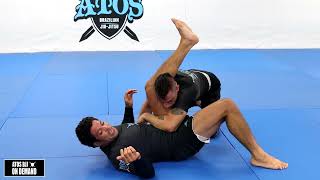 1:43Andre Galvao · Atosno-gino-gi: if you keep this leg low you're not going to have any leverage; the secret of the arm bar is bringing this calf right on top of his back, near his lat3:06Andre Galvao · Atosno-gino-gi: it's very important to keep his elbow inside; when his elbow is outside I don't get the angle; his elbow needs to touch or cross my belly button
 1:05Karel Pravec · Bernardo Faria BJJ Fanaticsno-gino-gi: usually when people go for the armbar from the guard they try to look for the arm control; I don't really care about the arm control; what I'm looking for is postural control because I know the arm bar is going to be there
 1:31Jean Jacques Machadogimake sure whenever you get the triangle raise like I'm doing the crunchy sit up; now my weight is all here; you can lift me but not have enough time to control the head3:46Henry Akins · Bernardo Faria BJJ Fanaticsgithis leg clamps down; I pull my toes back to me because it allows me to engage my hamstrings more3:47Andre Galvao · Atosno-gino-gi: you need to keep your toes up, facing the ceiling, and then you use your heel towards the mat4:51Andre Galvao · Atosno-gino-gi: trying to put his ear against his shoulder; I keep his ear against his shoulder which makes him really weak2:06Karel Pravec · Bernardo Faria BJJ Fanaticsno-gino-gi: I will just keep my legs as they are4:16Danny Stolfi · Breathe Jiu JitsugiI just want to pivot on my lower back; push off her hip and pivot all the way to the other side; I just want to pull that leg through a bit deeper4:58Danny Stolfi · Breathe Jiu Jitsugithe finish would be biting the heels down, squeezing the knees in, pulling the head with both hands and bridging my hips up
success means
synthesis The tap on the triangle, caught and released: the lock made before the grips go, the six adjustments in Stolfi's order, and the bridge stopped at the first sign of the tap with the hands on your own shin; nothing else in the chain is finished, and an undefended choke or armbar in the rounds is a two-count catch and a release. Stolfi's clip shows the finishing position once, the hands on the head at 5:22 to 5:23, and no tap and no release; the count is the partner's tap, not the clock.
4:58Danny Stolfi · Breathe Jiu Jitsugithe finish would be biting the heels down, squeezing the knees in, pulling the head with both hands and bridging my hips up5:19Danny Stolfi · Breathe Jiu Jitsugiif you're a kid and you're doing this the finish would be holding your shin, but the squeeze is the samethe situation
You are on your back in the gi with your closed guard locked and his posture already pulled forward by your legs; he kneels with his hands low on your belt or your chest and does not stand; you have no grip yet; the tall posture and its breaking are a reference (B3), the sweeps and the hip bump are references (B4, B5), and the guard he opens is another document's
the endpoint
The tap on the triangle, caught and released: the finish applied slowly with the heels biting, the knees squeezed, the hands on your own shin, and the hips bridging, stopped at the first sign of the tap; the endpoint is the submission and not a hold, and nothing else in the chain is finished in the session
you start with
- Your closed guard, his knees on the mat
not solved here · cooperative resets
- A tall posture with his head over his hips, or a stand (B3 and the threats; a reset)
- The hip bump, the kimura and the guillotine when he sits back (B4, a reference)
- The scissor, the pendulum and the grapevine sweeps (B5, references)
- The overhook and arm wrap attacks (B6), the arm drag and the back (B7) and the lapel (B8), references
- The stack fought with the neck or the back (a release)
- The guard opened by him and the pass (another document; a reset)
Sides. One orientation throughout, Stolfi's own, mirrored when the first grip is the left hand; the route card in section 1 and the grip notes carry every side. In short: the right hand crossing deep into his right collar and the left over the top into his left; the left foot on his right hip, the right leg high on his left shoulder, the pivot to your right and the left leg over his head for the armbar on his right arm with the grips kept; his right arm out, the left leg thrown over his head to the back of his neck, his left arm inside, the right leg locked, the triangle; the six adjustments to the finish. Which hand, which foot and which leg are read from stills of his clip, with the camera side settled by where each person faces and each limb traced from the hip or the shoulder, and the limitations say so.
what it is worth
The tap ends the match (article 2.1): two taps with the hand on the opponent, the ground or himself, two taps of the foot when the arms are trapped, a verbal withdrawal, or a scream of pain in the hold. Nothing in the chain scores before that: the closed guard is not a position that scores (Danaher's point in the reference), the armbar and the triangle held without the finish are, at the referee's discretion, an advantage for a submission attempt that put him in real danger (article 5.3), awarded only once there is no longer a chance of reaching a point-scoring position (5.5), and the sweeps that this document keeps as references score 2 when the bottom athlete inverts the position and holds the top for 3 seconds (4.6.1), with the mount after them 4 (4.4.1: on top, clear of the half guard, sitting on his torso and facing his head, two knees or a knee and a foot down, at most one arm trapped under your leg and that leg not past his shoulder, for 3 seconds) and no mount points when you land on top with a triangle fastened. The stalling rule cuts both ways: the top athlete in a closed guard who does not seek to pass while stopping your progress is stalling, and so is a bottom athlete who wraps or clutches without attacking (6.2.1, the referee's count in 7.3.1); a chain that keeps attacking is the answer the rule invites. None of this is a referee's call in training: the session's success is the tap, caught and released.
Article 2.1: the submission, on the tap of the hand or the foot, a verbal withdrawal or a scream of pain; 5.3 and 5.5: an advantage for a submission attempt that put the opponent in real danger, awarded only once there is no longer a chance of reaching a point-scoring position; 4.6.1: the sweep, 2 points, when the athlete on bottom inverts the position and holds the opponent on the bottom for 3 seconds; 4.4.1: the mount, 4 points, on top clear of the half guard, sitting on the opponent's torso and facing his head, with two knees or one foot and one knee down and at most one arm trapped under the leg, the trapping leg not extending past the shoulder, for 3 seconds, and no points when the athlete lands on top with a triangle fastened; 6.2.1 and 7.3.1: lack of combativeness in a closed guard on either side, with the referee's count
Source: IBJJF Rule Book v6.1 (2024), articles 2.1, 4.4.1, 4.6.1, 5.3, 5.5, 6.2.1, 6.2.3 and 7.3.1, read from the PDF (mirror: https://www.ligabjj.com/ibjjfrules/2024JUN_IBJJF_Rules_EN.pdf)
— the spine · learn this week
Danny Stolfi's cross choke to armbar to triangle
One coach's chain from the closed guard with the posture forward to the tap, in his own orientation: the cross choke, the armbar when he defends it with the grips kept, the triangle when he pulls the arm out, and six adjustments to the finish. Steps 2 and 3 are the chain's hinges and need his defence to arrive, so the session scripts it; Roger Gracie, Machado, Akins and Danaher supply checks on the posture, the choke and the armbar, never a step; the grips' palms are the session's choice, disclosed in the grip notes. B1 to B8 are references from their own set-ups and B9 is the reset list.
-
GATE
Read it: closed guard, his posture down, his hands low
You are on your back with the guard closed high on his back and his posture pulled forward by your legs; he kneels with his hands on your belt or your chest, low, not standing. The chain starts from here, and every attack in it is answered by his defence, which is the next attack's door.
At 1:05 to 1:09 (.frames/route-rusxrFII0oo-1.png at two seconds; .frames/zchoke-rusxrFII0oo-1.png at half seconds from 1:09) Stolfi lies on his back with his head toward the camera, Jamie kneeling inside his closed guard with her hands at his belt and her chest forward, and his hands rising to her collars. His words for the context: start with the cross choke, she defends, the armbar, she defends, the triangle, and the finish is the same whichever setup you used. synthesis Breaking a tall posture is the coaches' in the grip notes and B3; the session starts with his posture already forward and his hands low, and a partner who postures straight up and stays there is a reset, not a fight.
0:28Danny Stolfi · Breathe Jiu Jitsugiso the next submission is the triangle; we're going to keep the same context that we've been working with: starting with a cross choke attack, she'll defend the cross choke, I'll move to the arm bar, she'll then defend the arm bar and I'll move into a triangle0:48Danny Stolfi · Breathe Jiu Jitsugiit doesn't necessarily matter which setup you use for the triangle; the finish is generally going to be the same; the finishing mechanics will not change much depending on the setup; so to start I begin attacking the cross choke6:39John Danaher · Bernardo Faria BJJ Fanaticsgithe spine is the single longest lever that we get to work with; we can bring our knees together and employ a knee pull that goes through my training partner's defensive hands and enables us to break posture forward -
1
The cross choke: two collar grips, pull him down
Right hand crossing into his right collar, deep, four fingers in and the thumb out; left hand over the top of that forearm into his left collar, thumb in; pull him down with the legs and curl the wrists. Keep the grips whatever he does next.
Half-second stills (.frames/zchoke-rusxrFII0oo-1..2.png): at 1:09 to 1:10.5 Stolfi's right arm, from his right shoulder on the viewer's right, crosses her chest and his right hand goes into her right collar on the viewer's left and slides deep; at 1:11 to 1:13.5 his left arm reaches up on the viewer's left and his left hand comes over the top of his right forearm into her left collar on the viewer's right, the forearms crossed on her chest, while his feet rise and re-close high on her back (1:11.5 to 1:14.5); by 1:15 her head is down between his arms and the choke is on (1:15 to 1:24, .frames/route-rusxrFII0oo-1.png). Stolfi says to begin attacking the cross choke and, later, to keep tight grips on it to keep the person as uncomfortable as possible. Quarter-second crops (.frames/ygrip-rusxrFII0oo-1..3.png, 1:08.5 to 1:15) show the right hand closing on her right lapel from the viewer's left at 1:08.75 to 1:10.5 and the left hand reaching over the right forearm to her left lapel at 1:11.5 to 1:12.75, with both grips set and her head down by 1:13.5; they do not resolve the palms or the thumbs, and he does not say. synthesis The session specifies the grips, and the specification is an addition to Stolfi's route, disclosed here: the first hand, the right, goes in with four fingers inside the collar and the thumb outside, palm toward his neck, Machado's and Knight's first hand; the second hand, the left, comes over the top of the right forearm with the thumb inside the collar and the four fingers outside, Knight's over-the-top second hand, chosen because it is the one of his options that crosses over the first arm as Stolfi's does; the wrist curl that finishes the choke is Roger's, Akins's and Machado's. Machado's second hand under the first arm is the alternative for another night.
0:48Danny Stolfi · Breathe Jiu Jitsugiso to start I begin attacking the cross choke1:31Danny Stolfi · Breathe Jiu JitsugiI would advise continuing to keep tight grips on the cross choke to keep the person as uncomfortable as possible1:38Roger Gracie · Jiu-Jitsu MagazinegiI'm not going to move my arm, I'm just going to twist my wrist and bend it; they tap very fast1:02Jean Jacques Machadogiwhen I have both hands in, I open and I push the hands all the way through and then I bring him back down; I do a sit up and I pull him to me and there's the choke -
2
He pulls your arms down: the armbar on his right arm
He pulls your arms down and lifts his head: keep the grips; left foot on his right hip, right leg high on his left shoulder with the thigh tight and the foot to the ceiling; pivot so your head swings to your right; left leg over his head: the armbar on his right arm.
Half-second stills: at 1:15 to 1:24 Jamie's hands pull down on his forearms and her head comes up (.frames/zchoke-rusxrFII0oo-2..3.png); at 1:24.5 to 1:26.5 Stolfi's left foot, on the viewer's left, is on her right hip (.frames/zarm-rusxrFII0oo-1.png); at 1:27.5 to 1:30.5 his right leg, on the viewer's right, goes high with the foot pointed up and the thigh tight on her left shoulder (.frames/zchoke-rusxrFII0oo-4.png); at 1:29.5 to 1:31.5 his head swings toward the viewer's right, his own right, as his hips turn toward her right arm (.frames/zarm-rusxrFII0oo-1..2.png); at 1:32 to 1:35.5 his left foot leaves her hip, lifts on the viewer's left and the leg swings up over her head (.frames/zchoke-rusxrFII0oo-4..5.png, .frames/zarm-rusxrFII0oo-2.png); at 1:36 to 1:47 the armbar is held on her right arm with his left leg lying over her head, its foot having crossed to her left side, the viewer's right, and his right leg across her back with its foot on her right side, the viewer's left, the two legs crossing above her, and his hands still in her collars (.frames/zchoke-rusxrFII0oo-5..6.png, .frames/zarm-rusxrFII0oo-3.png). His words: she begins to defend the cross choke by pulling down on my arms and pulling her head up; I set up the armbar by stepping on the hip, keeping my thigh tight, pointing my foot to the ceiling, pivoting; keep tight grips on the cross choke. synthesis Which foot steps on the hip and which leg goes high are read from the stills, not spoken; the drill keeps them as read.
1:10Danny Stolfi · Breathe Jiu Jitsugishe begins to defend the cross choke by pulling down on my arms and pulling her head up; from here I'm going to begin setting up the arm bar by stepping on the hip again, keeping my thigh tight, pointing my foot to the ceiling, pivoting1:31Danny Stolfi · Breathe Jiu Jitsugiand then beginning to attack this arm bar; I would advise continuing to keep tight grips on the cross choke to keep the person as uncomfortable as possible3:06Henry Akins · Bernardo Faria BJJ Fanaticsgimy legs are responsible for not only keeping you in the arm lock but also preventing myself from getting stacked; I open my legs and I come all the way up underneath your armpit; this leg pushes you away from me 0:41Henry AkinsgiI'm already angled off to the side so that my hips don't have to go from here for the arm lock; if he defends by pushing with his arms now I have the arm lock as well; double attack
 -
3
He pulls the arm out: the triangle, then the collars go
He pulls his right arm out: throw your left leg back over his head to his right side and bring the shin in behind his neck from his right shoulder, his left arm still inside; the right leg comes off his back and hooks over the left ankle: the triangle. Only now let the collars go.
Half-second and quarter-second stills: at 1:47 to 1:50 Jamie pulls her right arm free (.frames/zchoke-rusxrFII0oo-7.png); from 1:51 to 2:03 the armbar legs stay where they were, his left leg over her head with its foot on her left side at the viewer's right and his right leg across her back with its foot on her right side at the viewer's left, her right arm out on the viewer's left with the hand toward the mat, her left arm inside, his hands still in her collars, while he talks (.frames/zchoke-rusxrFII0oo-8.png, .frames/ztri-rusxrFII0oo-1..3.png, .frames/ytri-rusxrFII0oo-1.png, .frames/yswap-rusxrFII0oo-1.png); at 2:03.5 to 2:04.25 his left foot travels from the viewer's right over the top of her head to the viewer's left, her right side; at 2:04.5 to 2:04.75 it comes back up and to the right as the shin settles behind her neck from her right shoulder, and his right foot leaves her back and rises from the viewer's left to the top right; at 2:04.75 to 2:05 his right knee hooks over the left ankle at the top right of the frame: the lock (.frames/yswap-rusxrFII0oo-2..3.png at quarter seconds; .frames/route-rusxrFII0oo-2.png at 2:03 and 2:05); at 2:06 to 2:14 he holds it and talks, her right hand posted on the mat at the viewer's left, and lets the collar grips go at about 2:14 (.frames/ytri-rusxrFII0oo-2.png, .frames/zfin-rusxrFII0oo-1.png). His words: she's going to begin pulling her arm out; I still have my cross-choke grips, so it's going to be hard for her to posture up; I throw my leg over her head and lock my legs in a triangle; now it's pretty safe to let go of my grips; I don't have the correct angle for the triangle yet. synthesis The foot's resting side, its path and the side of her neck the shin settles on are read from quarter-second stills and were corrected in round 3 after the reviewer traced the foot to the viewer's right; that the shin lies behind her neck rather than across her face is inferred from the lock that follows and from his word, triangle.
1:31Danny Stolfi · Breathe Jiu Jitsuginow to defend the arm bar she's going to begin pulling her arm out just like so1:52Danny Stolfi · Breathe Jiu JitsugiI still have my cross-choke grips; it's going to be hard for her to posture up from here; I'm going to throw my leg over her head and lock my legs in a triangle; now it'll be pretty safe for me to let go of my grips; I don't have the correct angle for the triangle0:20Danny Funggisometimes the opponent might have enough space during the transition to escape his arm; as you lose the first arm position now we're going to keep the pressure with our legs onto his back; this first leg is going to go around and loop his neck -
4
Bite the heels, bridge, pass his arm across, knees in
Squeeze the legs and bite the heels down; bridge high and pass his left arm across your hip toward your left; pull the knees in. Your left hand on his left wrist helps and is not required.
Two-second crops (.frames/zfin-rusxrFII0oo-1..3.png): at 2:14 to 2:34 the triangle is held and Stolfi's free hands gesture the squeeze and the heels; at 2:35 to 2:55 Jamie's left elbow is tucked in at his right hip while her right arm is out on the viewer's left with the hand posted on the mat; at 3:14 to 3:20 his hips are up in the bridge and her left arm is passed across his hips toward the viewer's left; at 3:22 to 3:34 his legs re-lock and his knees come in, and at 3:30 to 3:40 his left hand holds her left wrist (.frames/ywrist-rusxrFII0oo-1..2.png at half seconds). His words: I want to be squeezing my legs in and biting my heels down; if I just hold a loose triangle it's not enough; her elbow is going to be tucked into my hip so she can keep some space between her shoulder and her carotid artery; the first detail is I lift my hips up, that gives me the space to pull her arm across my hip and eliminate that space; then I pull her in with my legs, knees into my chest, still biting my heels down; I can keep one hand on the wrist, it's not completely necessary.
2:14Danny Stolfi · Breathe Jiu JitsugiI want to make sure to be squeezing my legs in and biting my heels down2:35Danny Stolfi · Breathe Jiu Jitsugiif I just hold a loose triangle it's not enough for me to just have the legs crossed; her elbow is usually going to be tucked into my hip so that she can keep some space between her shoulder and her carotid artery; that's going to keep her alive2:55Danny Stolfi · Breathe Jiu Jitsugithe first detail is that I'm going to lift my hips up; lifting my hips up is going to give me the space to pull her arm across my hip and begin to eliminate that space between her neck and her shoulder; I'm going to bridge my hips up here nice and high and I'm going to pass her arm across3:16Danny Stolfi · Breathe Jiu Jitsugito keep that space fully closed I'm gonna pull her in with my legs; I'm pulling my knees into my chest; I'm still biting my heels down; I'm still squeezing my knees in; I can keep one hand on the wrist; it's not completely necessary -
5
Shin grip, foot on his hip, pivot, leg through, lock
Right hand across to your left shin before the lock opens; right foot on his left hip; pivot on the lower back, not a hip escape, until your head has swung to your left; pull the left leg through; right leg over the left with the ankle behind the knee.
Half-second crops (.frames/ywrist-rusxrFII0oo-2..3.png, .frames/ypull-rusxrFII0oo-1..6.png) and two-second crops (.frames/zfin-rusxrFII0oo-3..5.png): at 3:41 to 3:56 Stolfi's right arm reaches up and across and his hand closes on his left shin over Jamie's neck, the left hand having held her left wrist until 3:40; at 3:56 to 4:04 the lock opens and the right foot comes down onto her left hip on the viewer's right; between 4:04 and 4:26 his head travels from the viewer's right to the viewer's left as he pivots (.frames/route-rusxrFII0oo-6.png at 4:05 to 4:27), one hand resting on the back of her head at 4:14 to 4:25 while the left leg is worked deeper; at 4:32.5 to 4:37.5 the right leg comes over the left and the feet lock at the top of the frame with the ankle behind the knee (.frames/ypull-rusxrFII0oo-4.png), and at 4:44 to 4:46 he points at the shoulder the lock blocks. His words: reach up and grab my shin with my opposite arm, reaching across to the shin that's directly over her neck; if I try to open my triangle from here she can posture up and get out; I use my right foot on her hip and pivot; I don't want to escape my hip, I want to pivot on my lower back, all the way to the other side; pull that leg through a bit deeper; bring my right leg over my left, the ankle behind the bend of my knee; my lock is blocking her shoulder. synthesis The pull of the leg through is his word for 4:16 to 4:26; the stills show the lock being worked and the hand on her head, not the pull itself.
3:36Danny Stolfi · Breathe Jiu JitsugiI'm going to reach up and grab my shin; I want to grab with my opposite arm reaching across to the shin that's directly over her neck; it's going to be safe for me to begin opening my triangle; if I try to open my triangle from here she can posture up and get out3:56Danny Stolfi · Breathe Jiu JitsugiI don't want to unlock my triangle until I have that grip on the shin; now I can start creating a better angle; I use my right foot on her hip and then I'm going to pivot4:16Danny Stolfi · Breathe Jiu JitsugiI don't want to escape my hip to create the angle necessarily; I just want to pivot on my lower back; push off her hip and pivot all the way to the other side; there's going to be a little bit of space still between my hamstring and her neck; I just want to pull that leg through a bit deeper4:37Danny Stolfi · Breathe Jiu Jitsugithen I'm going to bring my right leg now over my left, closing off the triangle completely; the finish would be with my ankle behind the bend of my knee; my lock is kind of blocking your shoulder; if you can see the shoulder in here it's not as tight of a triangle as it could be -
6
Finish: hands on your shin, bridge to the tap, release
Heels down, knees squeezed, both hands on your own shin, bridge slowly to the tap; release at once. Stolfi's own finish pulls the head; the shin is his rule for kids and the session's rule for everyone.
Half-second crops (.frames/yend-rusxrFII0oo-1..10.png, .frames/yhead-rusxrFII0oo-1.png) and two-second crops (.frames/zfin-rusxrFII0oo-6..7.png): at 4:50.5 to 4:53.5 the right leg lifts and re-locks as he shows the shoulder; at 4:56 to 5:04.5 his hands are open and moving at her head as he speaks the finish, with the right leg extended for part of it; at 5:08.5 to 5:13.5 the lock is re-set and his hands work at the lock while he speaks the kids' rule, no held shin grip is shown; at 5:22 to 5:23 both hands rest on the back of her head with the lock set, the one clear finishing position in the clip; from 5:26 to 5:43.5 he talks with the lock held and the hands loose, the lock re-set at 5:36.5 to 5:39.5; at 5:44.5 the shot dissolves into the next with the pair in the closed guard, and no release is observed. His words: it's a more effective choke if you can totally block that shoulder out; the finish would be biting the heels down, squeezing the knees in, pulling the head with both hands and bridging my hips up; if you're a kid you can't grab the head, the finish would be holding your shin, but the squeeze is the same. synthesis What the clip supplies is the finishing mechanics in words and one still of the hands on the head; no tap, no bridge under load and no release are observed, and the crops cut at his hips. The endpoint of the session, the tap caught and released with the shin held, is the author's rule; the count is the partner's, not the clock's. This record was rebuilt in rounds 2 and 3.
4:58Danny Stolfi · Breathe Jiu Jitsugiit's definitely going to be a more effective choke if you can totally block that shoulder out; and then the finish would be biting the heels down, squeezing the knees in, pulling the head with both hands and bridging my hips up5:19Danny Stolfi · Breathe Jiu Jitsugiremember if you're a kid you can't grab the head; if you're a kid and you're doing this the finish would be holding your shin, but the squeeze is the same; bridge the hips, squeeze your knees in0:50Jean Jacques Machadogiwhenever we get the triangle don't keep your head on the ground; when I raise my head my weight is on his neck
— grip notes
- Which hand, which foot, which leg, and how the sides were settled.
Stolfi says cross choke, step on the hip, thigh tight, foot to the ceiling, pivot, throw my leg over her head, lock, let go of my grips, hips up, arm across, knees in, opposite arm to the shin, right foot on her hip, pivot on the lower back, leg through, right leg over my left, ankle behind the knee, both hands on the head, bridge. He names the right foot and the right leg at the finish; the rest is read from the stills. The camera faces Jamie; Stolfi lies with his head toward the camera, like a man standing with his back to it, so his left is on the viewer's left and his right on the viewer's right, and each of his limbs is traced from the hip or shoulder rather than assigned by screen side; Jamie faces the camera, so her right is on the viewer's left. Each assignment, with its timestamps, is in the step bodies above and in qualification.json; the grips are at 1:09 to 1:13.5, the armbar at 1:24.5 to 1:47, the leg exchange at 2:03.5 to 2:05, the adjustments at 3:14 to 4:37.5, the one two-handed still at 5:22 to 5:23, and the dissolve at 5:44.5 with no tap and no release shown. The convention: a step marked transcript reproduces the cited speech; a step marked frames reproduces the speech and adds those assignments, read from 1080p stills at two seconds through the clip and at half seconds through the grips, the armbar, the lock, the wrist hand, the pivot and the finish, and at quarter seconds through the grips and the leg exchange; the sheets are listed in qualification.json. The stills settle which limb is where at the sampled moments and the order, not the pressure and not the moments between samples; a side the reviewer reads differently is adopted.
1:10Danny Stolfi · Breathe Jiu Jitsugistepping on the hip again, keeping my thigh tight, pointing my foot to the ceiling, pivoting4:37Danny Stolfi · Breathe Jiu Jitsugibring my right leg now over my left, closing off the triangle completely; the finish would be with my ankle behind the bend of my knee- The first grip and the second, as the coaches make them; Stolfi does not say.
Machado: four fingers in and the thumb out, the top index finger at the collarbone, the wrist brought past the elbow and the elbow connected to the sternum to break him down, both hands opened and pushed through, then the sit-up and the pull, the choke made across the body wrist to wrist with the bone, never with the elbows raised or the back of the hand; and in his other clip, the first hand very deep, the collar opened rather than pulled so the second hand has room, the heels kept above his belt so he cannot rise while the second hand goes under, and then the turn, not the pull. Akins: the thumb lined up behind the ear, the hand touching the neck before the grip closes, the grip closed from the pinkies, the wrist curled, the pull to the belly and not the chest so the elbows stay closed. Roger: bend the wrist, the sharp bone on the side of the neck, not the arms. Knight: the first hand palm up deep in the back of the collar; the second under palm up, or over with the thumb inside or a fistful of the material when he blocks the bicep. Xande and Tinoco reach the same choke from an arm wrap; Rayron Gracie from thumbs connected behind the neck. synthesis None of these is Stolfi's specification: his stills settle the hands and the crossing, not the palms. The session's grips are chosen from them and disclosed as an addition: the first hand four fingers in and the thumb out (Machado, Knight), the second hand over the top with the thumb in (Knight), the wrist curled (Roger, Akins, Machado); Machado's second hand under the first arm is the version for another night.
0:21Jean Jacques Machadogiwhat I want to do is break his posture by bringing my wrist past my elbow; I connect my elbow right to his sternum; when I come up I use my legs and I break the posture2:04Jean Jacques Machadogichoke with the bone, not the back of the hand; if you choke with the back of the hand it's never going to choke 0:00Jean Jacques MachadogiI want to make sure that I have my hand in his collar, especially the first one, very deep; whenever I touch the second hand don't keep pulling the first one because that makes no room for my second hand0:43Jean Jacques Machadogithe key when we choke, if you don't want to use all your strength, is to bring his face close to you; my elbows stay close to me, my hands turn this way
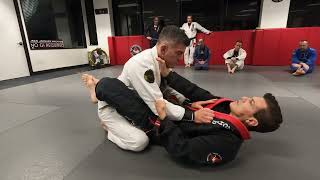 5:14Jean Jacques Machadogiwhenever I have the grip I bring my heels a little bit high; now when he tries to go up I have all the time I need for my second hand to go underneath; make sure you turn your hands like this5:58Jean Jacques Machadogimy legs holding him and the more he goes up the better for me; second hand, then turn; once you turn it's over; I don't need to be pulling down this much, just turn and my elbows just drop3:48Henry Akins · Bernardo Faria BJJ Fanaticsgithe ideal grip for me is I actually want to make sure that my thumb is just kind of lined up beside your ear or just behind your ear4:50Henry Akins · Bernardo Faria BJJ Fanaticsgianytime I put the hand in the collar the first thing I do is I just touch your neck; once I touch your neck now I start to close my grip and I start to close from my pinkies5:12Henry Akins · Bernardo Faria BJJ Fanaticsgito apply the pressure all I'm going to do is start to curl my wrist; you'll feel this bone going to your neck9:20Henry Akins · Bernardo Faria BJJ Fanaticsgia lot of times when people do the cross collar choke, when they pull to their chest their elbows open and you lose; pull to my belly and then just squeeze10:20Henry Akins · Bernardo Faria BJJ Fanaticsgiit's not done with the arms, it's done with the wrists; the arms are there to basically pull you in10:41Henry Akins · Bernardo Faria BJJ Fanaticsgieven if you have posture it still works0:56Roger Gracie · Jiu-Jitsu Magazinegiput the sharp part of your wrist, of your bone, against his neck; not the soft, the top and the bottom; it's all on the sides
 0:22Eli KnightgiI'm gonna go palm up, one here deep inside the back of this collar; second hand, if it goes under it's palm up; I pull him in this way, rotate my wrist toward me and finish the choke1:04Eli Knightgiif he's blocking me from going under, maybe he's blocking my bicep, then I can go over this way and either go thumb inside or just grab the tuft of material; lock it into place, connect the forearms, pull down2:30Rayron Gracie · Bernardo Faria BJJ Fanaticsgiboth thumbs are underneath the gi; I try to place this collar behind the top half of your head; no matter how strong you are, you cannot look up
— when the spine breaks
9 branches
Each one names the trigger you will feel, then the response. Learn the triggers; the responses are short.
- The same chain with other second and third links: armbar to triangle to omoplata, triangle to armbar and back, cross choke to armbar to a second armbarreference onlythe finish, in Danny Fung's, Greg Walker's, Eli Knight's, Roger Gracie's, Henry Akins's, the Trillo coach's and Gustavo Gasperin's words, each from its own first attack; their own ends
Fung, gi: the armbar first; when he escapes the arm, keep the leg pressure on his back, loop the first leg around his neck, and from the diamond with one arm in and one out, lift, press his shoulder across, turn his face the way his hand points and lock; if you try the triangle before the arm is across, his leg blocks the space, so bridge first; and when his head is too low for the triangle, grab the wrist, press the head, kick the leg out and sit up into the omoplata. Fung's other clip runs the triangle to the armbar when he postures up with the head high, and back to the triangle when he stacks. Walker, gi: the cross collar, he clamps your arms; release one hand to his tricep, open the guard, straighten one leg onto his hip, kick the head, swing the leg over for the armbar; he grabs his bicep; switch to the other tricep, post, straighten, the shin across his face, the second armbar. Knight, gi: the choke, blocked under and over; the armlock with the foot on the hip and the knee in the armpit; he pulls the arm free, the triangle; or when he pulls it free with his posture back, the leg hooks the neck and the hips switch to the other side for the armlock. Roger, from the arm wrap: when he defends the neck with the hand that stays in, the triangle with his wrist pushed into his own body, or the armlock with the hips pushed out and the elbows closed. Akins: the cross collar, he pushes up to defend, the head already angled makes the armlock. The Trillo coach's drill goes armbar to triangle and back. Gasperin, no-gi: the armbar; when he yanks the arm out, the triangle if his arm is bent and the omoplata if it is straight. synthesis None has its sides read from stills; references from the same door for a chain whose second link is not the armbar or whose third is not the triangle.
0:41Danny Fungginotice the diamond position with my legs, one arm in one arm out; I'm going to raise to elevate the arm; bring his arm against the carotid arteries of his neck; lift, press the shoulder across and now control his posture down; I like to turn his face in the same direction where his hand is pointing1:22Danny Funggiwe lose the arm, all you're going to do is bring this leg across and cross your ankles; sometimes you might try to finalize the triangle from here but because the arm is here when I turn he's going to block the space with this leg1:43Danny Funggiit's much more efficient to bridge first, bring the arm across and now you have all the space cleared; hold down his posture, turn, and now lock; when I lose the arm his head is down2:04Danny Funggiif I tried for the triangle here there's never enough space; if the head is too exposed on this side I'm only going to continue turning; I'm going to immediately grab the wrist on this side, press on his head and from here I'll triangle right away2:25Danny FunggiI'll switch my grip so I can break his base, put him flat; I'm going to kick this leg out so I can sit right beside him; we have the omoplata 1:02Danny Funggiif he can't control the posture he's not getting the submission; when you feel that the opponent postures up but they still stay on their knees, take a hold of this arm and trap my wrist onto his body1:23Danny Funggihe's going to pass this leg over and cross his feet, an X motion right here in his back, into an armbar; if the person starts to posture their back and bring their head up now you can still attack the armbar2:24Danny Funggithe moment I saw this now I start to stack; the lower I come down for the arm the more I'm bending my own arm; as I bring my posture down now he's going to switch to the triangle, control the head and keep the posture down0:41Greg Walker · BJJ Joe (Kris Kim's channel)giI'm going to raise my hips up, swing my hands underneath and I pull him forward to hug him down; now I can start sliding my hands up, your normal everyday cross collar choke; what's Jordan's defense? he's going to clamp over both my arms1:01Greg Walker · BJJ Joe (Kris Kim's channel)giif I get this choke good, match is over; however I'm going to expect him to defend; I'm going to release one of my hands, I'm going to grab over for his tricep, just like we do normal arm bars1:42Greg Walker · BJJ Joe (Kris Kim's channel)giI'm going to straighten my leg out, all holding him down; the straight leg is going to go on his hip; my top leg at the same time I push, I want to try and kick the top of his head2:02Greg Walker · BJJ Joe (Kris Kim's channel)giI have the grip on his lapel, I have the grip on the tricep; once I'm ready to swing my right leg over I'm going to release my right hand, swing my leg over and now I can catch that arm bar2:45Greg Walker · BJJ Joe (Kris Kim's channel)gias he grabs, my top hand is going to reach over, I'm going to grab his other tricep; my outside leg is now going to straighten; I need to bring my hand out to help create some space3:06Greg Walker · BJJ Joe (Kris Kim's channel)giI throw my leg, my shin is going to stay in front of his face; now his hands are all gone because they're all trapped inside; I can finish with that second attempt on the arm bar1:24Eli Knightgiif he's doing a better job of blocking on my bicep, can't go under, can't go over, then I'm gonna hold the back of the elbow; foot in the hip; knee way up into the armpit, push the head away, get the leg around, grab the wrist, squeeze the knees together; finish the arm lock2:05Eli Knightgiif he pulls the arm free, whenever he turns back to face me I'm gonna close up the legs; I'm gonna walk out, pass the arm to the other side, adjust the triangle, finish the triangle choke; we're going in a linear fashion: cross choke, arm lock, he pulls the arm free, triangle2:26Eli Knightgiif he gets his good posture back up and pulls the arm free, then this leg can hook the back of his neck; I change my hips from this side of his leg to this side; secure the arm; finish the arm lock
 0:41Roger Gracie · Mauricio Gomes BJJgiwhen he defends the neck the hand has to stay there; either go for the triangle: the hand that he's using to defend, I put my palm on top of his wrist and I push; hold the arm really tight into his own body and then throw my leg over1:43Roger Gracie · Mauricio Gomes BJJgiif he keeps his elbow connected to his knee it's hard, so I switch to the arm lock on that side; I push my hips out and I close my elbows together so I keep his arm straight0:00Henry Akinsgithis is a really nice combo attack I do from the cross collar choke from the guard when they try to push up with their hands to defend; the angle that I created with my head makes it really easy for me to transition to the arm lock
 0:05Trillo Jiujitsu Academy (coach not named in the clip)giI'm securing the arm, driving over and I bring the foot over, but the guy's smart, pulls that arm out; swing this leg over here, turn back this way and now you have a triangle, or you can switch it back to an armbar
 1:22Gustavo Gasperin · MMA Leechno-gino-gi: he's gonna use his arm on my chest to yank his arm out and free his arm; now we are going to go to either triangle or omoplata depending on the position of this arm; if his arm is bent this way it makes more sense to go for the triangle; if his arm is straight, the omoplata
- The choke is met with a straight back and a hand on the mat, or his hands split: the high guard and the clampreference onlythe choke or the armbar from a leg over his shoulder, in Machado's, Jon Thomas's, Danaher's, the Clark Gracie coach's and Xande Ribeiro's words; their own ends
Machado: when the choke is shallow and he rises through your legs, the hip goes up, and the armbar goes to the lower arm because the hip comes from behind. Jon Thomas, when both his hands are high: push the biceps, pummel under, dig for the collar and pin the elbow to his chest; when his forearm sits on your chest, bridge his elbow to your belly button, jump the hips up and re-close the guard with one leg over his shoulder, then push the head and switch the leg over it for the armbar. Danaher's clamp: a knee in front of one shoulder and a knee behind the other, so his hands cannot meet, reached by putting his hands on the mat and pivoting to an angle without touching the floor. The Clark Gracie coach: both hands deep, the elbow pulled to the ribs, the foot to the hip, climb the shoulder into the high guard, the choke first and the armbar when he defends; his spin under the far knee when he stacks is his own and is not drilled here, because a stack that loads your neck is a release in the session and the spin waits for its entry and its stop to be qualified. Xande's high closed guard when the arm is crossed, no-gi: the foot on the mat, the hips pushed higher, the legs closed on his armpits. synthesis References for the night the collar grip meets a straight back; none is read from stills here.
8:46Jean Jacques Machadogiwhen we get the choke sometimes it's not very deep; the person raises; as soon as they raise through your legs your hip has to go up; no armbar would be possible if you touch your lower back on the floor9:28Jean Jacques MachadogiI go to the lower arm, because your hip comes from behind4:24Jon Thomasginow he has both hands high; I'm going to push on the biceps to create a little space and really fast pummel my arm under and in4:46Jon Thomasgionce I switch I'm now going to dig through and start going for a collar grip; once I get the collar grip I want to pin my right elbow to his chest really tight5:07Jon ThomasgiI'm going to use my left hand to cinch this grip up higher behind the neck; I loosen my legs a little and I curl my wrist so that I get the sharp part of this bone to lock around his neck5:28Jon Thomasgioften your opponent will just have his forearm sitting on your chest; I'm going to use my hand behind the elbow, bridge and try to bring his elbow to about my belly button5:48Jon Thomasgionce I get the elbow to the belly button I'm going to unlock my legs, I jump my hips up and lock over his shoulder; reclosing my guard with my one leg over top of the shoulder; I squeeze my knees together and I clamp my feet down6:09Jon ThomasgiI go push his head away and as soon as I unlock I switch my leg over the head; I want it aimed over the head because it breaks his posture; I squeeze my knees, control the wrist and I can finish the arm bar10:45John Danaher · Bernardo Faria BJJ Fanaticsgiif we were able to put hands on the mat we could do something interesting; I work my hands inside and underneath my training partner's hands; I bring my knees high into the armpits and even as Bernardo goes to posture up we can easily break his balance forward and get hands to the mat11:25John Danaher · Bernardo Faria BJJ Fanaticsgithe next thing we need is to get an advantageous angle; I could do that by putting my foot on the floor, the problem is my opponent can step over my leg; so let's try to avoid hands on floor so much as foot on hip or even better turning out and pivoting using just the movement of my legs12:49John Danaher · Bernardo Faria BJJ Fanaticsgithe switch to a clamp where I bring a knee in front of my training partner's shoulder and a knee behind the opposite shoulder; this knee pushes, this knee pulls; when he tries to bring his hands together defensively it's physically impossible 0:01Clark Gracie Allegiance (coach not named in the clip)giwork my both hands nice and deep, opening and feeding that second hand; then I'm gonna come to his tricep and pull the elbow until I feel it on my ribs; then my foot is cleared to come to the hip and I'm gonna start to climb0:43Clark Gracie Allegiance (coach not named in the clip)gimy first attack from here can be right at your cross choke; if he starts to defend this position I'll go ahead and switch to an armbar finish here and start stretching him out, putting extra pressure over his neck so he can't stack me1:23Clark Gracie Allegiance (coach not named in the clip)giwhen he's defending his arm like this, a lot of times he starts to put all his weight onto your neck and shoulder; my free hand is going to come to his far knee; the more your partner stacks you the better because it puts you more on your shoulders, it makes it easier to spin
 1:21Xande Ribeiro · ADCC Officialno-gino-gi: entering the Matrix is basically doing a high closed guard; I need to put my foot onto the mat and push my hip higher where now I can close my legs higher on his armpits
- One step earlier: his posture is tall, his hands are on your hips, on the mat, one high and one low, or he leans back out of reachreference onlythe posture broken and an arm isolated, in Jon Thomas's, Danaher's, Machado's, Gordon Ryan's, Braulio Estima's, Stephan Kesting's, Rayron Gracie's and Xande Ribeiro's words; their own ends
Jon Thomas answers each hand position: both hands low, grab both lapels and crunch him over his own hands, then trap the tricep and shrimp for the overhook and the triangle; one high and one low, break the low grip with the cross sleeve and your own wrist, drag the sleeve across when he regrabs, the tricep, then the back, the pendulum sweep when he turns back in, or the collar choke when he clings to your hip; leaning back, come up on the elbow and threaten the hip bump, the triangle if he posts early, the overhook if he drives back in. Danaher: the knee pull whenever his head is in front of his hips, the hands kept close, the knock backward when his head is over or behind his hips. Machado: hang, do not pull; let him sit up a little and reel him back. Gordon Ryan, no-gi: knees first, then the hands. Estima: the pull kept while the upper body moves to the side; the constant collar pressure and the shake. Kesting's coach, no-gi: the hips climbed high and the knees clamped to make a lever of his spine. Rayron Gracie: divide his grips, the thumbs connected behind his neck under the collar so he cannot look up, the shins pushed when he stands and postures, the knees opened when he leans back. Xande: patience, and the side closed guard, never straight. synthesis These are the entry to this document's start; the session begins with the posture already forward, and a posture that cannot be broken at half effort is a reset.
1:02Jon Thomasgiwhen he has both hands on the hips it's very easy to pull him over top of his own hands; I grab both lapels, I do that same crunch motion and pull my knees to my chest and it buckles him over the hands1:23Jon Thomasgivery often he'll come to the floor and I immediately go over and grab behind this tricep; I'm going to really fast shrimp out and trap this arm; I can go to the belt and leave my foot on the hip; I could overhook and feed the lapel1:43Jon Thomasgionce I've isolated this now it's very easy to force the triangle; I block his bicep, I shrimp out on my side, I grab the wrist if needed and I come around for the triangle choke3:03Jon Thomasgione high and one low: I'm going to get a cross sleeve grip; I pummel underneath, grab my own wrist, I drive that into his wrist, that's going to break his grip; I don't immediately drag it across because often he's going to regrab the lapel3:23Jon Thomasgiwhen he tries to grab my lapel I can use that momentum to drag the sleeve across; I switch my hand to the tricep first; I shrimp out and I want to sit up and bring my chest and my body weight behind his tricep4:03Jon Thomasgionce I drag across he'll turn his body weight back towards me and I can grab his leg and throw both legs high and rock him up, a classic pendulum sweep, up towards mount6:29Jon Thomasgiyour opponent's going to be leaning back so far; I'm going to rock and come up on my left elbow and start to threaten the hip bump sweep; as I drive back he will want to post this hand; I knock him over and drive him to mount6:50Jon Thomasgiif he posts the hand early sometimes I can just grab the head, bring this around and I drop back for a triangle choke; very often as soon as you drive up he's going to drive back into you; right here I could immediately start trying to isolate this overhook7:22John Danaher · Bernardo Faria BJJ Fanaticsgiif we control our training partner's hands and keep the hands in close we can employ a knee pull to break his posture forward even if my opponent goes to stand up; that vulnerable second step is a great time for us to employ a knee pull8:02John Danaher · Bernardo Faria BJJ Fanaticsgionly when our opponent manages to get his head directly over his hips is he insensitive to a knee pull, but then he becomes vulnerable to having his balance broken backwards0:43Jean Jacques MachadogiI use my legs, I bring them up like straight up and I pull at the same time; as I do that I move my head because his head can hit my head1:28Jean Jacques MachadogiI let them sit up a little bit and I pull them back down; it's almost like catching a fish, reeling, letting them jump and then reel them, getting them tired1:47Gordon Ryanno-gino-gi: if I just try to pull my partner's hands across he just postures and he's out; but if I use my knees to pull him in, when he goes to posture we can use the knee pull to guide him across 0:21Braulio Estima · Timeless Jiu-Jitsu Academygias soon as I capitalize that pull and keep the pull and start moving my upper body to the side, there are many directions happening at the same time1:06Braulio Estima · Timeless Jiu-Jitsu AcademygiI'm going to control the collar, I'm going to apply a constant pressure, and now I'm gonna shake up and down; he will collapse
 0:40Grapplearts (Stephan Kesting's channel; instructor not named in the clip)no-gino-gi: I'm going to climb my hips as high up as I can and climb my guard up as high as I can; clamping my knees to your torso, trying to create as much of a lever out of your spine as I can1:06Rayron Gracie · Bernardo Faria BJJ Fanaticsgithe main thing is dividing the grips; if you hold near the belt, I can easily go up and start making this grip; try to break this grip; I'm connecting my thumbs behind Bernardo's neck1:50Rayron Gracie · Bernardo Faria BJJ Fanaticsgiif you stand up again but now keep your chest low, try to open my guard now with your chest low; it's impossible; the problem is not really with the standing up, the problem is posturing up2:51Rayron Gracie · Bernardo Faria BJJ Fanaticsgiif you do stand up and I miss the opportunity to get this, you posture up; I place both of my hands on your shin, I take my back off the mat and extend my arms and you bring it back3:53Rayron Gracie · Bernardo Faria BJJ Fanaticsgiyou stand up, I push the shins; you lean back from there, I start opening your knees and then bringing you down again
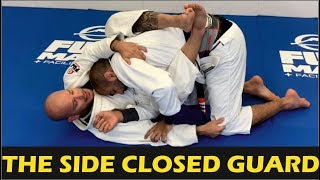 2:07Xande Ribeiro · Bernardo Faria BJJ Fanaticsgiif I close a guard what's the first thing you're thinking? my posture; I have to open; so me as a guard player I'm playing my strongest versus his weakest; for me it's about patience8:17Xande Ribeiro · Bernardo Faria BJJ Fanaticsgieverything starts from going sideways; there's no such thing in my system, guard straight; I'm protecting my center
- He sits back out of the chokes and armbars: the hip bump, the kimura and the guillotine as one chainreference onlythe mount, the kimura or the guillotine, in Jon Thomas's, Tom Davey's, Coach Nate's, the Chess Club coach's, Eli Knight's, Marcos Tinoco's and Chewjitsu's words; their own ends
When he leans so far back that no pull brings him forward, the coaches here come up instead. Jon Thomas: crunch and sit up, the hand on the floor, grab the tricep so he cannot post, drive with the foot and bump him to the mount; when he posts early, the leg over for the triangle; when he drives back in, the overhook. Tom Davey, no-gi: the hip bump; he posts the hand, move the hip to his wrist and take the kimura with the whole hand, lift before you rotate; he straightens the arm and leans back, hip bump again. Coach Nate, no-gi: let his posture pull you up, hook the arm at the tricep, drop the knee and bump; he posts, sit the hips toward the arm for the kimura with no thumbs; he body-locks you, scoot the hips back and snatch the guillotine. The Chess Club coach, no-gi: the kimura, he hides the arm inside his knee, the hip bump, he frees the arm and posts, the guillotine as you fall back. Knight, no-gi: the hip bump at ninety degrees, the guillotine when he tackles back in, the kimura at forty-five, the snap-down when he makes space. Tinoco, gi: do not sit up straight and do not sit up with the guard closed, swing the shoulder to the elbow and up to the hand, clear his posting arm under you. Chewjitsu, gi: the hip bump that offsets people and sets up the rest. synthesis References; in the session a partner who leans back out of reach is a reset, not a hip bump.
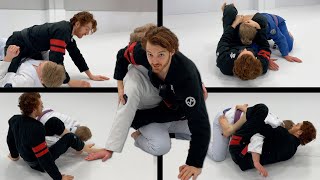 0:42Jon Thomas · Grapplearts (Stephan Kesting)giwhen he's leaning this far back I can't bring him forward but that means I can bring myself up really easy; I'm going to use that as momentum to come up to go for the hip sweep; if he comes back in I'll take what he gives me1:24Jon Thomas · Grapplearts (Stephan Kesting)giif I can get this tricep here and I can pull it in now I'm just going to drive with my right foot on the floor; I pull this in so he can't post and I'm just going to bump him over to the mount position3:28Jon Thomas · Grapplearts (Stephan Kesting)giI'm going to bring this left leg out and throw it over to go for the triangle; it's one of the most common responses when you go for this attack4:51Jon Thomas · Grapplearts (Stephan Kesting)gisome guys are just going to lean back into you suddenly; now this arm is isolated, it's easy to trap; I could go for a kimura; usually when I feel they drive back into me I instead focus on capturing this overhook
 1:44Tom Davey · The Grappling Academyno-gino-gi: as I go to do that he's gonna put his hand out to stop the sweep; as soon as he does that the most important thing I do is I move my hip right to where his wrist is and now I grab hold with my hands; I never grip with a thumb3:28Tom Davey · The Grappling Academyno-gino-gi: how do you defend a kimura? he leans back and he's made his arm straight so now I've lost the torque on the shoulder; now that I have him here I'm just gonna hip bump sweep
 1:21Coach Nate · BJJ4Breakfast (surname not given)no-gino-gi: there's only a certain number of things he can do to stop the sweep; he'll get 80 percent of the way swept and he'll post his hand to stop the sweep, in which case I go for a kimura, or he senses me coming up and tries to body lock me3:05Coach Nate · BJJ4Breakfast (surname not given)no-gino-gi: he locks my body and I know he's gonna push back into me; instead of going through the arm I'm gonna scoot my butt back, come around, snatch his neck, fall to that side and then choke the guillotine
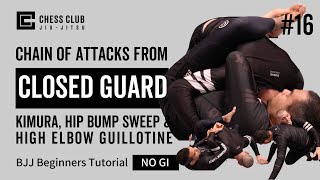 1:03Chess Club Jiu-Jitsu (coach not named)no-gino-gi: Jake does a really good job holding his arm inside his knee and I couldn't bring the hand behind the back; my second option here is going to be the hip bump sweep; I open my guard, step on the ground, hand, I sit on his lap and I spin around1:25Chess Club Jiu-Jitsu (coach not named)no-gino-gi: he managed to free the arm and he posts the hand; my third option is going to be a guillotine when I'm going back to the ground; this arm I was trying to control, I'm going to wrap around his head as I'm falling down back to my closed guard
 3:13Eli Knightno-gino-gi: if I go up to try to sweep like that he's going to drive back into me; if instead when he goes to tackle me I scoot out this way and cause separation, that gives me an opportunity with this sweeping arm to drive back underneath and slip inside5:16Eli Knightno-gino-gi: since he's on 45, I'm going to slide this over just like I did for the hip bump sweep but this time I'm going to hook underneath; I'm putting my wristwatch there and I want to turn his elbow; as I go to fall back my posted hand is going to grab by his wrist8:00Eli Knightno-gino-gi: I'm going to put my foot on his hip, post on my left hand and do like a technical standup; as I go to post and retract this leg I'm going to bring his head toward the floor, snapping him down2:25Tom Davey · The Grappling Academyno-gino-gi: before we try to put it behind his back, bring it up; if you bring it up enough he will tap; ninety percent is in the pull and then ten percent is the rotation2:02Coach Nate · BJJ4Breakfast (surname not given)no-gino-gi: once my butt gets to the mat towards the arm I'm coming down into my kimura grip, throwing my leg up over his back, no thumbs on the grip
 7:04Marcos Tinoco · BIG OSSgiwhen they come up they try to come up straight and the bridge just shuts it down; don't sit up straight; and don't sit up with your leg closed; once it's time to get up you have to open8:08Marcos Tinoco · BIG OSSgiI want to swing my shoulder like I'm doing a sit up into my elbow; it's a lot easier to make all the way to the hands and the foot10:10Marcos Tinoco · BIG OSSgithe best way: take this arm out and tuck under me; take this arm out and I'll push my hip and turn
 2:51Chewjitsu (Nick Albin)giif you're trying to break posture and people really lean back you can really come up here and go with it; because it's so powerful to offset people you can use it to set up a lot of combinations
- He postures and bases: the scissor, the pendulum and the grapevine sweeps, and the armbar off the blocked scissorreference onlythe mount, or the armbar off the blocked scissor and the shoulder crunch, in Marcos Tinoco's, Andre Galvao's, Chewjitsu's, the Guardian coach's, Danny Fung's, the Cobrinha coach's and Coach Nate's words; their own ends
Tinoco's three for white belts: the scissor with the collar grip deep and the hand on the side of the elbow, never the sleeve, the leg extended and the pull with the sweep of the bottom leg; the hip bump above; the pendulum with the arm across and the underhook, the knees bringing him onto you and the back leg driving his shoulder down, never from far out. Galvao: the knee like a seat belt across his body, kick first and chop after, pull him against your shin, and the collar and the shin together. Chewjitsu's four: the scissor, the hip bump, the pendulum and the reverse grapevine into the butterfly hook when he buries his head. The Guardian coach and Fung, when the scissor is blocked: the foot on the hip, the leg returned to the back, the other leg over the face, the wrist, the armbar. Tinoco's shoulder crunch from the underhook: pull him down with the legs when the stiff arm stops the sit-up, the underhook with the hands connected like a butterfly grip, the heel inside to make a butterfly hook, get to your side, clear his post and elevate, and the armbar when he pulls the elbow in to escape it. The Cobrinha coach, no-gi: the overhook, the knee shield and the scissor, and the switch to the other side when he blocks. Coach Nate's Xande sweep, in mixed kit with the top man in a gi: the sleeve and the pants, the knee kicked into the armpit. synthesis References; the session has no sweep, and a partner who postures up and bases is a reset in the rounds.
1:50Marcos Tinoco · BIG OSSginumber one go there as high as you can, control the person's posture; number two don't go on the sleeves because the person can bring the elbow back2:11Marcos Tinoco · BIG OSSgicollar grip deep; now I'm going to go around the edge of the elbow; my hand is sideways on his arm, not under; if I go under his arm he posts on the mat3:54Marcos Tinoco · BIG OSSgimy leg has to be extended, pull the person into me; I just have to sweep the bottom leg at the same time I pull; use the collar grip to pull myself to mount13:37Marcos Tinoco · BIG OSSgiwhen I go for the armbar the person's gonna tuck the head in; I'm going to go for the pendulum and lock and then push him that way; but I'm too far out; you cannot do the sweep far out, you have to be under15:02Marcos Tinoco · BIG OSSgibring this shoulder straight down; my back leg does this; now he goes straight to the shoulder; come up with good control and then mount 0:23Andre Galvao · Atosgiif you put your knee down like this your opponent will lean on you and start smashing you, you have no power to kick your leg; keep your knee like a seat belt, in a diagonal of his body1:46Andre Galvao · AtosgiI'm gonna kick my leg; I just gonna work with my quads and this leg here I'm gonna chop on his leg; it needs to be really fast; as I'm kicking I start kicking first and then I chop3:50Andre Galvao · Atosgipull your opponent against your shin; close your elbow; it's like pulling and push a little bit with your hip flexor; build the tension and then chop the leg8:18Andre Galvao · Atosgiyour shin is right under his collar; you pull the collar and you push the shin against the collar and against his chest; when I put my shin here now I can go both ways0:29Chewjitsu (Nick Albin)githe first one is the simplest one, the scissor sweep; we get our collar here, sleeve, and then we can get out here and we sweep the person over, come up to mount1:49Chewjitsu (Nick Albin)gisweep number two, the kimura or hip bump sweep; we get the hands out here, we come up, post on the hand and drive up all the way to mount3:31Chewjitsu (Nick Albin)githe pendulum sweep: I secure an arm, elbow, secure this point of base, hook underneath, open and then this leg swings like a pendulum to off balance him
 1:02Marcos Tinoco · BIG OSSgiI want to get under Matt's arm, but it's hard to sit up when he has a stiff arm, so the best choice here is pull him down by my legs; I'm going to pull him down2:04Marcos Tinoco · BIG OSSgifrom close guard use your heel inside; now extend it; when I extend it I put my foot in, now I have a butterfly hook2:26Marcos Tinoco · BIG OSSgiI want to use the heel from the butterfly hook to get to my side; now I pull his arm out of the way, lift my elbow; it's hard for him to post; now from here I want to elevate the butterfly hook; Matt has one post left; I'm just going to go there, chop8:24Marcos Tinoco · BIG OSSgithe trick part here is step on the hip, elevate your hip; now it's going to be hard for him to pull his arm out; now it's going to be hard for him to posture because this leg had to go up; this grip is going to get weak, so just change from here to here, push, leads into an armbar5:37Chewjitsu (Nick Albin)githe reverse grapevine to a butterfly guard, elevator sweep; useful if people try to bury their head in their chest; I'm going to take my feet down here and stick them in, extend the legs out and get my butterfly hook in
 0:09Guardian Jiujitsu & Judo (coach not named)giour opponent is pulling backwards making it hard to sweep them; I'm going to take my hamstring, put it on his hip, stretch my legs straight, come over to the side looking in his ear; this leg swings over and bites down; that can transition to the wrist, finish with my arm bar
 0:23Danny Funggiif I feel that I can't get the knee across, I'm gonna pull here so I can post on his hip and now this leg instead of coming across the stomach is gonna just return to the back; I point my knee just behind his shoulder0:43Danny Funggithis leg is just gonna do a rainbow across his face; it goes to the wrist, the other one releases the collar and I have two hands on to his wrist; keep this leg heavy so it doesn't posture out
 0:46Cobrinha Brazilian Jiu-Jitsu (instructor not named in the clip)no-gino-gi: I'm trying to go for the scissor sweep, he blocks me; now the same hand that was grabbing the head goes to his armpit; I bring him towards me and then now I'm gonna sweep him to the other side
 0:20Coach Nate · BJJ4Breakfast (surname not given)no-gimixed kit: I'm gonna get a grip on this leg on the pants; it works better if you grip lower on the pants where his shin is; I'm gonna take my left foot, put it on the mat, I'm gonna kick this knee forward to get his butt off of his leg
- You have an overhook or an arm wrap instead of the collarsreference onlythe knuckle choke, the triangle, the armbar or the sweep from the overhook, in Marcos Tinoco's, Roger Gracie's, Magid Hage's, Jason Scully's and the Cobrinha coach's words; their own ends
Tinoco, gi: from his belt or collar grip, the cross grip under and your own wrist to break it, the hands palmed in, the arm wrapped and the collar taken with four fingers in; the knuckle choke by extending; when he pushes the arm away, the hand slides from the collar to the sleeve, the elbow is held, the leg locks over the shoulder and the triangle is closed with his arm kept across and the shoulder shut; or the head pushed away for the armbar with the heels pulled in and the turn toward his head; or the butterfly hook and the sweep; and in his combined clip, the overhook taken by sitting up and hugging the head when the underhook will not come, the collar for the punching choke, and when the arm defends it, the leg locked over the shoulder for the armbar, the triangle when the arm is pulled out, and the sweep from the sleeve and the hook. Roger, from the arm wrap: the triangle with his defending hand pushed into his own body, or the armlock with the hips out and the elbows closed. Hage, no-gi: bait the underhook so he pummels, wedge the hand in thumb up, block the bicep, and the slow triangle with the wrist held from underneath. Scully, no-gi: the overhook belly-down armbar that becomes a triangle when the other arm is forgotten. The Cobrinha coach, no-gi: wrap the arm when his hands go to the mat. synthesis References; the session's grips are the collars.
 1:42Marcos Tinoco · BIG OSSgiI want to go cross grip; if Matt is holding my collar or my belt I'm gonna go under and get this traditional grip breaker, break this grip and now palm my hands right in; now his arm is stuck; this arm gonna go all the way in, trap, immediately control the collar and give this grip four fingers grip in2:46Marcos Tinoco · BIG OSSgimake this grip, you can shuffle a little bit and then shake and make four fingers grip; use my knuckles right there and make this grip tight; now all I have to do is extend4:33Marcos Tinoco · BIG OSSgiwhen I go for the choke he's gonna start defending; he's gonna keep pushing his arm away; I'm gonna let go the grip and get this grip right here, the sleeves; it's so easy from the collar to the sleeves5:35Marcos Tinoco · BIG OSSgiI want to switch his arm to the side; I really wanted to keep this arm across so he doesn't stack me; bring my hip down, hold my shin; look how I'm gonna close his shoulder; I want to use my inside tight; now lock7:18Marcos Tinoco · BIG OSSgithe details that I like for armbar: I don't want to extend my legs, I want to bring my heels into me; now I want to turn towards his head; now the armbar is way more tight because he cannot posture11:34Marcos Tinoco · BIG OSSgiI let go the collar, control the sleeve, tuck his arm in; the opposite side foot goes on the mat, hip escape, the butterfly hook; I use this grip to pull him around and elevate my hook; he has only one post; chop the bottom leg
 3:11Marcos Tinoco · BIG OSSgisometimes it's hard to get the under; so I sit up, hug the head, overhook, and I'll bring my partner down; now I can go collar; my arm goes around, hold the collar; now I can go for the punching choke right here3:53Marcos Tinoco · BIG OSSgithis arm is going to defend the punching choke; I want to try to catch the neck, he's following me; look what I'm going to do with my leg: open up, lock over the shoulder4:14Marcos Tinoco · BIG OSSgileg over, lock, and then this arm becomes an armbar; or if it feels like this arm bar is getting tight, he pulls the arm out and I lock the triangle, go back to the punching choke5:15Marcos Tinoco · BIG OSSgilet go the collar and get the sleeve; go back to the head; now I'm gonna hip escape, side the overhook; foot goes in; I'm going to lift Matt with my butterfly hook; chop the leg
 2:05Marcos Tinoco · BIG OSSgiI'm going to put this foot in, the same side arm, on the mat; move to the side and then bring my foot right on the side of his hip and keep my knee very tight on top of the shoulder5:31Marcos Tinoco · BIG OSSgifour fingers grip, hook your fingers on the lapel; now use my knuckles against his neck and just extend; I'm using my leg and push everything into him6:15Marcos Tinoco · BIG OSSgiI have a two and one where I have my knee into the arm; I can tap him on the arm right there or just gonna go through the choke and just extend your arm0:00Roger Gracie · Mauricio Gomes BJJgiyou have the arm wrapped, you're going for the choke, the guy's defending; there's two very good options when the person keeps the hand in and you can reach the neck: you can either go for triangle or your arm lock2:05Roger Gracie · Mauricio Gomes BJJgias I push him I keep closing my elbows in; I lock his arm so he doesn't have mobility; as you move your body away from him you want to lock his arm so he cannot twist it
 6:57Magid Hage · Bernardo Faria BJJ Fanaticsno-gino-gi: I'm going to go up on that underhook, he's going to pummel; as soon as he pummels I wedge my hand in, thumb up; as soon as I fall, my elbow is going to go block his bicep and my knee's gonna come out; from here it's just a slow painful process to the triangle7:38Magid Hage · Bernardo Faria BJJ Fanaticsno-gino-gi: if I have this grip on your wrist, your way out is down; if I have a reverse grip he has to go up, he cannot go up; my legs are not coming and I have a triangle
 0:41Jason Scully · The Grapplers Guideno-gino-gi: lots of times the person is working to defend and they don't pay attention to their opposite arm; this gives me the ability to clear my leg out and then go for a triangle; I still have the overhook on him so I can still armbar this arm0:00Cobrinha Brazilian Jiu-Jitsu (instructor not named in the clip)no-gino-gi: I need to break my opponent's posture and I need to get the overhook; as I bring him towards me by using my legs, when he puts the hands on the mat that's when I'm going to wrap his arm
- His arm crosses your centre line: the arm drag, the arm wrap choke and the backreference onlythe back, the arm wrap choke or the armlock, in Xande Ribeiro's, Chris Haueter's, Coach Brian's, Marcos Tinoco's, Magid Hage's and Wim Deputter's words; their own ends
Xande, gi: from his belt grip, the cross grip with your own wrist to break it, the hand swung under for the arm wrap and the grip kept until the wrap is made; the collar with the other hand, the posture controlled, the body turned sideways with the foot on the hip, the pinky grip and the elbow down to the hip for the choke; or when the wrap will not come, the arm redirected across and the armpit gripped, sideways, the guard re-closed, the forearm round the back, up on the near knee and the hook for the back. Haueter, gi: the palm pressed on his wrist to lock his grip on your gi, the lat taken from underneath for a power arm drag; when he postures, the sweep; when he blocks the sweep, the wrist or the armbar, and the body maneuvered over the arm when he resists it. Coach Brian, no-gi: the two-on-one arm drag with the elbow controlled, the head under the leg when he climbs, and the armbar with the arm laced. Tinoco, no-gi: the two-on-one to the high guard and the back, the arm drag from the wrist with the elbow caught when you sit up. Hage, no-gi: the limp arm out of his whizzer with the thumb down, pinched to the chest, the hips over the elbow, the head held like a ball, then the calf controlled, him rolled and the arm locked. Deputter, no-gi: keeping the distance early when the stack is coming, and the arm drag back to the back. synthesis References; none read from stills here.
 0:00Xande Ribeirogihe has a grip on my belt; I'm gonna do a cross grip; hand goes under, I got my own wrist; first attack I'm gonna break that grip, swing my hand under and I'm gonna get the arm wrap; make sure I keep this grip as long as I can until I am wrapped0:22Xande Ribeirogionce I make the grip I control his posture, lock the biceps, turn my body sideways to get in this angle; foot in the hip; now I'm gonna get my pinky grip here, elbow goes down to my hip, curl my hand into a choke1:03Xande Ribeirogisometimes I feel I cannot go on there so I'm just gonna redirect his arm across and grip right on his armpit; as soon as I get the grip, get sideways and close that guard; forearm around the back, get up on my near knee, put the hook, fall into the back control
 0:41Chris Haueter · Bernardo Faria BJJ FanaticsgiI'm gonna get that good tight spider guard, pressing my palm down on his wrist, locking his grip on my gi; then I'm reaching my other arm up underneath and I'm feeling to grab the lat, a power arm drag, deep grip1:22Chris Haueter · Bernardo Faria BJJ Fanaticsgihe goes to posture, I've got my sweep; he starts to block, I come up and I start attacking either his wrist or I bring my leg up and over and I start attacking the arm bar; when I feel resistance on the arm bar I'm gonna lift the arm up and I'm maneuvering my body over it
 2:28Coach Brian · TeachMeGrappling (Peterson Grapplers)no-gino-gi: he only has one free hand to work with; the only escape for this grip is to go that way with the head; it can't go anywhere because it's controlling the elbow; we can push it into his body and pull his body forward with the legs, stretch it across5:34Coach Brian · TeachMeGrappling (Peterson Grapplers)no-gino-gi: he shoots the head underneath the leg and he didn't go under the arm so the arm is laced inside; now we don't just go for the flower sweep, we can just finish
 0:20Marcos Tinoco · BIG OSSno-gino-gi: two in one control; this grip one down and one up; I want to use my leg and push Matt to the side; I want to lock my elbow on top of the shoulder; my leg, I'm going to start go high guard7:23Marcos Tinoco · BIG OSSno-gino-gi: I'm going to hold the wrist like around the watch, I'm going to go here as an arm drag; when I go around I want to sit up, grab, bring him down; he's going to start pulling his arm by posturing up; I keep my elbow tight; when he pulls I let go the wrist2:43Magid Hage · Bernardo Faria BJJ Fanaticsno-gino-gi: let's say I pummel this right underhook, I start sitting up and Bernardo whizzers; here's the limp arm; I'm gonna turn my palm down, my thumb down so that my elbow is safe and I'm going to whip my arm out3:26Magid Hage · Bernardo Faria BJJ Fanaticsno-gino-gi: to catch the arm I'm gonna do a limp arm and then pinch; right on his wrist I'm gonna pinch it to my chest; now I'm gonna get my hips up and over his elbow and then my knee to the ground; hold his head like a soccer ball and face his legs3:47Magid Hage · Bernardo Faria BJJ Fanaticsno-gino-gi: as soon as I face his legs I'll control his calf, roll him over and we're here in this arm locked position
 1:04Wim Deputterno-gino-gi: I can still keep a distance, turn the right shoulder; to defend that I could just do the arm drag again and I'm back on his back
- The gi gives you a lapel: the lapel fed behind his arm from the closed guardreference onlythe choke, the armbar or the back with the lapel, in the Energia coach's words; their own end
The Energia coach opens his lapel with the cross grip and watches what the pull triggers: the lapel wrapped over his head from in front of the arm for a quick choke; the lapel fed behind the arm and controlled with the elbow inside the collarbone and the foot on the hip so he cannot stack; the arms switched for a cross-collar-style choke with the grip taken close to the neck, the elbow on the carotid and the wrist turned; the sleeve pulled across and the sit-up when he defends with a hand; the head pushed away with the lapel as a lever for the armbar; the elbow popped inside and the technical get-up for the back. synthesis A reference for the night his lapel is loose; not read from stills here.
 0:34Energia Martial Arts (coach not named in the clip)gias soon as I start opening up my opponent's lapel this will usually trigger a reaction of any kind which I'm happy with; if she panics and starts grabbing lapel, I can go for triangles if she reaches back, I can go for the arm if she reaches forward1:14Energia Martial Arts (coach not named in the clip)giI want to control my opponent on this cross side; I can pull and push simultaneously; I want to open up her left side lapel; everyone crosses their gi left over right; I'm going to hold it like an ice pick at the very end of the lapel2:55Energia Martial Arts (coach not named in the clip)giour main objective is to put this lapel behind her arm; as I pull her forward, get her posture, I give it over to the other side; my left hand is going to control the lapel here and my elbow is going to go inside her collarbone4:18Energia Martial Arts (coach not named in the clip)gicontrolling the hip, controlling the posture, pulling it down, switching my arms to the other side; my initial grip is on the tip of the lapel and as I switch for the choke I go as close to her neck as possible5:40Energia Martial Arts (coach not named in the clip)giI'd rather sit up and start choking with my elbow in her neck; that gives me the choke, then I have so much more room for error; I can slide down to my forearm, wrist and then I finally have the hand8:05Energia Martial Arts (coach not named in the clip)giinstead of pushing her head away for the armbar I really like grabbing this lapel and making a form of a lever; this hand is controlling her posture and my elbow is pushing her face away1:54Energia Martial Arts (coach not named in the clip)giI pull her in and I'm going to use my legs as well; I imagine pulling your knee to my side; wrap over and my elbow goes underneath and I choke her6:44Energia Martial Arts (coach not named in the clip)giall I have to do is put my elbow on the carotid artery and pull with my wrist; I'm not pulling down, I'm turning my wrist to the side7:04Energia Martial Arts (coach not named in the clip)githis time she is defending with her left hand; we're going to grab the sleeve, I'm going to pull her arm all the way across my body to the opposite side and I sit up8:45Energia Martial Arts (coach not named in the clip)gishe's basing her hand on my posture; I keep control of the choke grip, I'm going to pop her elbow to the inside, I'm going to sit up; now I'm getting back exposure
- The cooperative resets: he postures straight up and stays there, or stands; he stacks the armbar or the triangle; he frees the trapped arm and turns his shoulder out of the triangle; he pulls his head out; he opens the guard by passing your leg; the choke or the triangle lands and he tapscooperative resetrestart from the start position, or stop
synthesis Six ends that are not this document's. A tap on the choke, the armbar or the triangle: release at once and restart; the finish is applied slowly and the tap ends the rep. His posture straight up over his hips, or a stand: the knee pull and the knock back are B3's and Danaher's, and Roger calls standing a major threat, with the São Paulo opening as the kneeling exception he names; reset. The stack on the armbar or the triangle: Akins's leg angle and Galvao's calf keep it away, the top man's own version is in the threats, and a stack that lands is a release, never a fight with the neck or the back. The arm freed and the shoulder turned out of the triangle: the chain is out of links; reset. His head pulled out of the triangle when the lock is opened too early: Stolfi's rule is the shin grip first; reset. The guard opened by him and your leg passed: the open guard is another document; reset.
 0:22Roger Gracie · Bernardo Faria BJJ Fanaticsgithe main reason that people open the guard is when they stand up; I find it much easier to block the person's attempt to open your guard when they're moving down there; if you stand up it's a big threat0:42Roger Gracie · Bernardo Faria BJJ Fanaticsgithere's one open guard that is more threatening, the São Paulo guard; they go exactly to open so they don't sacrifice themselves; but mainly if you stand up it's a big threat0:21Henry Akins · Bernardo Faria BJJ Fanaticsgithe biggest challenge is to not get stacked, especially when you're dealing with bigger, heavy guys; not only is it super uncomfortable but if you try to extend out that's where a lot of people get their back injured3:36Danny Stolfi · Breathe Jiu Jitsugiif I try to open my triangle from here she can posture up and get out
— negate first
Threat map
Some of the clips on the left show the coach performing the attack; watch them once so you recognise it. The answer on the right is a spine step, a branch, or marked as synthesis.
- The stack on the armbar and on the triangle
-
what they are doing
0:00Andre Galvao · Atosno-gino-gi: when you go for the arm, a lot of things can happen; you're going to try to take the arm out, stand up or try to smash, put pressure on you, stack you; stacking is usually the right thing to do 0:26Great Grappling (Jeremy Arel's school; coach not named in the clip)gitop view: if you wait for him to bring that leg around the head it's too late to start defending; the first thing I need to do is start to protect this arm; I'm going to bring this hand across, that's step one0:46Great Grappling (Jeremy Arel's school; coach not named in the clip)gitop view: I've got that hand controlling at his thigh and it's going to buy me a little bit of time so that I can stack him up; I need to take him straight up onto his shoulders; my knee comes over here as close to his ear as possible1:28Great Grappling (Jeremy Arel's school; coach not named in the clip)gitop view: I need to stay heavy in my butt, heavy in my shoulder pushing down; this right hand, I'm going to do little lawn mower starts with it; keep stacked up
 1:02Saulo Ribeiro · BJJ Librarygitop view: as soon as he starts to stretch, I bring his body this way; if I bring to the side, there is no more pressure3:49Saulo Ribeiro · BJJ Librarygitop view: some people say stack him, but when you stack here you allow him to go easily for the sweep to the mount or to go straight for the arm bar2:24Danny Funggithe moment I saw this now I start to stack; the lower I come down for the arm the more I'm bending my own arm
your answer
Recognise it: his hand across to your thigh, his knee driving toward your ear, his weight coming over your hips so your knees fold to your chest. Akins keeps the knee-to-chest angle with the leg under the armpit so the stack has nothing to push; Galvao puts the calf on his back and the ear to the shoulder; Deputter assumes the stack is coming and walks away before it lands, a prevention rather than an answer to a stack already on you; Fung switches to the triangle when the stack brings his head down; Saulo's escape drill shows the top man taking the legs to the side instead. synthesis In the session the partner stacks only at half effort and only until the rep is reset; a stack that folds you is a release, and the back is never fought.
4:06Henry Akins · Bernardo Faria BJJ Fanaticsgithis leg is responsible for you lifting up and pulling your arm out; when you go for the arm lock you shouldn't be able to pull your arm out and you shouldn't be able to stack me either4:51Andre Galvao · Atosno-gino-gi: trying to put his ear against his shoulder; if you cross like this, try to bring your head in, it's hard; I keep his ear against his shoulder which makes him really weak0:21Wim Deputterno-gino-gi: I have to assume the defense is going to be the stack; I curl my toes, squeeze my knees, and the further to finish the arm bar is to walk away; when I walk away now I can pull the arm and bring my knees to the floor - Posture regained, and the stand
-
what they are doing
0:22Roger Gracie · Bernardo Faria BJJ Fanaticsgithe main reason that people open the guard is when they stand up; I find it much easier to block the person's attempt to open your guard when they're moving down there; if you stand up it's a big threat6:12Roger Gracie · Bernardo Faria BJJ Fanaticsgiyou have a lot of threats on you here: your posture getting swept, triangle chokes, kimura, there's many; there's none against me; the only thing that I have to worry about is you opening my guard0:42Danny Funggionce I know the triangle is coming I'm going to start to posture up; my head is higher; for him to control the triangle he needs to keep my forehead where his stomach is2:08Gordon Ryanno-gino-gi: the key here is that I use my legs in conjunction with my hands to fight his posture; if he can posture up and then eventually stand to vertical posture he's going to open my guardyour answer
Recognise it: his head coming back over his hips, his hands pushing your chest or hips, a knee coming up to stand. The chain answers the first pull of the head with the armbar while the grips are kept, and the triangle is locked before the grips are released, which is what keeps his posture down at each link; Mavraganis's high guard and armbar when he stands, Rayron Gracie's shin push and Danaher's knock back are references. synthesis A partner who gets his head over his hips and stays there, or stands, is a reset in the session, not a fight.
1:52Danny Stolfi · Breathe Jiu JitsugiI still have my cross-choke grips; it's going to be hard for her to posture up from here 1:00Dimitri MavraganisgiI'm going to control the tops of his hands; I want to walk my legs up a little bit; the goal is to get a high guard on his shoulders or back; this keeps him from being able to posture up1:21Dimitri MavraganisgiI'm going to take one of the grips and keep it; the other grip I'm going to scoop his leg and bring myself to the side; this leg comes around, high up in the armpit; this leg is biting separately across the neckline; I'm going to start to elevate the hip and create the armbar
 - The arm pulled free, the head pulled out, the guard opened and passed
-
what they are doing
5:26Henry Akins · Bernardo Faria BJJ Fanaticsgithe other method, as soon as I grab your elbow I'm already telegraphing the arm lock; you're going to posture up7:21Eli Knightgisometimes whenever I open my guard I create the first initial opportunity for him to start his pass; if I had these options whenever I'm in my closed guard it keeps me positionally safe7:36Andre Galvao · Atosno-gino-gi: usually when you go for the arm bar here your opponent can escape, he can take that elbow out; move your leg back and try to catch the triangle1:22Gustavo Gasperin · MMA Leechno-gino-gi: he's gonna use his arm on my chest to yank his arm out and free his armyour answer
Recognise it: the elbow sliding past your hip, his head lifting as your lock opens, his knee cutting across your thigh once the guard is open. The chain is built for the first two: the arm pulled out is the door to the triangle, and the lock is not opened until the shin is held. Galvao's inner-thigh squeeze as the leg comes back and Knight's re-close when he turns back to face you are references. synthesis The pass is another document's; in the session the partner does not pass, and a guard opened by him is a reset.
3:56Danny Stolfi · Breathe Jiu JitsugiI don't want to unlock my triangle until I have that grip on the shin9:28Andre Galvao · Atosno-gino-gi: when I bring the leg back, notice that my inner thigh will squeeze his arm; so it helps me to escape the hips; now it's super hard for him to take the arm out; now I can lock easily and finish the triangle - The stall: elbows on the mat, head hidden, both collars held
-
what they are doing
4:54Rayron Gracie · Bernardo Faria BJJ Fanaticsgiwhen they get overwhelmed with these moves they try to stall; the most efficient way to stall is when they hold both collars on each side and they lock everything; if the elbows are off the mat then I can put the foot in the hip; the problem is when you place your elbows on the mat and hide your head4:57Jean Jacques Machadogiall I'm doing is creating motion because if someone on top is solid it's very difficult; I need him to be movingyour answer
Recognise it: his elbows on the mat by your hips, his head buried in your chest, nothing moving. Rayron Gracie's answer is a wrist lock from the thigh, which is not in this document; Machado's is motion, never letting him settle. synthesis In the session the partner does not stall; a partner who locks everything down for ten seconds is a reset, and the stalling rule in the stakes is the referee's business, not yours.
- The triangle held wrong: the neck pulled, the head cranked, the lock forced
-
what they are doing
5:19Danny Stolfi · Breathe Jiu Jitsugiremember if you're a kid you can't grab the head; if you're a kid and you're doing this the finish would be holding your shin, but the squeeze is the same0:30Jean Jacques Machadogiif you notice my head down it's very easy now for whoever's on top to raise their headyour answer
Recognise it in yourself: pulling his head down with the arms while the hips stay flat, or yanking the lock closed before the angle is made. Stolfi's finish pulls the head with both hands while the knees squeeze and the hips bridge (his words at 4:58; the hands on her head at 5:22 to 5:23), and his rule for kids is the shin instead of the head. synthesis The session's rules are the author's: the shin instead of the head for everyone, no crank on the head, no pull with the arms alone, the bridge to the first sign of the tap; any complaint from the partner's neck stops the rep at once.
— 20 minutes · gi
Tonight
synthesis The session is the author's; the mechanics are Stolfi's, from one exact start: on your back with the guard closed high and his posture pulled forward, his hands low on your belt or chest, no grip of yours yet. One orientation tonight, the right hand first; the mirror is another night. Every rep runs the whole chain to the triangle finish cooperatively, and the first three blocks each emphasise one link; The partner's script, once for every block: he defends each attack the way Stolfi's partner does, only that way and every time, at half effort: he pulls down on your arms and lifts his head against the choke, he pulls his right arm out of the armbar while your collar grips hold, and he tucks his left elbow into your hip in the triangle; he attacks nothing, does not stack, does not posture straight up and stay there, does not open the guard, and taps early; a defence that does not arrive is a reset, not a finish. The rounds' list: those three defences, a slow posture-up, a slow stack at half effort, or no defence; a stack that lands is a release, a posture that holds is a reset, and an undefended choke or armbar is a two-count catch and a release, never a finish. Two kinds of stop: the block's own reset, cooperative and named under each block, and the hard boundaries the scope lists (a tall posture held or a stand; the stack fought; the arm freed with the shoulder out; the guard opened; the neck or a shoulder complaining), which stop everything; both restart only after the partner releases every control.
safety · stop here
Three submissions are in the chain and none is held in the session. The cross choke is shown and not applied: the grips are made and the wrists curled to the first contact, then the partner's defence starts. The armbar is caught at the extension and released; the partner pulls the arm out on cue and does not stack with force, and a stack that folds you is a release, never fought with the neck or the back, which is where Faria says people are injured. The triangle is bridged to the first sign of the tap with the hands on your own shin, Stolfi's rule for kids and the session's rule for everyone; the head is never cranked and the neck never pulled with the arms alone; any complaint from the partner's neck stops the rep at once. The trapped shoulder in the triangle is kept relaxed by the partner, and the pivot is on the lower back, not a wrench on the shoulder. The tap, physical or verbal, ends every rep. The IBJJF lists the choke with a spinal lock and the spinal lock without a choke among its prohibited techniques (article 6.2.3, items 2 and 22 of its list), and the session prohibits them too. The release rules are the author's.
- The choke landing in the first block or the rounds. Shown, not applied: the wrists curl to the first contact and stop; a partner who does not defend is held for a count of two and released, never choked
- The armbar at the extension and the stack against it. Caught and released; the partner stacks at half effort only and only until the reset; a stack that lands is a release, never a fight with the neck or the back; an undefended armbar is held at the extension for a count of two and released
- The triangle finish: the neck, the trapped shoulder, the cranked head. Hands on your own shin, the bridge to the first sign of the tap, released at once; the partner keeps the trapped shoulder relaxed; any complaint from the neck stops the rep
- The pivot in step 5 becoming a hip escape that loads his shoulder. Pivot on the lower back with the foot on his hip; if the shoulder turns out, reset
- 1
The choke and its defence into the armbar
5 minOne orientation tonight, Stolfi's: the right hand first. From the exact start, at half speed, say the contacts as you make them: right hand crossing deep into his right collar; left hand over the top into his left collar; pull him down with the legs; curl the wrists, and stop there, the choke shown and not applied. He answers as Jamie does: hands pulling down on your forearms, head lifting. Keep the grips. Left foot on his right hip; right leg high on his left shoulder, foot to the ceiling; pivot, head to your right; left leg over his head; say it: armbar. Then finish the chain cooperatively as the card reads, to the tap and the release. Alternate one rep each, as many as fit in the five minutes; quality, not a count.
- 2
The armbar and its defence into the triangle
5 minThe same start and the same first two links, then the block's emphasis: hold the armbar with the collar grips kept, feel that he cannot posture, and let him pull the right arm out slowly; throw your left leg back over his head to his right side and bring the shin in behind his neck from his right shoulder, feel his left arm inside under your right thigh, bring the right leg off his back and lock it over your left ankle; say it: triangle. Only now let the collars go. If a defence does not arrive, stop and reset; the choke and the armbar are never finished in the block. Then the six adjustments as the card reads, the bridge to the tap, release. He keeps his left elbow tucked into your hip until the bridge moves it, and pulls the arm out only when you have the grips. Alternate one rep each for the five minutes.
- 3
The triangle finish, six adjustments, every time
6 minFrom the exact start, the chain at half speed with the emphasis on the finish: with the triangle locked and the collars released, say each adjustment as you make it: heels and knees; bridge, his left arm across; knees in, your left hand on his left wrist if it helps; right hand to the left shin; right foot on his left hip, pivot on the lower back until your head has swung to your left; leg through; right leg over, ankle behind the knee; hands on your own shin, not his head, bridge, and stop at the first sign of the tap; release. He keeps the elbow tucked until the bridge moves it and taps early. Alternate one rep each for the six minutes.
4:16Danny Stolfi · Breathe Jiu JitsugiI just want to pivot on my lower back; push off her hip and pivot all the way to the other side; there's going to be a little bit of space still between my hamstring and her neck; I just want to pull that leg through a bit deeper4:37Danny Stolfi · Breathe Jiu Jitsugithen I'm going to bring my right leg now over my left, closing off the triangle completely; the finish would be with my ankle behind the bend of my knee - 4
Positional rounds
4 minFour one-minute rounds from the exact start, alternating who is on the bottom. He may defend the choke by pulling your arms and lifting his head, the armbar by pulling the arm out, and the triangle by tucking the elbow and, at half effort, by posturing or stacking slowly; a stack that lands is a release, a posture that holds is a reset. He may also give no defence: then the choke is held at the first contact, or the armbar at the extension, for a count of two, never applied, and released, a catch counted as rehearsal and not as a finish, because neither finish is taught in the spine clip. You play the chain only: the collars, the wrists, the hip and the high leg, the pivot, the leg over, the lock before the grips go, the six adjustments, the tap. A defence you cannot answer with the next link is a reset, not a struggle; the sweeps, the overhook, the arm drag and the lapel are other nights' drills and are resets here.
— after the round
Check first
synthesis The author's table. Outcomes have more than one cause; check these in order.
| It happened | Check first |
|---|---|
| He postured out of the choke and nothing followed | In order, and no one of them is proved by the escape: first the posture before the grips, whether his head was in front of his hips when you started, or your legs let him sit up as your hands went in; then the choke, whether it lived in the wrists or in the arms, and whether the elbows flared; then the answer, whether his pull on your arms was met with the hip step and the high leg while the grips were kept, or with a fight to keep choking. |
| The armbar had no angle and he pulled the arm out easily | First the pivot: did your head swing to your right, or did your hips stay square under him? Then the high leg: was the thigh tight on his shoulder with the foot to the ceiling, or the leg low on his back? Then the grips: still in the collars as the leg came over, so he could not posture? An arm that comes out is the triangle's door only if the leg is already over his head and the grips are still on. |
| The triangle was locked and went nowhere | First the elbow: was his left elbow tucked into your hip, and did you bridge to pass the arm across before squeezing? Then the knees: pulled to your chest with the heels biting, or the legs simply crossed? Then the angle: did you grab the shin before opening, put the foot on his hip and pivot on the lower back, or hip-escape and let his shoulder out? Then the lock: the ankle behind the knee, the shoulder blocked? |
| His head came out as you adjusted | First: was the shin held before the lock opened? Stolfi's order is the grip on the shin, then the foot on the hip, then the pivot, and a lock opened without the grip is a posture-up for him. Then: did the knees keep squeezing and the heels keep biting through the pivot, and was the leg pulled through before the lock closed again? A head that comes out proves none of these on its own. |
| He stacked you | On the armbar: was the knee-to-chest angle kept with the leg under his armpit, or did your knee fold as you pulled the arm? Was the calf on his back or low on his hip? On the triangle: did you release rather than fight the stack? Galvao says the stack is usually the top man's answer to the armbar and Saulo warns that it can hand you the sweep or the arm; in the session a stack that lands is a release, whatever it would have cost him. |
| The rep became a stall | His elbows on the mat, his head hidden, your hands waiting. Machado's rule is motion; the session's rule is a reset after ten seconds, and the chain starts from a posture that is already forward, which the partner gives at the start. |
— the other doors · keep for later
Reference
Everything else read for this situation, grouped by door: the position and the attacks from the coaches in the gi, and the no-gi clips kept for their principles, cued as such.
The position and the attacks, from the coacheswhat the closed guard is and how each attack is made, in the gi
- Danny Stolfi
The whole chain in one clip, filmed at Breathe Jiu Jitsu with Coach Jamie receiving: the cross choke, her pull on the arms and her head up, the armbar with the grips kept, her arm pulled out, the triangle, the grips released, and the finish in six adjustments: heels and knees, the bridge and the arm across, the knees in, the shin grip, the foot on the hip and the pivot, the leg pulled through and the ankle behind the knee, the head and the bridge.
0:28Danny Stolfi · Breathe Jiu Jitsugistarting with a cross choke attack, she'll defend the cross choke, I'll move to the arm bar, she'll then defend the arm bar and I'll move into a triangle from there2:14Danny Stolfi · Breathe Jiu Jitsugitriangle is a really good control position but ideally we want to finish the submission2:35Danny Stolfi · Breathe Jiu Jitsugiher elbow is usually going to be tucked into my hip here as soon as she realizes she's stuck in a triangle3:36Danny Stolfi · Breathe Jiu Jitsugireach up and grab my shin; I want to grab with my opposite arm reaching across to the shin that's directly over her neck4:16Danny Stolfi · Breathe Jiu JitsugiI don't want to escape my hip to create the angle necessarily; I just want to pivot on my lower back4:58Danny Stolfi · Breathe Jiu Jitsugithe finish would be biting the heels down, squeezing the knees in, pulling the head with both hands and bridging my hips up5:40Danny Stolfi · Breathe Jiu Jitsugiand get that finish - Roger Gracie, with Bernardo Faria and at Jiu-Jitsu Magazine
From the bottom: the leg is stronger than the arm; the first fight is denying him a good grip in the middle of your chest, your hands blocking, because that is the one place an arm gives him posture; standing is a major threat to his guard, with the São Paulo opening as the kneeling exception; there is no mistake that makes him tap; and the choke, which is all in the wrist.
0:42Roger Gracie · Bernardo Faria BJJ Fanaticsgithere's one open guard that is more threatening, the São Paulo guard; but mainly if you stand up it's a big threat1:02Roger Gracie · Bernardo Faria BJJ Fanaticsgithe leg is stronger than the arm, so the person has the advantage; you can only use one arm to fight against my legs; as long as you're kneeling down I can reach your arm1:44Roger Gracie · Bernardo Faria BJJ Fanaticsgifrom zero we have nothing; the first fight is don't get a good grip in my chest; my hands are blocking; there's one place that your arms give you more posture, in the middle of my chest6:53Roger Gracie · Bernardo Faria BJJ Fanaticsgione mistake, you tap; there's no mistake that'll make me tap; my mistake will make you stand up and open my guard, that's it0:14Roger Gracie · Jiu-Jitsu Magazinegia lot of people think the choke is all in the arms, all by pulling; it's completely the opposite - Jean Jacques Machado
The choke from the guard with the elbow to the sternum and the wrist past the elbow; the deep first hand and the opened collar; the heels above the belt; the armbar from the choke when he raises, to the lower arm; the choke defended by the arm moving across, which is the armbar's cue; the triangle with the head raised; hanging on the neck and reeling him in; the circle of options; and the barrage of arm attacks, cited for one line because its captions garble the rest.
0:42Jean Jacques Machadogiwhat I want to do is break his posture by bringing my wrist past my elbow; I connect my elbow right to his sternum2:25Jean Jacques MachadogiI start to pull them across and that's where the choke is; it's a super tight choke and it happens fast; a lot of times you feed off the choke into other things5:14Jean Jacques Machadogiwhenever I have the grip I bring my heels a little bit high; now when he tries to go up I have all the time I need for my second hand to go underneath1:05Jean Jacques MachadogiI'm not really pulling, I'm hanging on him and bringing him in with my legs1:28Jean Jacques MachadogiI let them sit up a little bit and I pull them back down; it's almost like catching a fish, reeling0:21Jean Jacques MachadogiI try a choke and he defends the choke, I can go after the arm; he defends the arm, I can go after the sweep or go back to the choke; create a circle of options4:11Jean Jacques Machadogithe way for me to make him raise himself is to go for the choke and two things happen: he might move away from me or he might think he can actually defend the choke; one of your hands go deep; I don't pull the collar, I open the collar9:06Jean Jacques Machadogiyou get the choke, both hands; I'm gonna raise; as soon as I raise throw your hip up; you have a very tight armbar 0:44Jean Jacques Machadogifirst reaction people do here, as soon as they try to defend the choke my arm goes on that side1:04Jean Jacques Machadogiwhen the hand goes on that side; hold the collar, get the second hand for choke; I'm blocking, armbar1:52Jean Jacques Machadogithe weight from my head goes to my hip; that makes a lot harder for him to move and I can easily now grab the head0:02Jean Jacques Machadogiwhen I actually have someone in my guard I pinch my knees and I pull my heels to the back of his back; wherever he moves I can move him with my legs3:12Jean Jacques Machadogiat the same time that you isolate the arm you need more than that to distract him, or most important to make him react
 3:13Jean Jacques Machadogiwhatever adjustment he tried to do, the problem for him is he's worried about that arm; I switch for this arm because both arms now are parallel
 - Henry Akins, with Bernardo Faria
The cross collar choke as precision, not pressure: where the arteries are, the thumb behind the ear, the touch before the grip, the pinkies, the wrist, the pull to the belly; and the armbar that the legs do, with the indicator of the arm through the centre line, the head moved first with the legs still crossed, the leg under the armpit pushing him away and the clamping leg with the toes pulled back, so that he cannot stack and cannot pull the arm out; and the cross collar as the bait for it.
2:25Henry Akins · Bernardo Faria BJJ Fanaticsgiwhat we're trying to do is compress the arteries; the arteries are located right here, next to your windpipe; a little bit more in the front than they are to the sides3:07Henry Akins · Bernardo Faria BJJ Fanaticsgiit doesn't take much pressure; what we need is precision; a tiny amount of pressure in the right place3:48Henry Akins · Bernardo Faria BJJ Fanaticsgimy thumb is just kind of lined up beside your ear or just behind your ear4:50Henry Akins · Bernardo Faria BJJ Fanaticsgithe first thing I do is I just touch your neck; once I touch your neck now I start to close my grip and I start to close from my pinkies5:12Henry Akins · Bernardo Faria BJJ Fanaticsgistart to curl my wrist; you'll feel this bone going to your neck9:20Henry Akins · Bernardo Faria BJJ Fanaticsgipull to my belly and then just squeeze1:45Henry Akins · Bernardo Faria BJJ Fanaticsgithe good indicator of the time to go for an arm lock is any time your arm goes through the center of my body2:06Henry Akins · Bernardo Faria BJJ Fanaticsgiwhen I go for the arm lock I need to move my hips around your arm; if my head is here it's really difficult; we do a little head movement first; I lift my shoulders off the ground and I move my shoulders first; I'm keeping my legs crossed3:46Henry Akins · Bernardo Faria BJJ Fanaticsgithis leg clamps down; I pull my toes back to me because it allows me to engage my hamstrings more7:11Henry Akins · Bernardo Faria BJJ FanaticsgiI sit up and I get the cross collar; a lot of times I fake here because now you push away and that's the time; in order for you to avoid the cross collar a lot of guys push - John Danaher, Rayron Gracie, Xande Ribeiro and Karel Pravec, with Bernardo Faria
Danaher on the neutral position made weakly dominant: the hips on top, the knee pull, the hands to the mat, the angle, the clamp, and why separating his hands multiplies every attack. Rayron Gracie on retention first, the collar behind the head, and combinations. Xande's side closed guard and his patience. Pravec, no-gi, on postural control over arm control and the guard that opens only when it is too late for him to feel it; Faria says on camera that it never opens, and Pravec corrects him.
0:45John Danaher · Bernardo Faria BJJ FanaticsgiI've got short limbs, I can play a closed guard game without a problem; anyone can use it6:39John Danaher · Bernardo Faria BJJ Fanaticsgithe spine is the single longest lever that we get to work with; a knee pull that goes through my training partner's defensive hands and enables us to break posture forward10:45John Danaher · Bernardo Faria BJJ Fanaticsgiif we were able to put hands on the mat we could do something interesting; I bring my knees high into the armpits and get hands to the mat12:49John Danaher · Bernardo Faria BJJ Fanaticsgithe switch to a clamp where I bring a knee in front of my training partner's shoulder and a knee behind the opposite shoulder; when he tries to bring his hands together defensively it's physically impossible19:32John Danaher · Bernardo Faria BJJ Fanaticsgiif you separate my hands, which almost always starts with you putting a hand on the floor, now I can't join one hand to the other19:52John Danaher · Bernardo Faria BJJ Fanaticsgimy favorite attacks come in there; learning to separate your opponent's hands and getting mechanical advantage first before you perform the basic attacks doubles, triples or quadruples your percentage chance of success1:06Rayron Gracie · Bernardo Faria BJJ Fanaticsgithe main thing is dividing the grips; I'm connecting my thumbs behind Bernardo's neck0:23Rayron Gracie · Bernardo Faria BJJ Fanaticsgiit's one of the only positions in jiu-jitsu where the person at the bottom can attack and do everything and the person on top all they can do is open the guard9:00Rayron Gracie · Bernardo Faria BJJ Fanaticsgiwhen you fit the moves together like a puzzle, you try one and then where can you go from here2:48Xande Ribeiro · Bernardo Faria BJJ Fanaticsgithe side closed guard is pretty much this; you get my hand at collar and I start to play with whatever you push me to8:17Xande Ribeiro · Bernardo Faria BJJ Fanaticsgieverything starts from going sideways; there's no such thing in my system, guard straight2:07Xande Ribeiro · Bernardo Faria BJJ Fanaticsgiif I close a guard what's the first thing you're thinking? my posture; I have to open; for me it's about patience2:06Karel Pravec · Bernardo Faria BJJ Fanaticsno-gino-gi: I want to be perpendicular and I don't want to bring my leg over because when I bring my leg over this brief moment of looseness is when the guys leave; I will just keep my legs as they are; if the guy has broad shoulders I just bring my feet to the ceiling and then apply pressure3:09Karel Pravec · Bernardo Faria BJJ Fanaticsno-gino-gi: I actually opened it; people don't realize it; my hips are off the ground; there's a split second where the opponent doesn't feel the opening; I bring you forward and then I open it, but then now it's too late - Danny Fung, Greg Walker, Eli Knight, Jon Thomas and the gym coaches
The other chains in the gi: Fung's armbar to triangle to omoplata and the triangle-armbar double attack; Walker's choke to two armbars; Knight's linear line from the choke through the armlock to the triangle and the switched-hip armlock; Thomas's system by his hand position, and his hip bump and its connections on Kesting's channel; the Clark Gracie coach's high guard; the Trillo coach's drill; the Guardian coach's armbar off the blocked scissor; the Gracie Barra Jupiter coach's omoplata; the Energia coach's lapel.
0:00Danny Funggiin today's closed guard tutorial we're going to look at how we can combine techniques; we're going to look at the armbar, the triangle, as well as the omoplata2:46Danny Funggiwe'll have his arm trapped here on my waist; bring your opposite leg out in the S position; press with your big toe, raise your hips in the opposite direction of the shoulder3:30Danny Funggiwhere my head or my upper body goes will dictate the type of submission attack he's going to be using3:27Greg Walker · BJJ Joe (Kris Kim's channel)giI don't expect to get that first choke; I'm still going to give them a very good look; I'm going to commit to that choke, but in the back of my head I know that I just might not get it0:00Jon Thomasgito do pretty much any attack I have to break his posture forward; if he's up really tall it's hard to go for arm bars, hard to go for triangles2:03Jon Thomasgionce I hit the triangle I lock, I bridge my hips, push the arm across the body to prevent him from posturing, control the head; I want his neck to cut in tightly to my leg like a nutcracker5:31Jon Thomas · Grapplearts (Stephan Kesting)giit's not knowing the techniques, it's knowing when to do the techniques3:08Jon Thomas · Grapplearts (Stephan Kesting)giI like to pummel on the inside before I go because if I go here his hands are already there to block me; I'm going to sit up quick and go for this; he just posts his hand early0:22Clark Gracie Allegiance (coach not named in the clip)giif I can't come because the elbow's in my way I'll bump and cross; as I drop my hips I push the elbow inside and I start to climb up his shoulder; this high guard position, I want to have this leg on the bottom of the cross0:47Trillo Jiujitsu Academy (coach not named in the clip)gione, two, swing it over, pull the bottom arm out, I lift up the top leg and I transfer it over his head, cross your feet, now you have the triangle 0:21Gracie Barra Jupiter (coach not named)giI need my hips out towards his arm; I need to do a hip escape, and to control distance I want to get my right foot to the hip at the same time; I like to go to the bicep1:24Gracie Barra Jupiter (coach not named)giI straighten, post on the mat and I scoot back at a 45 degree angle to bring his shoulder down; his shoulder's down, he can't posture up; I'm gonna hold his waist
 0:20Jon Thomasgihe's going to find his posture by putting his hands somewhere; there's three primary ways: both hands low on your hips, one high and one low, or both high; so I need a different way to break each of these structures1:54Energia Martial Arts (coach not named in the clip)giI pull her in and I'm going to use my legs as well; I imagine pulling your knee to my side; wrap over and my elbow goes underneath and I choke her with my right hand and this one keeps in the collar
 - Marcos Tinoco, Andre Galvao, Chewjitsu, Xande Ribeiro, Chris Haueter and Coach Brian
The sweeps and the arm attacks that the branches recap: Tinoco's overhook attacks, his three submissions from the belt grip and his three white-belt sweeps; Galvao's scissor sweep with the seat-belt knee; Chewjitsu's four sweeps; Xande's cross grip to the arm wrap choke and the back; Haueter's power arm drag; and, no-gi, Coach Brian's two-on-one.
9:04Marcos Tinoco · BIG OSSgieverything starts from this point; that's my whole detail right here, start from this hands, make him reach for the second hand; he's not gonna like that0:41Marcos Tinoco · BIG OSSgione thing that I like to do here to trap this arm: Matt has arm on my belt, so I can go under; if he's holding my belt I can go cross grip under, hold my own wrist, break this grip3:48Marcos Tinoco · BIG OSSgimy knee on top of my elbow and keep the pressure right on this arm; the straight arm bar using the overhook connection1:10Marcos Tinoco · BIG OSSgiclose guard, I'm gonna go into the scissor sweep; I like to grab here right under his forearm; big mistake that you must avoid: grab right away lower grip, cross grip sleeves and try to do a sweep with this grip6:00Marcos Tinoco · BIG OSSgiI don't want to sit up right away if his hands are on me; he's gonna block me8:18Andre Galvao · Atosgiyour shin is right under his collar; you pull the collar and you push the shin against the collar and against his chest; when I put my shin here now I can go both ways3:11Chewjitsu (Nick Albin)gieven if you don't want to go across the arm I can take the forearm across the head and I can begin to push, which then leads to things like triangles3:31Coach Brian · TeachMeGrappling (Peterson Grapplers)no-gino-gi: if he ever tries to pull his arm out and it gets his elbow to your chest or your stomach, you have two hands on this arm; one of the biggest mistakes when you have an arm drag is you get really excited and you reach for the back
No-gi, kept for the principlesthe same attacks filmed without the gi, cued as no-gi
- Andre Galvao, Gordon Ryan and Gustavo Gasperin
No-gi: Galvao's armbar class, the calf on the back, the elbow inside, the toes up and the ear to the shoulder, the reverse S-mount from the high guard, and the triangle when the elbow comes out; Gordon Ryan on movement and angle from the knees; Gasperin's flow drill. Gasperin's MMA breakdown of the same chain, which cuts competition footage into the lesson, is set aside because the inserts have no established owner.
0:42Andre Galvao · Atosno-gino-gi: when you're attacking you need to get an angle; if I go for a kimura, it's not only bringing his arm here, I need to get the hips escape1:43Andre Galvao · Atosno-gino-gi: the secret of the arm bar is bringing this calf right on top of his back, near his lat3:06Andre Galvao · Atosno-gino-gi: it's very important to keep his elbow inside; his elbow needs to touch or cross my belly button4:51Andre Galvao · Atosno-gino-gi: I keep his ear against his shoulder which makes him really weak7:36Andre Galvao · Atosno-gino-gi: usually when you go for the arm bar here your opponent can escape, he can take that elbow out; move your leg back and try to catch the triangle3:47Andre Galvao · Atosno-gino-gi: you need to keep your toes up, facing the ceiling, and then you use your heel towards the mat0:23Gordon Ryanno-gino-gi: there are two things I need from here: I need movement and angle0:20Gustavo Gasperin · MMA Leechno-gino-gi: basic arm bar: the guy has a good posture; I'm going to control double C grip here on his hand; pull the guy towards me using my arms and also my legs, bring my knees close to my chest; I change my grip to his tricep; step on the hip with my knee tight on his shoulder1:01Gustavo Gasperin · MMA Leechno-gino-gi: climbing my leg all the way on top of his back; my shin is parallel to the mat, clamping the guy down; now I'm going to start pushing his head and going for my arm bar; my hamstring right on his neck5:52Andre Galvao · Atosno-gino-gi: your inner thigh, my hamstring over the shoulder and the inner thigh near his neck; this is pretty much a reversal S-mount - Eli Knight, Danny Fung, Tom Davey, Coach Nate and the Chess Club coach
No-gi: the hip bump, guillotine and kimura chains from the man who sits back; Fung's no-gi armbar to triangle, and, as a second combination that starts from the kimura, the omoplata, the omoplata sweep and the toe hold.
1:52Eli Knightno-gino-gi: he's trying to sit up and get some posture and pull away from me, I'm going to start to post back behind me and I'm going to go for this hip bump sweep; when he's up to almost 90 degrees my guard opens4:15Eli Knightno-gino-gi: I'm going to grab the outside blade of my hand; get this little snuff box bend right there underneath his chin; as we go to sit back I'm leaning toward that side to choke; my legs come up nice and high over his back 0:21Danny Fungno-gino-gi: in nogi he's going to latch on to my wrist, the c grip onto the wrist; he's going to go underneath the opposite arm and cup at the elbow; post onto the hip so he can bring his foot towards the ceiling; this helps him turn the corner1:45Danny Fungno-gino-gi: he's going for the arm lock position; I escape the arm, very common; now he brings this leg across and brings him to a triangle position2:26Danny Fungno-gino-gi: we can combine attacks when the first technique fails; using the kimura we'll do the same thing; he lies down, reaches for his own leg, gets the underhook underneath my knee and gets the omoplata position3:47Danny Fungno-gino-gi: he can't sweep me or roll me over, but this foot here is available; he reaches for the leg, switches to the toes and now a toe hold instead1:03Tom Davey · The Grappling Academyno-gino-gi: it can be a problem when people stay back; I can't get my arm bars, I can't get my chokes, but what I can get are kimuras and hip bump sweeps and I work them together0:00Coach Nate · BJJ4Breakfast (surname not given)no-gino-gi: once he goes to posture up I let his posture momentum pull me up, cupping the back of his head; once I get up all the way to my hand my hips are on top of his, my guard is open, I'm hooking over the arm, controlling it at the tricep0:01Chess Club Jiu-Jitsu (coach not named)no-gino-gi: a sequence of movements that is going to lead you to three different attacks; first one is the kimura, second one is the hip bump sweep, and the third one is the guillotine; once my partner starts defending one attack I'm going to transition for a different one
 - Magid Hage, Jason Scully, Xande Ribeiro, Wim Deputter, Marcos Tinoco and the Cobrinha coach
No-gi: the underhook and overhook attacks, the Matrix armlock from the high closed guard, the armbar that walks away from the stack, the two-on-one to the back, and the overhook scissor.
1:42Magid Hage · Bernardo Faria BJJ Fanaticsno-gino-gi: in the closed guard you're trying to make the person base on the ground; I try to pummel when the hands are on the ground; when I get the underhook I'm going to go up high trying to control one of his traps, preferably the far trap0:21Jason Scully · The Grapplers Guideno-gino-gi: I pummel inside, I break him down and I get my overhook; I angle out, I start pushing his head away, I start pulling my right leg out, I put my foot on his hip; then I start working to get my belly down armbar2:46Xande Ribeiro · ADCC Officialno-gino-gi: our Matrix arm lock; sometimes that arm is just slipping there; I move my hip up, switch, knee goes through, and I just finish the arm lock0:00Wim Deputterno-gino-gi: if I have an arm bar and I ask 90 percent of people how to finish the arm bar they will say pull the arm and lift your hip up; but when I pull the arm with my hip up he comes down and stacks me2:07Marcos Tinoco · BIG OSSno-gino-gi: use my leg, high guard, lock sideways; now it's going to be hard for him to posture; first grip goes grab the back; I want to start hip escape, push that way, now this arm going to go under his arm and grab the hands0:22Cobrinha Brazilian Jiu-Jitsu (instructor not named in the clip)no-gino-gi: I offset my hips just a bit to the side; now I'm pulling his head down; I get to the knee shield; I'm going to stretch him out by pulling him towards me; look at the scissor sweep right there2:03Grapplearts (Stephan Kesting's channel; instructor not named in the clip)no-gino-gi: I've attached myself to your body high enough that I'm able to create a lever; now as I pull forward I'm able to move you quite a bit more
— 62 clips · verified 2026-09-11
Ledger
Every clip on this page. Each was resolved on YouTube, its uploader channel recorded and reviewed, and its transcript read before a second was cited. Source names whose channel it is: the coach's own, the coach's gym, or the instructional publisher that filmed them.
| Coach | Channel | Source | Kit | Video | Uploaded | Length |
|---|---|---|---|---|---|---|
| Roger Gracie · Mauricio Gomes BJJ | Mauricio Gomes BJJ | coach | gi | Roger Gracie teaches attacks from the arm wrap position | 2020-05-11 | 2:50 |
| Roger Gracie · Jiu-Jitsu Magazine | JiuJitsuMag | publisher | gi | Roger Gracie, Cross Collar Choke: Jiu-Jitsu Magazine, Issue #27. | 2014-10-17 | 2:22 |
| Roger Gracie · Bernardo Faria BJJ Fanatics | Bernardo Faria BJJ Fanatics | publisher | gi | ROGER GRACIE Explains the Best Closed Guard in BJJ | 2022-05-19 | 11:58 |
| Jean Jacques Machado | JeanJacquesMachado | coach | gi | A barrage of attacks from closed guard | 2023-08-23 | 3:49 |
| Jean Jacques Machado | JeanJacquesMachado | coach | gi | Quickstart your closed guard journey | 2023-01-21 | 9:53 |
| Jean Jacques Machado | JeanJacquesMachado | coach | gi | JJM ONLINE 2006 - Principles Of Attacking From The Guard | 2020-09-04 | 5:51 |
| Jean Jacques Machado | JeanJacquesMachado | coach | gi | Mechanics of cross collar choke from closed guard | 2023-01-06 | 2:59 |
| Jean Jacques Machado | JeanJacquesMachado | coach | gi | The Arm Bar From The Closed Guard - Hand Positioning As An Indicator To Attack | 2022-12-07 | 2:17 |
| Jean Jacques Machado | JeanJacquesMachado | coach | gi | Your triangle will thank you for watching this detail | 2022-08-07 | 2:17 |
| Jean Jacques Machado | JeanJacquesMachado | coach | gi | Increasing the final percentage of cross collar choke | 2024-11-05 | 1:45 |
| Jean Jacques Machado | JeanJacquesMachado | coach | gi | Actually controlling from closed guard | 2024-02-22 | 3:24 |
| Eli Knight | Knight Jiu-Jitsu | coach | no-gi | Closed Guard Attack Sequence for White Belts (& Everyone Else) | Jiu-Jitsu Fundamentals | 2023-11-28 | 10:15 |
| Eli Knight | Knight Jiu-Jitsu | coach | gi | Jiu-Jitsu Submissions | Lots of Closed Guard Submissions | 2017-10-31 | 8:06 |
| Danny Fung | Danny Fung | coach | gi | Jiu-Jitsu | Armbar, Triangle, Omoplata from the Closed Guard | 2023-09-20 | 3:59 |
| Danny Fung | Danny Fung | coach | gi | Advanced Jiu-Jitsu | Triangle to Armbar Double Attack from the Closed Guard | 2023-04-06 | 4:13 |
| Danny Fung | Danny Fung | coach | gi | Jiu-Jitsu Fundamentals | Scissor Sweep to Armbar from the Closed Guard Position | 2019-10-21 | 1:47 |
| Danny Fung | Danny Fung | coach | no-gi | No-Gi Jiu-Jitsu | Closed Guard Combination Attacks | 2022-02-01 | 4:38 |
| Greg Walker · BJJ Joe (Kris Kim's channel) | BJJ Joe | coach | gi | Closed Guard | Cross Collar Choke to Armbar to Criss Cross Armbar with Professor Greg Walker | 2016-06-28 | 5:22 |
| Jon Thomas | JonThomasBJJ | coach | gi | Easy to Use Entire Closed Guard System | 2022-01-03 | 8:17 |
| Jon Thomas | JonThomasBJJ | coach | gi | Breaking Posture in Closed Guard ( The Complete Guide ) | 2021-03-15 | 7:18 |
| Jon Thomas · Grapplearts (Stephan Kesting) | Stephan Kesting | coach | gi | The BJJ Hip Bump Sweep and How to Connect It to Other Attacks, by Jon Thomas | 2021-06-27 | 7:52 |
| Grapplearts (Stephan Kesting's channel; instructor not named in the clip) | Stephan Kesting | coach | no-gi | How to Break Posture in Closed Guard | 2021-03-21 | 4:30 |
| Marcos Tinoco · BIG OSS | BIG OSS Jiu-Jitsu Channel | coach | gi | 3 Closed Guard Submissions You’re NOT Doing (but you should!) | 2021-12-05 | 10:32 |
| Marcos Tinoco · BIG OSS | BIG OSS Jiu-Jitsu Channel | coach | gi | 3 Must-Know Shoulder Crunch Attack From Closed Guard | Techniques You Need to Know | | 2024-04-28 | 11:08 |
| Marcos Tinoco · BIG OSS | BIG OSS Jiu-Jitsu Channel | coach | gi | 5 Unstoppable Over Hooks Attacks ( They Won't See it Come) | 2022-10-23 | 15:47 |
| Marcos Tinoco · BIG OSS | BIG OSS Jiu-Jitsu Channel | coach | gi | The PERFECT Overhook & Underhook Attacks You’re Missing from Closed Guard! | 2025-05-11 | 6:52 |
| Marcos Tinoco · BIG OSS | BIG OSS Jiu-Jitsu Channel | coach | gi | 3 Closed Guard Sweeps Every White Belt MUST Know! | 2021-09-05 | 18:59 |
| Marcos Tinoco · BIG OSS | BIG OSS Jiu-Jitsu Channel | coach | no-gi | 3 Ways To Dominate Your Opponent From Closed Guard In NOGI ( Must Know) | 2023-11-26 | 11:23 |
| Andre Galvao · Atos | Atos Jiu-Jitsu HQ | World's Best BJJ Academy - Home Page | gym | no-gi | Closed Guard Attacks - Andre Galvao | 2022-03-18 | 19:54 |
| Andre Galvao · Atos | Atos Jiu-Jitsu HQ | World's Best BJJ Academy - Home Page | gym | gi | Unstoppable Scissor Sweep - Andre Galvao | 2021-04-02 | 25:53 |
| Xande Ribeiro | XANDE RIBEIRO | coach | gi | Cross grip from Close Guard Grip Break to Arm Wrap Cross Choke and to Take the back | 2023-12-15 | 1:44 |
| Xande Ribeiro · Bernardo Faria BJJ Fanatics | Bernardo Faria BJJ Fanatics | publisher | gi | The Side Closed Guard by Xande Ribeiro | 2019-09-25 | 12:24 |
| Xande Ribeiro · ADCC Official | ADCC Official | publisher | no-gi | The Side Closed Guard: Xande Ribeiro Teaches The Jiu-Jitsu Technique He Used To Win At ADCC! | 2024-02-02 | 3:47 |
| Saulo Ribeiro · BJJ Library | BJJLibrary | publisher | gi | Armbar Escape from Guard (Saulo Ribeiro - BJJLibrary.com) | 2013-07-29 | 6:04 |
| Henry Akins · Bernardo Faria BJJ Fanatics | Bernardo Faria BJJ Fanatics | publisher | gi | NEVER Get Stacked In Arm Bar From Closed Guard - Henry Akins | 2022-08-23 | 9:59 |
| Henry Akins · Bernardo Faria BJJ Fanatics | Bernardo Faria BJJ Fanatics | publisher | gi | Learn The Perfect Cross Collar Choke From Closed Guard by Henry Akins | 2022-06-28 | 14:26 |
| Henry Akins | Henry Akins' Hidden Jiu-Jitsu | coach | gi | Closed Guard Options - Choke transition to Armlock | 2023-06-02 | 1:19 |
| John Danaher · Bernardo Faria BJJ Fanatics | Bernardo Faria BJJ Fanatics | publisher | gi | How To Build The Perfect BJJ Closed Guard Game by John Danaher | 2019-10-26 | 21:42 |
| Chris Haueter · Bernardo Faria BJJ Fanatics | Bernardo Faria BJJ Fanatics | publisher | gi | Closed Guard Sequence by Chris Haueter | 2017-11-25 | 4:16 |
| Magid Hage · Bernardo Faria BJJ Fanatics | Bernardo Faria BJJ Fanatics | publisher | no-gi | Overhook and Underhook Attacks from Closed Guard with Magid Hage | 2022-06-16 | 10:13 |
| Karel Pravec · Bernardo Faria BJJ Fanatics | Bernardo Faria BJJ Fanatics | publisher | no-gi | Very Good Posture Control From BJJ Closed Guard by Karel “Silver Fox” Pravec | 2020-07-04 | 7:15 |
| Rayron Gracie · Bernardo Faria BJJ Fanatics | Bernardo Faria BJJ Fanatics | publisher | gi | A Gracie Teaches The Grip That Makes People QUIT | 2025-11-16 | 12:05 |
| Gustavo Gasperin · MMA Leech | MMA Leech | coach | no-gi | BJJ Flow Drill: Armbar Triangle Omoplata From Closed Guard | 2018-03-21 | 4:02 |
| Chewjitsu (Nick Albin) | Chewjitsu | coach | gi | 4 Full Guard Sweeps Every BJJ White Belt Should Learn As Early As Possible | 2021-10-12 | 8:18 |
| Gordon Ryan | Gordon Ryan | coach | no-gi | How to Create Angles in Closed Guard Like Gordon Ryan | 2025-06-15 | 4:03 |
| Wim Deputter | Wim Deputter BJJ | coach | no-gi | Why your Armbar from Guard always fails | 2023-01-23 | 1:16 |
| Tom Davey · The Grappling Academy | The Grappling Academy | coach | no-gi | The Kimura Hip Bump Sweep - Kimura Combo | 2018-01-31 | 5:31 |
| Coach Nate · BJJ4Breakfast (surname not given) | BJJ4Breakfast | coach | no-gi | Close Guard Attacks: Hip bump sweep - kimura - guillotine sequence | BJJ for Breakfast | 2021-11-04 | 6:31 |
| Coach Nate · BJJ4Breakfast (surname not given) | BJJ4Breakfast | coach | no-gi | The Xande sweep from closed guard | 2022-08-05 | 1:01 |
| Jason Scully · The Grapplers Guide | The Grapplers Guide by Jason Scully | publisher | no-gi | Overhook Closed Guard Triangle Choke From Belly Down Armbar by Jason Scully | 2015-12-30 | 2:19 |
| Clark Gracie Allegiance (coach not named in the clip) | Clark Gracie Allegiance Jiu Jitsu | gym | gi | Closed Guard Attacks & Spin to Belly Down Arm Bar | 2020-05-07 | 2:05 |
| Cobrinha Brazilian Jiu-Jitsu (instructor not named in the clip) | Cobrinha Brazilian Jiu-Jitsu & Fitness | gym | no-gi | Scissor Sweep From Overhook Closed Guard | Cobrinha Online | 2024-06-14 | 2:09 |
| Energia Martial Arts (coach not named in the clip) | Energia Martial Arts | gym | gi | Lapel attacks from closed guard | 2022-06-26 | 11:18 |
| Gracie Barra Jupiter (coach not named) | Gracie Barra Jupiter And Stuart | gym | gi | Gracie Barra Jupiter Omoplata From Closed Guard | 2018-09-16 | 3:33 |
| Great Grappling (Jeremy Arel's school; coach not named in the clip) | Great Grappling | gym | gi | Closed Guard Armbar Defense.mov | 2011-08-22 | 4:24 |
| Coach Brian · TeachMeGrappling (Peterson Grapplers) | TeachMeGrappling Coach Brian | gym | no-gi | KILLER Closed Guard Attack SERIES - Armbar! | 2018-08-09 | 13:14 |
| Trillo Jiujitsu Academy (coach not named in the clip) | Trillo Jiujitsu Academy | gym | gi | Guard Armbar to Triangle Combination | 2017-01-03 | 1:35 |
| Chess Club Jiu-Jitsu (coach not named) | Chess Club Jiu-Jitsu | gym | no-gi | No Gi BJJ Beginners Tutorial - Kimura, Hip Bump Sweep & High Elbow Guillotine Chain of Attacks | 2023-10-06 | 4:36 |
| Braulio Estima · Timeless Jiu-Jitsu Academy | Timeless Jiu-Jitsu Academy | gym | gi | Braulio Estima Closed Guard Posture Break | 2021-11-13 | 1:42 |
| Danny Stolfi · Breathe Jiu Jitsu | Breathe Jiu Jitsu | gym | gi | Cross Choke to Armbar to Triangle from Closed Guard | 2020-06-29 | 7:06 |
| Dimitri Mavraganis | DMBrazilianJiuJitsu | coach | gi | Arm-Bar When Opponent Stands (Closed Guard) | 2020-07-10 | 4:28 |
| Guardian Jiujitsu & Judo (coach not named) | Guardian Jiujitsu & Judo | gym | gi | Scissor Sweep to Armbar | 2020-03-23 | 1:19 |
what was not verified
- Evidence convention: a step marked transcript reproduces the cited speech; a step marked frames reproduces the speech and adds hand, foot, leg and side assignments read from 1080p stills of rusxrFII0oo (Stolfi in the white gi on his back, Coach Jamie in the black gi kneeling in his guard). The camera faces Jamie; Stolfi lies with his head toward the camera, like a man standing with his back to it, so his left is on the viewer's left and his right on the viewer's right; Jamie faces the camera, so her right is on the viewer's left; each limb is traced from the hip or the shoulder in the crops rather than assigned by screen side. The decisive sheets: the grips (.frames/zchoke-rusxrFII0oo-1..3.png at half seconds, 1:09 to 1:26.5), the armbar (.frames/zarm-rusxrFII0oo-1..3.png at half seconds, 1:24 to 1:38; .frames/zchoke-rusxrFII0oo-4..6.png), the triangle lock and its transition (.frames/ztri-rusxrFII0oo-1..3.png at half seconds, 1:48 to 2:00, and .frames/ytri-rusxrFII0oo-1..2.png at half seconds, 2:00 to 2:10; .frames/zchoke-rusxrFII0oo-7..8.png), the grips at quarter seconds (.frames/ygrip-rusxrFII0oo-1..3.png, 1:08.5 to 1:15), the leg exchange at quarter seconds (.frames/yswap-rusxrFII0oo-1..3.png, 2:02 to 2:06.75), the wrist hand and the shin grip (.frames/ywrist-rusxrFII0oo-1..3.png at half seconds, 3:30 to 3:44), the hands on the head (.frames/yhead-rusxrFII0oo-1.png at half seconds, 5:20 to 5:24), the pivot and the lock (.frames/ypull-rusxrFII0oo-1..6.png at half seconds, 4:14 to 4:46), the finish (.frames/yend-rusxrFII0oo-1..10.png at half seconds, 4:50 to 5:46, and .frames/zfin-rusxrFII0oo-1..7.png at two seconds, 2:14 to 5:44) and the whole demonstration wide at two seconds (.frames/route-rusxrFII0oo-1..8.png, 1:05 to 5:45) and at half seconds (.frames/chain-rusxrFII0oo-1..7.png, 1:08 to 2:16); the sheets are listed in qualification.json. The stills settle which limb is where at the sampled moments and the order, not the pressure and not the moments between samples; a side the reviewer reads differently is adopted.
- Stolfi names the right foot on her hip and the right leg over the left at the finish; which hand takes which collar (the right hand crossing into her right collar, 1:09 to 1:10.5, the left over the top into her left, 1:11 to 1:13.5), which foot steps on the hip for the armbar (the left, 1:24.5 to 1:26.5), which leg goes high (the right, 1:27.5 to 1:30.5), which leg goes over her head (the left, 1:32 to 1:35.5), which arm is attacked (her right, 1:36 to 1:47), where the left foot rests in the armbar (her left side, the viewer's right, 1:36 to 2:03), its path back over her head and in behind her neck for the triangle and the right leg's rise off her back to lock (2:03.5 to 2:05), which arm is inside the triangle (her left, 1:51 to 2:55), which hand holds her wrist (his left, 3:30 to 3:40) and the direction of each pivot (his head to his right at 1:29.5 to 1:31.5, to his left at 4:04 to 4:26) are read from the stills and marked as such in the steps. Round 1 of review found the collars reversed and round 2 found the left foot's side and path reversed; the readings above are the corrected ones. No tap is shown in the clip: the finishing position with both hands on the head is seen once, at 5:22 to 5:23, the shot dissolves at 5:44.5 with no release observed, and the session's endpoint, the tap caught and released with the shin held, is the author's rule.
- The endpoint is the submission, not a hold: the tap on the triangle, and only that. The choke and the armbar are never finished in the session because their finishes are not taught in the spine clip; a partner who does not defend them in the rounds is held for a count of two and released, a catch and not a finish. The three-second counts of the other systems do not apply.
- The spine range covers Stolfi's demonstration, 1:05 to 5:44, shown once with the talk; the clip is the third of a series at his academy (the next submission is the triangle, he says at 0:28), and the cross choke and the armbar are set up on camera but not taught in detail here: the stills settle which hand goes to which collar and which arm is on top, not the palms or the thumbs; the session specifies the palms as an addition, disclosed in step 1 and the grip notes (the first hand four fingers in and the thumb out, after Machado and Knight; the second hand over the top with the thumb in, after Knight; the wrist curled, after Roger, Akins and Machado), and Machado's second hand under the first arm is the alternative. Coach Jamie, the receiving partner, is named in the clip and not otherwise identified.
- The start assumes the posture already pulled forward with his hands low; in the clip Jamie kneels with her chest forward and her hands at his belt at 1:05 to 1:09 while his hands rise to her collars. Breaking a tall posture is filmed by Danaher, Machado, Jon Thomas, Gordon Ryan, Estima, Rayron Gracie and Kesting's coach and is B3, not a step; a posture that cannot be broken at half effort is a reset in the session.
- The spine is one clip by one coach on his academy's channel (Breathe Jiu Jitsu; the clip's description names Professor Danny Stolfi, a Mendes Brothers black belt, and the academy's About text names him as its professor). B1 to B8 are references and B9 is the reset list: Fung's, Walker's, Knight's, Roger Gracie's, Akins's, Thomas's, Danaher's, Machado's, Tinoco's, Galvao's, Xande's, Haueter's, Hage's, Scully's, Davey's, Deputter's, Mavraganis's, Rayron Gracie's, Pravec's, Gasperin's, the Cobrinha, Energia, Gracie Barra Jupiter, Clark Gracie, Trillo, Guardian, Chess Club, Great Grappling, Peterson Grapplers and BJJ4Breakfast coaches' sides and exchanges are not read from stills, and the session rehearses the spine alone; the limitation is said in each. Where a publisher's clip is cited (Bernardo Faria BJJ Fanatics, Jiu-Jitsu Magazine, ADCC Official, World Martial Arts, BJJ Library, The Grapplers Guide, Grapplearts), the instructor is named and credited when the clip or its title names him, the emitter credits Faria's own remarks in his interviews to Faria per window, and the credit stays with the channel where the instructor is not named (Grapplearts' posture clip).
- Stolfi's captions are automatic and clean; the cues quote them with the obvious word restored (coach Jamie, the partner's name, is heard as written). Machado's class clips are recorded from the floor and his words are cued where legible; his barrage of attacks (Ud2SvQWkYm4) is garbled and is cited for one legible line in the reference. Xande Ribeiro's side closed guard clip on Faria's channel is garbled in places and is cited for three legible lines. Roger Gracie's clip with Faria is a conversation in speakerless captions; the cited passages are first-person explanations that the reader can check. In Danaher's closed guard clip the exchange at 19:11 to 20:34 reads as Danaher's explanation with a remark from Faria near 19:52, and the cues there are credited to Danaher; the speaker turns are read from the captions' content and are not verified from audio; in Pravec's clip Faria's observation that the guard never opens (2:48) is corrected by Pravec at 3:09, and only Pravec's words are cued.
- Kit was read from frames for every clip: 44 gi, 17 no-gi and one mixed among the cited clips (Coach Nate's Xande sweep, the top man in a gi jacket and the bottom man in a rashguard, with sleeve and pants grips, cued mixed kit:); the no-gi clips are listed in NOGI and every cue from them begins no-gi:. Round 1 of review corrected three labels: Fung's scissor sweep to armbar is gi, Coach Nate's Xande sweep is mixed, and Coach Brian's arm drag series is no-gi. The Great Grappling and BJJ Library clips show the top man's defence and their cues begin top view:. Fifteen clips were considered and excluded, with the reasons in the ledger: five without usable captions (Roger Gracie's own armlock clip, Xande's omoplata drill, the Alpha BJJ and Gracie Barra Spring Hill clips, and Roger Gracie's FloGrappling seminar, whose automatic captions are noise), three on refused channels (no rank or About text), six off the situation (Roger Gracie's armlock and Jordan's choke-to-armbar from the mount, Saulo Ribeiro's sweep against the knee cut, Machado's collar-and-sleeve control and Jon Thomas's two collar-sleeve clips with the guard open), and Gasperin's MMA breakdown, whose competition inserts have no established owner.
- Boundaries that are cooperative resets because no answer is qualified here: the tall posture held or the stand, the stack fought, the arm freed with the shoulder turned out of the triangle, the head pulled out of an early-opened lock, the stall of ten seconds, and the guard opened by him. The choke and the armbar are caught and released and the triangle is finished to the first sign of the tap; B9 is the reset list, not a branch to play.
- Coverage: the harness check is a screening test, not a verification; it takes the words of each cue longer than three letters, stopwords aside, and warns only when none of them appears in the transcript from 25 seconds before to 45 seconds after the cited second, and a cue that begins with a kit or view prefix is exempt from that warning. What the screen does not do, the reading did: the cited transcripts were read in full by the author; the reviewer's rounds are recorded in reviews/. Pressure, safe load and grip retention under resistance have not been tested.
- The system has not been tested on the mat by its editors.
- Round 4 approved the content at 5386baf647f3 with one minor open, the length of the route card's step labels and the trace repeated in the grip note; it was applied after the round (short labels with one instruction per card line, the trace replaced by a pointer to the step bodies and qualification.json) and no route claim, side or timestamp changed.
Compiled and checked by the Randori editors at Way of Yawara: every citation read against the spoken transcript, sources reviewed , last reviewed 2026-09-11.
In the library
Last updated 2026-09-11.
Framework: Ribeiro & Howell, Jiu-Jitsu University · the shipped learn-graph