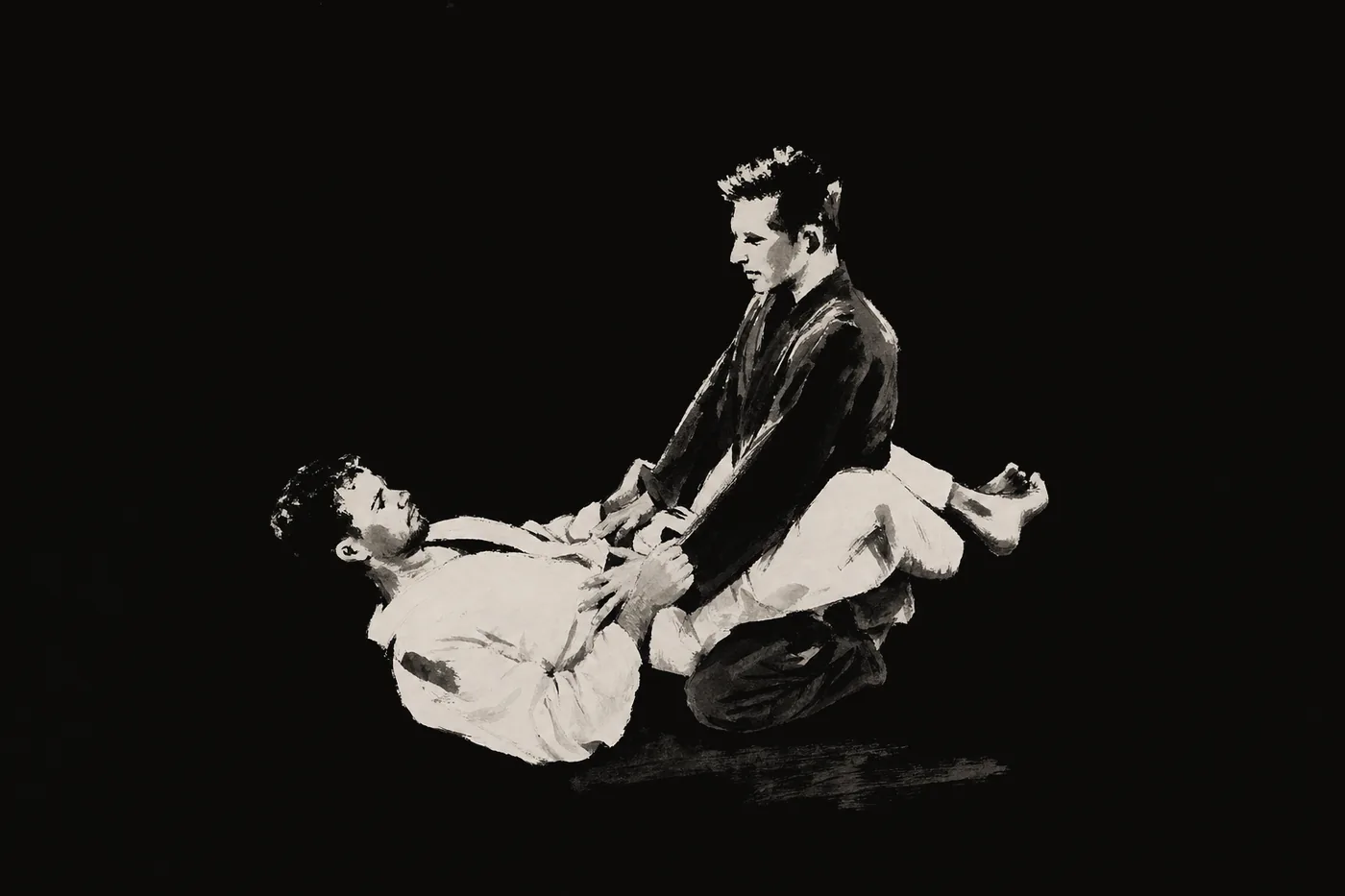
Learn / Jiu Jitsu / Systems / Opening closed guard when they hold you down, then the pass, in the gi
Closed Guard · pass it · gi
Opening closed guard when they hold you down, then the pass, in the gi
On your knees in his closed guard, take the sleeve on your right-hand side and pin it to the mat, block his other hand, shoulder down and up into the tripod with the sleeve kept, walk to the pinned side and hand the sleeve under his back, drop a knee and hug, sprawl on the back of his knee until the guard opens, step over, side control. He has pulled closed guard, broken your posture and taken your sleeve, and every time you come up he pulls again: you cannot stand and you cannot pass a guard that is closed. The spine below is Marcos Tinoco's arm-trap pass in the gi, the variation he teaches for heavy, strong guards, one coach and one route in his own orientation: his left sleeve taken with your right hand, the same-side grip, and pinned to the mat beside his left hip, his right hand blocked, your left shoulder down on his right arm and your left hand posted far out while the right keeps the sleeve, the knees lifted into a tripod that takes away his leverage, the walk toward his left side, the pinned arm's side, while the sleeve is handed under his back to your left hand, the right knee dropped by his head with the hug and the pull, the left leg walked out and the left hip sprawled heavy on the back of his left knee until his feet uncross, the step over and side control on his left side held three seconds; the mount he takes after it is beyond the endpoint. The standing break, the kneeling breaks, the log splitter, the Sao Paulo pass, the passes after the open and the ways back to posture are references; the armbar, the triangle, the arm wrap and the sweeps are the threat map. 38 gi clips, 13 no-gi clips and one clip that changes kit by segment are cited, the no-gi passages cued as such; ten clips were considered and excluded.
Key takeaways
- Success means Side control on his left side, chest to chest, his legs out, three seconds.
- The spine is 6 steps after the gate, circle under and take his left sleeve with your right hand, pin it by his left hip, block his right hand, shoulder down, up into the tripod: the left hand far out, the right hand on the sleeve, knees off the mat, his hips lifted, walk toward his left side and hand the sleeve under his back to your left hand, drop your right knee by his head, hug his head with your right arm, pull him into you; walk your left leg toward his knee and wiggle your hip, sprawl heavy on the back of his left knee until his feet uncross, step over his leg and settle side control on his left side; hold three.
- When it breaks there are 7 named branches; learn the triggers, the responses are short.
- Evidence: 52 clips from 38 channels (26 clips from a coach's own channel, 18 from a gym's, 8 from an instructional publisher's), every timestamp checked against the spoken transcript. Sentences marked synthesis are the editors', not a coach's.
his legs are stronger than your arms, so one arm goes first
Every time you sit up he pulls with his legs and your sleeve, and your hands cannot out-pull his hips. Roger Gracie, from the bottom, says why the closed guard is his: the leg is stronger than the arm, you can only use one arm against his legs, and as long as you kneel he can reach it; his first concern is your posture. Tinoco's answer is not to out-pull the legs but to take one arm out of the fight: if he lets the man use his legs he keeps breaking his posture, so the best way is to avoid one of his arms. Machado's rule for the top is the same from the other side: with posture there are no armbars, no chokes and no sweeps, and people in a hurry to pass forget it.
 1:02Roger Gracie · Bernardo Faria BJJ Fanaticsgithe leg is stronger than the arm, so the person has the advantage; you can only use one arm to fight against my legs; as long as you're kneeling down I can reach your arm; my first concern is against your posture
 1:43Marcos Tinoco · BIG OSSgiif I let him just use legs he was gonna keep breaking my posture, pulling me down, and it's gonna be very annoying; so the best way is to avoid one of his arms
 0:43Jean Jacques Machadono-gino-gi: head is supposed to be above your shoulders, not in front of your shoulders; once you have posture, no armbars, no chokes, no sweeps, just because you have posture
 1:02Chewjitsugithe belly button or the belt rule: when they lean forward over top of this person's belt line, we're now off balance, boom, right there
one arm trapped under him reduces what he can attack
His arm pinned to the mat, then fed under his own back and held there: the attacks from that side need an arm he no longer has. Tinoco's claim for the whole pass is exact: once you trap the arm on the man's body you minimise all the attacks against you, and with the arm trapped and the hug on he says you are stronger than he is; he also says where it fails, when there is no weight on your legs and you bend over and get flipped. Leonardo Nogueira's Sao Paulo pass is built on the same pin: one arm on the ground before anything else, because going for the underhook and dropping down at once exposes you to the omoplata, the triangle and the sweep. Seymour Yang teaches Roger Gracie's version with the weight put through the shoulder so the arm wrap cannot be used. synthesis The trap reduces his options while the pin, the hug and the base stay intact; nothing here makes the armbar, the triangle or the sweep impossible, and the threats and resets say what happens when they arrive.
12:24Marcos Tinoco · BIG OSSgionce you have a chance to trap the arm on the person's body you minimize all the attacks against you4:10Marcos Tinoco · BIG OSSginow I'm gonna let go my first grip; now I can even drop to my knees; now his arm is trapped right there; what I'm gonna do with these hands, I wanna hug9:11Marcos Tinoco · BIG OSSgiwhen you trap the arm, hug, hold it, pull; everything is management, my body weight; don't over commit; I don't want to bend over and then flip it over; that can happen if you don't have weight on your legs 1:01Leonardo Nogueira · Bernardo Faria BJJ Fanaticsgidon't try to get there on the hook and drop down right away; you expose yourself for submissions, omoplata, triangles and sweeps; first I must pin one of his arms on the ground
 4:36Seymour Yang (Meerkatsu)giI'm going to reach under, take an underhook, but I'm gonna put all my weight over onto this shoulder, and by putting my weight into this shoulder I'm stopping him from being able to use this arm wrap
the shoulder and the tripod hold you up, and the pinning hand never lets go
Your shoulder down on him, one hand posted far out, the other still on his sleeve, your knees off the floor and his hips lifted with them. Tinoco's detail for a man who keeps pulling: the shoulder goes down, the free hand goes to the mat, the knees lift and his hip elevates; the tripod base means he has no leverage to pull you down, so the posting hand can go far out; and the sleeve stays in the other hand until the second hand has it under his back, because he lets go of the first grip only after the second is made. Machado's rule for staying up is different in shape and the same in principle: the contact with him is purely the hip and the shoulders stay behind his belt, so that when he pulls you do not move. Kesting's kneeling break loads the head and the walking knees instead, with the belt held in straight arms. synthesis These are three different bases; Tinoco's is the one drilled, and Machado's upright rule belongs to the posture before the route starts, not to the head-down tripod.
2:46Marcos Tinoco · BIG OSSginow I'm gonna use my shoulder down; look, when I put my hands on the mat, look how I'm gonna lift my knees off the mat; look, his hip elevates; don't over commit, I want to keep my weight to his hip3:08Marcos Tinoco · BIG OSSgiwhy the tripod base: now it's hard, try pulling me down, Matt; he can't, he doesn't have a leverage; so now my hands can go far out4:10Marcos Tinoco · BIG OSSgiI'm gonna go right there, grab; now I'm gonna let go my first grip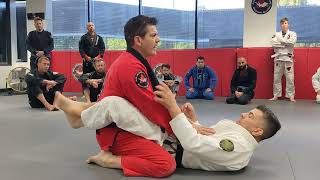 1:02Jean Jacques MachadogiI want to make sure the contact that I have with him now is purely my hip; he can pull me down, I don't even move, he's the one that has to get up; it's my hip
 1:02Stephan Kestinggiyou can hold yourself with a straight arm for a fairly long time; I'm gonna do two things: put my head down and walk my legs backwards on my knees
the guard opens under weight on the back of his knee, not under a push
Your hip sprawled onto the back of his knee, the legs spread, the turn little by little until his feet uncross. Tinoco does not push the legs apart; he sprawls heavy on the back of the knee and turns little by little, and says the man is going to open. Saulo Ribeiro's kneeling break says the same about the hands: it is not about pushing the guy, you open the guard with your body and your back, and if you still cannot get there you keep circling. Machado waits for the shoulders to come off the floor, because with the shoulders down the hips are working and with them up the legs are weak. synthesis The three-second hold in side control after the open is this document's test; Tinoco says score the three points, settles across the chest and then takes the mount, which is beyond the endpoint.
8:05Marcos Tinoco · BIG OSSgilook how I'm gonna sprawl; I wanna sprawl on the back of his knee; I want to sprawl heavy; he's gonna open8:27Marcos Tinoco · BIG OSSgiI'm gonna turn it little by little, one, two, three; now his leg is open; I love this one; take your time, score the three points, walk back, here I am 2:51Saulo Ribeiro · World Martial ArtsgiI'm not going to push; it's not about push; remember guys, you don't want to push the guy; we start to make a circle, that's what opens the guard; you're going to open the guard with your body, with your back, not with your hand4:55Saulo Ribeiro · World Martial Artsgiif you feel that you still cannot get there, you just keep make a circle, circle, and break the grip4:47Jean Jacques Machadogiwhenever his shoulders are down I'm not touching his leg, because his control is very good; the moment he raises his shoulder, perfect, there we go; I must wait for his shoulders to be off the floor
success means
synthesis Side control held: chest to chest on his left side, your hips low, his legs out behind you, and nothing happening for three seconds (the count is the session's test, the author's; the stills show Tinoco settled there for about five and a half seconds and about a second and a half before he moves to the mount). The guard open with you still between his legs is not the endpoint; the mount Tinoco takes after side control, and the kimura finish of his first variation, are his, beyond the endpoint. B1 to B6 end where their coaches end them and do not claim this position.
the situation
You are on your knees inside his closed guard in the gi; he has broken your posture at least once and has his hands on you, at your belt, your lapels or your sleeves, and he keeps pulling to break you down again; you have your posture back on your knees with your elbows in (getting it back from his chest is a reference, B6); you have not yet won a grip of your own; standing to break is a branch (B1) and is not played; the guard he opens on his own terms is another document's; the mount Tinoco takes after side control is his continuation, beyond the endpoint
the endpoint
Side control on his left side: chest to chest, your hips low, his legs out behind you, held for three seconds; the count is the session's test, the author's; the stills show Tinoco settled there for about five and a half seconds at 8:42 to 8:47.5 and about a second and a half at 7:42 to 7:43.5, each time before he moves to the mount (from 8:49; from 7:44), which is beyond the endpoint
you start with
- Your posture on your knees
- His hands on your belt or sleeves
not solved here · cooperative resets
- The posture broken to his chest and not regained (B6, a reference; a reset)
- Standing to break the guard (B1, a reference; not played, and the heel grab and the pull as the second foot lifts are the threats)
- The armbar, the triangle, the omoplata and the cross collar choke (taps)
- The arm wrapped past your tricep and the climb to your back (a reset; no escape installed)
- The hip bump and the scissor landed (resets), and the guard he opens on his own to sweep, leg lock or otherwise (a stop; the open guard is another document)
- The mount after side control (Tinoco's continuation; not tonight's)
Sides. One orientation throughout, Tinoco's own, mirrored when you trap the other arm: you kneel in his closed guard with his hands on your belt, your lapels or your sleeves; your right hand circles under his left wrist, the hand on your right-hand side, takes his left sleeve at the cuff, the same-side grip, and pins it to the mat beside his left hip; your left hand blocks his right hand; your left shoulder comes down onto his right arm and chest with your head on him; your left hand posts far out while your right hand keeps the sleeve, and your knees lift into a tripod that raises his hips; you walk your feet toward his left side, the side of the pinned arm, while the shoulder stays on him; your left hand reaches under his back and takes his left sleeve behind him, and your right hand lets go; your right knee drops beside his head and your right arm hugs his head, pulling him into you; your left leg walks out toward his knees, your hips wiggle against the lock, and your left hip sprawls heavy onto the back of his left knee until his feet uncross; your left leg steps over his left leg and you settle chest to chest in side control on his left side, the side of the trapped arm. Tinoco speaks in grab the sleeve, pin this arm, I block, shoulder down, my hands far out, walk diagonal, under his back, let go my first grip, drop one knee, hug, pull, walk my leg towards his knee, wiggle my hip, sprawl on the back of his knee, turn little by little, score the three points; which hand, which shoulder and which leg are read from stills of his clip, with the camera side settled by where each man faces and each arm traced to its shoulder, and the limitations say so.
what it is worth
The pass scores 3 once you have surmounted his legs and held side control or north-south for 3 seconds (article 4.2); that is the endpoint, and Tinoco says score the three points as he comes across. A pass that reaches the position without 3 seconds of stability is an advantage (5.6.2 covers the stack and the roll to four points; 5.1 and 5.2 the near-completed position), and an advantage is awarded only once the scoring opportunity is over (5.5). A kneeling athlete in a closed guard who does not seek to pass while preventing the guard player's progress is stalling (6.2.1, the closed guard example), as is the bottom athlete who wraps and clutches without attacking, and the referee's count decides it (7.3.1); whether the trap and the tripod read as progress and a wait on the knees with both hands on his chest does not is the author's analysis, not the rule. None of this is a referee's call in training: the session's success is side control held and counted.
Article 4.2: the athlete in top position surmounts the legs of the opponent in bottom position (passes guard or half guard) and maintains side control or north-south over him for 3 seconds; 5.5: an advantage is awarded only after the scoring opportunity from the position has passed; 5.6.2: an advantage from a guard pass when the passer stacks the opponent or lets him roll to four-point kneeling and controls the back with a knee down; 5.1 and 5.2: advantages for a position nearly completed or not held; 6.2.1: lack of combativeness includes an athlete in an opponent's closed guard who does not seek to pass while preventing the opponent from progressing, and a bottom athlete who wraps or clutches without intending to submit or score, with the referee's count in 7.3.1
Source: IBJJF Rule Book v6.1 (2024), articles 4.2, 5.1, 5.2, 5.5, 5.6.2, 6.2.1 and 7.3.1, read from the PDF
— the spine · learn this week
Marcos Tinoco's arm-trap pass
One coach's route from the closed guard on your knees to side control held, in his own orientation: the right hand under his left wrist to his left sleeve and the pin beside his left hip, the left hand blocking his right, the left shoulder down on his right arm and the left hand posted while the right keeps the sleeve, the tripod, the walk toward his left side, the pinned arm's side, with the sleeve handed under his back to the left hand, the right knee and the hug, the left leg out and the left hip sprawled on the back of his left knee, the open, the step over and side control on his left side before his mount. Step 5 is the wait and needs his ankles to strain, not a push; the session names the resets when the arm frees or the hips escape. Roger Gracie, Machado, Nogueira and Saulo Ribeiro supply checks on what the position is and why the details matter, never a step; B1 to B6 are references from their own set-ups and B7 is the reset list.
-
GATE
Read it: on your knees in his closed guard, your posture back, his hand on your sleeve
You are kneeling in his closed guard with your elbows in and your head over your hips; his hands are on you, at your belt, your lapels or your sleeves, and he keeps pulling to break you down again. The fight you pick is not with his legs: it is for one arm, his left, the arm on the side of your right hand.
This is the start Tinoco names for the second variation, the one for heavy, strong people who do not let you stay up: the same connection as the first, from a closed guard where the man keeps breaking the posture and pulling down. At 6:50 to 6:57 (.frames/v2grips-bs0IejiQ76Q-1.png at half seconds, .frames/z1grip-bs0IejiQ76Q-1..2.png at quarter seconds) Tinoco is upright on his knees in the partner's closed guard, the partner's hands at Tinoco's belt and lapels (6:55 to 6:56.25). Tinoco says which arm: sometimes you hold my sleeves, so I circle under and grab the sleeve; the arm he takes with his right hand is the one on the viewer's left, and with the partner's head toward the camera that is the partner's LEFT arm, the arm on the same side as Tinoco's right hand, traced from the cuff to the partner's left shoulder in the still. synthesis His words say sleeves and the stills show the belt: the entry is the same from either hold, the right hand circling under his left wrist. Getting the posture back when it has already been broken to his chest is the grip notes' and B6's; the session starts with the posture regained, his hands on you honest, and his pulls at half effort.
6:38Marcos Tinoco · BIG OSSgisecond variation, same thing; this one for heavy, strong people that doesn't like you stay here; same connection: grab, pin, my weight is there, I block right here, shoulder down1:43Marcos Tinoco · BIG OSSgiwe're here with Matt Daniel's closed guard; if I let him just use legs he was gonna keep breaking my posture, pulling me down; the best way is to avoid one of his arms1:22Roger Gracie · Bernardo Faria BJJ Fanaticsgimy first concern is against your posture; that's like number one rule; the first fight is don't get a good grip in my chest -
1
Circle under and take his left sleeve with your right hand, pin it by his left hip, block his right hand, shoulder down
Your right hand circles under his left wrist, the hand on your right-hand side, and takes his left sleeve at the cuff, the same-side grip; pin that arm to the mat beside his left hip. Your left hand blocks his right hand so it cannot pull you down. Then your left shoulder comes down onto his right arm and chest with your head on him, his right hand caught under the shoulder; the right hand keeps the sleeve pinned.
Three contacts in order, all in the quarter-second stills of the first demonstration, where Tinoco faces the camera and the partner's head is toward it (.frames/z1grip-bs0IejiQ76Q-1..5.png): at 6:56.75 to 6:57.25 Tinoco's right hand, on the viewer's left, lifts the partner's left sleeve, the arm on the same side of the screen as Tinoco's right hand (the partner's head is toward the camera, so his left is on the viewer's left, and the sleeve runs back to his left shoulder); at 6:58.75 to 6:59.25 his right hand pins that sleeve to the mat beside the partner's left hip; at 6:59.5 to 7:00.75 his left hand, on the viewer's right, points to and blocks the partner's right hand, which is at Tinoco's belt; at 7:00.75 to 7:02 his head and left shoulder drop onto the partner's right side, the partner's right hand caught under the shoulder, and the left hand goes out to the mat, the right hand still on the sleeve. From behind at 7:58 to 8:00.75 (.frames/z2grab-bs0IejiQ76Q-1..2.png) the same: the right hand, on the viewer's right, to the partner's left sleeve (this camera is behind Tinoco, so the partner's head is away from it and his left is on the viewer's right), the left hand to the partner's right hand, the head dropping to the viewer's left. Tinoco's words are circle under, grab the sleeve, pin this arm on the mat, this hand was going to pull me down so I block, and shoulder down. In the gi he takes the sleeve rather than the wrist and says the sleeve is the stronger grip for what comes next.
2:04Marcos Tinoco · BIG OSSgisometimes you hold my sleeves; I circle under, grab the sleeve right here; now I want to pin this arm on the mat; from here bring this arm on the mat2:46Marcos Tinoco · BIG OSSgithis hand was staying here because he was gonna try to pull me down, so I block; so now I'm gonna use my shoulder down3:28Marcos Tinoco · BIG OSSgiI like to use the sleeves; why? because my grip is gonna come here; don't hold it here because it's gonna block yourself; hold the sleeves -
2
Up into the tripod: the left hand far out, the right hand on the sleeve, knees off the mat, his hips lifted
Post your left hand far out on the mat, keep the right hand on his pinned sleeve, lift your knees and stand into a tripod with your hips high and your shoulder still on him; his hips come off the mat with his legs still locked, and he has nothing to pull against.
At 7:02.5 to 7:05.5 (.frames/v2grips-bs0IejiQ76Q-2..3.png at half seconds; .frames/side1-bs0IejiQ76Q-1.png) Tinoco's feet are on the mat, his knees up, his hips high, his left hand posted wide by the partner's head on the viewer's right and his right hand on the sleeve under his chest; the partner's hips are lifted off the mat with his ankles still crossed behind Tinoco's back. From behind at 8:00.25 to 8:02.25 (.frames/z2grab-bs0IejiQ76Q-2..3.png) the same tripod, feet wide. Tinoco says why: when the hand goes to the mat and the knees lift, his hip elevates; the tripod base means he cannot pull you down because he has no leverage, so the hand can go far out; and do not over commit, the weight stays on his hip. synthesis His words say hands; the stills show one palm posting and the other hand still on the sleeve, and the session keeps it that way, because the sleeve is what the next step hands off.
2:46Marcos Tinoco · BIG OSSgilook, when I put my hands on the mat, look how I'm gonna lift my knees off the mat; look, his hip elevates right here; don't over commit, I want to keep my weight to his hip3:08Marcos Tinoco · BIG OSSgiwhy the tripod base: now it's hard, try pulling me down, Matt; he can't, he doesn't have a leverage; so now my hands can go far out -
3
Walk toward his left side and hand the sleeve under his back to your left hand
Keep your shoulder on him and walk your feet around toward his left side, the side of the pinned arm, so his body twists over it; then reach your left hand under his back, take the pinned left sleeve behind him, and let your right hand go. His left arm is now trapped under his own body, and his right arm is the free one.
The walk and the exchange, in the first demonstration from the partner's side (.frames/side1-bs0IejiQ76Q-1..3.png at half seconds): at 7:05.5 to 7:09.5 Tinoco's feet step around toward the partner's left side, the viewer's left and the side of the pinned arm, while his head and shoulder stay over the partner's chest; at 7:10.5 to 7:12.5 his left hand reaches under the partner's back and closes on the white cuff of the pinned left sleeve, and at 7:13 to 7:14 his right hand comes free. From the partner's left side in the redo (.frames/side3-bs0IejiQ76Q-1..2.png): the left hand under the back at 8:04.5 to 8:06.5, the cuff in it at 8:06 to 8:08. His words: because I stay in the line, when I come up I need to walk diagonal; hold the sleeve and then under his back you're gonna hold it, that's the grip; now I let go my first grip and his arm is trapped right there.
3:28Marcos Tinoco · BIG OSSgibecause I stay in the line, when I come up I need to walk diagonal; hold the sleeves and then under his back you're gonna hold it, and that's the grip; it's so much stronger3:50Marcos Tinoco · BIG OSSgilook how I'm gonna walk; when I'm here: block, lean, look, I come up, now I'm gonna walk to the side4:10Marcos Tinoco · BIG OSSgiI'm gonna go right there, grab; now I'm gonna let go my first grip; now his arm is trapped right there6:58Marcos Tinoco · BIG OSSgithe trick is here: I don't want to stay here, I want to go there, grab the arm, as you guys saw -
4
Drop your right knee by his head, hug his head with your right arm, pull him into you; walk your left leg toward his knee and wiggle your hip
Drop one knee, the right, beside his head and hug his head with your right arm, pulling him into you with the trapped arm held; then walk your left leg out toward his knees and wiggle your hips against his lock.
First demonstration (.frames/side1-bs0IejiQ76Q-4..7.png at half seconds): at 7:13 to 7:15.5 Tinoco's right knee comes down beside the partner's head; at 7:15.5 to 7:16.5 his right hand is free and gesturing as he talks; at 7:17 to 7:18.5 his right arm wraps the partner's head; at 7:18.5 to 7:21.5 his left leg walks out long toward the partner's knees and his hips move against the lock, the partner's ankles still crossed. Redo from the partner's left side (.frames/side3-bs0IejiQ76Q-3..4.png): the right knee down by the head and the hug at 8:08.5 to 8:10, the left leg out at 8:10 to 8:12 and again at 8:18 to 8:21 (.frames/v2angle2-bs0IejiQ76Q-2..3.png). His words: before I drop to my knees I want to drop one knee, keep the weight in here, now pull back into you; I wanna walk my leg towards his knee and I want to wiggle my hip. And the rule for the hug: everything is management, body weight, do not over commit, and do not bend over and try to flip it, which happens when there is no weight on your legs.
6:58Marcos Tinoco · BIG OSSgibefore I drop to my knees I want to drop one knee; so now keep the weight in here; now pull back into you7:22Marcos Tinoco · BIG OSSgiI wanna walk my leg towards his knee and I want to wiggle my hip8:05Marcos Tinoco · BIG OSSginow drop to one knee, hug; now what I'm gonna do, I want to pull that into me9:11Marcos Tinoco · BIG OSSgiwhen you trap the arm, hug, hold it, pull; everything is management, everything my body weight; don't over commit; I don't want to bend over and then flip it over; that can happen if you don't have weight on your legs -
5
Sprawl heavy on the back of his left knee until his feet uncross
Drop your hips and sprawl your legs back, your left hip heavy on the back of his left knee, and turn little by little; do not push his legs, wait for the lock to break.
Redo, from the partner's left side (.frames/v2angle2-bs0IejiQ76Q-3.png, .frames/v2-bs0IejiQ76Q-8.png): at 8:22 to 8:27 Tinoco's hips drop and his legs spread back, his left hip and thigh pressing down on the back of the partner's left knee, the knee nearest the camera, with the hug and the trapped arm kept; at 8:28 to 8:29.5 the partner's feet come apart (.frames/v2pass-bs0IejiQ76Q-1.png). In the first demonstration the sprawl is at 7:26.5 to 7:29 and the ankles are already uncrossed by 7:29 to 7:31 (.frames/v2drop-bs0IejiQ76Q-1..2.png at half seconds). His words: sprawl heavy and keep passing slow; I wanna sprawl on the back of his knee; he's gonna open; turn it little by little, one, two, three, now his leg is open.
7:22Marcos Tinoco · BIG OSSginow I'm gonna sprawl heavy and keep passing slow, boom, and then finish, as I control8:05Marcos Tinoco · BIG OSSgilook how I'm gonna sprawl; I wanna sprawl on the back of his knee; I want to sprawl heavy; he's gonna open8:27Marcos Tinoco · BIG OSSginow look how I'm gonna turn it little by little, one, two, three; now his leg is open -
6
Step over his leg and settle side control on his left side; hold three
Walk your legs back, bring your left leg over his left leg, and come down chest to chest on his left side with his legs behind you; hold it three seconds. Tinoco goes on to the mount from there; that is his, not tonight's.
Redo, at half seconds: at 8:30 to 8:37.5 (.frames/side4-bs0IejiQ76Q-2..4.png) Tinoco stays sprawled across the partner's chest as his legs walk back and around, at 8:38.5 to 8:41.5 (.frames/side4-bs0IejiQ76Q-5.png, .frames/z4pass-bs0IejiQ76Q-1..2.png) his left leg lifts and comes over the partner's left leg, and at 8:42 to 8:47.5 (.frames/z4pass-bs0IejiQ76Q-3..4.png) he is chest to chest on the partner's left side with his hips low and the partner's legs out behind him, about five and a half seconds; at 8:48 to 8:48.5 his leg crosses the partner's torso and from 8:49 he is mounted (.frames/z4pass-bs0IejiQ76Q-5..6.png). The first demonstration shows the same side control at 7:42 to 7:43.5 (.frames/v2drop-bs0IejiQ76Q-3.png) and the mount from 7:44. His words: take your time, score the three points, walk back, here I am; finish, as I control, and hold right here. synthesis The endpoint is the side control before the mount, and the count is the session's test, the author's; Tinoco names the points, does not count, and moves on.
— grip notes
- Which hand, which shoulder, which leg, and how the sides were settled.
Tinoco says grab the sleeve, pin this arm, I block, shoulder down, my hands far out, walk diagonal, under his back, let go my first grip, drop one knee, hug, walk my leg towards his knee, wiggle my hip, sprawl on the back of his knee, turn little by little. The stills add which. The camera side is settled from the facing of each man and each arm is traced to its shoulder: in the first demonstration Tinoco faces the camera, so his right is on the viewer's left, and the partner lies with his head toward the camera, like a man standing with his back to it, so the partner's LEFT is also on the viewer's left; Tinoco's right hand and the partner's left arm share a screen side. The second demonstration starts from behind Tinoco (his right on the viewer's right; the partner's head away from the camera, so the partner's left on the viewer's right) and turns to the partner's left side, where the partner's left knee is the one nearest the camera. From that: the right hand takes and pins the partner's left sleeve, the same-side grip, beside the partner's left hip (6:56.75 to 6:59.25; 7:58 to 7:59.25); the left hand blocks the partner's right hand and then posts (6:59.5 to 7:02); the left shoulder and head go down on the partner's right side (7:00.75 to 7:02; 8:00.25 to 8:00.75); the feet walk toward the partner's left side, the pinned arm's side (7:05.5 to 7:09.5); the left hand takes the left sleeve under his back (7:10.5 to 7:12.5; 8:04.5 to 8:06.5); the right knee drops by the head (7:13 to 7:15.5; 8:08.5 to 8:10) and the right arm wraps it (7:17 to 7:18.5); the left leg walks toward his knees (7:18.5 to 7:21.5; 8:10 to 8:12; 8:18 to 8:21); the left hip sprawls on the back of his left knee (8:22 to 8:27); the left leg steps over his left leg (8:38.5 to 8:41.5); side control is on his left side, the trapped arm's side (8:42 to 8:47.5; 7:42 to 7:43.5), and the mount after it (from 8:49; from 7:44) is not the endpoint. The convention: a step marked transcript reproduces the cited speech; a step marked frames reproduces the speech and adds those assignments, read from 1080p stills at one second through the whole route and at half and quarter seconds through the grips, the walk, the hand-off, the drop and the pass; the sheets are listed in qualification.json. The stills settle which hand and which leg are where at the sampled moments and the order, not the pressure and not the moments between samples; a side the reviewer reads differently is adopted, and was twice: the round 1 draft had both men mirrored, and the round 2 draft had Tinoco's limbs right but the partner's arms mirrored by a screen-side rule written backwards, which round 3 replaces with the shoulder trace.
- Getting the posture back when it is already broken to his chest.
The route starts with your posture back; these are the coaches' ways of getting it back, and they are notes, not steps. Machado: the shoulders behind his belt, the contact purely the hip, look forward and not down, and when he pulls you do not move, he has to come up. Chewjitsu's rules for the low position: stay behind his belt line, lock the arms, and step the knee back before stepping in so the base never narrows. Chad Hardy, no-gi: wait him out with the elbows in, and if you are broken down go through the armpits at once, forehead under his chin to keep his back flat, hips walked in, and never a hand on the mat. Inverted Gear's coach: elbows glued to the ribs, shoulders square with the hips, and when broken down, thumbs in the armpits and punch yourself back to his hips. Jordan, in the gi at 0:12 and no-gi from 0:20: hands never on the chest with the elbows out, never on the mat, never reaching back, and, in the gi again at 3:21, the hips tracked. synthesis None of these is drilled here; the session's partner breaks the posture at half effort and lets it be regained, and a posture that cannot be regained is a reset (B7).
0:21Jean Jacques MachadogiI want to make sure that the belt is the limit for me; I don't want my shoulders ahead, because now my body is leaning forward and I become so reliant on my hands1:22Jean Jacques Machadogikeep your shoulders behind the belt, that will save you a lot of headaches1:02Chewjitsugithe belly button or the belt rule: when they lean forward over top of this person's belt line, we're now off balance, boom, right there2:46ChewjitsugiI don't want to bring my knee in and then step out, because there's going to be a moment where I'm now off balance; so what we do instead is we take our knee back and then step in 0:46Chad Hardyno-gino-gi: I'm not in a rush from this position; if I start rushing that's when I put myself in trouble; when he tries to sit up I push him back down, but I made sure my elbows were in and I did not overextend2:28Chad Hardyno-gino-gi: if I do get broken down, once I get here I go through the armpits right away, and I take my forehead and put it underneath his chin; I'm gonna drive my head right back in to get his back flat on the mat3:10Chad Hardyno-gino-gi: I just start driving my head; they keep crowding the hips like this and they're just keeping their head in until I can walk myself back; I never want to touch my hands on the mat
 0:41Inverted Gear (coach not named in the clip)giyour elbows are in; don't overextend yourself too much; my elbows are glued to my ribs; my shoulders are square with my hips1:23Inverted Gear (coach not named in the clip)giif he's breaking me down, in the gi grab the lapel, thumbs in, and punch in his armpits; I will go in his armpits, thumbs up, to try to push myself back, and then I work my way to his ribs, back to his hips
 0:00Jordan (Jordan Teaches Jiujitsu)no-giit's very important we don't keep our arms on our partner's chest; this leaves us vulnerable to attack because we have our elbows extended0:40Jordan (Jordan Teaches Jiujitsu)no-gino-gi: we also don't want to keep our hands on the mat, for the same principles as before; we're not controlling our partner and we're leaving our limbs vulnerable1:00Jordan (Jordan Teaches Jiujitsu)no-gino-gi: reaching back isn't going to be a good idea either; it's going to leave you vulnerable to triangles
— when the spine breaks
7 branches
Each one names the trigger you will feel, then the response. Learn the triggers; the responses are short.
- You can stand: your upper body is free, or you have won the grip you needreference onlythe guard opened standing, in Chewjitsu's, Rodrigo Freitas's, Osiander's, Marcelo Garcia's, Kesting's, Jordan's, Mauricio Gomes's and the gym coaches' words, each from its own grip; their own ends
The other way to open a closed guard is to stand, and the coaches here start it from different grips. Chewjitsu, from a sleeve: two hands on the sleeve and wrist, pulled across to the far hip, stand up on the same side as that arm with the foot brought in close, both knees behind his hips, hands on the hips, sit back into the chair and step back to break. Rodrigo Freitas at Gracie Barra, from the collar and the sleeve: stand to the side of the arm you hold, squeeze the knees on his butt, push the leg down, the knee and shin over his leg, the hand behind his knee, the sprawl onto his leg; if he blocks the first direction, the knee goes back on the leg and the pass goes the other way, to chest on chest, which is where he counts the pass. Osiander, from his collar grip on you: break it, dominate it, block the hip, stand on the dominated side, switch grips to the middle of the thigh, toes out, step back. Marcelo Garcia, with your hands on his biceps: stand up one side, post on the chest and on the knee, push down and circle to side control; Kesting's version learned from him relies on the man having no grip on you at all, pins both wrists or the armpits, jumps to the feet, controls the knee with the hand behind the leg, and kicks the foot out if he grabs a heel. Jordan: grab the sleeve or wrist so he cannot grab your legs, stand, push down on the knee, step back. Mauricio Gomes's thirty-six seconds: up, clean, open, step back, the weight on top. Pearson's coach stands with the sleeve trapped and pries the knee with a straight arm to reach a passing posture, knee staple, double under or over under; the Brazilian Top Team and Movement coaches stand from the lapel and the sleeve into a knee cut. synthesis None of these has its sides read from stills; references, and the reason the session does not stand: Roger's pull the moment the second leg leaves the floor is in the threats. A pass counted here is three points only on the stakes' conditions, the legs surmounted and side control held three seconds.
 0:43Chewjitsugiif it's gi I'll grab the sleeve and wrist; I'll pull it all the way over to the other side of the stomach; when I stand up I stand up to the same side as the leg1:23ChewjitsugiI bring my foot in close; I'm not gonna stand out really wide; I want to bring both of my knees in to the hips2:45Chewjitsugiwe stand in close, bring the knees in; I'm gonna sit back on the chair; I'm sitting back on my heels, a ton of pressure on his legs; step back here and I can break the guard open
 0:25Rodrigo Freitas (as heard in the clip) · Gracie Barra Manhattan Beachgimy first grip is going to be my right hand, my strong grip on both collars, close to his chest; my second step I'm going to grab this sleeve; I'm going to stand up to the same side that I have his hand1:06Rodrigo Freitas (as heard in the clip) · Gracie Barra Manhattan Beachgisqueeze your legs on his butt and you never point your foot outside; switch my grip, posture, bring my hip forward; push his leg down; as I push his leg down I'm going to bring my knee and my shin over his leg1:47Rodrigo Freitas (as heard in the clip) · Gracie Barra Manhattan BeachgiI'm going to do kind of like a sprawl, and as I do my sprawl my weight goes on his leg2:07Rodrigo Freitas (as heard in the clip) · Gracie Barra Manhattan Beachgihe's going to block, he has a strong arm, I have a hard time to pass; no problem, I'm going to go to the other side; I bring my knee back on his leg, grab deeper on his shoulder, keep my weight on his leg2:28Rodrigo Freitas (as heard in the clip) · Gracie Barra Manhattan Beachgidrive him forward and get chest with the chest, and we're going to pass his guard and score three points
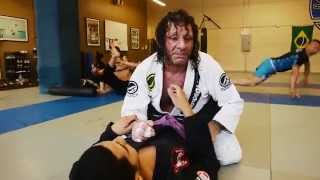 2:06Kurt Osiandergibreak his grip, dominate it and block his hip; my back is straight; I'm going to take a big step, step up, switch the grip, grab in the middle of his thigh, step back, turn my feet out2:47Kurt Osiandergiif I allow him to put the hand in my collar I have to break it out, dominate it; now I'm going to step up on the dominated side, one two, switch grip, elbow in
 0:00Marcelo Garcia · MGInActionno-gino-gi: I'm going to get posture, both hands on his biceps, start standing up one side; post my hand on his chest and the other side on his knee; push down and just circle to the side and get the side control
 0:21Stephan Kestinggiit relies on him not having grip; if he's got a lapel grip I can't do this; I have to be free, my upper body has to be free, which means first I need to grip fight0:41Stephan Kestinggiif I've got both wrists I'm going to pin both wrists to his body and I'm going to jump up to my feet; I stand all the way up; I'm going to control the knee and put my hand into the space behind him2:03Stephan Kestinggivery common for him to grab one heel or both your heels, bridge his hips and throw you back; if he's grabbing your heel I need to be able to kick my foot out: I'm kicking up under his armpit and then looping out the side4:43Jordan (Jordan Teaches Jiujitsu)no-githe reason why I grab the sleeve is so she can't grab my legs; I engage my hips, pushing down on the knee, not the pants, stepping back and breaking the guard
 0:00Mauricio Gomesgiwe have all the way up; clean; feel that it's open, step back; the weight on top; secure
 0:41Pearson Brazilian Jiu-Jitsu (coach not named)giI'm going to step up with my left leg, lean onto my right knee, and then get my right leg underneath of me; I double up my grip so that I posture up, and then switch so I can start leaning to the opposite side1:22Pearson Brazilian Jiu-Jitsu (coach not named)gionce I get to this position I don't need the sleeve grip anymore; I need to pin this leg to the ground; that way I can get into any form of passing posture that I'd like: inside knee staple, outside knee staple, double under or over under
 0:24Brazilian Top Team Happy Valley (coach not named)giI also need the sleeve; I never want to stand up without the sleeve, especially in the gi, too many sweeps available; I put this leg up first so he doesn't grab it; as I stand up I posture tall, I grab inside the knee and break the guard open
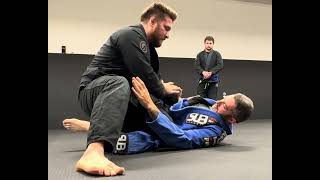 1:02Movement Jiu Jitsu New Kent (coach not named)giI stand with the side that I have the arm on; I keep the sleeve, I stand tall, I'm going to can-opener his guard, lean this way and lock your arm out; when I straighten back up it's going to pry his guard open
- You stay low: a kneeling break with the knee in the middle, the walk back, the backstep, or the wrist and the kneereference onlythe guard open from the knees, in Kesting's, Saulo Ribeiro's, Roger Gracie's, Arroyo's and the gym coaches' words; their own ends
Kesting's kneeling break: both hands on the belt shoved up to the solar plexus, head down, walk the knees backwards until the ankles strain and open, then bend the arms and pop one knee up, watching for the ankles crossing behind your neck. Saulo Ribeiro: the elbow on the side of his leg, not pushing; the knee to the side of his butt, not the middle; the step and the turn of the body that opens the guard with your back, and if it does not open, circle. Roger Gracie's knee between the legs: both collars held, elbows closed, push yourself back with the legs until the arms straighten, come up and drop the knee right between his legs, then push back; it works on a man your height or smaller and not, he says, on someone much smaller. Matt Arroyo, no-gi: posture, grab the wrist on the side you lift, turn the knee into his hip, the shin vertical, the hand inside his knee, the elbow locked and the core driving down; and his simpler answer, stand and let him open. The Six Blades coach's kneeling backstep from the lapel and the pants: one knee in, backstep, drive the knee down and cross the back leg into side control. The Chess Club and Lincoln coaches teach the beginner's version, one knee in the middle or on the sit bone and the other knee out, the hips pushed back; Lincoln's adds a second action with the other knee when the partner is long, says why he prefers standing, and gives the beginner's hand rules. Valhalla's coach: the V of the knees, cloth grabbed, one leg out first, the knee to the middle, the hips back and up into combat base; Procel's coach the knee wedge; the BJJ4Breakfast coach the knee to the middle, sit back, push down. synthesis None of these has its sides read from stills; references from the same door, for the night his grip is not on the sleeve.
0:41Stephan KestinggiI'm gonna take his belt, I'm gonna shove it up as high as I can, basically over his solar plexus2:06Stephan KestinggiI feel his ankles break open, bend my arms and pop up to one knee; this is a pretty good guard pass position; knee cuts available, a smash pass available1:07Saulo Ribeiro · World Martial Artsgimake sure that you have your elbow in contact to him; your elbow has to be on his leg, in the side of his leg, because that's what gives you the base1:47Saulo Ribeiro · World Martial Artsgieverybody says put the knee in the butt; but the knee cannot be in the middle, you don't have base for that; you just drive your knee a little bit to the side; what is going to give me the leverage is my step and when I turn my body2:51Saulo Ribeiro · World Martial Artsgiit's not about push; we start to make a circle, that's what opens the guard; you're going to open the guard with your body, with your back, not with your hand4:55Saulo Ribeiro · World Martial Artsgiif you feel that you still cannot get there, you just keep make a circle, circle, and break the grip 0:22Roger Gracie · BJJ Fanaticsgiif you have long legs and you're in someone's closed guard smaller than you, it does not work, because your knee will not find the space to go between the person's legs; not with someone much smaller than you1:04Roger Gracie · BJJ FanaticsgiI want to put both, like my knuckles, on his armpit; keep your elbows close because I don't want him underhooking me; I'm going to start pushing myself back; I stretch my arms, now I come up and that's when I bring one leg inside2:08Roger Gracie · BJJ FanaticsgiI'm feeling my knee right between his legs, and then I drop down my knee; then push back and the leg is open
 2:24Matt Arroyono-gino-gi: step one is posture; I grab the wrist of the side I'm lifting my leg up; step two, I take my knee and I turn it slightly into his hip; this puts his spine out of alignment3:04Matt Arroyono-gino-gi: this leg has to be completely vertical; my hand is going to go right on the inside of his knee; lock my elbow completely out and I'm just going to use my core to push4:46Matt Arroyono-gino-gi: all you have to do is stand; he's going to open his guard on his own because he wants to sweep me or he wants to leg lock me
 0:21Six Blades NOVA (Emil Takeuchi's channel; instructor not named in the clip)giif I grab his lapel, elbow down, grab his pant, elbow in; posture up, head up, chest up; I'm going to put my left knee in and backstep; drive that knee down, cross with the back leg into a side control position
 1:06Chess Club Jiu-Jitsu (coach not named)giI need to bring one of my knees right in the middle and my opposite knee pointing outwards; all I need to do is pushing my hips backwards to break his guard open
 2:23Lincoln Brazilian Jiu-Jitsu Center (coach not named)gifor the most part as a beginner the best rule is just two arms in or two arms out will keep you safe4:07Lincoln Brazilian Jiu-Jitsu Center (coach not named)githe knee on my right side is gonna make a U motion and I'm gonna park it on one of my partner's sit bones; I reach my left leg back; I sit back and down and twist my hips and round my back6:49Lincoln Brazilian Jiu-Jitsu Center (coach not named)giI keep my left hand grip and my right hand is going to mirror the left hand grip; I rise up slightly to unweight my right leg and I take it back and now I square up to open the guard8:33Lincoln Brazilian Jiu-Jitsu Center (coach not named)giI generally believe that it's better to stand up to break the guard; the advantage of the seated guard break is stability9:14Lincoln Brazilian Jiu-Jitsu Center (coach not named)githe price I pay is I'm less powerful; I don't have gravity dragging Mike down on my side
 2:54Valhalla Academy (coach not named)gipants, elbows tight, head up; I'm going to move one leg out first, I maintain this V; slide this over into the middle of his butt; push my hips back and then this knee will come straight up into the combat base position
 0:00Procel Brazilian Jiu-Jitsu (coach not named)githe collar that goes into the sternum and pinning on the hip; slide the knee in the center, push back, you break the guard; turn this knee towards the inside and work to secure our pass
 0:00BJJ4Breakfast (coach not named in the clip)gidouble lapel control, elbow on the inside, grab the fabric at the hips, elbow on the inside; sit up tall, shift your knee to the middle of their butt, push your other knee out, sit back, push down, open up
- A different break from a broken or rebuilt posture: the log splitterreference onlythe guard split with the knee to his tailbone and the sit back, in Greg Hamilton's, the Absolute MMA coach's, Chad Hardy's, Dave Thomas's and the Work Harder coach's words, each from its own posture; their own ends
Several of these coaches split the guard with a knee wedge and a sit-back rather than the upright standing break, and each starts from his own posture. Greg Hamilton at Renzo Gracie DFW starts from posture regained: pop up to the tripod, walk the knee into his tailbone and line it up between his legs, chest down, then the hands from the collars to the belt and the heel brought to the mat, and walk to the side so it lines up; if he hides under you it is a lot to fish back out. The Absolute MMA coach, no-gi, also starts from posture: walk the knees back and push the hips back so he has to climb his legs, stand with the feet forward, the knee to your own chest with the shin vertical, step backwards and sit back; the common fault is aiming the knee at his hips instead of your chest, and if his legs are long, lean away and post before you sit. Chad Hardy, no-gi, starts broken down: through the armpits, walk back, the knee behind his butt, arms tight so the armbar has nothing, sit back into combat base and cut through. Dave Thomas, no-gi, stands: hands in the armpits before standing so he cannot grab an ankle, feet back, one knee in, sit down. The Work Harder coach, no-gi, starts broken down: ride the storm of his hands, elongate the guard, stand and walk the feet in tight like a balance beam, the knee under his seat, collapse the chest to the knee and sit; then turn the pushing hands into pulling hands on the hips and stay connected, and his knee pin follows from there. synthesis None has its sides read from stills; references from the same door, for the night the sleeve is not there.
 4:47Greg Hamilton · Renzo Gracie Jiu Jitsu DFWgiI want to pop up to the tripod, and then I want to walk my right knee right into the tailbone, and I want to line it up between his legs; do my chest down as I begin to bring my heel down5:08Greg Hamilton · Renzo Gracie Jiu Jitsu DFWgifrom here, go to the belt, and then you have the log splitter guard break; I'm continuously going right up the middle6:16Greg Hamilton · Renzo Gracie Jiu Jitsu DFWgithe hands go from the collars to the belt, and then leaning back so my heel goes to the mat; from here it's fairly easy to go across his feet7:16Greg Hamilton · Renzo Gracie Jiu Jitsu DFWginow they start breaking their posture; it's hard to even recollect yourself; all that's left is this right here until you fish it back out
 0:17Absolute MMA St Kilda (coach not named in the clip)no-gino-gi: first off I need to have posture; this is my favorite grip to get, just lateral to the shoulders, blocking the arms; it stops him from being able to reach at my legs and reach at my head1:19Absolute MMA St Kilda (coach not named in the clip)no-gino-gi: I'm going to start to walk back on my knees and start to push my hips back; it starts to put a little bit of pressure on his legs, so he'll probably find it much easier if he climbs2:40Absolute MMA St Kilda (coach not named in the clip)no-gino-gi: push the hips back when you step out; have your feet reasonably far forward; your shin needs to be vertical; I connect my knee to my chest with my shin vertical and I step backwards and sit back4:05Absolute MMA St Kilda (coach not named in the clip)no-gino-gi: focus not on putting my knee to his hips; focus on putting my knee into my own chest and sitting backwards3:51Chad Hardyno-gino-gi: once I get my posture broken, my favorite thing to do is called a log splitter; I'm just gonna push up and start to extend; my arms are going to stay in close to my body and I'm going to take my knee and put it right behind the person's butt4:32Chad Hardyno-gino-gi: I go to combat base; I just sit back, I let go of everything, I sit back; most of the time it'll go right through the middle
 0:00Dave Thomas (JitsHappens)no-gino-gi: I'm going to need to stand up; before I stand up I'm going to stick my hands in his armpits; I want to keep my feet back, I'm not going to step too close to his butt; one knee goes in and then sit right down
 3:23Work Harder AND Smarter BJJ (a black belt under Faria and Tinoco, name not given)no-gino-gi: I'm going to stand up and put all my pressure on his shoulders, and I'm going to walk my feet in very tight together like I'm on a balance beam4:03Work Harder AND Smarter BJJ (a black belt under Faria and Tinoco, name not given)no-gino-gi: I get my knee right under the seat, right behind the butt, and I'm collapsing my chest to my knee; and then I'm going to sit straight down; this is called the log splitter4:45Work Harder AND Smarter BJJ (a black belt under Faria and Tinoco, name not given)no-gino-gi: my hands that were pushing on the hips are going to now pull the hips, and I'm going to keep my elbows in; whether the guard stays open or not, I'm locked with them6:29Work Harder AND Smarter BJJ (a black belt under Faria and Tinoco, name not given)no-gino-gi: all I really need to do is get this knee down by pushing this knee down and having this knee controlled; I'm creating torque on the hips
- The same closed guard and the same arm pin, other coaches' passes from it: the Sao Paulo pass, the arm wrap turned round, and Tinoco's own other variationsreference onlythe top of half guard, the mount or side control, in Leonardo Nogueira's, Seymour Yang's, Jean Jacques Machado's words and Tinoco's own first and third variations; their own ends
Leonardo Nogueira's Sao Paulo pass, on Faria's channel: one arm pinned on the ground first, a grip at the armpit rather than a straight dive for the underhook, walk forward and get the underhook deep with the head over his shoulder, the weight placed on his leg with his knee on the floor, then let go of the arm to control the leg, switch the base, push it down, step over, the foot on his thigh and the head on the ground, push through, and finish with the head pushing his chin and the knee under his shoulder; Faria, receiving it, says how much pressure and how tight it is. Seymour Yang's arm trap Sao Paulo with three ways out, and Roger Gracie's version that breaks the rules: reach under for the underhook, put all your weight into that shoulder so the arm wrap cannot be used, cut the angle with the elbow past his head, and walk with the chest through his shoulder until he opens; Yang adds that anyone with a bad neck should not do it. Machado's hold-and-wait: the arm hooked and the knee popped out, and then no attempt to pass; he holds, the man has to get out, and the pass is when he moves. Tinoco's own first variation ends in the mount with a kimura-style finish on the trapped arm, and his third, for the long-legged man, drops to the knees with the sleeve, rotates and pushes, brings the knee out of the legs, crossfaces and passes. synthesis Sides are not read from stills for any of them; references, and Tinoco's first and third variations are his own alternatives, not this route.
1:21Leonardo Nogueira · Bernardo Faria BJJ FanaticsgiI'm not gonna go straight for the underhook because he's gonna turn his body sideways; I get a grip and now I walk forward and get my underhook deep and my head goes over his shoulder1:41Leonardo Nogueira · Bernardo Faria BJJ FanaticsgiI place my weight on top of his leg, watch, his knee's on the floor; now it's hard for the guy to get any sweep or submission on me; now it's time for me to let go the arm and control his leg2:02Leonardo Nogueira · Bernardo Faria BJJ FanaticsgiI switch my base, push it back down, step over; I want to place my foot on his thigh, my head on the ground; push, push, push2:24Leonardo Nogueira · Bernardo Faria BJJ Fanaticsgiby the end of the pass I like to place my head pushing his chin outside; finish with my knee under his shoulder4:13Leonardo Nogueira · Bernardo Faria BJJ Fanaticsgiit's amazing how well he does it and how tight it is; I wish everybody was here in my position right now just to feel how much pressure, how tight it is3:55Seymour Yang (Meerkatsu)githis one is Roger's version; it breaks all of the rules; don't let him break my posture down, don't let him wrap my arm, keep him straight as possible; this pass breaks all three of those rules4:56Seymour Yang (Meerkatsu)giI'm going to cut the angle for him, reach over, my elbow in his head; keeping my weight down at my chest going through his shoulder, just walk around until he opens his guard6:00Seymour Yang (Meerkatsu)giif you've got a bad neck don't do this 0:24Jean Jacques Machadogiwhen I make that lock, shoulder in, my head goes on that side; I have the option to choose the collar or his arm; I have to pop my knee out this way, because if I stay here he's going to slip me0:45Jean Jacques Machadogihere's the key: I don't try to pass his guard anymore; if I try to start moving to pass he's the one that gets the leverage to defend; I hold, and he is the one that has to get out; then when he moves out, that's when I pass3:30Jean Jacques Machadogithis is a trap: if you get there you will pass every single time; you just need the timing; lock and wait; whatever's on the bottom trying to get out, I accomplished; I stretch him out5:14Marcos Tinoco · BIG OSSgishoulder pressure; now I'm gonna sneak into mount and then let go the arm and stay right here10:14Marcos Tinoco · BIG OSSgigrab this sleeve; don't grab here, this might be good for no-gi, but in the gi this one works much better; pin, put weight on, and here10:57Marcos Tinoco · BIG OSSginow from here push; now I'm only going to get out of the legs; you can hold this here, frame11:18Marcos Tinoco · BIG OSSgihook, crossface and then pass; so strong, you don't give a chance for the person to do anything
- The guard is open and you are on top of an open guard: the passes the coaches finish withreference onlyside control by the double under, the over-under and the knee cut, in Danny Fung's, Marcelo Garcia's, Arroyo's, Faria's, Kesting's, Rodrigo Freitas's and the gym coaches' words; their own ends
Once the feet uncross, the coaches here go three ways. The double under: Danny Fung swims both elbows inside, hands behind the knees, palm to palm, drives the knees under his butt, grabs the collar and raises up into side control; the BJJ4Breakfast coach pulls him into the lap like a ramp, cross-reaches thumb in, up on the toes and turns the shoulder and head; the Six Blades coach folds rather than stacks and turns; Arroyo, in the gi, hooks the belt when the man backs away and steps up to flip him; Marcelo Garcia, no-gi, stacks, takes the weight off and lets him turn with the knee inside the armpit into the crucifix. The over-under: Faria walks to the side to stretch the leg down, walks to the mirror and steps over like a leg drag, and Kesting's version stands, tucks the elbow in like karate and hunts the far collar so the triangle never comes. The knee cut: Freitas, the Gracie Barra Aliso Viejo coach, the Brazilian Top Team and Movement coaches, with the head down, the far sleeve collected and the knee slid through to side control, and the Aliso Viejo coach's answer when the underhook is denied, the collar and the sleeve punched by his armpit to flatten him; and Kesting's kneeling break lists the same three options. synthesis None of these is qualified here; the spine's pass is Tinoco's step over the leg from the sprawl, and the rest are references. Arroyo's other way of clearing a posting hand with the knee is not carried here.
 0:43Danny Funggielbows go on the inside; I bring the hands right behind the knees; palm to palm; now I drop my other knee and I drive so my knees are just below his butt1:27Danny FunggiI grab one side of his collar, I drive with my shoulder; now I just raise up and I'm already in the side control; I press against his leg so he doesn't recover the guard0:20BJJ4Breakfast (coach not named in the clip)giswim your hands in and come under; lock your hands, gable grip, pull them into your lap; this is a ramp; I want to put his back onto that ramp; it's going to keep him from hip escaping1:01BJJ4Breakfast (coach not named in the clip)giI'm just going to turn my toes to the left, turn my shoulder, turn my head, and his legs come right back, and then we're on the side control
 0:41Six Blades NOVA (Emil Takeuchi's channel; instructor not named in the clip)gieverybody knows the difference between stacking and folding; right now all I want to do is grab his hips and fold; if he starts to move I'm going to start to stack, grab onto the lapel, and turn, turn, turn and pass the guard
 2:05Matt Arroyogiif I'm having trouble sucking him in and he keeps backing up, I'll take my fingers right in his belt and just hook his belt; step up one leg, flip them over and go right to the back
 0:21Marcelo Garcia · BJJ Fanaticsno-gino-gi: I can have a double under, I can reach for his shoulder, I can really start stacking; as soon as I see a chance my knee goes right inside his arm2:05Marcelo Garcia · BJJ Fanaticsno-gino-gi: I'm taking the weight off so he can turn, and with my knee inside of his armpit, turn around, I have a perfect position to just step in and trap his arm
 1:43Bernardo Faria · BJJ Fanaticsgihis shin and his knee is blocking my hip; I'm gonna walk a little bit to the side and I'm gonna stretch his leg down; once I did that I'm gonna walk all the way down to the opposite side2:23Bernardo Faria · BJJ Fanaticsgimy shoulder is really heavy on his belly; my legs carry his leg; I can just step over his leg, position myself like a leg drag, control his hand and establish his side control
 1:45Stephan Kestinggione of the keys is to do this standing, and the other key is to control the sleeve; this elbow is coming in here, think karate; if I leave it out here I'm going to get triangled2:27Stephan Kestinggimy other hand comes under; I still personally prefer grabbing high and grabbing the collar; this is searching for a far collar, this knee comes down
 2:07Bernardo Faria · Grapplearts (Stephan Kesting)giI'm going to stand up with the other hand anywhere around his hip; keep this hand on his lapel just to have some post; now I'm going to push his leg down, push out, and step over his leg before he closes his half guard
 0:44Gracie Barra Aliso Viejo (coach not named)gishuffle to the side, pin his leg down, clamp his leg with a knee slice here; usually we go for an underhook; today he's going to stay tight, I can't get the underhook, so I'm going to switch to this control where I'm pulling his collar into his armpit2:07Gracie Barra Aliso Viejo (coach not named)giif I cannot underhook, I'm going to grab the collar and the sleeve, and I'm going to punch right by his armpit, flattening him out on the ground as I pull the other one1:06Brazilian Top Team Happy Valley (coach not named)gionce the guard is broken open I can step back and get myself into my position; my shin on his thigh, my other leg is out here; my head aiming towards his chin, I grab this elbow, and now I'm passing right into side control3:08Movement Jiu Jitsu New Kent (coach not named)giI collect the far side sleeve, pull up, create a little window for me to knee slide through, and I keep my head down as I knee slide through into side control
- One step earlier: your posture is broken to his chestreference onlythe posture regained on your knees, in Machado's, Chewjitsu's, Hardy's, Jordan's, the Inverted Gear, Absolute MMA, Renzo Gracie DFW, Lincoln and Valhalla coaches' words; their own ends
Machado, three ways: the shoulders behind the belt with the contact purely the hip, look forward and not down, the head above the shoulders, and the hip used in every movement so that when he pulls you do not move. Chewjitsu: the belt line rule, the arms locked out like bending a bar on the bench, the knee stepped back before it steps in. Jordan, in the gi for the first and the last two and no-gi for the middle two: no hands on the chest with the elbows out, no hands on the mat, no reaching back, hips tracked, and the butt all the way up or all the way down and never in the sweep zone between. Chad Hardy, no-gi: wait him out with the elbows in, never reach toward his neck, and when broken down go through the armpits with the forehead under his chin and walk the hips back in. The Absolute MMA coach, no-gi: with posture the triangle and the armbar are too far away, and once it is lost the first aim is to get it back. The Renzo Gracie DFW coach on the pyramid of the post and the second hand as its backup, and the grip rolled so it cannot be pulled across; the Inverted Gear coach on elbows glued to the ribs and shoulders square with the hips; the Lincoln and Valhalla coaches on where the hands may and may not be. synthesis These are the entry to this document's start; the session begins with the posture back and his sleeve grip on, and a posture that cannot be regained is a reset.
0:42Jean Jacques Machadogithe simple fact that I look straight forward and try to keep my shoulders behind his belt; not my hands, my hands can be here, but my shoulder should be behind his belt; when I lean forward I have too much contact with him with the wrong part of my body3:04Jean Jacques MachadogiI don't want to go up, because if I go up I pull the same way; I'm moving my tailbone forward; if my tailbone is back he stopped pulling me0:43Jean Jacques Machadono-gino-gi: head is supposed to be above your shoulders, not in front of your shoulders1:24Jean Jacques Machadono-gino-gi: bring me down; what did I do different? using my hip; not my butt back, that's my hip; the more he tries to pull, the better; and when he raises his shoulders off the floor his legs are very weak1:02Chewjitsugithe belly button or the belt rule: when they lean forward over top of this person's belt line, we're now off balance2:46ChewjitsugiI don't want to bring my knee in and then step out, because there's going to be a moment where I'm now off balance; we take our knee back and then step in3:29Chewjitsugiwith the push we want to make sure that our arms are locked in place; it's like you're bending the bar when you're bench pressing; we're making sure that his body is flat0:00Jordan (Jordan Teaches Jiujitsu)no-giit's very important we don't keep our arms on our partner's chest; this leaves us vulnerable to attack because we have our elbows extended0:40Jordan (Jordan Teaches Jiujitsu)no-gino-gi: we also don't want to keep our hands on the mat; we're not controlling our partner and we're leaving our limbs vulnerable1:00Jordan (Jordan Teaches Jiujitsu)no-gino-gi: reaching back isn't going to be a good idea either; it's going to leave you vulnerable to triangles3:21Jordan (Jordan Teaches Jiujitsu)no-giI'm also tracking the hips to keep Nikki's back on the mat; we really need to track the hips when we're postured low3:43Jordan (Jordan Teaches Jiujitsu)no-giwe need to keep our butt down when postured high; the midway zone where our butt is off our heels is also the sweep zone where you lack base; we need to be all the way up or all the way down0:46Chad Hardyno-gino-gi: I'm not in a rush from this position; if I start rushing that's when I put myself in trouble; when he tries to sit up I push him back down, but I made sure my elbows were in and I did not overextend2:07Chad Hardyno-gino-gi: my elbows are in to make it tough for him to break me down; where you're going to start getting submitted is if I start reaching towards his neck2:28Chad Hardyno-gino-gi: if I do get broken down, once I get here I go through the armpits right away, and I take my forehead and put it underneath his chin3:10Chad Hardyno-gino-gi: I just start driving my head; they keep crowding the hips and keeping their head in until I can walk myself back; I never want to touch my hands on the mat 0:21Absolute MMA (coach not named in the clip)no-gino-gi: he tries to triangle me while I'm like this, he's too far away, he can't get his hips up; once I lose my posture all of those options start to become available; if you've lost your posture your main aim should be get your posture back0:41Greg Hamilton · Renzo Gracie Jiu Jitsu DFWgimy right hand needs to create a post so that my knees and my right hand create essentially a triangle or a pyramid; you need to look forward, not down; have the second hand as a backup because he's going to want to break your posture2:45Greg Hamilton · Renzo Gracie Jiu Jitsu DFWgiI need to take the slack out; put it together and roll it; when you roll it, it makes it harder for him to break that grip and pull it across0:41Inverted Gear (coach not named in the clip)giyour elbows are in; don't overextend yourself too much; my elbows are glued to my ribs; my shoulders are square with my hips; they're not getting past my hips1:00Lincoln Brazilian Jiu-Jitsu Center (coach not named)giI don't put my hands on the floor; I don't reach much past the midline of my partner's abdomen; each arm should not cross the midline much1:14Valhalla Academy (coach not named)giI need to be straight up and down; if I'm humped over like this it's not going to work; push on his armpits a little bit, grab cloth, and walk your way back up; my knees need to be in a V, wide; if they're narrow I'm going to get swept
 0:01Foundation Chicago (coach not named)no-gino-gi: wide base, inside position, posture; we're going to pop up off the back here; one leg goes in the center, step back
- The cooperative resets: the armbar, the triangle, the omoplata or the cross collar locks; the arm wrap takes your back; the hip bump or the scissor lands; he pulls you down and you cannot regain the posture; he opens on his own terms to attack a leg or sweep you; his hips keep sliding out from under your sprawlcooperative resetrestart from the start position, or stop
synthesis Six ends that are not this document's. A locked armbar, triangle, omoplata or cross collar choke: tap, release, reset, and the checks say which contact was missing. His overhook or arm wrap that gets your arm across and his chest behind your tricep, Jon Thomas's route to the back, or Roger's climb to the shoulder: reset the moment your arm crosses, no late escape is installed. A completed hip bump or scissor sweep: reset; Chewjitsu's base rules and Jordan's all-the-way-up-or-down are references. Posture broken to his chest and not regained in a few seconds of half-effort pulling: reset; B6 is the reference. He opens the guard himself to sweep or to attack a leg as you rise, which Arroyo says is what a stand invites: the open guard is another document; reset. His hips escape out from under the sprawl and he starts to turn away or recover: hold what you have, and if the guard closes again, reset.
 2:44Jon ThomasgiI switch my left hand behind his tricep; I unlock my legs, I shrimp out to the side and I want to pull myself up behind and get my chest behind his tricep; now it's easy to lock in on the armpit and start progressing into basic attacks for the back7:33Roger Gracie · Bernardo Faria BJJ FanaticsgiI'll go over and then I'm gonna start attacking your arm; being over I have the advantage; the next step you'll be trying to gain your shoulder8:14Roger Gracie · Bernardo Faria BJJ Fanaticsgimost of my armlocks, I gained the shoulder first; very difficult to go from zero to the end; getting the shoulder, keeping that position, and then when the moment comes to go over, my success is much higher4:47Jon Thomasgithe opponent's leaning so far back that when I do this I can't bring him forward; this is when doing the hip bump sweep threat is really powerful; very often he will drive back into you which again allows you to break the posture4:46Matt Arroyono-gino-gi: all you have to do is stand; I stand up, he's going to open his guard on his own because he wants to sweep me or he wants to leg lock me; those are the two things he can do there
— negate first
Threat map
Some of the clips on the left show the coach performing the attack; watch them once so you recognise it. The answer on the right is a spine step, a branch, or marked as synthesis.
- The armbar and the triangle from a broken posture
-
what they are doing
6:12Roger Gracie · Bernardo Faria BJJ Fanaticsgiyou have a lot of threats on you here: your posture getting swept, triangle chokes, kimura, there's many; there's none against me; the only thing that I have to worry about is you opening my guard 0:00Chess Club Jiu-Jitsu (coach not named)gibiggest mistake you make inside someone's closed guard is having your arm extended there in front of his chest; that's pretty much the position that he wants; keep your arms nice and tight, close to your body, elbows towards your hips1:27Chess Club Jiu-Jitsu (coach not named)gias soon as they grab my arm I want my second hand to go under the arm; he's trying to extend my arm this way, I can bend my arm; the defence of the armbar is gonna be your opposite hand
 0:36Eduardo FragagiI want to trap his hand right here; once I drop the hand I'm gonna hook this arm right here and then I'm gonna push this arm in, and then I have the setup for my triangle0:20Stephan Kestinggione arm's in, one arm's out; it's an instant triangle against anybody who's got a triangle4:36Stephan Kestinggiit's not really one arm in one arm out; it's one arm in maybe just to the depth of the fingers, and I have to be super careful that he doesn't reach in and pull this arm out and kick through1:00Jordan (Jordan Teaches Jiujitsu)no-gino-gi: reaching back isn't going to be a good idea either, it's going to leave you vulnerable to triangles; Nikki needs one arm in and one arm out for a triangle
your answer
Recognise it: your arm straight across his chest or reaching past his midline, one arm inside his legs and one out, your head pulled below his belt line. The route keeps both arms working on one side of him, the pinned sleeve in the right hand and then under his back in the left, and the head on his chest, which is what Tinoco says reduces the attacks; Kesting's rule for his own over-under is two in or two out, with a fingers-deep exception he warns about. synthesis In the session no submission is attacked; a locked armbar, triangle, omoplata or collar is a tap, release and reset, and the Chess Club coach's late armbar defence is a reference, not a plan.
- The arm wrap and the climb to your shoulder, to the back or the omoplata
-
what they are doing
2:03Jon Thomasgiwhen our opponent is one high one low, I'm going to focus on breaking this grip; I get a cross sleeve grip, I go underneath and I grab my own wrist; as soon as I break this grip he's usually going to try to regrip, so I want to catch his wrist and guide this across the body3:48Roger Gracie · Bernardo Faria BJJ Fanaticsgithe moment that I feel you have a good grip, I go over; I can break that because I'm over; now your elbow breaks and if you try to stand up, by combining pulling with my legs1:01Leonardo Nogueira · Bernardo Faria BJJ Fanaticsgidon't try to get there on the hook and drop down right away; you expose yourself for submissions, omoplata, triangles and sweepsyour answer
Recognise it: his arm coming over the top of yours and his chest turning behind your elbow, or your own reach for an underhook without the pin. Roger goes over the arm the moment your grip is good; Jon Thomas breaks the high grip and guides the wrist across; Nogueira's reason for pinning the arm before the underhook is exactly this. The route's pin, then the shoulder, then the sleeve under his back, keeps the trapped arm from being wrapped, and the other hand blocks his second grip until the shoulder replaces it. synthesis An arm already wrapped with his chest behind your tricep is a reset in the session; no back escape is installed.
- The sweeps when you lean or stand: the hip bump, the scissor and the flower, the heel grab, and the pull as your second leg lifts
-
what they are doing
1:23Chewjitsugiif I try to kick the legs now nothing's going to happen because his center of gravity is nice and low; we begin the scissor sweep by pulling this person off balance; he's leaning forward over top of me, now we can sweep the legs2:05Chewjitsugiwhen they bring that knee in behind the hips they get knocked off balance with something like a flower sweep; he'll grab my sleeve and then kick the leg over, boom4:47Jon Thomasgiif he's leaning really far back, that means it gives me a lot of support; so when I crunch it actually pulls me up off the floor; I catch this elbow and I drive him over to try to sweep to mount4:48Roger Gracie · Bernardo Faria BJJ Fanaticsgithere's a perfect moment when to pull: it's the moment that you take your second leg off the floor; if you bring one leg up and then I try to pull, you're still solid; the moment they take the other leg off the floor I got it2:03Stephan Kestinggivery common for him to grab one heel or both your heels, bridge his hips and throw you back; anytime he grabs your heel it's a bad thing 0:46Marcelo Garciano-gino-gi: if he comes on my right leg, I'm gonna leave my leg; I have to put one leg back, because that's the only way1:29Marcelo Garciano-gino-gi: if he comes home again I'm ready to move; if I don't have a leg in front I have to make sure I do two steps
your answer
Recognise it: his hips loaded onto you as you lean, his sleeve grip and a leg kicking over as your knee comes in, his hands on your heels as you stand, or his pull timed to your second foot. The route never stands: it works from the knees to the tripod with the shoulder on him and the sleeve kept, and Tinoco's base rule is the weight kept on his hip without over committing. Chewjitsu's base rules and Jordan's all-the-way-up-or-down are the general answers; Kesting kicks the foot out of a heel grab; Marcelo keeps a leg back. synthesis In the session a landed sweep is a reset, and the partner does not attack the heels because nobody stands.
- Posture broken and held down
-
what they are doing
2:26Roger Gracie · Bernardo Faria BJJ Fanaticsgifor you to break that grip you gotta pass my hands; at the same time I'm pulling you; that will force you to put your arm somewhere else, and anywhere else you put is weaker 0:40Grapplearts (Stephan Kesting's channel; instructor not named in the clip)no-gino-gi: I'm going to climb my hips as high up as I can and climb my guard up as high as I can; clamping my knees to your torso, trying to create as much of a lever out of your spine as I can
 0:21Braulio Estima · Timeless Jiu-Jitsu Academygias soon as I capitalize that pull and keep the pull and start moving my upper body to the side, there are many directions happening at the same time0:43Braulio Estima · Timeless Jiu-Jitsu Academygitheir body cannot assimilate that; keep the same pressure, look, and then I have the posture
 1:04SBG Portland (coach not named in the clip)no-gino-gi: if when I get to this grip I cut an angle to here, it's more difficult for him to hit me from here; and it's harder for him to get back up1:45SBG Portland (coach not named in the clip)no-gino-gi: try and get posture from here; it's harder from here for him to get posture for most people than it is from here
your answer
Recognise it: his knees climbed high on your ribs, a pull with a turn added, or his hips angled off to one side so your posture has nowhere to come back to. Estima and the SBG coach show the bottom player's side of it. This document starts after the posture is back; the coaches' ways of getting it back are in the grip notes and B6, and Tinoco's route is built so that the pull has no leverage once the shoulder is down and the tripod is up. synthesis A posture that cannot be regained at half effort is a reset, not a fight.
- He opens on his own terms: the leg attack or the sweep as you rise
-
what they are doing
4:46Matt Arroyono-gino-gi: he's going to open his guard on his own because he wants to sweep me or he wants to leg lock me; be ready for the two things he can do: he's going to try to leg lock me, go after a leg; or he's going to grab my ankles and try to sweep me0:22Roger Gracie · Bernardo Faria BJJ Fanaticsgithe main reason that people open the guard is when they stand up; I find it much easier to block the person's attempt to open your guard when they're moving down there; if you stand up it's a big threatyour answer
Recognise it: his feet uncrossing before you asked them to, with his hands going to your ankle or his hooks coming in. Arroyo names it as the price of standing; Roger says standing is the big threat to his guard and that is why the route here does not stand. synthesis If he opens to attack, the open guard is another document's: reset, and the session's partner keeps the guard closed until the sprawl breaks it.
— 20 minutes · gi
Tonight
synthesis The session is the author's; the mechanics are Tinoco's, from one exact start: on your knees in his closed guard with your posture back and his right hand on your left sleeve, pulling at half effort. One orientation tonight, his left arm trapped, the arm on the side of your right hand, taken with the same-side grip; the mirror is another night. Every rep ends at the spine's endpoint, side control counted to three before any mount, or at a named reset; the first three blocks each emphasise one part of the route but every rep in them runs to side control cooperatively, one rep each in turn for the block's minutes with no count to reach; no other route is played, and the other coaches' breaks and passes are references. Two kinds of stop: the block's own reset, cooperative and named under each block, and the hard boundaries the scope lists (the posture broken and not regained; a locked submission or a wrapped arm; a landed sweep; the guard he opens on his own terms; the trapped shoulder, the neck or a knee complaining), which stop everything; both restart only after the partner releases every control.
safety · stop here
No submission is attacked in this document. The pinned arm is trapped under his own back from step 3: the partner keeps that shoulder relaxed, the hug in step 4 is on the head and never a crank on the neck, and any complaint from the trapped shoulder, the neck or a knee stops the rep at once. The sprawl in step 5 puts your hip on the back of his knee while his ankles are still crossed and loads a flexed knee: it is done slowly, and the partner uncrosses when the lock strains rather than holding until it is forced. The armbar, the triangle, the omoplata and the collar chokes that punish a lost posture are taps, never fought; an arm wrapped past the tricep is a reset. Two references carry instructions that are not drilled here in any form: Seymour Yang's walk until the man opens or his back gives, kept only with his own warning about a bad neck, and Arroyo's knee into a posted elbow, which is not carried at all; the IBJJF prohibits intentional blows (6.1). The release rules are the author's.
- His trapped arm and shoulder under his own back (steps 3 and 4, every block). The partner keeps the shoulder relaxed; any load on the shoulder is a stop and a reset, and the hug is on the head, never across the throat
- His crossed ankles and flexed knee under the sprawl (step 5). Slowly; the partner uncrosses when the lock strains; any complaint from a knee is a stop; no forcing of a locked guard, and a guard that will not open is a reset
- His neck under the hug and your weight (steps 4 to 6). The arm hugs the head, not the neck; any complaint from the neck is a stop at once
- The armbar, the triangle, the omoplata and the cross collar choke from a broken posture (threats). Not attacked in the session; a locked one is a tap, release and reset; no late escape is drilled
- The arm wrap and the climb to your back (threats). The partner does not wrap the arm past your tricep in any block; an arm that crosses is a reset
- 1
The sleeve, the shoulder and the tripod
5 minOne orientation tonight, Tinoco's: his left arm, the arm on your right-hand side, is the one you trap. From the exact start, at half speed, say the contacts as you make them: right hand under his left wrist to his left sleeve, pin it by his left hip; left hand on his right hand, block; left shoulder down on his right arm, head on his chest; left hand out to the mat, right hand stays on the sleeve. Then lift the knees into the tripod and feel his hips come off the mat; say it: tripod. Then finish the route cooperatively: walk your feet toward his left side, the pinned side, left hand under his back to the sleeve, right knee down and hug, left leg out, sprawl on the back of his left knee until he uncrosses, step over, side control, count three. He pulls at half effort and offers nothing else. Alternate one rep each, as many as fit in the five minutes; quality, not a count.
- 2
The walk, the hand-off and the hug
5 minThe same start and the same first two steps, then the block's emphasis: walk your feet toward his left side with the shoulder kept on him and the right hand still on the sleeve, feel his body twist, reach your left hand under his back and take the sleeve, and only then let the right hand go; say it: under. Drop the right knee beside his head, hug his head with the right arm and pull him into your chest; say it: hug. Then the rest cooperatively: the left leg out toward his knee, the sprawl, the open, the step over, the count. He keeps his feet crossed and his free right arm honest, and does not reach for your neck. Alternate one rep each for the five minutes.
- 3
The sprawl and the pass, every time
6 minFrom the exact start, the full route at half speed with the block's emphasis at the end: the left leg walked out toward his knees, a wiggle of the hips against the lock, then the hips dropped and the left hip heavy on the back of his left knee, the legs spread, the turn little by little; wait, do not push his legs; when his feet uncross, walk the legs back, bring the left leg over his left leg, come down chest to chest on his left side, count three out loud, and stop there; the mount is not tonight's. He keeps the guard closed honestly until the sprawl breaks it and does not fight the pass after it. Alternate one rep each for the six minutes.
- 4
Positional rounds
4 minFour one-minute rounds from the exact start, alternating who is on top. He holds the sleeve and pulls at half effort, may sit up into you, may fight to free the pinned arm before it is under his back, may hip escape under the sprawl and re-close, may bump you with the guard closed when you lean; he does not attack a submission, does not wrap the arm past your tricep, and does not open the guard on his own, so the scissor and the flower, which need an open guard, are not in the round: if his feet uncross for any reason but the sprawl, that is a cooperative stop. You play the route only: the sleeve, the block, the shoulder, the tripod, the walk, the sleeve under his back, the knee and the hug, the leg out, the sprawl, the open, the step over, the count. A guard that will not open under the sprawl is not fought with anything else tonight; after ten seconds of nothing, reset. The standing break, the kneeling breaks, the log splitter, the Sao Paulo pass and the other coaches' passes are other nights' drills and are resets here.
— after the round
Check first
synthesis The author's table. Outcomes have more than one cause; check these in order.
| It happened | Check first |
|---|---|
| He pulled you straight back down | In order, and no one of them is proved by the pull: first the sleeve, still pinned in your right hand and your shoulder down on him; then his other hand, blocked or covered by the shoulder; then the hips, up in the tripod with the feet on the mat and the weight on his hip, not over committed past it; then the legs, whether there was weight on them. Tinoco names all of these; the upright belt-line rule is for the posture before the route, not for the tripod, which puts the head and shoulder forward on purpose. |
| You could not get the sleeve under his back | First the walk: did your feet go around toward his left side with the shoulder kept on him, so his body twisted and the space under his back opened? Then the grip: did the left hand reach the cuff under his back before the right let go? If both hands left the sleeve, the arm is free and the rep is over. |
| He freed the arm as you dropped the knee | First the pull: was he pulled into your chest with the hug as the knee came down, or did you sit up and give the arm slack? Then the order: one knee, the right, not two, and the weight kept on him, which Tinoco calls management. |
| The guard would not open under the sprawl | First the leg: was your left leg walked out toward his knees and your hip on the back of his left knee, or on his thigh? Then the turn: little by little, one, two, three, not a push with the hands. Then the time: take your time; after ten seconds of nothing in the rounds, that is a reset, not a shove. |
| He hip-escaped as you stepped over and closed the guard again | First the hug and the arm: still on? Then the step: did the left leg come over his left leg with the chest still down, or did you rise? The pass after the open is still under the same weight. |
| An arm was caught, or you were swept | Was one arm in and one out, or reaching past his midline? Did you lean over his belt to reach before the route started, or bring the knee in and step out so the base narrowed? Both are the threat map's; in this route the arms stay on one side of him and you never stand. A lock or a landed sweep is a reset. |
— the other doors · keep for later
Reference
Everything else read for this situation, grouped by door: posture and the position from the coaches on both sides, and the no-gi clips kept for their principles, cued as such.
Posture and the positionwhat it is to be in a closed guard, from the coaches on both sides
- Marcos Tinoco
The whole pass from the top of his clip: the closed guard is annoying because the legs lock and the hands control your posture, so the answer is to trap an arm under the man's body, which reduces the attacks; three variations, the first into the mount and a finish on the trapped arm, the second for heavy strong people into the sprawl and the pass, the third for long legs with the sleeve, the rotation and the crossface.
1:03Marcos Tinoco · BIG OSSgiit's a very strong way to pass any kind of closed guard, because people lock the legs, and they use the hands to control your posture; this type of pass, I'm gonna show you guys three strong details1:23Marcos Tinoco · BIG OSSgiit's trapping the arm under the person's body; it's very similar to the Sao Paulo pass, and I'm gonna show you different ways5:14Marcos Tinoco · BIG OSSgishoulder pressure; now I'm gonna sneak into mount and then let go the arm and stay right here6:38Marcos Tinoco · BIG OSSgisecond variation, same thing; this one for heavy, strong people that doesn't like you stay here10:14Marcos Tinoco · BIG OSSgigrab this sleeve; don't grab here, this might be good for no-gi, but in the gi this one works much better; pin, put weight on11:18Marcos Tinoco · BIG OSSgihook, crossface and then pass12:03Marcos Tinoco · BIG OSSgithose are the three options; once you have a chance to trap the arm on the person's body you minimize all the attacks against you - Roger Gracie, with Bernardo Faria
From the bottom, on Faria's channel: why standing is the big threat to a closed guard, while most kneeling attempts are easier for him to stop, with the Sao Paulo opening the exception he names; the first fight is your grip in the middle of his chest, because higher exposes your arms and lower is weak; he goes over the arm the moment your grip is good; the pull is timed to your second foot leaving the floor; and, in his words, it is not equal while he attacks and you only defend: your mistake can make you tap, and his mistake can let you stand and open his guard.
0:22Roger Gracie · Bernardo Faria BJJ Fanaticsgithe main reason that people open the guard is when they stand up; I find it much easier to block the person's attempt to open your guard when they're moving down there0:42Roger Gracie · Bernardo Faria BJJ Fanaticsgithere's one open guard that is more threatening, the Sao Paulo guard; they go exactly to open so they don't sacrifice themselves; but mainly, if you stand up it's a big threat1:44Roger Gracie · Bernardo Faria BJJ Fanaticsgithere's one place that gives you more posture: the middle of my chest; if it's higher than that, you expose your arms; if you go too low it's harder for you to keep your posture because it's easier for me to pull you6:33Roger Gracie · Bernardo Faria BJJ Fanaticsgithis is not equal, because I'm attacking and you're defending; you're not attacking back; this is a very advantaged position for me6:53Roger Gracie · Bernardo Faria BJJ Fanaticsgione mistake, you tap; there's no mistake that'll make me tap; my mistake will make you stand up and open my guard, that's it3:48Roger Gracie · Bernardo Faria BJJ Fanaticsgithe moment that I feel you have a good grip, I go over; I can break that because I'm over4:48Roger Gracie · Bernardo Faria BJJ Fanaticsgithere's a perfect moment when to pull: it's the moment that you take your second leg off the floor - Jean Jacques Machado
Posture as a body rule: shoulders behind the belt, the hip as the contact, look at the window and not at him, wait for the shoulders to leave the floor, and when the legs open block and spread; his opening control from the collar and the belt with the feet flat and the head kept back, the grip broken by pushing before the hand comes over the neck.
1:42Jean Jacques Machadogiwhen he tries to put it down it's my hip; he has to come up, and when he comes up it's amazing that with a little touch his feet just uncross2:03Jean Jacques Machadogiwhen the legs open, remember: block, and I look at the window; now I spread his leg as much as possible; to pass the guard, look forward; close the distance and go 0:03Jean Jacques MachadogiI'm gonna put my right hand and hold the collar; the other hand can hold the belt or inside the belt as you wish; I spread out my knee, I put my feet flat; I'm gonna keep my head behind0:45Jean Jacques MachadogiI break his grip; now I bring my right hand, I put it on top of his neck and I hold this lapel and I stick my thumb in the belt; I open my hand like I hold a basketball on top of his belly
 - Saulo Ribeiro
The kneeling break as the safest way: the elbow on the side of his leg for base, the knee to the side of the butt, the step and the turn that open the guard with the back, one movement and then freeze to check the base; why the arm is not exposed to the armlock when his hips are that low; and keep circling if it does not open.
0:22Saulo Ribeiro · World Martial Artsgiyou have to think that your partner has to be your best friend, so you don't want to hurt him; you want to find the right spot to save your energy and be able to open the guard3:53Saulo Ribeiro · World Martial Artsgiwhen I go, I go just one time; I put it here and go, boom, and I freeze here; you have to see if your base is good4:13Saulo Ribeiro · World Martial Artsgisome guys think your arm is too exposed, the guy can go for the armlock; but he cannot, because look how down his hips are; he has no angle4:55Saulo Ribeiro · World Martial Artsgino matter how strong the leg is, no matter how long the leg is; if you feel that you still cannot get there, you just keep make a circle and break the grip1:07Saulo Ribeiro · World Martial Artsgiyour elbow has to be on his leg, in the side of his leg, because that's what gives you the base1:47Saulo Ribeiro · World Martial Artsgithe knee cannot be in the middle, you don't have base for that; you just drive your knee a little bit to the side - Jon Thomas and Braulio Estima
From the bottom, the posture-breaking you are answering: Thomas's three grip structures on top, both low, one high one low, both high in the armpits, and how each is broken, including the pull past the tricep to the back and the hip bump against the man leaning back; Estima's two directions at once.
0:20Jon Thomasgihe's going to find his posture by putting his hands somewhere; there's three primary ways: both hands low on your hips, one high and one low, or both high; so I need a different way to break each of these structures3:25Jon Thomasgithis grip is hard to break, so usually what I focus on here is pummeling under; I get a grip on the shoulders and I try to bench press the shoulders a little bit; this will force some space to open and really quick I'm going to snake my finger under1:00Jon Thomasgiif the guy has both hands low here, this is kind of a weak position, because if I can pull him over his hands it's easy to break; I double grip both lapels, I crunch and I bring my knees to me2:03Jon ThomasgiI get a cross sleeve grip, I go underneath and I grab my own wrist; as soon as I break this grip he's usually going to try to regrip, so I want to catch his wrist and guide this across the body2:44Jon ThomasgiI switch my left hand behind his tricep; I shrimp out to the side and I want to pull myself up behind and get my chest behind his tricep4:47Jon Thomasgithe opponent's leaning so far back that when I do this I can't bring him forward; this is when doing the hip bump sweep threat is really powerful1:06Braulio Estima · Timeless Jiu-Jitsu AcademygiI'm going to control the collar, I'm going to apply a constant pressure, and now I'm gonna shake up and down; he will collapse
No-gi, kept for the principlesthe same position filmed without the gi, cued as no-gi
- Jean Jacques Machado
No-gi: the same concept of closing the hip from the top; the head above the shoulders, never in front; the hip in every movement; when he raises his shoulders off the floor his legs are weak, and the leg pops.
0:20Jean Jacques Machadono-gino-gi: the more I try to get away from his head, the more I'm losing my balance; do not put your shoulder ahead of your knees; never look down2:26Jean Jacques Machadono-gino-gi: I look forward and the hip; if I don't use my hip he pushes me back; bring your knees in and use your head; when his shoulders are off, pop the leg - Chad Hardy and the Absolute MMA coaches
No-gi: patience with the elbows in and never a reach for the neck, the armpits and the forehead under the chin when broken down, the hips walked back and the log splitter to combat base; the near-side posture rule that puts the triangle out of reach; the log splitter's mechanics of the hips pushed back, the feet forward, the shin vertical and the knee to your own chest.
1:26Chad Hardyno-gino-gi: widen your knees out, this is going to make it so I can't rock side to side; my elbows are turned in and locked2:07Chad Hardyno-gino-gi: where you're going to start getting submitted is if I start reaching towards his neck; it's easy for a more advanced grappler to submit you2:28Chad Hardyno-gino-gi: if I do get broken down, once I get here I go through the armpits right away, and I take my forehead and put it underneath his chin3:51Chad Hardyno-gino-gi: once I get my posture broken, my favorite thing to do is called a log splitter; my arms are going to stay in close to my body and I take my knee and put it right behind the person's butt1:19Absolute MMA St Kilda (coach not named in the clip)no-gino-gi: I'm going to start to walk back on my knees and start to push my hips back; it starts to put a little bit of pressure on his legs, so he'll probably find it much easier if he climbs4:32Chad Hardyno-gino-gi: I go to combat base; I just sit back, I let go of everything, I sit back; most of the time it'll go right through the middle2:40Absolute MMA St Kilda (coach not named in the clip)no-gino-gi: your shin needs to be vertical; I connect my knee to my chest with my shin vertical and I step backwards and sit back4:05Absolute MMA St Kilda (coach not named in the clip)no-gino-gi: focus not on putting my knee to his hips; focus on putting my knee into my own chest and sitting backwards0:00Absolute MMA (coach not named in the clip)no-gino-gi: me being upright like this and using my hands to maintain my posture, it's very difficult for any submissions to occur - Marcelo Garcia, Matt Arroyo and the Grapplearts coach
No-gi: Garcia's standing rule of a leg kept back when the man reaches for it and his double-under stack that lets the man turn into the crucifix; Arroyo's wrist and turned knee, and his stand that makes the man open; the Grapplearts coach on the bottom's lever, knees clamped high on the torso.
1:29Marcelo Garciano-gino-gi: if he comes home again I'm ready to move; if I don't have a leg in front I have to make sure I do two steps1:23Marcelo Garcia · BJJ Fanaticsno-gino-gi: I put my knees on the floor and now I'm going to push really hard and I'm going to let him turn2:05Marcelo Garcia · BJJ Fanaticsno-gino-gi: I'm taking the weight off so he can turn, and with my knee inside of his armpit, turn around, I have a perfect position to just step in and trap his arm1:23Matt Arroyono-gino-gi: the key is posture; I'm not going to open a closed guard down here, and if you try you're going to get submitted; you have to get your head free and clear2:24Matt Arroyono-gino-gi: I grab the wrist of the side I'm lifting my leg up; I take my knee and I turn it slightly into his hip3:04Matt Arroyono-gino-gi: this leg has to be completely vertical; my hand is going to go right on the inside of his knee; lock my elbow completely out4:46Matt Arroyono-gino-gi: all you have to do is stand; he's going to open his guard on his own because he wants to sweep me or he wants to leg lock me2:03Grapplearts (Stephan Kesting's channel; instructor not named in the clip)no-gino-gi: I've attached myself to your body high enough that I'm able to create a lever; now as I pull forward I'm able to move you quite a bit more - The SBG, Foundation Chicago, JitsHappens and Work Harder coaches
No-gi: the angle cut from the bottom that makes posture hard to regain; the class drill of the standing break to the inside position, cited for two legible lines; the hands in the armpits before the stand; the log splitter to the knee pin with the elbows glued and the head down.
0:22SBG Portland (coach not named in the clip)no-gino-gi: I break Travis down, he posts, I climb, I pull my shoulders back and I have a nice solid grip; it's harder for him to get back up1:29Foundation Chicago (coach not named)no-gino-gi: same break we were just practicing; the posture, stand, step back; as we're here we get inside position0:20Dave Thomas (JitsHappens)no-gino-gi: with the no-gi it's very little friction there, so it should be easy to get that done; the gi is a little bit harder, but the same idea2:22Work Harder AND Smarter BJJ (a black belt under Faria and Tinoco, name not given)no-gino-gi: I want to drop my elbows down and glue them to his side and put my head down, and also I want to elongate that space; I'm not staying up high, I'm actually pushing away from him3:23Work Harder AND Smarter BJJ (a black belt under Faria and Tinoco, name not given)no-gino-gi: I'm going to stand up and put all my pressure on his shoulders, and I'm going to walk my feet in very tight together like I'm on a balance beam4:03Work Harder AND Smarter BJJ (a black belt under Faria and Tinoco, name not given)no-gino-gi: I get my knee right under the seat, right behind the butt, and I'm collapsing my chest to my knee; and then I'm going to sit straight down6:29Work Harder AND Smarter BJJ (a black belt under Faria and Tinoco, name not given)no-gino-gi: all I really need to do is get this knee down by pushing this knee down and having this knee controlled
— 52 clips · verified 2026-09-11
Ledger
Every clip on this page. Each was resolved on YouTube, its uploader channel recorded and reviewed, and its transcript read before a second was cited. Source names whose channel it is: the coach's own, the coach's gym, or the instructional publisher that filmed them.
| Coach | Channel | Source | Kit | Video | Uploaded | Length |
|---|---|---|---|---|---|---|
| Jean Jacques Machado | JeanJacquesMachado | coach | gi | The Closed Guard Passing Video That Will Keep On Giving | 2022-04-09 | 5:49 |
| Jean Jacques Machado | JeanJacquesMachado | coach | no-gi | Posture to break closed guard regardless of what you're wearing | 2023-03-06 | 3:10 |
| Jean Jacques Machado | JeanJacquesMachado | coach | gi | The ultimate control in opening the closed guard (2022 Affiliate Camp) | 2022-10-28 | 2:13 |
| Jean Jacques Machado | JeanJacquesMachado | coach | gi | The Hold & Wait Guard Pass | 2022-07-13 | 3:58 |
| Marcos Tinoco · BIG OSS | BIG OSS Jiu-Jitsu Channel | coach | gi | The Strong Way to Pass Closed Guard: They Don't Want You to Know | BJJ | | 2023-09-24 | 12:57 |
| BJJ4Breakfast (coach not named in the clip) | BJJ4Breakfast | coach | gi | Basic Double under pass for closed guard | 2022-11-07 | 2:10 |
| Chad Hardy | Chad The Beast Hardy | coach | no-gi | How to Frustrate and Open The Guard In BJJ (+Log Splitter Guard Break) | 2018-06-12 | 6:10 |
| Chewjitsu | Chewjitsu | coach | gi | If You Struggle Breaking Closed Guard as White Belt, Then Watch This Video | 2021-12-29 | 5:24 |
| Chewjitsu | Chewjitsu | coach | gi | Crack Open a Strong Full Guard with this Standing Break in BJJ | 2019-03-14 | 4:37 |
| Kurt Osiander | Kurt Osiander Move of the Week | coach | gi | Kurt Osiander Move of the Week - Closed Guard Pass | 2015-06-10 | 4:17 |
| Marcelo Garcia | Marcelo Garcia Jiu-Jitsu | coach | no-gi | Marcelo Garcia: Breaking Closed Guard & Preventing Leg Attacks | 2020-05-01 | 5:27 |
| Marcelo Garcia · MGInAction | MGInActionVideos | publisher | no-gi | Marcelo Garcia on Breaking the Closed Guard | 2013-01-15 | 0:38 |
| Matt Arroyo | Matt Arroyo Jiu Jitsu | coach | no-gi | How to NEVER Get Stuck in the Closed Guard Again! | Jiu Jitsu Tutorial | 2025-06-30 | 6:29 |
| Matt Arroyo | Matt Arroyo Jiu Jitsu | coach | gi | One of the Most Effective Guard Passes in Jiu Jitsu! | 2025-04-21 | 5:10 |
| Mauricio Gomes | Mauricio Gomes BJJ | coach | gi | Classic Standing Guard Pass | 2021-06-21 | 0:36 |
| Seymour Yang (Meerkatsu) | Meerkatsu's BJJ Videos | coach | gi | Opening the closed guard: Arm Trap and Roger Gracie version of the Sao Paulo Pass | 2020-03-16 | 7:52 |
| Grapplearts (Stephan Kesting's channel; instructor not named in the clip) | Stephan Kesting | coach | no-gi | How to Break Posture in Closed Guard | 2021-03-21 | 4:30 |
| Stephan Kesting | Stephan Kesting | coach | gi | How to Open Closed Guard From the Knees | 2018-03-24 | 3:10 |
| Stephan Kesting | Stephan Kesting | coach | gi | A Technique to Open Tough Closed Guard Learned from Marcelo Garcia | 2017-07-05 | 3:29 |
| Bernardo Faria · Grapplearts (Stephan Kesting) | Stephan Kesting | coach | gi | Bernardo Faria Guard Pass vs Closed Guard | 2015-07-21 | 4:48 |
| Stephan Kesting | Stephan Kesting | coach | gi | How to NOT Get Triangle Choked During Guard Passing | 2014-08-20 | 5:31 |
| Absolute MMA St Kilda (coach not named in the clip) | Absolute MMA St Kilda - Melbourne | gym | no-gi | Opening the closed guard 2.1 The logsplitter open | 2018-11-20 | 8:38 |
| Absolute MMA (coach not named in the clip) | Absolute MMA | gym | no-gi | BJJ Intro 5.2 - How to Posture in Closed Guard | 2019-12-18 | 0:56 |
| Rodrigo Freitas (as heard in the clip) · Gracie Barra Manhattan Beach | Gracie Barra | gym | gi | Barra Technique Tuesday - Passing the Closed Guard | 2011-08-29 | 2:58 |
| Gracie Barra Aliso Viejo (coach not named) | Gracie Barra Aliso Viejo | gym | gi | Passing the Closed Guard with a Knee Slice Pass | Open, Cut and Control | 2026-02-17 | 3:26 |
| Greg Hamilton · Renzo Gracie Jiu Jitsu DFW | Renzo Gracie Jiu Jitsu DFW | gym | gi | Log Splitter Closed Guard Break - Uncross Their Feet to Open The Closed Guard by Greg Hamilton BJJ | 2023-03-17 | 8:44 |
| SBG Portland (coach not named in the clip) | SBG PDX & Vancouver BJJ and MMA Videos | gym | no-gi | Using Weight To Break Posture In Closed Guard | 2019-06-21 | 4:45 |
| Braulio Estima · Timeless Jiu-Jitsu Academy | Timeless Jiu-Jitsu Academy | gym | gi | Braulio Estima Closed Guard Posture Break | 2021-11-13 | 1:42 |
| Leonardo Nogueira · Bernardo Faria BJJ Fanatics | Bernardo Faria BJJ Fanatics | publisher | gi | How To Pass The Closed Guard Using The Sao Paulo Pass by Leonardo Nogueira | 2019-03-23 | 5:39 |
| Roger Gracie · BJJ Fanatics | BJJ Fanatics | publisher | gi | Opening The Closed Guard With The Knee Between The Legs by Roger Gracie | 2025-05-14 | 4:44 |
| Marcelo Garcia · BJJ Fanatics | BJJ Fanatics | publisher | no-gi | BJJ Training - Double Under Pass to Crucifix by Marcelo Garcia | 2021-03-29 | 3:17 |
| Bernardo Faria · BJJ Fanatics | BJJ Fanatics | publisher | gi | How to Pass With Over Under by Bernardo Faria | 2022-04-18 | 5:13 |
| Inverted Gear (coach not named in the clip) | Inverted Gear | publisher | gi | Avoiding triangle and armbars in closed guard | 2016-09-29 | 2:01 |
| Roger Gracie · Bernardo Faria BJJ Fanatics | Bernardo Faria BJJ Fanatics | publisher | gi | ROGER GRACIE Explains the Best Closed Guard in BJJ | 2022-05-19 | 11:58 |
| Jon Thomas | JonThomasBJJ | coach | gi | Breaking Posture in Closed Guard ( The Complete Guide ) | 2021-03-15 | 7:18 |
| Jordan (Jordan Teaches Jiujitsu) | Jordan Teaches Jiujitsu | coach | no-gi | Closed Guard Passing Guide | BJJ Fundamentals | 2021-06-11 | 8:04 |
| Chess Club Jiu-Jitsu (coach not named) | Chess Club Jiu-Jitsu | gym | gi | BJJ Beginners Tutorial - Opening Closed Guard from a Kneeling Position | 2023-07-15 | 2:50 |
| Chess Club Jiu-Jitsu (coach not named) | Chess Club Jiu-Jitsu | gym | gi | BJJ Beginners Tutorial - Armbar Defence from Closed Guard | 2023-09-07 | 6:48 |
| Danny Fung | Danny Fung | coach | gi | Jiu-Jitsu Fundamentals | Closed Guard Break to Double Under to Stack Pass | 2020-01-15 | 3:10 |
| Foundation Chicago (coach not named) | Foundation Chicago | gym | no-gi | Standing Guard Break to Knee Cut Pass (White Belt) | 2022-09-24 | 3:19 |
| Movement Jiu Jitsu New Kent (coach not named) | Movement Jiu Jitsu New Kent | gym | gi | Standing closed guard break to knee cut pass, let’s review! | 2025-12-05 | 5:07 |
| Pearson Brazilian Jiu-Jitsu (coach not named) | Pearson Brazilian Jiu-Jitsu | gym | gi | Standing Guard Pass from Closed Guard | Gi Class | Pearson Brazilian Jiu-Jitsu | 2023-01-25 | 2:29 |
| Procel Brazilian Jiu-Jitsu (coach not named) | Procel Brazilian Jiu-Jitsu | gym | gi | Knee Wedge Closed Guard Break into Knee Through Pass | Intro to Jiu-Jitsu | Procel BJJ | 2022-02-28 | 0:39 |
| Six Blades NOVA (Emil Takeuchi's channel; instructor not named in the clip) | Six Blades NOVA Emil Takeuchi | gym | gi | Passing the Closed Guard series: Knee slice pass | 2019-11-26 | 1:21 |
| Six Blades NOVA (Emil Takeuchi's channel; instructor not named in the clip) | Six Blades NOVA Emil Takeuchi | gym | gi | Passing the Closed Guard Series: Double Under Pass | 2019-11-26 | 1:37 |
| Valhalla Academy (coach not named) | Valhalla Academy | gym | gi | Technique 1 - Guard Break from Knees | 2013-08-24 | 4:21 |
| Saulo Ribeiro · World Martial Arts | WorldMartialArts | publisher | gi | Saulo Ribeiro Jiu-Jitsu Revolution 1 - Passing the Guard | 2009-11-03 | 5:10 |
| Work Harder AND Smarter BJJ (a black belt under Faria and Tinoco, name not given) | Work Harder AND Smarter BJJ | coach | no-gi | BJJ No Gi / MMA - Closed Guard break 'The Logsplitter' and knee pin guard pass (variation) | 2021-07-27 | 10:02 |
| Eduardo Fraga | Eduardo Fraga BJJ | coach | gi | Arm Trap Triangle Set Up from Closed Guard | 2021-08-02 | 5:36 |
| Lincoln Brazilian Jiu-Jitsu Center (coach not named) | Lincoln Brazilian Jiu-Jitsu Center | gym | gi | Week 3 Kneeling guard break | 2020-03-28 | 10:22 |
| Dave Thomas (JitsHappens) | JitsHappens | coach | no-gi | Log Splitter Guard Pass | 2008-10-31 | 0:51 |
| Brazilian Top Team Happy Valley (coach not named) | Brazilian Top Team Happy Valley | gym | gi | Standing guard break and the knee slice pass #bjj #jiujitsu #brazilianjiujitsu #btt | 2025-03-17 | 2:14 |
what was not verified
- Evidence convention: a step marked transcript reproduces the cited speech; a step marked frames reproduces the speech and adds hand, shoulder, leg and side assignments read from 1080p stills of bs0IejiQ76Q (Tinoco in the blue gi on top, the partner in the white gi with a purple belt underneath). The camera side is settled by where each man faces, and each gripped arm is traced from the cuff to its shoulder rather than assigned by screen side: in the first demonstration (6:38 to 7:50) Tinoco faces the camera, so his right is on the viewer's left, and the partner lies with his head toward the camera, like a man standing with his back to it, so the partner's left is also on the viewer's left; Tinoco's right hand and the partner's left arm share a screen side, and the sleeve Tinoco lifts at 6:56.75 runs back to the partner's left shoulder. The second demonstration (7:50 to 8:51) starts from behind Tinoco (his right on the viewer's right; the partner's head away from the camera, so the partner's left on the viewer's right) and turns to the partner's left side, where the partner's left knee is the one nearest the camera. The decisive sheets: the grips, the block and the shoulder (.frames/z1grip-bs0IejiQ76Q-1..5.png at quarter seconds), the tripod, the walk, the hand-off, the knee and the hug in the first demonstration (.frames/side1-bs0IejiQ76Q-1..7.png at half seconds) and in the redo (.frames/z2grab-bs0IejiQ76Q-1..5.png at quarter seconds, .frames/side3-bs0IejiQ76Q-1..4.png at half seconds), the sprawl and the open (.frames/v2angle2-bs0IejiQ76Q-3.png, .frames/v2drop-bs0IejiQ76Q-1..2.png), the walk-back, the step over, side control and the mount after it (.frames/side4-bs0IejiQ76Q-1..6.png, .frames/z4pass-bs0IejiQ76Q-1..6.png, .frames/v2drop-bs0IejiQ76Q-3..4.png); the whole clip at one- and two-second steps and every other sheet are listed in qualification.json. The stills settle which hand and which leg are where at the sampled moments and the order, not the pressure and not the moments between samples; a side the reviewer reads differently is adopted, and was twice: the round 1 draft had both men mirrored, and the round 2 draft had Tinoco's limbs right but the partner's arms mirrored by a screen-side rule written backwards; this draft traces the arms.
- One hand exchange is read from the stills and not spoken: Tinoco says grab the sleeve, hands on the mat and let go my first grip; the stills show the right hand keeping the sleeve through the shoulder-down and the tripod while only the left palm posts (7:00.75 to 7:05.5; 8:00.25 to 8:02.25), and the left hand taking the sleeve under his back before the right releases (7:10.5 to 7:14; 8:04.5 to 8:08). The walk's direction, toward his left side, is read from 7:05.5 to 7:09.5 in the first demonstration and 8:03 to 8:06.5 in the redo.
- The endpoint evidence: Tinoco chest to chest on the partner's left side at 8:42 to 8:47.5 (about five and a half seconds) and at 7:42 to 7:43.5 (about a second and a half), each time before his leg crosses the torso and he takes the mount (8:48 to 8:51; 7:44 to 7:47.5); the round 1 draft counted the mount as side control and no longer does. The three-second count is the session's test, the author's, and Tinoco names the three points rather than counting. His first variation ends in the mount with a kimura-style finish (5:14 to 5:56) and his third in a crossface pass (10:57 to 12:03); neither is this route's endpoint.
- The spine range covers Tinoco's second variation, 6:38 to 8:51, demonstrated twice, once facing the camera with the talk and once from behind and from the partner's left side; his general set-up (the sleeve, the pin, the block, the shoulder, the tripod, the walk and the grip under the back) is spoken in the first variation at 1:43 to 4:31 and is cited from there where the words are clearer. The first variation (1:43 to 6:38) and the third (9:53 to 12:24) are his own alternatives and are in B4 and the reference. The camera-positioning remark at 8:27 (come in front of my legs) is not a cue.
- The start assumes the posture already regained on the knees with his hands on you; in the stills Tinoco's partner holds his belt and lapels (6:55 to 6:56.25), and Tinoco's words say sleeves; the entry, the right hand circling under his left wrist to his left sleeve, is filmed from the belt hold and is the same from a sleeve hold. Getting the posture back from his chest is filmed by Machado, Chewjitsu, Hardy, the Inverted Gear coach and Jordan, and is a grip note and B6, not a step; a posture that cannot be regained at half effort is a reset in the session.
- The spine is one clip by one coach on his own channel (Tinoco's BIG OSS), with the partner named as Matt in the clip. B1 to B6 are references and B7 is the reset list: the standing break, the kneeling breaks, the log splitter, the Sao Paulo pass, the passes after the open and the ways back to posture are not read from stills, and the session rehearses the spine alone; the limitation is said in each. Where a publisher's clip is cited (Bernardo Faria BJJ Fanatics, BJJ Fanatics, Grapplearts, World Martial Arts, Meerkatsu's channel), the instructor is named and credited when the clip or its title names him, and the credit stays with the channel when it does not (Grapplearts' posture clip and the Inverted Gear clip name no instructor); the emitter credits Faria's own remarks in Roger Gracie's and Nogueira's clips, and Kesting's framing in Faria's over-under clip, to the speaker per citation. Roger Gracie's clip is a conversation with Faria in speakerless captions: the passage at 5:50 where the voice summarises is not cited, and the cited passages at 1:02 to 2:26, 3:48, 4:48, 6:12, 6:33, 6:53, 7:33 and 8:14 are first-person explanations that the reader can check.
- Tinoco's captions are automatic and garble his words in places (sprawl rendered as sprout or spray, the partner's name as Matt, Mac or Max); every cue is what the transcript says at that second with the obvious word restored. Machado's class clips are recorded from the floor with a live class and his words are cued where legible. The Foundation Chicago clip is a class recording with fragmentary captions and is cited for two legible lines.
- Kit was read from frames for every clip: 38 gi, 13 no-gi, and one clip that changes kit by segment, among the 52 cited; the no-gi clips are listed in NOGI with every cue from them beginning no-gi:, and Marcelo Garcia's standing break (032wIsVv0hY, a rashguard and grappling pants, first recorded as gi) was reclassified in round 3. Jordan's clip (nAEWx5bsv0g) alternates kit by segment and the ledger marks it mixed; each cited cue is prefixed from the frame at its own second: gi at 0:05 and 0:12 for the arms-on-chest cue at 0:00, no-gi at 0:20 to 1:00 for the cues at 0:40 and 1:00, gi at 3:21, 3:43 and 4:43, and no-gi again at 4:23 and 5:03; the section at 6:46 was not sampled and is not cited. Ten clips were considered and excluded, with the reasons in the ledger: six for provenance (channels with no rank or academy stated, or no About text), one without captions, two publishers' clips whose instructors cannot be identified from the captions, and one publisher's clip that starts from De La Riva rather than the closed guard.
- Boundaries that are cooperative resets because no answer is qualified here: the posture broken and not regained, the trapped arm freed, his hips escaped from under the sprawl with the guard re-closed, a landed hip bump or scissor, the guard he opens on his own for any reason, and the arm wrapped past the tricep. The armbar, the triangle, the omoplata and the collar chokes are taps. B7 is the reset list, not a branch to play.
- Coverage: the harness check is a screening test, not a verification; it takes the words of each cue longer than three letters, stopwords aside, and warns only when none of them appears in the transcript from 25 seconds before to 45 seconds after the cited second, so one shared word passes it, and a cue that begins with a kit prefix such as no-gi: is exempt from that warning altogether. What the screen does not do, the reading did: the 52 cited transcripts were read in full by the author, and the reviewer read the citations against the transcript chunks in three rounds, finding cues and prose attached one chunk early or late in the branches, the threats and the reference in rounds 1 and 2; those were moved, split or given their own citation in rounds 2 and 3. Reading is not measurement: pressure, safe load and grip retention under resistance have not been tested, and the remaining limits are the ones above.
- The system has not been tested on the mat by its editors.
Compiled and checked by the Randori editors at Way of Yawara: every citation read against the spoken transcript, sources reviewed 2026-09-10, last reviewed 2026-09-11.
In the library
Last updated 2026-09-11.
Framework: Ribeiro & Howell, Jiu-Jitsu University · the shipped learn-graph