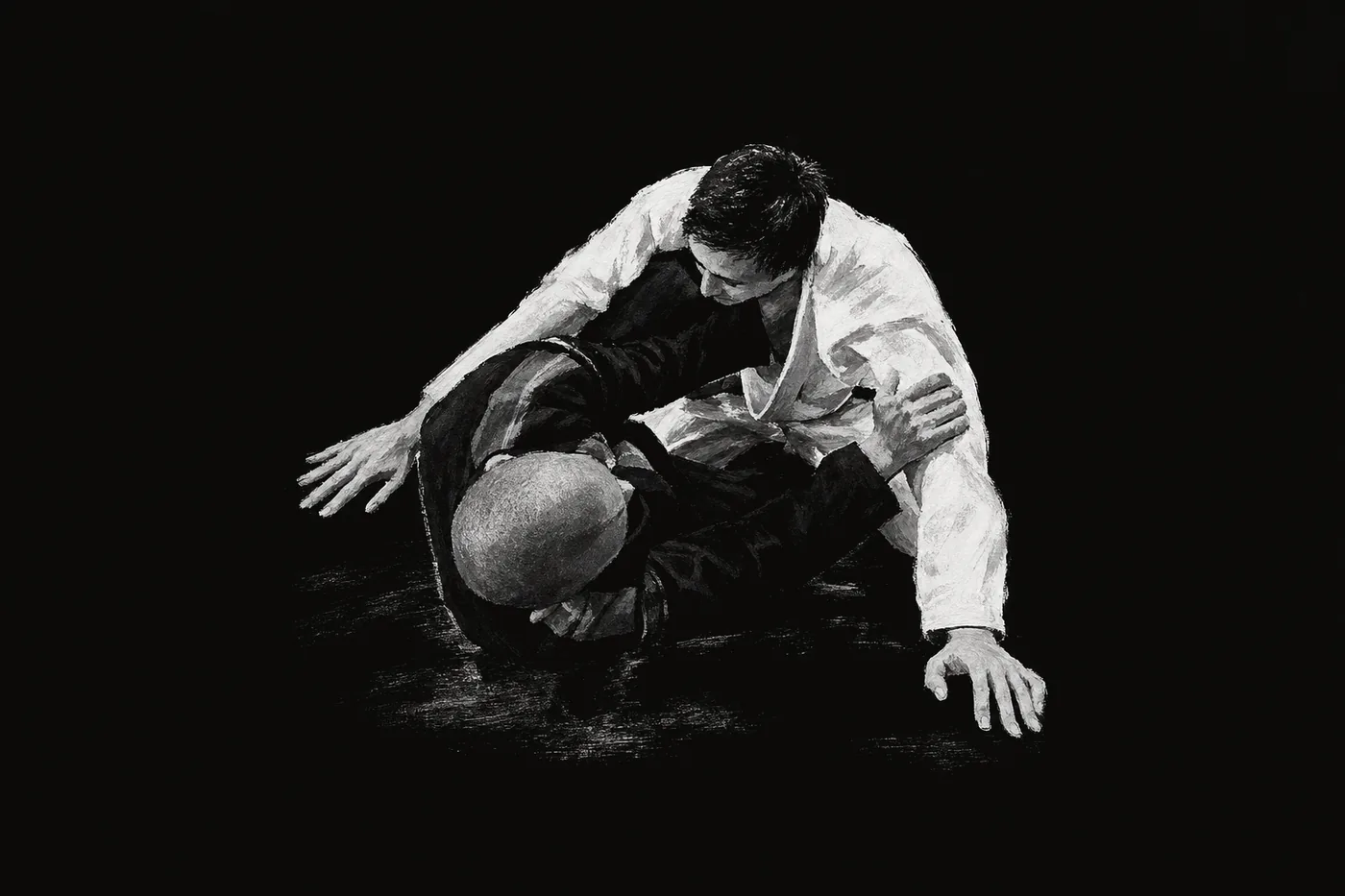
Learn / Jiu Jitsu / Systems / Passing the knee shield half guard in the gi
Half Guard · pass it · gi
Passing the knee shield half guard in the gi
This is the gi system. The gi version has its own clips and its own spine.
The cuff of his bottom leg and his collar, tripod, shin over his shin, head on the shoulder, flat, pin. The knee shield keeps your chest off him, and every time you clear it the knee comes back. The spine below is Gustavo Gasperin's knee cut through the shield in the gi, one coach and one route in his own orientation: two grips before you move (the cuff of the pants on his bottom leg, then his collar), tripod up with your head in front of his shoulder, punch the bottom leg down and slide your shin over his shin with the knee going back toward his ankle, come perpendicular, drive the top shoulder to the mat, and hold side control for three seconds. Two conditional steps cover the foot that lands on your hip and the man who stays on his side; the leg weave is the drill for the man who balls up. Fifteen gi clips and five no-gi ones for the principles, every no-gi cue marked, transcripts read and cited to the transcript chunk, one orientation written out below.
Key takeaways
- Success means Leg clear, his left shoulder glued to the mat, your chest on his chest, for three seconds.
- The spine is 4 steps after the gate, tripod up, head in front of his left shoulder, punch the bottom leg down and slide your right shin over his right shin, perpendicular, and drive his left shoulder to the mat, side control on his right side, held three seconds, with 2 conditional steps: if his top foot lands on your hip as you tripod; if he will not go flat: the elbow, or the crossface.
- When it breaks there are 7 named branches; learn the triggers, the responses are short.
- Evidence: 20 clips from 12 channels (11 clips from a coach's own channel, 4 from a gym's, 5 from an instructional publisher's), every timestamp checked against the spoken transcript. Sentences marked synthesis are the editors', not a coach's.
chest to chest
The shield is his left shin between your chest and his; the goal is your chest on his with his left shoulder on the mat. The shield only works while he is on his side; flat on his back, with his knees pointing up, there is no shield. So the route is not against the shield: it is against the bottom leg, then the shoulder.
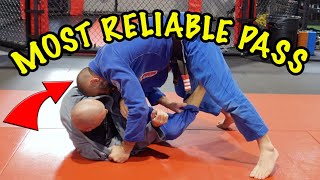 1:45Gustavo Gasperin · MMA Leechgiflattening the guy, putting him on his back; the shield only works if he is on his side; on his back his knees point up, there is no shield
 0:20Lachlan Giles · Absolute MMAno-gino-gi: I want to get chest to chest and people put this knee shield in which limits my ability to do that
his bottom leg
His right leg, hooking your right ankle, is what keeps him in the guard; his left knee is only the shield. Control the bottom leg to limit his recovery while you move; the cuff grip does that only while the knee and the hip controls that follow stay on (lift your knee off his hip and he recovers). Then free your foot from its hook.

the pin, three seconds
Your leg clear of his hook, his back flat, his left shoulder on the mat, your chest on his chest, held. Clearing the shield is not the pass and a flattened shoulder alone is only progress. IBJJF awards the pass only after three seconds in side control or north-south; the leg must be clear and the position held.
success means
synthesis Side control on his right side held for three seconds: your leg clear of his hook, his back flat, your chest on his chest, his left shoulder under your head and shoulder, your hips low and legs back. Clearing the shield is not the pass; a flattened shoulder with your foot still hooked is not the pass; a shoulder that comes off the mat inside the three seconds is the start of the next shield.
the situation
He is in knee shield half guard, on his right side: his right leg hooks your right ankle, his left shin is across your chest, his hands frame or hold your collar; you are inside his half guard in the knee-cut base, your right knee up with the foot on the mat and your left knee down, your hands free, no underhook either way yet. A sleeve grip on you or an arm blocking his collar is the entry variation in step G; if the grip will not come, it is a stop
the endpoint
Side control on his right side, held three seconds: your right leg clear of his hook, his back flat, your chest on his chest, your hips low and your legs back, your head over his left shoulder, your left arm across him; the right hand is not part of the endpoint; the count is the session's test, the footage shows the position for about a second
you start with
- Your hands are free
- His shield is his left knee
not solved here · cooperative resets
- His underhook established with him up on his elbow (the dogfight)
- Your back taken from the shoulder-over
Sides. One orientation throughout, Gasperin's own, mirrored when the shield is his right knee: he is on his right side; his left knee is the shield across your chest; his right leg hooks your right leg, so your right leg is the inside leg, its knee up with the foot on the mat, and your left knee is down; your right hand reaches behind his left leg to the cuff of his right pants, fed by the left; your left hand holds his collar; your head goes in front of his left shoulder; your right shin slides over his right shin with your right knee going toward his right ankle and landing beside his right hip; you drive his left shoulder to the mat and pin on his right side with your head over his left shoulder. Gasperin speaks in collar, bottom leg, cuff, shin, knee, head and shoulder; which hand, which leg and which side are read from stills of his clip, and the limitations say so.
what it is worth
Clearing the shield and holding side control for 3 seconds is a guard pass, 3 points. Clearing it without the hold is at most an advantage.
Article 4.2: the top athlete surmounts the legs (guard or half guard) and maintains side control or north-south for 3 seconds; articles 5.1 and 5.2: an advantage for a pass position reached but not held for the 3 seconds, or nearly completed; 5.5: awarded only once there is no longer a chance of the pass scoring
Source: IBJJF Rules Book v6.1 2024 (the current PDF from ibjjf.com/books-videos), articles 4.2, 5.1, 5.2, 5.5; read 2026-09-10
A completed pass is 3 points in the second half of regulation and in overtime; in the first half it scores nothing, but the position it leaves you in still decides the match.
Each position must be established for 3 seconds or more, out of any danger of submission; the judges look for control with at least 75 percent of the opponent's back on the mat; no positive points in the first half of regulation, points in the second half and in overtime; the World Championships run 10-minute qualifying rounds (first 5 without points) and 20-minute finals (first 10 without), other events publish their own durations
Source: ADCC Rules and Regulations page at adcombat.com (Points, positive points; Fight durations), read 2026-09-10
— the spine · learn this week
Gustavo Gasperin's knee cut through the knee shield
One coach's route from the two grips to a pin held three seconds, in his own orientation: his left knee the shield, your right leg inside, your right hand on the cuff of his right pants and your left on his collar. Step 2 is conditional at the tripod (his foot on your hip) and step 5 is conditional before the pin (he stays on his side); each returns to the route. Jon Thomas's knee cut against the shield is B3, his own set-up in the same orientation, and supplies no step; Giles's no-gi tripod is a check on step 1 and is marked as such.
-
GATE
Two grips before you move: the cuff of his bottom leg, then his collar
Right hand behind his left leg to the cuff of his right pants, fed by the left hand; then the left hand in his collar. If he already holds your sleeve, it comes free first.
Two grips. First the bottom leg, his right: reach your right arm behind his left leg and take the cuff of the pants at the ankle; the left hand feeds the cuff to the right if you need it (1:02 to 1:11 in the stills). At the knee is fine, but the cuff is best: a grip at the knee sits too close to his hand, where he can convert it into a lasso or break it. Then the collar with the left hand, to keep him close when you start to pass. He will not let you have the collar for free. If his right hand already holds your left sleeve, the stills at 1:39 to 1:43 show the left forearm circling down and around out of his fingers, the right hand keeping the cuff and the base unchanged, and then the left hand taking the collar; Gasperin says only 'break this grip and then control the collar', so the path of the arm is read from the stills and drilled slowly; if the grip will not come, stop and reset. If his arm blocks the way to the collar, Gasperin says to pummel the hand inside and take the collar; which way the hand goes round is read from the stills.
0:42Gustavo Gasperin · MMA Leechgitwo grips: control the collar to keep the guy close to me, and control his bottom leg1:02Gustavo Gasperin · MMA Leechgiat the knee is fine, or the best, the cuff of the pants; use my other hand and feed to this one, my arm is going behind his leg1:22Gustavo Gasperin · MMA Leechgiat the knee my hand is too close to his hand, he might convert this into a lasso or break it; he might be controlling my sleeve already, break this grip and then control the collar2:06Gustavo Gasperin · MMA Leechgiif it blocks my arm I pummel, control the collar -
1
Tripod up, head in front of his left shoulder
From the knee-cut base, right knee up and left knee on the mat, come up on your toes; your head goes in front of his left shoulder, never under his armpit.
The base in the stills is the knee-cut base: your right knee, the inside leg, up with the foot on the mat, and your left knee down (1:00 to 1:47). With the two grips, tripod up on your toes from there. Your head goes right in front of his left shoulder: pushing your head against the shoulder helps turn him flat, and that is the whole goal. Do not drive your head under his armpit; he can catch you there with a loop choke.
1:45Gustavo Gasperin · MMA Leechgitripod up and free my leg; my head goes right in front of his shoulder; push my head against the shoulder helps to turn the guy flat3:31Gustavo Gasperin · MMA Leechgimake sure to not drive your head under his armpit, he can catch me with a loop choke3:06Lachlan Giles · Absolute MMAno-gino-gi: his frames fight me; drive perpendicular to the frames by tripoding -
2only if: his left foot steps on your hip while you tripod and you cannot get close
If his top foot lands on your hip as you tripod
Move closer to north-south to clear the leg; that takes your hips, and your right leg, away from his legs; then your right knee to his hip, left leg extended for base, and flatten from there.
As you tripod, his top leg sometimes steps on your hip and you cannot get close. Move a little closer to north-south to clear that leg. In the stills (4:40 to 4:55) that move carries your hips, and with them your right leg, up and away from his legs, so the leg is out of his hook without the shin slide; then your right knee comes to his hip, blocking it, with your left leg extended behind for base (4:55), both grips still held, and you drive him flat from there (step 4) and count only once the right leg is clear.
-
3
Punch the bottom leg down and slide your right shin over his right shin
The cuff grip punches his leg down; your right shin slides on top of his right shin, your right knee going back toward his ankle, not forward into the shield; the knee lands on the mat beside his right hip.
Use the cuff grip to punch his leg down a little, so you can slide your right shin on top of his right shin. Your right knee does not go forward, because his shield is in the way: it goes back, toward his knee and then his ankle, and that frees your foot from his hook. In the stills (3:07 to 3:13) the knee comes down to the mat beside his right hip with the leg clear, the collar grip still on and the cuff still held.
2:26Gustavo Gasperin · MMA Leechgislide this shin over his shin and my knee goes toward his ankle; it does not go forward because his shield is on my way2:46Gustavo Gasperin · MMA Leechgiuse the pants grip to punch his leg down a little so I can slide my shin on top of his shin, my knee going toward his ankle, so I can free my leg -
4
Perpendicular, and drive his left shoulder to the mat
With the leg clear you are across him; drive your head against his left shoulder until his back is on the ground, the collar grip kept.
Now you are more or less perpendicular to him. Drive your head all the way against his left shoulder, the top one, trying to put his back on the ground: glue that shoulder to the mat. He might try to push you away; keep the collar control and the pressure. The right hand is not a scripted event from here: the 5:08 still shows the cuff still held during the drive, and at the pin (5:09.5 to 5:10) the right hand is hidden; Gasperin does not speak a release. synthesis Nothing here scripts one: keep the cuff through the drive and the count. Sometimes he will not go flat from here, which is what step 5 is for.
3:09Gustavo Gasperin · MMA Leechgiwe are perpendicular to him; drive my head all the way against his shoulder, put his back on the ground, glue that top shoulder on the ground, that is the pass3:53Gustavo Gasperin · MMA LeechgiI go perpendicular on my toes pushing the guy down flat; he might try to push me away and I keep the collar control, maintaining the pressure -
5only if: he stays on his side under the head pressure and you cannot push him flat
If he will not go flat: the elbow, or the crossface
Change the collar grip to his left elbow and pick it up; or crossface from the collar with the left arm.
A lot of times you cannot push him flat completely. Change the left hand from the collar to his left elbow and pick the elbow up (the stills at 4:25 to 4:29): once the elbow is up it is easier to flatten him and establish side control; the collar is gone and you finish with the elbow held. Or, keeping the collar, crossface with the left arm across his face to help turn him flat. Either way the drive to his back is with the control you now have, elbow or crossface, into the pin (step 6); the right hand is not scripted here, and the stills do not show what it holds.
4:16Gustavo Gasperin · MMA Leechgiif I cannot push the guy flat completely I change the grip from the collar to the elbow; once I pick his elbow up that is easier to flatten the guy4:57Gustavo Gasperin · MMA Leechgiif he turns to his side I can pick the elbow up; from the collar I can crossface to help turn the guy flat -
6
Side control on his right side, held three seconds
Chest on his chest, hips low, legs back, your head over his left shoulder, your left arm across him; the right hand is not part of the endpoint; count three.
Establish side control on his right side: his back flat, your chest on his chest, your hips low with the legs back, your head over his left shoulder, your left arm across his upper body (the stills at 5:09.5 to 5:10, and 4:26.5 to 4:29 in the elbow variation); the right hand is not part of the endpoint and is hidden in the pin stills. Hold it for three seconds before anything else; that is what the rulebook scores and what the shield was for. synthesis The count is the session's test; the footage shows the position for about a second, not a hold.
— grip notes
- Which grips these are, and what was read from the footage.
Gasperin says collar, bottom leg, cuff of the pants, shin, head, shoulder, elbow. The stills add which hand, which leg and which side: he is on his right side with his left knee the shield, your right leg is inside, your left hand holds the collar, your right hand holds the cuff of his right pants, your right shin slides over his right shin, and the pin is on his right side with your head over his left shoulder. The convention: a step marked transcript reproduces the cited speech; a step marked frames reproduces the speech and adds those assignments, read from 480p stills at one-, two- and three-second steps (1:00 to 1:47, 1:55 to 3:35, 3:37 to 5:22) and half-second steps at the pin (4:20 to 4:35, 5:00 to 5:18). The limitations list them.
- The sleeve.
Gasperin breaks the sleeve grip before he takes the collar, and the break is not spoken; the stills at 1:39 to 1:43 show it as the left forearm circling down and around out of his fingers, the right hand keeping the cuff and the base unchanged, the same entry as step G, and a grip that will not come is a stop. Thomas's rule for his own standing set-up (B3) is different, keep the hand posted and never give it; that rule is not part of this route, where both hands are working.
— when the spine breaks
7 branches
Each one names the trigger you will feel, then the response. Learn the triggers; the responses are short.
- He balls up, elbow to knee, and you cannot get inside after the shin slideits own drillside control on his left side, the opposite side from the spine's pin, reached by running behind him; if he does not turn in, you are behind him with the belt grip, and that is a stop
He feels the pass and connects his elbow to his knee; you cannot get inside, and you will not finish the way you did. Keep the tripod, and instead put your right knee between his legs, close to his hip, and stay low, blocking his bottom leg with it and controlling his top leg with your ribs; if you lift that knee he recovers the guard. From here, if you cannot flatten him: let go of the cuff, control his belt behind his back with the right hand, stay low with your head in front of his chest, hook his top ankle, the left, with your left foot and stretch his leg all the way to buy time (7:34 to 7:38 in the stills), push off that foot, lift the right leg and run behind him (7:40 to 7:48). If he tries to turn into you, your left elbow is on the ground so he does not get the underhook, and you take the crossface and the underhook for side control on his left side. synthesis If he does not turn in, nothing after the run is shown: stop, partner releases, restart.
5:19Gustavo Gasperin · MMA Leechgiif he balls up and connects elbow to the knee I cannot get on the inside; throw my leg over and go to this leg weave position6:20Gustavo Gasperin · MMA Leechgimy knee in between his legs closer to his hip, blocking his bottom leg; if I lift my knee up he can recover his guard7:03Gustavo Gasperin · MMA LeechgiI cannot flatten the guy; I let go the pant grip and control his belt; hook this top leg, his ankle, stretch his leg all the way7:25Gustavo Gasperin · MMA Leechgipush off this foot and I am running behind the guy; if he tries to turn into me my elbow is on the ground so he does not get his underhook; crossface and underhook to establish my side control- From the leg weave he pushes you awayits own drillthe mount, past this document's endpoint; Gasperin's own finish
If he pushes you away from the leg weave he gives you the space for the underhook. Underhook him, and your shoulder starts running over his shoulder, in front of it, which flattens him; he cannot keep his knee connected to his elbow twisted like that. Then crossface, or underhook and overhook, open his arm, and your knee goes under his armpit to the mount.
8:06Gustavo Gasperin · MMA Leechgiif he pushes me away he gives me space for my underhook; my shoulder runs in front of his shoulder which helps to flatten the guy; then I can go to the mount8:48Gustavo Gasperin · MMA Leechgicrossface, or underhook and overhook; flatten the guy, open his arm, my knee under his armpit to the mount- You are standing and he holds a cross collar, pulling and shielding (Thomas's set-up)its own drillthe knee cut finished inside his elbow-knee space, Thomas's side control
Jon Thomas's knee cut against the shield, from its own start, in the same orientation as the spine (his right leg inside, the shield his partner's left knee). His words: keep the knee up, do not give the sleeve, keep that hand posted or in the air; the right hand grabs the material near his ribs or the lapel and presses; take the weight off the knee onto the foot and turn the knee toward his stomach, which turns the shield vertical; the right elbow loops inside; cut the knee toward the armpit into the elbow-knee space, grab the elbow, pull and slide through; finish inside that space so he cannot frame. Against an extreme shield, grab the bottom leg, stand, direct the knee in only far enough to loop the elbow, then cut and catch the arm he pushes with.
 1:21Jon Thomasgimake sure he does not get a hold of this sleeve early; keep this hand posted out; grab the material near his ribs or the lapel1:41Jon ThomasgiI press on his ribs, take the weight off my knee toward my foot and turn my knee toward his stomach; this turns his shield vertical; this right elbow comes to the inside2:03Jon Thomasgicut my knee toward the armpit, the elbow knee space, grab the elbow, pull and slide through; finishing the pass inside that elbow knee space2:44Jon Thomasgithe extreme shield: grab the bottom leg, stand up, pull it up as I direct the knee in, just far enough to loop my elbow in3:04Jon Thomasgielbow in, start cutting the knee, he pushes, I catch the arm and slide through4:04Jon Thomasgikeep the left hand on the floor, do not give the sleeve; frame hard with the right hand
- You are leaning forward on the shield with your weight on him (Roger's set-up)its own drillRoger's half guard position with him flat and his head controlled, not the pin
Roger Gracie's shoulder over the shield, from its own start. It only works if you are leaning forward with your weight on him: lean, keep the bottom leg stiff and out, push your shoulder and elbow over his shield leg, and collapse straight away. The one risk is the underhook as you open the elbow to go over: if you feel his arm shooting under yours, the moment you go over you collapse your body down to his head and lean all your weight on top of that arm so he cannot progress it. Then put him flat on his back, grab the hand, and you have the half guard; press the shoulder in, grab his head, and pass from there.
 0:45Roger Gracie · BJJ Fanaticsgithis only works if I am leaning forward; keep the leg stiff, my weight is on him; push my shoulder, my elbow goes over that leg1:25Roger Gracie · BJJ FanaticsgiI collapse straight away; the one thing to be careful of as I go over is the underhook1:49Roger Gracie · BJJ Fanaticsgiif I feel his arm shooting under my arm, the moment I go over I collapse my body down to his head, all my weight on top of the arm2:09Roger Gracie · BJJ Fanaticsgiput him flat on his back, grab the hand, and now we have the half guard3:36Roger Gracie · BJJ Fanaticsgigrabbing his head, press the shoulder in, switch, get the underhook back
- A low shield with his heel up, his shin on your hip bone (Machado's set-up)its own drillhis leg stapled and the windshield wiper over it; Machado's pass position, then his own finish
Jean Jacques Machado's foot trap, from its own start. When his heel is up, put your forearm on it and drive his heel to the back of his thigh; there is no leverage left in that leg. Hand on his knee, push it through, windshield wiper your leg up and over, and staple his leg; stay there and catch your breath, he cannot move. When his heels are open, push the knee to the mat and bring your hips back to close the space so the knee cannot come back in. Coming around, keep the arm in or pinch it: reaching lets him give you the kimura.
 0:21Jean Jacques Machadogiuse my forearm and put his heel to the back of his thigh, there is no leverage now; hand on his knee, push it through, windshield wiper up and over and staple his leg1:04Jean Jacques MachadogiI stay here, catch my breath; when his heels are open push the foot through1:25Jean Jacques Machadogicoming around, if this arm is out he is going to give me a kimura, so I am pinching or grabbing his leg2:08Jean Jacques Machadogihips back, close the area so I cannot bring his knee back in, push his knee to the mat
- A high shield in the gi and you are on your knees, his frames pushing (Glick's set-up)its own drillin the main direction, north-south or a pin around the corner; in the other direction and after a lasso, an intermediate position Glick calls ready to pass, where the drill stops
Brian Glick's tripod pass, from its own start. Scoop the shield if you can, to separate his knees; if he will not let you pummel the arm through, take the leg weave post instead: the hand goes through and posts as a fist or a cup, weight on it, so he cannot pull the bottom knee through or move his hips into you. Take a collar grip (or regrip over his sleeve grip), pummel your head through the space if you can, and tripod, up off the knees; take your knee through and pummel it out. Main direction: walk out, sprawl on his leg, smash his knees together, walk around the corner, extract the arm and pin. Other direction, when he blocks the natural way: walk and step over his top foot, walk around the corner, take the arm out and move up; that ends ready to pass, not passed. If he opens the top knee and lassos your posting arm: shelf his leg, crowd, clear the arm, and you are in a flank or leg drag position, again ready to pass; the drill stops there and resets.
 1:01Brian Glickgione good answer is to scoop it; a scoop grip lets you separate your partner's knees2:02Brian Glickgiwhen I cannot pummel, take this hand, reach it through and post it; the leg weave, fist post2:24Brian Glickgiput a little weight on it; when he goes to pull the bottom knee through it is not that easy; he cannot move his hips into you3:24Brian Glickgiregrip over the top of his sleeve grip or take a collar grip; pummel the head through and go into a tripod, up off the knees, knee through and pummel it out4:04Brian Glickgiwalk out, sprawl on his leg, walk around the corner, extract the arm and pin; smash the two knees together4:26Brian Glickgiwhen you encounter resistance in the natural direction, go back the other way4:46Brian Glickgiwalk a bit and step over the top of it; walk around the corner, take the right arm out and move up5:29Brian Glickgiif he lassos the posting arm, shelf his leg, crowd, and clear5:51Brian Glickgithis flank position; you are ready to pass6:14Brian Glickgia leg drag type position6:54Brian Glickgiwalk around the corner, clear our head, and move to north-south, and we pass7:37Brian Glickgibring our head forward, and now you are ready to pass
- He gets the underhook and comes up to his elbow, or your back is exposed as you go overcooperative reset
synthesis No clip in this document teaches the recovery once he has the underhook and is up on his elbow in the dogfight, or once he has your back from the shoulder-over; Roger's clip names the risk and Gasperin's leg weave keeps the elbow on the ground to deny it. In the session this is the hard boundary: stop, partner releases, restart from the entry.
— negate first
Threat map
Some of the clips on the left show the coach performing the attack; watch them once so you recognise it. The answer on the right is a spine step, a branch, or marked as synthesis.
- The bump sweep once he has your sleeve
-
what they are doing
your answer
Recognise it: he needs your sleeve. Gasperin breaks a sleeve grip before taking the collar (step G). synthesis No clip here shows a defence once the bump is under way; in the session, being bumped over is a reset.
- The arm drag, the John Wayne sweep and the butterfly bait when you smash the shield
-
what they are doing
 1:22Gustavo Gasperin · MMA Leechgibreak the grip and arm drag, keep his hand stuck on the ground, come up and get my seatbelt3:10Gustavo Gasperin · MMA LeechgiI clear my shield and allow him to smash me; his hip comes on top of my knee and I hit the sweep with the forward momentum4:51Gustavo Gasperin · MMA Leechgias he smashes me I pummel the underhook, get my butterfly hook and sweep5:51Gustavo Gasperin · MMA Leechgiif he does not come forward I sit up with my underhook
your answer
Recognise them: the arm drag comes after he breaks your collar grip, with his shield kept; the John Wayne and the butterfly bait come from him clearing his own shield to invite the smash. The arm he drags is the collar arm. synthesis The spine does not smash the shield; it takes the bottom leg and tripods (steps G to 3). Whether that prevents these is the author's reading, not shown; in the session a sweep is a reset.
- Roger's flyby when you lean in
-
what they are doing
your answer
Recognise it: he needs you leaning in with a hand on his knee. synthesis The spine's weight goes through the tripod and the head on his shoulder, not leaning on the shield; B4 leans by design and is a different set-up with its own risk. No clip here shows a defence to the flyby; in the session it is a reset.
- The lasso when your punching hand points up
-
what they are doing
your answer
Gasperin's cuff grip stays low behind his leg (step G); Machado's rule for any hand that goes through the gap between his knees is to the mat, knuckles down (reference).
- The kimura when you reach or turn
-
what they are doing
your answer
Elbows closed and the head in front (step 1); in B5, pinch the arm or hold the leg while coming around.
- The loop choke if your head goes under his armpit
-
what they are doing
your answer
Head in front of his left shoulder, never under the arm (step 1).
- The knee that comes back
-
what they are doing
your answer
The cuff grip and the knee to his hip block the bottom leg (steps G and 2, B1); the shoulder pinned is what keeps the shield from returning (step 4).

— 20 minutes · gi
Tonight
synthesis The session is the author's; the mechanics are Gasperin's, from one exact start, with the sleeve-grip and blocked-collar entries drilled as their own variations because he does not speak the break. Every route rep ends at the pin with a three-second count out loud; the two conditional reactions end at the same pin; the leg weave ends where Gasperin ends it, on the other side, and resets. Two kinds of stop: the block's own reset, cooperative and named under each block, and the hard boundaries the scope lists (his underhook with him up on the elbow; your back taken), which stop everything; both restart only after the partner releases every control. The rounds use the agreed test: side control held three seconds ends the round.
safety · stop here
No submission is attacked in this document. Three things load the neck or the shoulder and each has a stop: the head drive into his shoulder (step 4) is pressure on his shoulder and jaw, released the moment he taps; the shoulder-over in B4 is the same; the loop choke and the kimura are his attacks on you and the session stops at the first sign of either rather than fighting out of it. The release rules are the author's.
- The head drive on his shoulder and jaw (step 4, B4). Release the moment he taps or says stop; drill it at half pressure until both know the feeling
- The loop choke when the head slips under the armpit (step 1). If the collar closes on your neck, stop and reset; do not drive through it
- The kimura when the arm is out coming around (B5). Tap early; the session resets on any submission threat
- 1
The two grips and the tripod
4 minPartner sets the shield with his hands framing. Reach behind his left leg for the cuff of his right pants with the right hand, feeding it with the left if you need; then the collar with the left; tripod up on the toes, head in front of his left shoulder, never under the arm. Say the two grips out loud. Then five entries where his right hand starts on your left sleeve: circle the left forearm down and around out of his fingers, slowly, the right hand keeping the cuff, then the collar; if it will not come, that is a stop. Then five where his arm blocks the collar hand: pummel the hand inside and take the collar. Swap.
- 2
The route, to the pin every time
7 minFrom the exact start, cooperatively: the two grips; tripod; punch the leg down and slide the right shin over his right shin, knee toward his ankle, until the knee is on the mat beside his right hip; perpendicular, head against his left shoulder until his back is flat; keep the cuff through the drive and the count; side control and count three out loud. He resists lightly only at the shoulder. Ten reps, swap, then the mirror side (his left leg hooking your left, his right knee the shield) with every hand and foot swapped.
- 3
Two reactions, then the leg weave
5 minPartner gives one of these per rep, on cue. His left foot lands on your hip as you tripod: move toward north-south so your hips and right leg come away from his legs, right knee to his hip with the left leg back for base, flatten, pin, count three once the leg is clear. He stays on his side under your head: change the collar to his left elbow, pick it up, flatten, pin, count three. He balls up elbow to knee after the shin slide: right knee between his legs, low, belt grip, hook his left ankle with your left foot and stretch, run behind, and when he turns in, elbow to the ground, crossface and underhook, side control on his left side, then reset. Cycle through all three, then swap.
- 4
Positional rounds
4 minFour one-minute rounds from the exact start, alternating who passes. He defends for real, sweeps allowed; you pass. Restart on the pin held three seconds, on a sweep, on a guard recovered, or on a tap. Getting underhooked and taken to the dogfight is a stop, not a round to fight; that is another system.
— after the round
Check first
synthesis The author's table. Outcomes have more than one cause; check these in order.
| It happened | Check first |
|---|---|
| He recovered the guard after the shin slide | Was the cuff grip on his right pants before you moved, or did you tripod with one grip? Did the right knee go back toward his ankle, or forward into the shield? Did you lift the knee off his hip in the leg weave? |
| He swept you | Did he have your sleeve? Were you leaning into the shield instead of tripoding on your toes? Was your weight through the head on his shoulder or through your hands? |
| He stayed on his side and you stalled | Did you change the collar to the elbow, or keep pushing the collar? Was your head driving the shoulder, or resting on it? |
| He got the underhook | Was your elbow on the ground when he turned in (B1)? Did you open the elbow to go over the shield (B4's risk)? |
| You got choked or kimura'd on the way through | Was your head in front of his shoulder or under his armpit? Was the arm out when you came around (B5)? |
| You passed and lost it inside three seconds | Was the leg clear of his hook before you counted? Was his left shoulder glued to the mat, or only his hip? Were your hips low with the legs back, or up on the knees? |
— the other doors · keep for later
Reference
Everything else read for this situation, grouped by door: the principles (Giles and Danaher's high shield no-gi, cued as such; Danaher's half guard passing in its own underhook context), the other gi routes through the same door, and the bottom player's side of it, so you know what he is doing.
The principlewhat beats a shield
- Lachlan Giles
No-gi, the principles: block the shield before it exists, hand inside on the ribs with the elbow locked and the torso close; then the three strategies, squash the knees together (remove your weight for a moment, fold, chest to the outside of the leg, take the waist), open the knee out (ribs inside the knee, hips low, walk to the side until the knee opens and the elbow slips past), or free your foot outside the legs (hold the knee, use your knee in his calf to open it, straighten to clear a hook). Beat the knee line before completing anything, or he goes to closed guard; circle down and back, not straight across. Against frames, tripod and drive perpendicular to them.
0:20Lachlan Giles · Absolute MMAno-gino-gi: blocking the knee shield, put your hand inside on the outside of the ribs with your elbow locked; keep your torso close2:04Lachlan Giles · Absolute MMAno-gino-gi: squashing: gooseneck grip on the knee, remove my chest for a moment, fold, chest on the outside of the leg, then control the waist4:08Lachlan Giles · Absolute MMAno-gino-gi: what opens the knee shield is getting my chest underneath, hips low; start walking, beat the knee shield4:52Lachlan Giles · Absolute MMAno-gino-gi: you have to beat the knee line first or he goes to closed guard; circle down and back, not straight across3:06Lachlan Giles · Absolute MMAno-gino-gi: his frames are fighting me; drive perpendicular to the frames by tripoding in5:55Lachlan Giles · Absolute MMAno-gino-gi: freeing your foot: hold the knee, use my knee into his calf to open it; if he hooks, step on the mat and straighten first 2:48Lachlan Giles · Absolute MMAno-gino-gi: get my ribs on the inside of the knee3:28Lachlan Giles · Absolute MMAno-gino-gi: keep walking this way, eventually the knee opens out and I can slip my elbow past6:12Lachlan Giles · Absolute MMAno-gino-gi: you cannot beat a frame while there is weight on it; move the weight off for a moment, a forearm chop to get the knees together, then capture the waist
 - John Danaher, half guard passing
In his position, where the bottom player has already won the underhook and is coming up, movement across his hip line flattens him, not the crossface; once the shoulder and hip are down the crossface works. Beat the knee first, then the head; push his knee down with the elbow rather than the hand, into the three-quarter mount. Gasperin's route is a different position: no underhook is established, and his crossface from the collar is one of his ways to help the shoulder down.
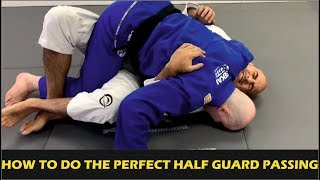 4:09John Danaher · Bernardo Faria BJJ Fanaticsgionce I beat someone's knee, now it is safe to start controlling my opponent's head7:34John Danaher · Bernardo Faria BJJ Fanaticsgihis interest is getting to an underhook and coming up; no amount of crossface pressure will flatten your opponent out from this position8:14John Danaher · Bernardo Faria BJJ Fanaticsgiwhat flattens someone out in this position is never crossface pressure, it is movement across my opponent's hip line9:37John Danaher · Bernardo Faria BJJ Fanaticsgipush on my training partner's knee, the hand or the elbow, I prefer the elbow; the three-quarter mount
 - John Danaher, the high shield
No-gi: against a high shield with his knee inside your shoulder and his hand on your triceps, post on his hip, bring the other hand back to yourself, retreat, hand under his knee, foot back and turned out, come up standing and run his knees up so they point at the ceiling, elbow in front of his knee, knees together, sit straight down into chest to chest. Filmed without gi grips; how it applies against a collar or sleeve grip is not shown.
 1:04John Danaher · BJJ Fanaticsno-gino-gi: post on my training partner's hip, my second hand comes back to my own body, retreat; my hand goes underneath his knee, foot back, foot outwards, come up to a standing position1:24John Danaher · BJJ Fanaticsno-gino-gi: my elbow in front of his knee so when he tries to bring his knees together it is tough; my two knees together, sit straight down, and we walk forward into the chest to chest position2:06John Danaher · BJJ Fanaticsno-gino-gi: pop up and run everything up and make his knees point at the ceiling
 - Jean Jacques Machado
The angle of the knee dictates the approach: vertical, leg on the shoulder; aligned with your hips, sprawl and smash; the 45-degree pocket, punch the hand through the gap between his knees to the mat, get the sleeve, drop and sprawl, head to the top of the shoulder, open him up and flatten him; knees pointing up, block the inside hip with your knee, side control. The hand that punches through goes to the mat, never up.
 0:00Jean Jacques Machadogithe angle of the knee dictates how I approach: more vertical, leg on shoulder; closer to my hips, sprawl and smash; the 45-degree pocket0:42Jean Jacques Machadogipunch your hand down, control the pant or fist to the mat, get access to their sleeve, drop and sprawl, head to the top of the shoulder3:09Jean Jacques Machadogiget his knees vertical, block the inside hip with your knee, then release and side control5:31Jean Jacques Machadogiif I punch my hand through and my hand points up, this is full lasso; your hand has to go to the mat
Other gi routesthe same door, other coaches
- Xande Ribeiro
The weave pass: the hand goes under your own knee and cups his knee, because passing the shield is about controlling the bottom leg; move the bottom knee out of the way, then turn your hip and aim it at the back of your hand, head down, and cut.
- Marcos Tinoco
Five answers: the collar grip locked under the shoulder, push the knee to get his push back, then the underhook as the anchor with your leg hooking his; the pants grip punching the knee down and the back door under him; the weave with the collar and a pocket grip on the knee, the hip up and past the knee line; stand with top collar and bottom knee and clean the knee with the elbow; and the ankle grip pushing his heel into his hip before the knee goes over.
 1:45Marcos Tinoco · BIG OSSgiget this collar grip locked right under the shoulder; push his knee and he pushes back, that is the reaction2:27Marcos Tinoco · BIG OSSgishoot my underhook and hook the shoulder, that is my anchor; I hook this leg so he does not bring the leg around4:50Marcos Tinoco · BIG OSSgigrip on the side of the pants, push this knee down, punching; that space is what I am looking for5:31Marcos Tinoco · BIG OSSgipin his leg down, bring my hip up, back door, get under, get the back7:17Marcos Tinoco · BIG OSSgiuse my shoulders to bring my hip up; pass the line of the knee, walk back, flatten him8:43Marcos Tinoco · BIG OSSgitop collar, bottom knee, step one two, no knee shield anymore; use my elbow to clean up the knee11:53Marcos Tinoco · BIG OSSgipush his heels into his butt; my knee goes around, the other leg is free
 - Samuel Nagai
Let go of the knee, switch the collar, grab over his knee, weight on the outside leg, take the knee out and push his knee down with the knuckles, head close to his shoulder, knees together, and switch to the other side like a knee on belly switch; he ends with the elbow on his hip and the knee by his head, as the captions have it; the still was not checked.
 0:21Samuel Nagai · BJJ Fanaticsgilet go the collar, grab over his knee, weight on my outside leg0:43Samuel Nagai · BJJ Fanaticsgitake my knee out and use my knuckles to push his knee down, head close to his shoulder, like switching knee on belly2:05Samuel Nagai · BJJ Fanaticsgielbow on his hip, knee on his head
 - Matt Arroyo
Bring him to his other side: collar and pants, stand, knee between his legs, rock him over, sit on his shin with your foot pinning his knee; then pass from the shin ride.
- Roger Gracie, the lasso half
When he lassos your arm from the half guard, hold the pants by the knee and put weight behind his leg, open your foot and turn your hips to remove your leg from under his, scoop over, then turn his whole body away before you pass.
 0:58Roger Gracie · Jiu-Jitsu Magazinegihold the knee, grab the pants by the knee, put weight behind his leg1:19Roger Gracie · Jiu-Jitsu Magazinegiopen my left foot and turn my hips out to remove my leg from underneath his leg, then scoop over2:00Roger Gracie · Jiu-Jitsu Magazinegimake his whole body turn the opposite side

The bottom player's sidewhat he is doing from the shield
- Gustavo Gasperin
No-gi: the shield transfers your weight through his knee and hip into the mat; he controls one shoulder with the knee, the other with the hand, elbow inside the knee so the knee cannot be smashed; most of his attacks start by coming up to the elbow, and arm drags are there from the shoulder too. When his knees get smashed together his feet separate, and he switches to the Z guard, knee on top of your thigh, feet crossed, keeping you sitting on your heel.
 0:43Gustavo Gasperin · MMA Leechno-gino-gi: the knee shield manages the distance; his body weight runs against my shield, against my hip, against the mat1:04Gustavo Gasperin · MMA Leechno-gino-gi: my elbow on the inside of the knee so if he tries to smash the knee my elbow is in the way2:28Gustavo Gasperin · MMA Leechno-gino-gi: my attacks come mostly when I am on my elbow2:50Gustavo Gasperin · MMA Leechno-gino-gi: options from here too if I am on my shoulder, especially arm drags
 2:05Gustavo Gasperin · MMA Leechno-gino-gi: as he smashes my knees my feet separate; that is the time to transition into the Z guard4:06Gustavo Gasperin · MMA Leechno-gino-gi: I want the guy sitting on his heel; curl the bottom leg, push the top leg against his hip
 - Lachlan Giles, the Z guard
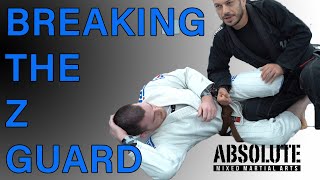
Against the Z guard, pry his feet open by pressure on the front knee before anything; then the hip grip, head on the shoulder, pull the knees together into a tripod, pick up his knee and straighten his leg as you drop your chest, flick outside the legs and over the top.
— 20 clips · verified 2026-09-10
Ledger
Every clip on this page. Each was resolved on YouTube, its uploader channel recorded and reviewed, and its transcript read before a second was cited. Source names whose channel it is: the coach's own, the coach's gym, or the instructional publisher that filmed them.
| Coach | Channel | Source | Kit | Video | Uploaded | Length |
|---|---|---|---|---|---|---|
| Jon Thomas | JonThomasBJJ | coach | gi | Passing The Knee Shield With The Knee Cut | 2018-03-26 | 4:59 |
| Brian Glick | Brian Glick | coach | gi | This Tripod Pass Crushes Every Knee Shield Guard | 2025-07-03 | 8:27 |
| Jean Jacques Machado | JeanJacquesMachado | coach | gi | Foundations and applications of passing knee shield | 2023-02-17 | 9:02 |
| Jean Jacques Machado | JeanJacquesMachado | coach | gi | Low knee shield pass with foot trap | 2023-03-14 | 2:51 |
| Marcos Tinoco · BIG OSS | BIG OSS Jiu-Jitsu Channel | coach | gi | 5 Ways to Destroy Knee shield ( Every Belt Should know) | 2023-03-19 | 13:44 |
| Matt Arroyo | Matt Arroyo Jiu Jitsu | coach | gi | How to defeat this annoying knee shield! | 2024-02-17 | 1:03 |
| Gustavo Gasperin · MMA Leech | MMA Leech | coach | gi | Knee Shield Half Guard Pass Combo | 2024-01-23 | 9:43 |
| Gustavo Gasperin · MMA Leech | MMA Leech | coach | no-gi | Knee Shield Half Guard Basics | 2017-03-03 | 4:23 |
| Gustavo Gasperin · MMA Leech | MMA Leech | coach | no-gi | Z-Guard VS. Knee Shield Half Guard | 2021-12-10 | 5:34 |
| Gustavo Gasperin · MMA Leech | MMA Leech | coach | gi | 3 Sweeps From Knee Shield Half Guard | 2023-04-18 | 6:25 |
| Roger Gracie · Roger Gracie TV | Roger Gracie TV | coach | gi | Roger Gracie's Knee Shield 'Flyby' Sweep | 2026-07-27 | 3:27 |
| Lachlan Giles · Absolute MMA | Absolute MMA St Kilda - Melbourne | gym | no-gi | Pass the Knee Shield with These 3 Strategies | 2025-08-11 | 7:31 |
| Lachlan Giles · Absolute MMA | Absolute MMA St Kilda - Melbourne | gym | gi | Breaking the Z guard (Lachlan Giles) | 2021-06-10 | 5:54 |
| Lachlan Giles · Absolute MMA | Absolute MMA St Kilda - Melbourne | gym | no-gi | This is the most common issue when passing guard | 2026-06-29 | 11:30 |
| John Danaher · Bernardo Faria BJJ Fanatics | Bernardo Faria BJJ Fanatics | publisher | gi | How To Do The Perfect Jiu Jitsu Half Guard Passing by John Danaher | 2020-04-10 | 22:55 |
| Roger Gracie · BJJ Fanatics | BJJ Fanatics | publisher | gi | Getting Over The Knee Shield With Shoulder Following Up With Half Guard by Roger Gracie | 2025-05-13 | 5:35 |
| John Danaher · BJJ Fanatics | BJJ Fanatics | publisher | no-gi | Clearing A High Knee Shield by John Danaher | 2023-05-15 | 3:18 |
| Samuel Nagai · BJJ Fanatics | BJJ Fanatics | publisher | gi | Knee Cut vs. Knee Shield by Samuel Nagai | 2022-11-30 | 2:34 |
| Roger Gracie · Jiu-Jitsu Magazine | JiuJitsuMag | publisher | gi | Roger Gracie, Lasso-Half Guard Pass: Jiu-Jitsu Magazine, Issue #27. | 2014-10-17 | 2:42 |
| Xande Ribeiro · Timeless Jiu-Jitsu Academy | Timeless Jiu-Jitsu Academy | gym | gi | The BEST Way To Pass The Knee Shield | Xande Ribeiro | 2024-09-27 | 4:22 |
what was not verified
- Evidence convention: a step marked transcript reproduces the cited speech; a step marked frames reproduces the speech and adds hand, leg and side assignments read from 480p stills. G and steps 1 to 6 are marked frames for: his shield being his left knee with him on his right side, your right leg inside, the right hand on the cuff of his right pants fed by the left, the left hand on the collar, the sleeve break with the left forearm circling down and around (1:39 to 1:43, the path not spoken), the knee-cut base with the right knee up (1:00 to 1:47), the right shin over his right shin and the knee landing beside his right hip (3:07 to 3:13), the head on his left shoulder, the elbow pick (4:25 to 4:29) and the pin on his right side (kzTdXfDIndw at one-second steps 1:00 to 1:47, two-second steps 1:55 to 3:35, three-second steps 3:37 to 5:22, half-second steps 4:20 to 4:35 and 5:00 to 5:18; .frames/entry-*, fine-*, fine2-*, pin-*).
- The endpoint is the position in the stills at 5:09.5 to 5:10 and 4:26.5 to 4:29 (chest on chest, hips low, legs back, his left shoulder under the passer's head and shoulder); from 5:10.5 Gasperin lifts his torso and moves his legs, which is his exit, not the pin. The stills at 4:04 to 4:10 show the tripod, not the pin, and are not cited for it. The three-second hold is the session's test and is not in the footage; the footage shows the position for about a second. The right hand: the 5:08 still shows the cuff still held during the drive, and at the pin the right hand is hidden; Gasperin does not speak a release, so the document scripts none and keeps the cuff through the count (an author's rule). An earlier reading of a raised right hand at 5:06 to 5:09 was wrong: that raised arm is the bottom player's, in the gray sleeve, and the claim is withdrawn (.frames/pin2-kzTdXfDIndw.png, half-second steps 5:00 to 5:18).
- The spine range covers Gasperin's instruction only, 0:42 to 5:20; the leg weave (B1, 5:19 to 7:50) was read at two-second steps from 6:40 to 7:50 for the knee, the hooking foot and the run, and at fifteen-second steps before that; B2 (8:06 to 9:28) at fifteen-second steps only.
- Gasperin does not speak the path of the sleeve-grip break (1:39 to 1:43, read from stills) or which way the hand goes round a blocking arm (the pummel itself is spoken at 2:06); the break is drilled slowly, and a grip that will not come is a stop.
- Thomas's clip (B3) is in the same orientation as the spine (his right leg inside, the shield his partner's left knee); it is cited in his own words and supplies no step.
- Thirteen of the thirty-one clips considered are no-gi. Five are cited (Giles's two principle clips, Danaher's high shield, and Gasperin's two bottom-side clips), in the needs table, one check on step 1, the threat map and the reference, every cue prefixed no-gi. The other eight are excluded with reasons. Fifteen gi clips are cited.
- B1 ends in side control on his left side, the opposite side from the spine's pin, and is a drill that resets; B2 to B7 are other routes from their own starts with their own ends; none is drilled tonight except B1, and none claims the spine's endpoint.
- The system has not been tested on the mat by its editors.
Compiled and checked by the Randori editors at Way of Yawara: every citation read against the spoken transcript, sources reviewed 2026-09-10, last reviewed 2026-09-10.
In the library
Last updated 2026-09-10.
Framework: Ribeiro & Howell, Jiu-Jitsu University · the shipped learn-graph