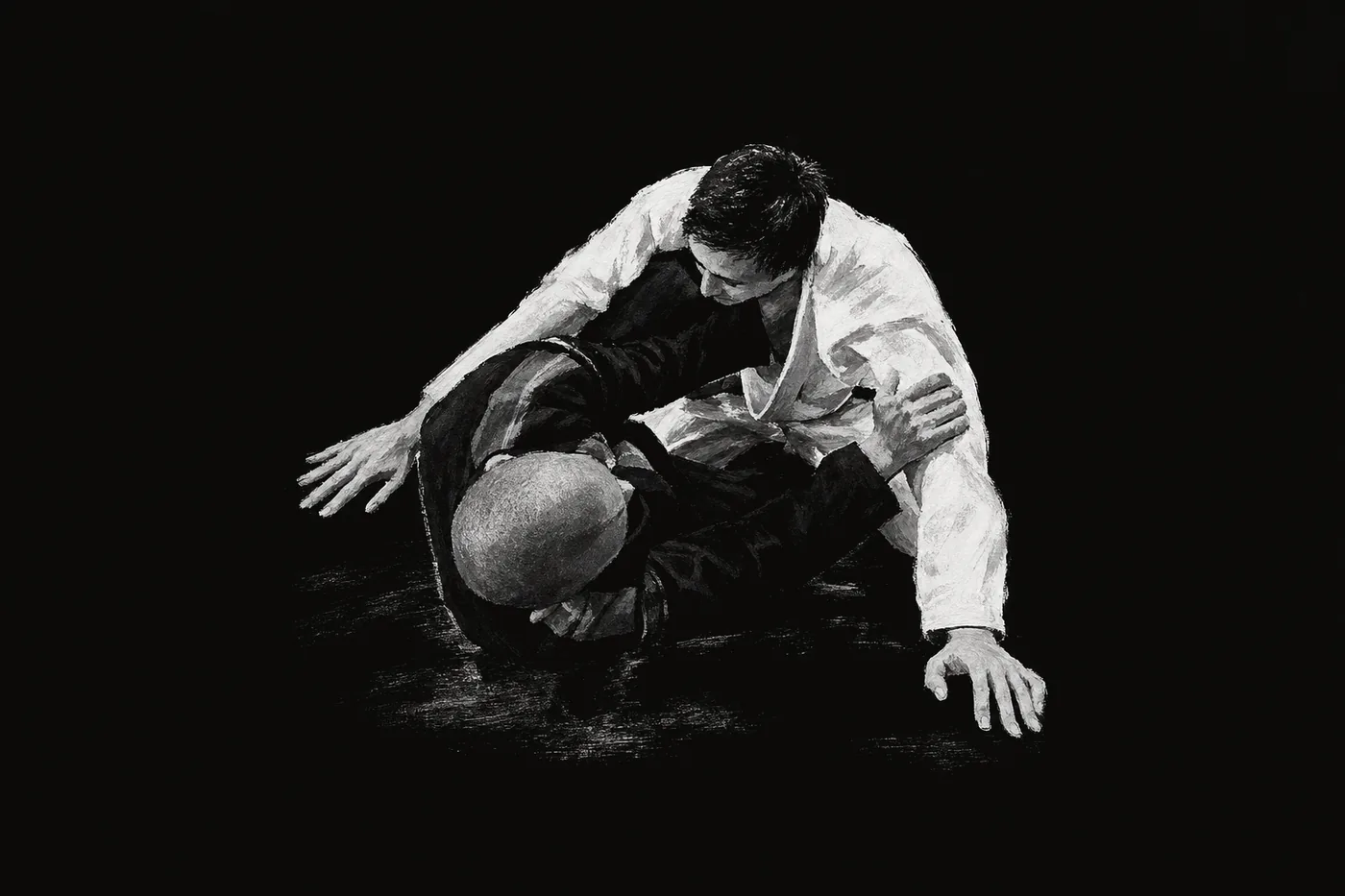
Learn / Jiu Jitsu / Systems / Top half guard when they win the underhook, in the gi
Half Guard · pass it · gi
Top half guard when they win the underhook, in the gi
This is the gi system. The gi version has its own clips and its own spine.
Read the stage; a hand on his neck and a hand on his hip; lift your back until the arms are straight; re-pummel elbow first; crossface and flatten him. You are passing half guard, he gets the underhook, and the next thing you know he is on his knees or on your back. The spine below is Jeremy Arel's answer for the early stage in the gi, one coach and one route in his own orientation: read the stage, a hand on his neck or ear and a hand on his hip, lift your shoulders and back until both arms are straight and his ear comes off your chest, re-pummel the arm elbow first to your underhook, crossface and flatten him out. His own two answers for the later stages, the reverse sit at the elbow and the backstep when he is coming around, are the drills; Jon Thomas's suitcase grip, Jake Mackenzie's opposite underhook and Malachy Friedman's two answers are branches from their own starts; his shoulder lock is a reference with a stop. Fifteen gi clips, eleven no-gi ones and one in mixed kit for the principles, every no-gi cue marked, transcripts read and cited to the transcript chunk, one orientation written out below.
Key takeaways
- Success means His back on the mat with your underhook and crossface back, before he builds to his elbow.
- The spine is 4 steps after the gate, left hand to his neck or ear, right hand to his hip, lift your shoulders and back away until both arms are straight, re-pummel the right arm, elbow first, to your underhook, the left hand still on his head, crossface with the left arm and flatten him out.
- When it breaks there are 8 named branches; learn the triggers, the responses are short.
- Evidence: 27 clips from 20 channels (15 clips from a coach's own channel, 9 from a gym's, 3 from an instructional publisher's), every timestamp checked against the spoken transcript. Sentences marked synthesis are the editors', not a coach's.
the stage he is at
Early: his arm is under yours but he has no frame under him yet, his hips are down and he is not on his elbow. Elbow: he has built onto his elbow. Late: his head is inside and most of his weight is on your back. Arel teaches three answers and each belongs to a stage: the lift while it is early, the reverse sit once he has built to the elbow, the backstep when he is coming around to your back. The mistake is not losing the underhook; it is answering the wrong stage.
 0:25Jeremy Arel · Great Grapplinggiearly options, then late options; he has not started to build a frame and elevate his hips yet2:29Jeremy Arel · Great Grapplinggiif he is up on his elbow it is too late to push the head down; you have made a bigger mistake if you let them build up onto the elbow5:35Jeremy Arel · Great Grapplinggihe has inside head control and eighty percent of the weight on my back; the conventional movement is a whizzer, and the problem is you are guaranteeing them the underhook
no overhook, no hands on the floor
Your arm over his underhook arm, or your hands posted on the mat, as the first reaction. The selfish kid principle: you have the underhook or no one has it; the overhook guarantees it to him. A hand on the floor is a hand he can bump; a re-pummel with no space is an arm he traps and rolls.
0:05Jeremy Arel · Great Grapplinggiwe do not want to overhook because that goes against the selfish kid principle: I have the underhook or no one has the underhook, and if you overhook it guarantees it0:46Jeremy Arel · Great GrapplinggiI cannot have my hands on the floor, and if you try to re-pummel right here this is when I slam the door and I roll you over; your arm gets trapped on the inside 2:51Aaron Benzrihemgiwhat I do not want is for him to get an underhook and get onto his side; this is called an underhook get-up and it is the start of almost every half guard sweep
flat, with your underhook and crossface back
His back on the mat, your arm under his and your other arm across his face, chest down, still in half guard. That is the pass position every basic half guard pass starts from; the pass itself is another document. Machado's rule: the goal is not to pass, the goal is to kill the underhook; the pass is the second half.
2:08Aaron BenzrihemgiI need to attain an underhook on the side of my leg that is trapped; I am trying to flatten my opponent, keep his shoulder down3:33Aaron Benzrihemgithe crossface makes him look the other way so he does not have the ability to turn into me 0:41Jean Jacques Machadono-gino-gi: the goal right now is not to pass the guard, the goal is to kill the underhook; the pass is the second half
success means
synthesis Him flat with your underhook and your crossface in, chest down, held for three seconds (the count is the session's test; the footage shows the position). His ear back on your chest is not the endpoint; your underhook regained with him still on his side is not the endpoint; a flat man whose underhook is still under your arm is not the endpoint. The reverse sit and the backstep end where Arel ends them and do not claim this position.
the situation
You are on top in half guard, chest to chest, your right leg between his legs and your left leg posted outside; he faces you on his side and his left arm has just come under your right arm as the underhook, that hand open or flat on your back, not gripping your belt or pants; it is early: he has no frame under him yet, his hips are down and he is not up on his elbow; your left hand is free; his elbow, his knees, a belt or pants grip that holds you down, and your back are the later stages (branches and resets)
the endpoint
Him flat: his back on the mat, your right underhook (hand open on his upper back) and your left crossface (the arm wrapped round his head, your shoulder in his jaw), your head low beside his left ear, on the underhook side, your chest on his chest, your left knee on the mat and your right leg inside, held for three seconds; the count is the session's test, the footage shows the position at 2:14.5 to 2:16 from the second camera
you start with
- Your left hand is free
- Your right leg between his legs
not solved here · cooperative resets
- Him up on his knees in the dogfight with your whizzer gone
- His hook in your leg with your back exposed
- The sweep completed, you on the bottom
- His switch to deep half completed under you
- His belt or pants grip that holds you down through the lift
Sides. One orientation throughout, Arel's own, mirrored when your left leg is the one inside: he faces you on his side; your right leg is between his legs and your left leg is posted outside; his left arm is the underhook, under your right arm; your left hand is free and goes to his neck or ear; your right hand goes to his hip; you lift your shoulders and back until both arms are straight; your right arm re-pummels under his left arm, elbow first, while the left hand stays on his head; your left arm wraps his head as the crossface with your shoulder in his jaw, your head goes low beside his left ear, on the underhook side, your left knee on the mat and your right leg inside; he goes flat onto his back. Arel speaks in the hand, the neck or ear, the hip, my shoulders and back, my elbow, the underhook, the crossface; which hand, which arm and which leg are read from stills of his clip (the second camera at 2:05 to 2:17 settles the arms), and the limitations say so.
what it is worth
The underhook is the start of his sweep and of his back take. His sweep scores 2 once he has inverted the position and held you on the bottom for 3 seconds (article 4.6.1), or once you have turned to all fours with a knee down and he controls your back for 3 seconds without needing hooks (4.6.2); back control scores 4 only with his heels between your thighs, legs not crossed, at most one arm trapped below the shoulder line, held 3 seconds (4.5); the mount 4 when he is clear of the half guard, sitting on your torso facing your head, held 3 seconds (4.4). Recovering the top inside his 3 seconds denies the sweep. Your own pass, later, is 3 (4.2). A position reached but not held may be an advantage (5.1, 5.2). None of this is a referee's call in training: the session's success is the flat pin held, and a drill's reset boundary is not automatic points.
Article 4.6.1: the athlete on bottom with the opponent in guard or half guard inverts the position and maintains the opponent on the bottom for 3 seconds; 4.6.2: the opponent turns to all fours and the athlete controls the back without hooks, keeping at least one of the opponent's knees on the ground for 3 seconds; 4.5: back control with the heels between the thighs, legs not crossed, at most one arm trapped and not above the shoulder line, 3 seconds; 4.4: mount clear of the half guard, sitting on the torso with two knees or a foot and a knee down, facing the head, 3 seconds; 4.2: the pass, surmounting the legs and holding side control or north-south for 3 seconds; 5.1 and 5.2: advantages for positions reached but not held or nearly completed
Source: IBJJF Rules Book v6.1 2024 (the current PDF from ibjjf.com/books-videos), articles 4.2, 4.4, 4.5, 4.6, 5.1, 5.2; read 2026-09-10
— the spine · learn this week
Jeremy Arel's early answer to the underhook
One coach's route from the moment the underhook lands to him flat with your underhook and crossface back, in his own orientation: him facing you on his side, his left arm under your right, your right leg inside, your left hand to his neck, your right to his hip, the lift, the right arm through with the left hand still on his head, the left arm across. Benzrihem and Machado supply checks on what the endpoint is for, never a step. No step is conditional; the two later stages are Arel's own branches from their own starts.
-
GATE
Read the stage, and keep your hands off the floor
He has the underhook but no frame under him yet: early. Hands stay on him, not on the mat; no overhook; no re-pummel yet.
You have made a mistake and he has the underhook: his left arm under your right, him on his side facing you, your right leg between his legs, your left leg posted outside. Read the stage first. Early means he has not built a frame under himself, lifted his hips or come up on his elbow; this route is for early, and the reverse sit (B1) and the backstep (B2) are for the two stages after it. Your hands cannot go to the floor, and a re-pummel from here with no space is how he slams the door on your arm and rolls you. Do not overhook his arm either: the overhook guarantees him the underhook.
0:25Jeremy Arel · Great GrapplinggiI have made some mistakes and Marty has gotten to the underhook; he has not started to build a frame and elevate his hips yet, so this is early0:46Jeremy Arel · Great GrapplinggiI cannot have my hands on the floor; if you try to re-pummel right here this is when I slam the door and roll you over0:05Jeremy Arel · Great Grapplinggiwe do not want to overhook; the selfish kid principle -
1
Left hand to his neck or ear, right hand to his hip
Bring the free left hand over and place it on his neck or ear; place the right hand, the hand of the underhooked arm, on his hip. Neither hand pushes him away.
Bring your left hand, the free one, over and place it on his neck or ear (1:43 to 1:47 in the stills, and 2:08 to 2:09 from the second camera). Then the right hand, the hand of the underhooked arm, goes to his hip (1:49; in the first demonstration it rests on the floor for a moment on the way, which Arel then tells you not to do). Do not push him away with either: he can grab a little with the underhook and use a push; the hands are placed, and the next step makes the distance. Do not elbow him in the face on the way over.
0:46Jeremy Arel · Great Grapplinggithe first thing you are going to do is bring the hand over and place it on the neck or ear, then place a hand on the hip1:06Jeremy Arel · Great Grapplinggione of the mistakes I see is people try to push away; with the hand on the neck he is not going to be able to follow me up1:28Jeremy Arel · Great Grapplinggido not elbow your partner in the face, neck, nose or ear; the hand comes over on the ear or neck, hand on the hip -
2
Lift your shoulders and back away until both arms are straight
Not a push-up: the core and the back lift, the arms only hold the distance; his ear comes off your chest and the hand on his neck stops him following you up.
Straighten the arms by lifting your shoulders and your back away from him (1:13 to 1:33 in the stills, and 2:10 from the second camera: both arms straight, his head held down by the left hand, his hip by the right). He wants to keep his ear tight to you so you never get this space; the hand on the neck is what ensures he cannot follow you up. It is not a push-up: the arms maintain the distance, your core and back make it.
1:06Jeremy Arel · Great GrapplinggiI want to straighten my arms by lifting my shoulders and my back away; he wants to keep that ear nice and tight1:28Jeremy Arel · Great Grapplinggihand on the hip, I am lifting my shoulders and my back away; do not try to do a push-up, the arms maintain the distance, your core and back make the distance2:08Jeremy Arel · Great Grapplinggithe space is made by lifting the back; very basic fundamental stuff but it is important -
3
Re-pummel the right arm, elbow first, to your underhook, the left hand still on his head
From the hip the right arm comes in and under his left arm, leading with the elbow, while the left hand keeps his head; the underhook is in before the head hand moves.
Now bring the right hand in: from his hip, re-pummel under his left arm, leading with your elbow, and take your underhook; the left hand stays on his head the whole time (2:11 from the second camera: the right elbow up and the forearm diving inside his arm, the left hand still on his head). The space you made in step 2 is what lets the elbow through; with his ear back on your chest it does not go. Establish the underhook before the head hand does anything else; that is the order the stills show, and it is the order that keeps him from following you up while the arm is in transit.
-
4
Crossface with the left arm and flatten him out
The left arm wraps his head from the neck, forearm across his face and hand over to his far side, your left shoulder in his jaw; your head goes low beside his left ear, on the underhook side, your chest on his chest, your left knee on the mat and your right leg inside; he goes flat onto his back; count three.
With the underhook in, the left hand leaves his neck and the left arm wraps his head as the crossface: the forearm goes across his face and the hand reaches over to his far side (2:13.5 to 2:14 from the second camera), and your left shoulder drives into his jaw behind it. That is the wrapping arm; the pressure is the shoulder and your chest. Then you flatten him back out onto his back, away from you: your head goes low beside his left ear, on the underhook side (the first draft said the crossface side; the stills at 2:15 to 2:15.5 show Arel's head beside Marty's left side while Marty's right arm is on the camera side), your chest lands on his chest, your left knee is on the mat and your right leg stays inside his half guard (2:14.5 to 2:16: Arel's head down beside Marty's left ear, chest on chest, the left knee down, Marty's back on the mat). The right arm stays under his left arm as the underhook with the hand open on his upper back; no clasp is needed. You can turn his jaw with the crossface, but that is not what this is about; a scrappy crossface is fine as long as he goes flat. Hold it for three seconds before anything else. synthesis The count is the session's test; Arel does not count, and at 2:16.5 he is already coming up to talk.
1:48Jeremy Arel · Great Grapplinggihit your crossface, flatten them back out2:08Jeremy Arel · Great GrapplinggiI am getting the crossface and I am flattening him out; when you get the crossface you can turn the jaw, but we are talking about getting the underhook3:33Aaron Benzrihemgithe crossface makes him look the other way so he cannot turn into me
— grip notes
- Which arm, which leg, and what was read from the footage.
Arel says the hand, the neck or ear, the hip, my shoulders and back, my elbow, the underhook, the crossface. The stills add which: he faces you on his side with his left arm under your right, your right leg between his legs and your left leg posted outside; the hand that goes to his neck is your left, the hand on his hip is your right, the arm that re-pummels is your right (2:11, with the left hand still on his head) and the arm that crossfaces is your left. The first draft had all of this mirrored; the reviewer's reading of the second camera was adopted. The convention: a step marked transcript reproduces the cited speech; a step marked frames reproduces the speech and adds those assignments, read from 640 by 360 stills at one- to four-second steps through the early option (0:37 to 2:17, both cameras) and four-second steps through the reverse sit (3:10 to 5:18) and the backstep (5:35 to 7:51); the camera is far and the pair is small, so the stills settle which hand and which leg and the order, not the pressure. Thomas, Mackenzie and Friedman are cited in their own words and their sides are not transposed.
- The selfish kid.
Arel's rule for the whole position: you have the underhook or nobody has it. Every branch here either takes the underhook back (the spine, Mackenzie's opposite underhook, Friedman), kills it where it is (the reverse sit, Friedman's knee on the hip) or leaves it behind (the backstep). None of them whizzers to hold on.
0:05Jeremy Arel · Great Grapplinggithe selfish kid principle just means I have the underhook or no one has the underhook5:35Jeremy Arel · Great Grapplinggiif you put this whizzer in you are guaranteeing them the underhook; they can fight, they can come up, knee tap, there are whole systems from this position- Timing, with a partner who keeps moving (the backstep).
Arel says this about the backstep drill: a good partner does not freeze at the cue, they keep going to the back, and if you do not move they should get there; when they are in motion the leg is looser and the move is easier than against a static partner. synthesis The same lesson is applied to the lift in the session as the author's, not Arel's: the early stage is a window, and when it closes you change branch rather than keep lifting.
6:57Jeremy Arel · Great Grapplinggia good training partner can keep moving all the way; if I do not move the person should get to my back; you have to develop that timing together7:18Jeremy Arel · Great Grapplinggiwhen they are in motion it is easier to do than if they are static, because they are not holding your leg as tight
— when the spine breaks
8 branches
Each one names the trigger you will feel, then the response. Learn the triggers; the responses are short.
- He has built onto his elbow under the underhook before your hands are placed, and he has not yet sat upits own drillhis underhook killed under your chopped elbow, his hip pinned by your inside knee with the free leg straight, a grip on his pants or belt, Arel's own end; the stills show Arel back on top after it (4:42, 5:14) but nothing is spoken about the continuation, so the rep resets there
Arel's reverse sit, from its own start. Once he is on the elbow it is too late to push the head down; that makes space, and the space is his back take. Before he starts to sit up, bring your right arm, the underhooked one, over his back and reverse sit: your hips switch to face his legs, and the closer your outside elbow gets to his elbow the more it kills the underhook, so bring the elbow all the way around to the outside and chop it down (3:26 to 3:42 in the stills). As you sit, your free left leg extends and your inside right knee pinches at his hip so his hip cannot go to the floor (3:58 to 4:18). If he is still building base under you, grab whatever you can with the left hand, pants, belt, pants, not both hands on the arm (the left hand on his clothing at 4:38 to 4:42 and 5:06; at 4:22 to 4:30 Arel's right hand is pointing out the hip and the leg, an explanation, not a grip), and pull yourself forward while you shrimp your hips back, which puts the lever over the top of his arm (4:34 to 4:42); disengaging the bottom leg to do it is fine. Ultimately what we want is to kill the underhook.
2:50Jeremy Arel · Great Grapplinggiif he is up on his elbow it is too late to push the head down; he has a strong frame and if I push that space I am going to get taken back3:11Jeremy Arel · Great Grapplinggibefore he starts to sit up I bring this arm over and I reverse sit3:33Jeremy Arel · Great Grapplinggithe closer I get my outside elbow to his elbow the more it kills his underhook; bring the elbow all the way around to the outside and chop it down4:14Jeremy Arel · Great Grapplinggias I reverse sit this is going to extend and my inside leg comes in and pinches at the hip so that his hip cannot go onto the floor4:35Jeremy Arel · Great Grapplinggigrab whatever you can, pull yourself forward and shrimp your hips back; the lever goes over the top of the arm; ultimately we want to kill the underhook4:55Jeremy Arel · Great Grapplinggigrab pants, belt, pants; I do not want both on here; I am pulling but I also shrimp my hips away- Late: his head is inside, most of his weight is on your back and he is coming aroundits own drillthree-quarter mount with your chest to the floor and the inside knee cleared, Arel's own end; the pass from there is another document
Arel's backstep, from its own start. Do not whizzer to protect the back; go the complete opposite way. Both hands go to the floor, lift your butt as high as you can and throw the free leg, the left, over (6:11 to 6:27 in the stills); the further he has got toward your back the better the backstep works. After it, keep the chest angled to the floor as much as you can; the sign that it will work is that the inside knee clears, so keep the hips high and do not sit on the floor (6:27 to 6:39). Then three-quarter mount. When he is deep with base you are late to the party: the hands go way over to the side rather than to a crossface, because the crossface is a liability for lifting the hips; leave the arm over the top of his body as you step. If he does not push that arm, use it to lift the hips and turn; if he does push it, Arel rides a submission from there that this document does not teach, synthesis so a push on that arm is a cooperative stop tonight, and so is an inside knee that will not clear: no three-quarter mount is promised, you release and restart. The arm over his head is where the guillotine and his butterfly hooks live, and that is a stop too.
5:56Jeremy Arel · Great GrapplinggiI am going to go the complete opposite way and back step; the goal is to get my hips high, because the further he gets to my back the better the back step will be6:16Jeremy Arel · Great Grapplinggiboth hands come to the floor, I lift my butt as high as I can, then I throw that leg over; I keep my chest angled to the floor; whether it works is if I can clear my inside knee6:36Jeremy Arel · Great Grapplinggimy hips high, I am not sitting on the floor, my knee is cleared, and then I try to go to three-quarter mount8:22Jeremy Arel · Great GrapplinggiI bring my hands way over to the side, I am not going for the crossface, I bring my hips up8:44Jeremy Arel · Great Grapplinggiwhen I step I leave my arm over the top of the body; if he starts to push this a lot of times I will ride the trap; but if he does not9:05Jeremy Arel · Great GrapplinggiI can use it to elevate my hips to turn; when the arm is over the head that is when it leads into guillotines; he can start running the butterfly hooks- He is up on his elbow and keeps trying to come up into you, or is already deep on your back (Thomas's own start, the coyote guard)its own drillhim set back down with your knee centred into his hip and your underhook or collar grip re-dug, Thomas's own end; his knee cut after it is his own
Jon Thomas's suitcase grip, from its own start and in his own words (his right leg inside, his left leg back; the same orientation as the spine). Before he is on the elbow the sleeve stops him; once he is already up on his elbow, hold the back of his pant leg with the right hand and lift it like a suitcase as he tries to come up: keep coming up, he cannot. Elevate, then centre the knee back into his hip and set him down; if he over-tries, coming in too hard and too fast, you can mount him instead. Once the knee is centred, dig the underhook or the collar grip and finish the way you finish. Thomas says the whizzer will not work against people who play this game well; hold the leg instead.
 6:45Jon Thomasgiin the case that the guy gets a little bit deeper, I like to hold this pant; that is your fail safe, because a lot of people will try to whizzer here7:05Jon Thomasgithe guys are too good at this game, the whizzer is not going to work; now he is already up on his elbow, so to prevent him from coming up I lift his leg like a suitcase7:25Jon Thomasgiwhen I elevate here, keep coming up, this is going to prevent him; now I can come back again with the knee7:46Jon Thomasgiif he keeps persisting I elevate this and I centre the knee in and push him back down; if he over-tries I can mount, otherwise I dig the underhook or the collar grip6:25Jon Thomasgiif he is overly aggressive and keeps trying to turn in, you can just mount immediately
 3:27Jon Thomasgikeep my left leg back and my right hand grabs this back pant leg; a very good last-stage grip3:47Jon ThomasgiI elevate and start standing up; he tries to come up on his elbow and cannot because I am elevating this leg; then I turn my knee back into his hip
- You choose to let him come up to his elbow to take the underhook (Mackenzie's own set-up, a trap)reference onlythe opposite underhook with your chest down, his other arm opened and controlled, your hook slid over with the foot flexed, waiting for him to move; Mackenzie's own end, then side control or the mount if he moves, and a held position with a cooperative reset if he never does
Jake Mackenzie's opposite underhook, from its own start and in his own words; sides are not assigned. Stay a little low and give him space to come up: it is important that he comes up to his elbow, because that gives you a pocket of space. As he does, bring your shoulder down and go straight into the underhook on the other side (the grip can vary; the hand can even stay on the ground). Pinch the knees, use your knee to free a little from his hip, bring the knee off the floor, keep the head connected. Do a good job of controlling his other arm: forget it and things go back on you. Open it up, lay the chest down tight, slide your hook over with the foot flexed the whole time. Then wait: the moment he tries to hip escape or move, his legs open a little, your foot comes up, and you go to the side or straight to the mount. synthesis If he never moves, nothing is shown: hold the position and reset cooperatively. Sides are not assigned and the hand exchanges are not read from stills, so this is a reference, not a drill.
 0:41Jake Mackenzie · Bernardo Faria BJJ FanaticsgiI want to stay a little bit low; I give him a little bit of space so he can come up to get the underhook1:01Jake Mackenzie · Bernardo Faria BJJ Fanaticsgiit is very important that I make him come up to his elbow; that gives me a pocket of space; I bring my shoulder down and come right into this underhook1:21Jake Mackenzie · Bernardo Faria BJJ Fanaticsgipinch my knees; use my knee to free a little on the hip; bring my knee off the floor; keep my head connected; it is very important that I control this arm1:42Jake Mackenzie · Bernardo Faria BJJ Fanaticsgiif I forget about this arm things go back on me; open this up, lay my chest down nice and tight, slide my hook over, my foot stays flexed the whole time2:02Jake Mackenzie · Bernardo Faria BJJ FanaticsgiI wait for the guy to try to hip escape; if he tries to move his legs come open a little, my foot comes up, and I can go to the side or straight to the mount2:45Jake Mackenzie · Bernardo Faria BJJ Fanaticsgiget a hold of this tricep, open his arm as much as I can, lay my weight; my leg can come out to the side, or keep the hook and hop to the mount
- He gets the underhook while you are still up on your knees (Friedman's own start)reference onlyhim flattened with your underhook back and your ankles crossed, Friedman's own end; the cut across is his pass
Malachy Friedman's knee on the hip, from its own start and in his own words; sides are not assigned. When he gets the underhook and you are on your knees, if he gets to his knees he throws your arm off and takes the back, and if you whizzer he rolls underneath you. So step your knee up and place it right on his hip with a little pressure and start to come around; he cannot come around now. Push his leg down and cross your ankles: if he tries to pull you up he cannot pull you past his butt, because the frame is there. Then take an underhook, flatten him out, push his head for spinal alignment and cut across; or take the underhook on the other side, flatten him, cross the leg over and pass on that side. synthesis Sides are not assigned and the sixty-six-second clip does not show the hand exchanges, so this is a reference, not a drill.
 0:00Malachy Friedmangiif he gets to his knees he can chuck my arm off and take my back, or if I whizzer he can roll underneath me; so when he gets his underhook I step my knee up and place it right on his hip0:21Malachy Friedmangiimpossible for him to come around now; push this leg down and cross my ankles; if he tries to pull me up he cannot pull me past his butt; now I get an underhook, flatten him out, push his head for spinal alignment and cut across0:43Malachy FriedmangiI can also get the underhook on this side; I want to make sure I flatten them out, then I cross my leg over and pass on that side
- He sits up on the underhook (Friedman's own start)reference onlyon top with your leg pulled out, or the quarter mount with your hips turned down, Friedman's own end; the pass after it is his own
Malachy Friedman's step back, from its own start and in his own words; sides are not assigned. When he sits up, grab right underneath his armpit; get on your toes and step back, and land on your foot before your butt touches the ground; put your shoulder down, which is what separates you, and pull and scoop your hips into him while you push his neck away. Grab the top of his pants and push and pull at the same time, pulling your leg out and coming on top. If pulling the leg out feels like a sweep, pull his legs instead and turn your heel down like a key so your knee hits the ground, turn the hips down and come over into the quarter mount; underhook and pass; or take the other underhook, flatten him and pass to the other side. synthesis Which hand takes the armpit, which pushes the neck and which grabs the pants is not read from stills, so this is a reference, not a drill.
 0:00Malachy Friedmangihe sits up; I grab right underneath his armpit; I get on my toes and step back, and make sure I land on my foot before my butt touches the ground; I pull and scoop my hips into him, pushing his neck away0:20Malachy Friedmangigrab the top pants; scoop my hips backwards into his armpit, push and pull at the same time, pulling my leg out and coming on top; as I step back I put my shoulder down, that is what separates us0:41Malachy Friedmangiif he feels like he will sweep me if I pull out too much, I pull his legs and turn my heel like a key down so my knee can hit the ground1:02Malachy Friedmangiturn my hips down and come over, the same position as the quarter mount pass; get my underhook; or get this underhook, flatten him out and pass to the other side
- As you dig the underhook back he switches to deep half (Thomas's own start)reference only
Jon Thomas's shoulder lock, in his own words, kept here as a reference and not drilled: when he goes for deep half as you get the underhook, let him, keep the underhook, catch the sharp bone of your wrist under the tendon below his elbow, slide your knee under his head, make a rear naked choke grip and lay directly over his head; the rotation is the shoulder lock, a kimura motion with a pull. If he unlocks his legs and rotates, it becomes a triangle position with the same lock or a straight armbar. synthesis It lands fast on people who play this position tight, which is why it is a stop here: tap early, and the finish is never applied at speed.
 0:22Jon ThomasgiI get this underhook and the guy is switching to deep half; this is a great time for a really powerful shoulder lock0:42Jon Thomasgias he rotates I keep this underhook; I catch the sharp part of my wrist bone under his elbow; my knee slides under his head and I make a rear naked choke grip as I lay directly over his head1:02Jon Thomasgiat this angle it is easy to get this rotation, and it is a shoulder lock; the same motion as a kimura but I also pull in at the same time1:22Jon Thomasgiwhen you land here it hits so fast usually the guys scream; such a quick submission they do not have time to think2:03Jon Thomasgiif he unlocks his legs and rotates I end up in a triangle position; the same submission, or a straight armbar
- He is up on his knees in the dogfight with your whizzer gone; or his hook is in and your back is exposed; or the sweep is complete and you are on the bottomcooperative reset
synthesis No clip in this document recovers the top from those from the top player's side. O'Conaill teaches the bottom exactly what happens next: without your whizzer his near hook goes in and he climbs to the back, and once his knees are under him and yours is down he calls it his sweep already (what it scores is in the stakes, not here). In the session each of these is a hard boundary: stop, partner releases, restart from the entry.
 1:01Darragh O'Conaillgibottom view: as soon as he does not have the whizzer his back is open; we want the near hook3:54Darragh O'Conaillgibottom view: if you have gotten to here without the whizzer and the knees are on the mat, I have already swept them; if he rolls over his shoulder I am on the top
— negate first
Threat map
Some of the clips on the left show the coach performing the attack; watch them once so you recognise it. The answer on the right is a spine step, a branch, or marked as synthesis.
- The underhook get-up and the dogfight
-
what they are doing
2:51Aaron Benzrihemgian underhook get-up is pretty much the start of almost every half guard sweep0:00Darragh O'Conaillgibottom view: once we have gone to the dogfight we need to identify whether he has the whizzer or not1:22Darragh O'Conaillgibottom view: I still have the knee torque, control of his hips; the near hook, and climbyour answer
Recognise the stages of his climb: the underhook, then the shoulder off the mat, then the elbow, then the knees. The early lift (steps 1 and 2) is for the first; once he is on the elbow it is the reverse sit (B1) or Thomas's suitcase (B3); once his knees are under him with your whizzer gone it is a reset (B8). synthesis Peterson's clip shows one thing he does from the dogfight when your head is low and your whizzer is not hiked up: going high with the arm and sitting back; he says himself that against a postured whizzer he rolls instead.
 2:56Brian Peterson · TeachMeGrapplingno-gino-gi: bottom view, notice how his head is low and my head is above his; the way he should whizzer is posture up, hike the whizzer up and turn his hip3:18Brian Peterson · TeachMeGrapplingno-gino-gi: bottom view, if he does that I do not recommend you go high; I recommend you go for the roll3:38Brian Peterson · TeachMeGrapplingno-gino-gi: bottom view, I sit back so I can take my hand off; my arm crawls up high; he cannot bring me forward4:20Brian Peterson · TeachMeGrapplingno-gino-gi: bottom view, look to your right and pull; once the whizzer gets weak change to palm to palm
 - The high underhook that keeps you parallel
-
what they are doing
 1:01Bernardo Faria and Tom DeBlass · BJJ Fanaticsgibottom view: bring your underhook up to my far trap; my head is above his head and I am parallel to his body1:23Bernardo Faria and Tom DeBlass · BJJ Fanaticsgibottom view: I need to keep my head below his head, and he is pushing me so high; I cannot turn my body
 0:22Lachlan Giles · Absolute MMAgibottom view: nice and high, it stops him turning that corner; the biggest lever to stop him going cross body
your answer
Recognise it: his underhook reaching for your far shoulder, your head above his, your hips parallel to his; DeBlass says a top player like that has no leverage to turn. The lift in step 2 breaks his ear from your chest before he climbs. In the gi he can also grip the middle of your pants or your belt with the underhook hand to pull himself in and climb, which Giles says is not there in no-gi: the start of this document has that hand open or flat on your back, not gripping; synthesis a belt or pants grip that holds you down when you lift is not solved here and is a cooperative stop, because the lift makes distance, it does not break grips.
1:02Lachlan Giles · Absolute MMAgibottom view: I grip the middle of the pants or the belt; that is not available in no-gi1:22Lachlan Giles · Absolute MMAgibottom view: in the gi we can grip the belt and use that to pull our opponent forward and continue to climb 1:00Lachlan Giles · Absolute MMAgibottom view: immediately when we underhook it should be high; the worst thing is he goes cross body
 - The whizzer trap: what he does if you overhook
-
what they are doing
 2:25Marcos Tinoco · BIG OSSgibottom view: whoever has the underhook wins the battle; I go higher on the underhook and cup the shoulders3:05Marcos Tinoco · BIG OSSgibottom view: if you try to push my head to re-pummel I bump him and keep his hands busy4:31Marcos Tinoco · BIG OSSgibottom view: connect a gable grip and put weight; force him to give up on the whizzer, so much pressure on the shoulder5:15Marcos Tinoco · BIG OSSgibottom view: I place my first hook, I turn him, bring my second hook in, and go for the back
your answer
Recognise why the spine never overhooks (G): Tinoco climbs the underhook to the shoulders and drives until you give the whizzer up, then takes the back; Chewjitsu limp-arms out of it or rolls under it when you drive back. In the backstep the arm is let go to post (B2).
 0:41Chewjitsu (Nick Albin)gibottom view: as soon as you feel a whizzer, limp arm out and immediately attack a single leg1:02Chewjitsu (Nick Albin)gibottom view: he is standing up to his foot and driving into you; I roll underneath at an angle and pinch this elbow tight1:44Chewjitsu (Nick Albin)gibottom view: a regrip sweep; he is whizzering me and I am tripping off his grip
 - The hook on your leg and the back, when you backstep
-
what they are doing
3:07Jon Thomasgiguys who know this game well, when you try to backstep they catch your leg and turn this into a back take 1:26Lachlan Giles · Absolute MMAno-gino-gi: if I am too far forward he just gets up and takes my back, or drives through and gets on top by grabbing my leg3:10Lachlan Giles · Absolute MMAno-gino-gi: if I stay here and backstep he catches a hook on my leg and pushes me down; that is starting to take my back
your answer
Recognise it before B2: a backstep with the inside knee still trapped and the weight forward gives him the hook. Arel's answers are the high hips, the chest to the floor and the cleared knee; Giles's own backstep, with its different preparation, is in the reference. synthesis If his hook lands as you step, it is the B8 reset.
- The deep half switch as you re-dig
-
what they are doing
your answer
Recognise it: as your right arm re-pummels he drops under you to deep half. Thomas's answer is the shoulder lock (B7), a reference here with a stop. synthesis In the session a completed deep half switch is a reset, not a scramble.
— 20 minutes · gi
Tonight
synthesis The session is the author's; the mechanics are Arel's, from one exact start: early, before he has built to his elbow. Every route rep ends flat with the underhook and crossface held for three seconds; the reverse sit and the backstep reps end where Arel ends them and reset. Two kinds of stop: the block's own reset, cooperative and named under each block, and the hard boundaries the scope lists (his knees under him with your whizzer gone; his hook in your leg; the sweep completed; deep half completed), which stop everything; both restart only after the partner releases every control.
safety · stop here
No submission is attacked in this document. The crossface in step 4 loads his jaw and is applied at half pressure and released on a tap. The backstep has two hazards of its own: an arm left over his head invites the guillotine, which is a stop rather than a fight, and a trapped or loaded knee is a stop rather than a push. Thomas's shoulder lock, Hage's kimura trap, Massaro's shoulder lock, the Energia face plant and front headlock and the Pendergrass chin fold are references, observation only, never drilled. The release rules are the author's.
- The crossface on his jaw (step 4). Half pressure; he taps and the partner releases at once; turn the jaw only enough to keep him flat
- The guillotine when your arm goes over his head in the backstep (B2). If his arm wraps the neck, stop and reset rather than fight it out; the arm stays over his body, not his head
- Your own knee in the backstep (B2). If the inside knee will not clear or loads as you step, stop and reset rather than push through; an author's rule, Arel's cue is only that the knee must clear and the hips stay high
- The shoulder lock (B7, reference only). Not drilled; if it is ever tried the rotation is slow and any pressure is a tap at once
- The kimura trap Hage sets on the bottom player's arm, and Massaro's shoulder lock (references). Not drilled; they are the top player's attacks on the partner's shoulder, observation only here
- The face plant, the front headlock and the chin fold in the Energia and Pendergrass references. Not drilled; observation only; any neck loading stops at once on a tap or discomfort
- 1
Neck, hip, and the lift
4 minHe takes the underhook cooperatively, his hand open on your back, and keeps his hips down. Left hand over to his neck or ear, right hand to his hip; lift the shoulders and back until both arms are straight, with the hand on the neck holding his head down. Hold two seconds. No push, no hands on the floor, no overhook: say the two hands out loud. Ten reps, swap.
- 2
The route, to flat every time
6 minFrom the exact start, cooperatively: the two hands; the lift; the right arm in under his left, elbow first, to the underhook, the left hand staying on his head until it is in; the left arm wrapped round his head with the shoulder in his jaw; your head low beside his left ear, on the underhook side, chest on chest, left knee down, right leg inside; flatten him onto his back and count three out loud. He resists lightly only by keeping his ear in. Ten reps, swap, then the mirror side (your left leg inside, his right arm the underhook, the hands swapped) with every hand and foot swapped.
- 3
Two stages later: the reverse sit and the backstep
5 minEvery rep starts from the start, and the partner gives one stage on cue, said out loud. B1: he builds to his elbow before your hands are placed; your right arm comes over his back, reverse sit with the elbow chopping down outside his, the free left leg straight, the inside right knee pinning his hip, left hand on his pants or belt, pull yourself forward and shrimp the hips back; it ends there, and you release and restart. B2: he gets his head inside and drives to your back; both hands to the floor, hips as high as you can, throw the free left leg over, chest to the floor, clear the inside knee, three-quarter mount; if the knee will not clear or he pushes the arm you left over his body, stop instead. Alternate the two, then swap.
3:33Jeremy Arel · Great Grapplinggibring the elbow all the way around to the outside and chop it down4:14Jeremy Arel · Great Grapplinggithis is going to extend and my inside leg comes in and pinches at the hip4:35Jeremy Arel · Great Grapplinggigrab whatever you can, pull yourself forward and shrimp your hips back4:55Jeremy Arel · Great Grapplinggigrab pants, belt, pants; I do not want both on here6:16Jeremy Arel · Great Grapplinggiboth hands to the floor, lift my butt as high as I can, throw that leg over; I keep my chest angled to the floor; whether it works is if I can clear my inside knee6:36Jeremy Arel · Great Grapplinggimy hips high, I am not sitting on the floor, my knee is cleared, and then I try to go to three-quarter mount - 4
Positional rounds
5 minFive one-minute rounds from the exact start, alternating who is on top. He takes the underhook and works it for real, building to the elbow and coming around when you are slow; he does not switch to deep half and does not hunt a submission. You answer the stage you find: the lift and the route while it is early, the reverse sit at the elbow, the backstep when he is coming around. The spine's success is the flat pin held three seconds; B2 ends at three-quarter mount held three seconds; B1 ends at the reverse sit with his underhook killed and the grip on, and is released and restarted, because nothing after it is taught here. His hook in your leg, his knees under him with your whizzer gone, a belt or pants grip that holds you down through the lift, or the sweep completed is a reset, not a scramble.
— after the round
Check first
synthesis The author's table. Outcomes have more than one cause; check these in order.
| It happened | Check first |
|---|---|
| He built to his elbow and you were still pushing his head | Was the stage read (G)? Were both hands placed before you lifted, or did you push with one? Once he is on the elbow it is B1, not the lift. |
| You lifted and he came up with you | Was the left hand on his neck or ear, holding his head, or on his shoulder? Did the core and back lift, or did you push up on the arms? Was his ear off your chest before the re-pummel? Did he have your belt or pants (a stop, not a lift)? |
| The re-pummel got trapped and you were rolled | Did the right arm go in elbow first with the arms straight, or hand first with no space (G's warning)? Did the left hand stay on his head until the underhook was in? Were your hands on the floor? |
| He got flat and came back up | Was the left arm wrapped round his head with your shoulder in his jaw when you flattened him, or only across his face? Was your head low beside his left ear, on the underhook side, and your chest on his chest, with the left knee down? Did you count the three seconds chest down, or lift to look? |
| The backstep gave him the hook or the back | Were the hips as high as you could lift them, chest to the floor? Did the inside knee clear before you settled? Did the arm go over his head (the guillotine)? |
| The reverse sit and he still came up | Was the elbow chopped all the way around to the outside of his? Was the free leg straight and the inside knee pinning his hip? Did you pull and shrimp the hips back, or only pull? |
— the other doors · keep for later
Reference
Everything else read for this situation, grouped by door: what the underhook is for, the other gi routes through the same door, and the no-gi clips kept for their principles, cued as such.
The principlewhat the underhook is for
- Aaron Benzrihem
The basic half guard pass is the underhook on the side of your trapped leg plus the crossface; the underhook keeps his shoulder down, the crossface makes him look away so he cannot turn into you; the sleeve grip keeps him off his elbow when you cannot get the underhook; then switch the base, walk the knee free with the head low, and knee slice or force the three-quarter mount.
2:08Aaron Benzrihemgiattain an underhook on the side of my leg that is trapped; I am trying to flatten my opponent, keep his shoulder down3:33Aaron Benzrihemgithe crossface is to make him look the other way so he does not have the ability to turn into me; misaligning the spine4:34Aaron Benzrihemgiif I hold his sleeve he can never get up to his elbow; I let go of his sleeve, he gets up to his elbow5:15Aaron Benzrihemgithe first step once I attain the underhook and the crossface is to clear my knee line6:39Aaron Benzrihemgias I come onto my toes I push his head this way, forehead on the mat; it makes it more difficult for him to maintain control of my knee8:46Aaron Benzrihemgioption number two: rather than slice I drive forward, all my weight smothering him, and bring both my knees to the mat - Jean Jacques Machado
No-gi: when he sits up and fires the deep underhook, punch the arm down onto the knee and control the leg; from there the underhook has no power; the goal is to kill it, not to pass yet; the space between his knees is what you watch for the three-quarter mount.
0:00Jean Jacques Machadono-gino-gi: he sits up and fires off that deep underhook; we punch the arm down; I drop my hip and make sure his knee points away from me0:21Jean Jacques Machadono-gino-gi: the underhook has no power simply because I am controlling the leg5:11Jean Jacques Machadono-gino-gi: this leg control is the big neutraliser when it comes to dealing with the underhook5:31Jean Jacques Machadono-gino-gi: pay attention to the space between his knees; the wider that gap, I can go to three-quarter mount
Other gi routesthe same door, other coaches
- Kenneth Brown
Heavy on his hips, cut the back of his biceps and drop the chest; pull the arm, turn the hip lateral and draw the knee toward it for the crossface; a hand on his hip so he cannot bridge; a deeper crossface pulling up on the shoulder; then the knee across into the quarter mount and the underhook on the opposite side, with two passes from there. synthesis The transcript is auto-captioned and rough; the words are his but the order of hands is not read from stills, so this stays a reference.
 1:03Kenneth Browngilower my centre of gravity, heavy on his lower hip; when he tries to come up it is harder; then I cut the back of his biceps and drop my chest1:24Kenneth Browngipull his arm slightly, turn my hip lateral and draw my knee towards it; this allows me to go for the crossface2:32Kenneth Browngia deeper crossface by pulling up on the shoulder, gripping lower on the lat, pulling the elbow in2:52Kenneth Browngionce I can see my knee I drive it across, forcing the quarter mount, and fight to get the underhook on the opposite side
 - Jon Thomas, the coyote guard
The early answer when he hugs your back: stiff arm on the material at his mid back, the left hand on the floor, the left leg back, draw the right leg back and come up on the toes so the knee angles into his hip and centres him up; then dig the underhook and cut. The lapel can do the stiff arm's job.
5:45Jon Thomasgiif I go early and get this grip I can usually stiff arm this; I back my leg up first, turn, and use this hand for support on the floor6:25Jon Thomasgionce I get him centred I can dig an underhook or the collar; I take an underhook, I can cut and finish1:03Jon Thomasgigrab the material on his mid back and stiff arm on it; my left hand on the floor and my left leg back1:24Jon Thomasgidraw my right leg back and come up on my toes; this allows me to angle my knee into his hip and centre him up2:05Jon Thomasgisometimes this lapel will be out in the middle of the match and I will just use the back of this lapel; when I centre up I can keep this lapel and circle my elbow in front
No-gi, for the principlescued as such
- Lachlan Giles, the backstep
No-gi: the backstep is the last counter, for when his chest is tight and the knee cannot be freed across; free the knee over the top first by facing in line with him, rest the shin over his top leg and sit back on it, use the overhook only while freeing the knee and let it go to post low as you step, then collect his top leg with your leg rather than stepping wide.
0:26Lachlan Giles · Absolute MMAno-gino-gi: if he gets the underhook and brings me in line with him I can frame the hip and free my leg; when he has closed his hip and chest tight that is no longer a good idea1:06Lachlan Giles · Absolute MMAno-gino-gi: our aim is to take our free leg to the other side and tilt our opponent flat2:09Lachlan Giles · Absolute MMAno-gino-gi: to free the knee I cannot face him; I have to turn my hips in the same plane he is facing2:29Lachlan Giles · Absolute MMAno-gino-gi: bring my knee up just over the top; it does not go to the ground; rest my shin over the top and sit onto this top leg2:50Lachlan Giles · Absolute MMAno-gino-gi: sit back on this leg with my weight; very important when we step back so we do not get caught with a back take3:30Lachlan Giles · Absolute MMAno-gino-gi: the overhook stops him popping out to my back; but I do not want to backstep while maintaining it, I need to post4:11Lachlan Giles · Absolute MMAno-gino-gi: when you post you want to post low with the head being blocked; if you post too high you give their head freedom to pop out the back4:52Lachlan Giles · Absolute MMAno-gino-gi: bring my leg behind the top leg and collect it; when I pick up the bottom leg and turn I have trapped him in - Josh Saunders
No-gi: post the hand that could whizzer into his armpit as a skeletal frame, drive your head down his body until your chin is past his elbow, then crossface if his elbow is tucked or a near side underhook of your own if he blocks with a biceps tie; against the lower leg shift, switch the knees down and put a knee on his top hip, or backstep short with the shoelaces to the pit of his knee. His shoelace tuck belongs to his own next move, sitting into the legs after the backstep, where a leg left out loads the knee; it is not part of Arel's backstep.
 1:44Josh Saundersno-gino-gi: use this hand to C-post into his armpit and give yourself a skeletal frame underneath2:04Josh Saundersno-gino-gi: if I can get my chin over his elbow there is not a chance he is lifting me from here2:44Josh Saundersno-gino-gi: now I can use my left hand for crossfaces and near side underhooks of my own; if his elbow is tucked I go direct to a crossface3:04Josh Saundersno-gino-gi: if he is blocking with a bicep tie I come up in the triceps tie and go near side underhook, and walk across his body and flatten him out5:48Josh Saundersno-gino-gi: switch my knees down and put my knee on top of his hip; when he tries to get his top hip over the bottom one he runs into it6:28Josh Saundersno-gino-gi: a short, sharp backstep where you find your shoelaces to the pit of his knee9:54Josh Saundersno-gino-gi: if I want to go down to the legs from this situation10:15Josh Saundersno-gino-gi: do not leave your left leg out; if I sit back from here I might load up my knee; tuck my shoelaces underneath my own foot and sit back into my seated position
 - East Midlands BJJ
No-gi: shoot the hand under his armpit pinning his elbow to your ribs, gable grip, pull him in like a bear hug and drive him flat, chest first then head to the mat; hop the knees up to free the knee and drive it to the mat into three-quarter mount; sprawl the far leg through behind the other knee to break his grip.
 0:31East Midlands BJJ (coach not yet named)no-gino-gi: take my hand, shoot underneath this armpit, pinning this elbow tight to my ribs0:53East Midlands BJJ (coach not yet named)no-gino-gi: a gable grip, not an S grip; pull our partner in like a bear hug, drive them flat, my chest leads forward then my head comes to the mat2:15East Midlands BJJ (coach not yet named)no-gino-gi: bring our knees up, hop, my right knee becomes free, drive the knee all the way down to the mat; now we are in a three-quarter mount3:22East Midlands BJJ (coach not yet named)no-gino-gi: this leg comes through behind my other leg, behind my knee, a figure four; sprawling aggressively breaks that grip
 - Tum Voorn
No-gi, observation only: on the elbow, take the overhook, block the base of his head with your own wrist grabbed and face-plant him rather than push him back to his shoulders (pushing back is his sweep); or reach behind his elbow; once he is in the dogfight, slide the leg out and go to the front headlock with the arm switched from the armpit to the elbow. synthesis The face plant drives his head to the mat and the front headlock leads to chokes; neither is drilled here, and if either is ever tried it stops at once on a tap or any neck discomfort.
 1:50Tum Voorn · Energia Martial Artsno-gino-gi: he goes for the underhook; the first thing I do is take this overhook; the overhook prevents the back take2:10Tum Voorn · Energia Martial Artsno-gino-gi: I grab my own wrist at the base of the head; if I push him back to his shoulders he will sweep me; I make him do a face plant3:11Tum Voorn · Energia Martial Artsno-gino-gi: for the second technique, instead of the overhook I reach behind in this space behind his elbow4:14Tum Voorn · Energia Martial Artsno-gino-gi: he starts switching his legs into the real dogfight; I slide out and go back to front headlock
 - Kieran Davern
No-gi: when he gets the underhook and his shoulder off the mat, chin over his shoulder, weight from his hip to his far shoulder, a near side underhook so he cannot retract his elbow and come up; keep his knee from his elbow with your hip; pummel to the crossface and underhook and walk the foot up into the mount.
 0:51Kieran Davern · KD Grapplingno-gino-gi: put our chin over our training partner's shoulder, bring our weight from his right hip over to his left shoulder and take a near side underhook2:15Kieran Davern · KD Grapplingno-gino-gi: our main concentration on the near side is we do not want him to bring his knee up to his elbow; we turn our hip down4:59Kieran Davern · KD Grapplingno-gino-gi: my fingers go past his elbow and I send my body weight from his right hip over to his left shoulder; now he is weak
 - David Avellan
No-gi: lose the underhook and do not care; make it weak by pinching the elbow and bringing your weight over it, get the undercut on his bottom arm, lower the chest, step the free leg up by his hip, twist and cut across his waist with the head down.
 0:35David Avellanno-gino-gi: even though you underhook I am making it weak, pinching my elbow and bringing the centre of my weight over here0:55David Avellanno-gino-gi: you lose the underhook, no worries, I get the undercut on the bottom arm1:17David Avellanno-gino-gi: I lower my chest first, then fly out over it, close that arm up; my left leg steps up right by his hip and I twist and knee cut across his hips2:23David Avellanno-gino-gi: I want to cut sideways across his waist, not with the foot angled up; I bring my head down and control it real tight
 - Carl Massaro
No-gi, observation only: sit through into the hip switch so his underhook becomes a liability you can face, put his hand to the floor and lock the arm, push the bottom leg to bring the knee over, and backstep into the reverse position; what follows in his clip is a shoulder lock, which is not written here and is not drilled.
 0:22Carl Massarono-gino-gi: we sat through into this very strong hip switch position; because I switched my hips his underhook became a liability; I can now face it and address it1:03Carl Massarono-gino-gi: I put his hand to the floor, I grabbed, I took that extra time to lock, I pushed on that bottom leg to bring my knee over the top and we backstep
 - Magid Hage
No-gi, observation only: when he controls your knee and gets the underhook, pinch your elbow to keep his underhook low, come over his head and change the base, scoop his elbow like a heel hook and slide your arm under into a kimura trap on his arm, shin across his hip, pry the half guard open with the toes, shoulder roll, and when he sits up spin to his back. It is a submission trap on his shoulder and it is not drilled here.
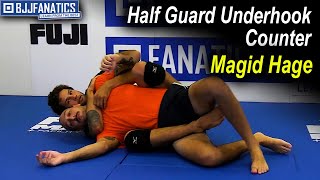 0:41Magid Hage · BJJ Fanaticsno-gino-gi: instead of whizzering, I pinch my elbow to keep his underhook low; then I come over his head and change my base1:01Magid Hage · BJJ Fanaticsno-gino-gi: lock up a kimura trap on his elbow; scoop it with my wrist like I would a heel hook, peel it up and slide this arm under1:21Magid Hage · BJJ Fanaticsno-gino-gi: bring my left leg across his hip, push his underhook down with my armpit and lock up my kimura trap2:02Magid Hage · BJJ Fanaticsno-gino-gi: use my toes to pry his half guard open, get a shoulder roll and land in this kimura trap; as he sits up I spin all the way around taking his back
 - Pendergrass Academy
Mixed kit, observation only: whizzer, then the hand behind his head to fold his chin to his chest, the knee up, and a spin on the other knee to the far side with the arm trapped. synthesis The chin fold loads his neck; it is not drilled here and would stop at once on a tap.
 0:23Pendergrass Academy (coach not yet named)no-gino-gi (mixed kit): I want to whizzer so it does not go to my back; I grab my own wrist and put my hand on his neck to put weight on him0:43Pendergrass Academy (coach not yet named)no-gino-gi (mixed kit): my left hand goes to the back of the head and I put his chin towards his chest; I lift my right knee; I spin on my left knee
 - Lachlan Giles, the bottom's reclaim
No-gi, bottom view: what he does once you have the crossface and underhook back, which is to off-balance you until you post and pummel his own underhook in the space.

— 27 clips · verified 2026-09-10
Ledger
Every clip on this page. Each was resolved on YouTube, its uploader channel recorded and reviewed, and its transcript read before a second was cited. Source names whose channel it is: the coach's own, the coach's gym, or the instructional publisher that filmed them.
| Coach | Channel | Source | Kit | Video | Uploaded | Length |
|---|---|---|---|---|---|---|
| Marcos Tinoco · BIG OSS | BIG OSS Jiu-Jitsu Channel | coach | gi | The Best Way To DESTROY Whizzer From Half Guard (YOU NEED THIS) | 2022-11-06 | 8:14 |
| Jean Jacques Machado | JeanJacquesMachado | coach | no-gi | Killing the underhook from no-gi half guard top (timestamped) | 2022-09-28 | 7:30 |
| Jon Thomas | JonThomasBJJ | coach | gi | Passing Half Guard (Coyote/Dog Fight) | 2021-01-14 | 6:29 |
| Jon Thomas | JonThomasBJJ | coach | gi | How to Force the Half Guard and Pass | 2019-10-17 | 8:49 |
| Jon Thomas | JonThomasBJJ | coach | gi | Stop the Half Guard Fast With This Brutal Shoulder Lock | 2019-10-24 | 3:46 |
| Kenneth Brown | Kenneth Brown | coach | gi | The Safest Way to Pass Underhook Half Guard | 2022-11-29 | 4:50 |
| Jeremy Arel · Great Grappling | Great Grappling | gym | gi | Defending Against the Under Hook - Half Guard Top | 2023-12-20 | 9:58 |
| Lachlan Giles · Absolute MMA | Absolute MMA St Kilda - Melbourne | gym | no-gi | Backstep Pass to Counter the Underhook (Lachlan Giles) | 2022-07-05 | 7:47 |
| Jake Mackenzie · Bernardo Faria BJJ Fanatics | Bernardo Faria BJJ Fanatics | publisher | gi | Half Guard Pass Using Opposite Under Hook by Jake Mackenzie | 2018-06-28 | 4:29 |
| Magid Hage · BJJ Fanatics | BJJ Fanatics | publisher | no-gi | Half Guard Underhook Counter by Magid Hage | 2022-10-23 | 4:31 |
| Bernardo Faria and Tom DeBlass · BJJ Fanatics | Bernardo Faria BJJ Fanatics | publisher | gi | 5 Tips To Improve Your Half Guard by Bernardo Faria & Tom Deblass | 2018-02-17 | 11:04 |
| Lachlan Giles · Absolute MMA | Absolute MMA St Kilda - Melbourne | gym | gi | The main sweep to know from half guard (Lachlan Giles) | 2023-01-25 | 6:09 |
| Lachlan Giles · Absolute MMA | Absolute MMA St Kilda - Melbourne | gym | no-gi | Reclaiming underhook half guard by off balancing your opponent (Lachlan Giles) | 2019-01-19 | 5:51 |
| Lachlan Giles · Absolute MMA | Absolute MMA St Kilda - Melbourne | gym | gi | How Should You Position Your Underhook In Half Guard? | 2022-06-09 | 3:54 |
| Darragh O'Conaill | Darragh O Conaill BJJ | coach | gi | Underhook Half Guard - Dogfight vs No Whizzer | 2021-02-08 | 10:37 |
| Brian Peterson · TeachMeGrappling | TeachMeGrappling Coach Brian | gym | no-gi | "Going High" to Beat the Whizzer in the DOGFIGHT! | 2019-10-23 | 14:09 |
| Chewjitsu (Nick Albin) | Chewjitsu | coach | gi | Half Guard Sweeps getting Mauled by Overhook in Dogfight in BJJ | 2019-02-27 | 3:29 |
| Aaron Benzrihem | Aaron Benzrihem bjj | coach | gi | Half Guard Passing - Basic Under Hook & Cross Face PLUS CONCEPTS | 2019-10-13 | 13:00 |
| David Avellan | David Avellan | coach | no-gi | Lost the Half Guard Under Hook Battle from Top? Good! | 2018-08-09 | 3:28 |
| Carl Massaro | Carl Massaro BJJ | coach | no-gi | How to deal with the underhook from halfguard players - with a finish | 2025-05-29 | 3:29 |
| Kieran Davern · KD Grappling | KD Grappling | coach | no-gi | The Nearside Under Hook for BJJ & MMA | Counter Opponents Under Hook | Half Guard Top Attacks | NoGi | 2022-02-14 | 7:08 |
| Josh Saunders | Josh Saunders | coach | no-gi | This One Grip Shuts Down Underhook Half Guard | 2026-06-23 | 14:36 |
| Malachy Friedman | Malachy Friedman | coach | gi | How to kill the UnderHook! | 2023-10-12 | 1:06 |
| Malachy Friedman | Malachy Friedman | coach | gi | Stop the half guard underhook with this simple Jiu Jitsu tip! | 2023-10-04 | 1:37 |
| Pendergrass Academy (coach not yet named) | Pendergrass Academy of Martial Arts | gym | no-gi | Utilizing the Whizzer to Pass Half Guard, PAMA, Raleigh NC | 2022-03-17 | 1:50 |
| East Midlands BJJ (coach not yet named) | East Midlands BJJ | gym | no-gi | JIU JITSU - HALF GUARD UNDERHOOK PASS | 2020-05-16 | 5:12 |
| Tum Voorn · Energia Martial Arts | Energia Martial Arts | gym | no-gi | Dogfight Counteratttacks - how to beat their guard | 2023-03-21 | 7:17 |
what was not verified
- Evidence convention: a step marked transcript reproduces the cited speech; a step marked frames reproduces the speech and adds hand, arm and leg assignments read from 640 by 360 stills. G and steps 1 to 4 are marked frames for: him facing you on his side with his left arm under your right, your right leg inside and your left leg posted, the left hand to his neck or ear (1:43 to 1:47; 2:08 to 2:09) and the right to his hip (1:49), the lift with both arms straight (1:13 to 1:33; 2:10), the right arm re-pummelling elbow first with the left hand still on his head (2:11) and the left arm crossfacing, him flat (2:12 to 2:17). Sheets: .frames/early-PxmQekq5Zow-1..3.png (four-second steps 0:37 to 2:17, cropped to the pair), .frames/pummel-PxmQekq5Zow-1..2.png (1:37 to 1:55 at two seconds; 2:05 to 2:14 at one second), .frames/zoom2-PxmQekq5Zow-cam1.png and -cam2.png (0:37 to 1:07 at four seconds and 2:05 to 2:15 at half seconds, at twice the size); the reverse sit at four-second steps 3:10 to 5:18 (.frames/rsit-PxmQekq5Zow-1..4.png); the backstep at four-second steps 5:35 to 7:51 (.frames/bstep-PxmQekq5Zow-1..4.png). The camera is far and the pair is small in the frame; the stills settle which hand and which leg and the order, not the pressure.
- The first draft had the arms and the inside leg mirrored (his right arm under your left, your left leg inside) and cited 1:41 to 1:49 as the re-pummel; the reviewer's reading of the second camera is adopted: the re-pummel is at 2:11, the right arm with the left hand still on the head, and 1:43 to 1:49 is the head hand being placed while the other hand rests on the floor and then reaches the hip. The document is written in that orientation and is not a mirror of the footage.
- The endpoint is the flat position at 2:14.5 to 2:16 from the second camera (the left arm wrapped round his head at 2:13.5 to 2:14, then his back on the mat, Arel's chest down, his head beside Marty's left ear on the underhook side (the second draft said the crossface side; the reviewer's reading of 2:15 to 2:15.5 is adopted), the left knee down, the right leg inside; .frames/finish-PxmQekq5Zow.png at half-second steps 2:12.5 to 2:17); at 2:16.5 Arel comes up to talk, which is the exit, not the pin. The three-second hold is the session's test and is not in the footage. In the first camera (1:45 to 1:55) the flattening is partly hidden behind Marty's back. Where the right hand rests inside the underhook is not visible; an open hand on his upper back is the session's instruction, no clasp required.
- The spine range covers Arel's instruction only, 0:05 to 7:51; the early option is demonstrated three times (0:37 to 1:33, 1:37 to 1:55, 2:05 to 2:17), the reverse sit twice and the backstep three times; none is a single continuous take of all three, which is by design: they are three stages, not one route.
- Which leg extends in the reverse sit (the free left leg) and which pinches (the inside right knee) follow Arel's words 'this leg extends and my inside leg pinches at the hip' and the stills at 3:58 to 4:30, where one leg is straight and the other bent at his hip; the grip hand is the left, visible on his clothing at 4:38 to 4:42 and 5:06; at 4:22 to 4:30 Arel's right hand is pointing out the hip and the leg, an explanation, not a grip.
- Thomas, Mackenzie and Friedman are cited in their own words from their own starts; Thomas's clip has his right leg inside (read from his words 'left leg back, right hand grabs the pant'), the same side as Arel's; Mackenzie's and Friedman's sides and hand exchanges are not read from stills, so their branches are references, not drills.
- Kenneth Brown's clip is auto-captioned and rough; it is a reference, not a branch, and its hands are not read from stills.
- The ADCC sidebar is omitted: this is a gi document and the ADCC page's sweep and back conditions were not re-read for it.
- Eleven no-gi clips and one mixed-kit clip are cited (Machado, Giles's backstep, Saunders, East Midlands, Voorn, Davern, Avellan, Massaro, Hage, Peterson, Giles's reclaim, and the Pendergrass clip in mixed kit), in the checks, the threats and the reference, every cue prefixed no-gi; fifteen gi clips are cited, Thomas's coyote guard clip among them. The rest of the thirty-two clips considered are excluded with reasons.
- The system has not been tested on the mat by its editors.
- Jon Thomas's coyote guard clips (zU7kOmW0Fxo and its re-upload hBsDFnfwieY) are gi: a black gi with a red belt on Thomas and a navy gi on his partner; the first kit reading (no-gi and mixed) was wrong and is corrected in the clip index and the ledger.
- Massaro, Hage, Voorn and the Pendergrass clip are observation-only references: their finishes (a shoulder lock, a kimura trap, a face plant and front headlock, a chin fold) are named but not written as instructions and are never drilled.
- Arel's auto-captions at 1:28 say 'right hand comes over on the ear'; the second camera shows the left hand placed on his head (2:08 to 2:09) and the right arm re-pummelling (2:11), so the caption word is not treated as anatomical evidence and the cue is quoted without it.
- The finish's head side was read wrong in the second draft (the crossface side); the stills at 2:15 to 2:15.5 show Arel's head beside Marty's left ear, the underhook side, with Marty's right arm on the camera side, and the document says so throughout.
Compiled and checked by the Randori editors at Way of Yawara: every citation read against the spoken transcript, sources reviewed 2026-09-10, last reviewed 2026-09-10.
In the library
Last updated 2026-09-10.
Framework: Ribeiro & Howell, Jiu-Jitsu University · the shipped learn-graph