Learn / Jiu Jitsu / Systems / Retaining guard against the knee cut in the gi
Open Guard · retain it · gi
Retaining guard against the knee cut in the gi
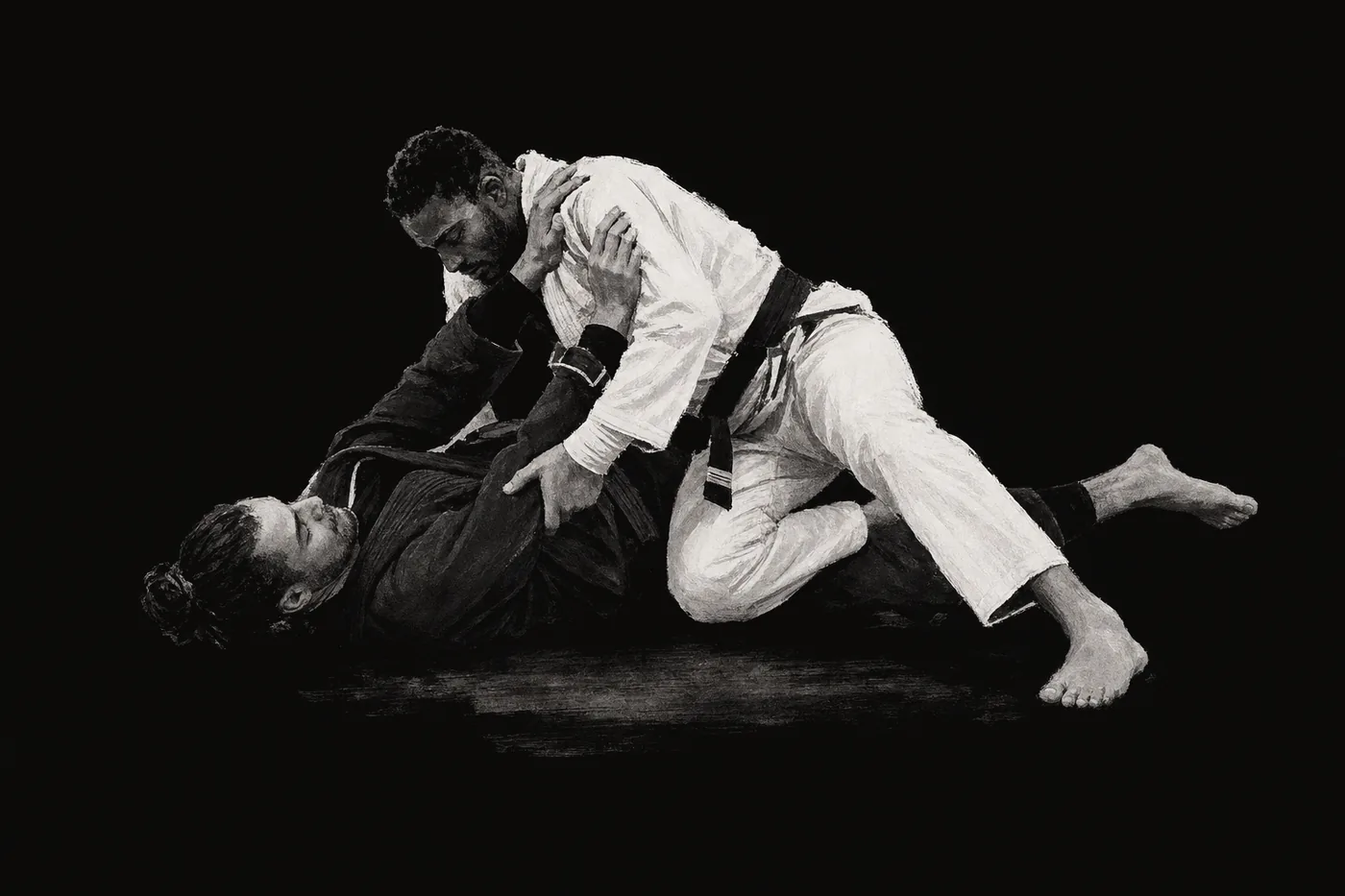
Knee above the arm, frame both shoulders, foot over your own arm to his shoulder, push, leg out and up; he cannot knee cut. The knee cut is the pass people lose to: his knee across your thigh, a hand on your lapel, and the leg you attack with is gone. The spine below is Jon Thomas's first line of knee cut defence, one coach and one route, in the order his footage shows it: keep the trapped knee above your arm, frame both shoulders as he cuts, loop your outside foot over your own arm onto his shoulder, push, and bring the leg out and up into his arm, the frames on while it comes out; once the leg is out he cannot knee cut. What guard you rebuild is the next decision, spider in his footage. One conditional step covers his hand on your knee; Thomas's three reactions are drills that end where he ends them; the late stages are drills with their own starts. Fifteen gi videos, transcripts read and cited to the second, one orientation written out below.
Key takeaways
- Success means The leg free and both feet on him before he can put the knee back through.
- The spine is 4 steps after the gate, frame both shoulders as he cuts, left foot over your own left arm onto his right shoulder, push, and bring the right leg out and up into his left upper arm, the knee cut is over: both feet on him, with 2 conditional steps: then rebuild a guard: in the footage, spider; if his right hand pins your left knee instead of the lapel.
- When it breaks there are 9 named branches; learn the triggers, the responses are short.
- Evidence: 15 clips from 10 channels (6 clips from a coach's own channel, 6 from a gym's, 3 from an instructional publisher's), every timestamp checked against the spoken transcript. Sentences marked synthesis are the editors', not a coach's.
the trapped leg
Your right leg between his legs, his right knee driving across your right thigh toward the mat. Most of the basic traditional attacks from guard need that leg free: the triangle, closed guard, the omoplata, the guards you would recover to. Once his knee hits the floor the bottom leg is very hard to get back.
the grips
His right hand on your left lapel; his left hand on your right pants; no crossface yet, no underhook. A posted left hand is outside the qualified start and a stop. Two kinds of knee cut: the blast with the underhook straight into side control, and the set-up with collar and sleeve or pants that takes your shoulders off the mat and pivots you. Which of your knees he controls decides which of Thomas's responses is open.
 0:16Lachlan Giles · Absolute MMAgithe blast knee cut with the underhook, and the set-up with collar and sleeve or pants
 1:22Jon Thomasgithis arm will either be on my lapel, a very common entrance, or he will be on my leg
 0:42Gustavo Gasperin · MMA Leechgiespecially in the gi, once he controls the arm or the sleeve things get complicated
chest exposure
The pass is finished when your chest is exposed and a shoulder is held down. Danaher's coaching model, not the rulebook: six things the passer has to satisfy in order, break your connection, take a grip, get an angle, close the distance, change level, control the head and shoulders. The more of them he has, the more you must risk.
success means
synthesis The knee cut is over: the right leg is free and up against his left upper arm, the left foot is on his right shoulder, his hand is off your pants; Thomas's own end, shown at 1:58 and at 0:30 to 0:33 of his other clip. The session adds an untested test, keeping both feet on him while he tries once to put the knee back through, and then the guard you rebuild. 'Leg free' with no foot on him is not the endpoint; a knee cut that is stopped but leaves you flat with no connection is the start of the next one. Thomas's reactions B1, B2 and B3 end where he ends them.
the situation
He is on his right knee with it across your right thigh and is starting to cut it to the mat; his right hand holds your left lapel, his left hand holds your right pants; no crossface and no underhook yet; your right knee is bent and still in front of your left arm, your left knee and both hands are free. Not this start: a knee already below his arm (with lapel and pants held it is B1, otherwise a cooperative stop) and his left hand posted on the mat instead of on your pants (outside the qualified start; a stop)
the endpoint
The knee cut is over, in Thomas's words: the right leg is free and up against his left upper arm, the left foot is on his right shoulder, his hand is off your pants. Which guard you rebuild is the next decision (spider in the footage). Any hold of this position against a re-entry is the session's untested test, not in the footage
you start with
- Your right knee is bent and still in front of your left arm
- Your left knee is free
- Your hands are free
not solved here · cooperative resets
- Flat with the crossface connected and his knee on the mat
- His underhook established with your knee on the mat
Sides. One orientation throughout, mirrored for a left-knee cut: you are on your back; his right knee cuts across your right thigh, so your right leg is the trapped leg (the bottom leg once you turn) and your left leg is the outside leg; his right hand is on your left lapel, his left hand on your right pants; you frame his right shoulder with your left hand and his left shoulder with your right; your left foot loops over your own left arm onto his right shoulder; the freed right foot comes up against his left upper arm. If you then rebuild spider, the left hand takes his right sleeve first, then the right hand his left. Thomas speaks in lapel, leg, sleeve, elbow and foot; which hand and which foot, and the order, are read from half-second frames of his clip, and the limitations say so.
what it is worth
A completed knee cut is a guard pass, 3 points. A guard recovered before he holds side control or north-south for 3 seconds denies the pass; the referee may still give an advantage for the near pass once there is no longer a chance of it scoring.
Article 4.2: the top athlete surmounts the legs (guard or half guard) and maintains side control or north-south for 3 seconds; articles 5.1 and 5.2: an advantage for a pass position reached but not held for the 3 seconds, or nearly completed; 5.6.2: half guard control from guard that does not solidify the pass; 5.5: awarded only once there is no longer a chance of the pass scoring
Source: IBJJF Rules Book v6.1 2024 (the current PDF from ibjjf.com/books-videos), articles 4.2, 5.1, 5.2, 5.5, 5.6.2; read 2026-09-10
A completed pass is 3 points in the second half of regulation and in overtime; in the first half a pass scores nothing, so retention that keeps him from 3 seconds of control costs nothing on the board there.
Each position must be established for 3 seconds or more, out of any danger of submission; the judges look for control with at least 75 percent of your back on the mat; no positive points in the first half of regulation, points in the second half and in overtime; at the World Championships the qualifying rounds are 10 minutes (first 5 without points) and the finals 20 (first 10 without), other events have their own durations
Source: ADCC Rules and Regulations page at adcombat.com (Points, positive points; Fight durations), read 2026-09-10
— the spine · learn this week
Jon Thomas's first tier of knee cut defence
One coach's route from the moment the knee starts across to the end of the knee cut, in one orientation and in the order his footage shows: his right knee, your right leg trapped, your left foot to his right shoulder, the leg out and up, the frames on while it comes out and the right one moving as the foot rises. Step 5 is what comes next in the footage, spider, with the repositioning it takes named rather than smoothed over; it is a guard choice, not the retention. Step 6 is conditional and happens only when his right hand pins your left knee instead of the lapel; it ends when the leg is out. G keeps a protection you still have; a knee already below his arm goes to B1 or to a stop. Giles's headquarters retention and Machado supply checks on the same mechanics, never a step; Danaher supplies the standard for what you rebuild toward.
-
GATE
Right knee tight to your chest, in front of your left arm
Keep the trapped knee tight and above your arm; never let it drop low; do not turn it over into a knee shield by instinct.
This step keeps a protection you still have; it does not build one you have lost (if the knee is already below his arm, see B1). The most common mistake is dropping the trapped leg low when it starts to get trapped, which makes it much easier for his knee to go through. Keep your right knee tight to your chest and in front of your arm, so it is hard for him to put it on the floor; keep your knees above his knee, at a little angle. Do not point the knee across to block: that is where you get hip smashed. And avoid the instinct of turning the knee over into a knee shield as he enters; it drops the leg and traps you in a game you may not want. Keeping the knee tight to the chest also covers the space so he cannot take the underhook.
0:41Jon Thomasgikeep this knee tight to my body; people drop this leg low and the knee goes through1:22Jon Thomasgithe knee in front of my arm makes it hard to get it to the floor 0:01Jon Thomasgikeeping my knee above my arm makes it hard to get in deep on the knee cut
 1:05Jean Jacques Machadogikeep your knees above his knee and a little angle1:39Lachlan Giles · Absolute MMAgipointing the knee across gets you hip smashed3:47Jon Thomasgiavoid the instinct of turning this knee over as he enters3:42Lachlan Giles · Absolute MMAgiknee tight to the chest so they cannot take the underhook
 -
1
Frame both shoulders as he cuts
Left hand on his right shoulder, right hand on his left shoulder, elbows in, core tight; the near shoulder too.
As he starts to cut, frame with both hands, one on each shoulder: your left hand on his right shoulder, your right hand on his left. Framing only the far shoulder does not address the shoulder closest to you. Frame first; do not grab the sleeve first, because then his shoulder comes close and you cannot get the foot up.
1:22Jon Thomasgiif he is on my lapel: keep this frame tight, frame both hands, one on each shoulder0:42Jon Thomasgigrab the sleeve first and his shoulder comes close; frame and it is easy1:39Lachlan Giles · Absolute MMAgias he knee cuts, frame both shoulders2:00Lachlan Giles · Absolute MMAgiframing only the far shoulder does not address the near shoulder -
2
Left foot over your own left arm onto his right shoulder
Loop the outside foot over your own framing arm onto his shoulder; the foot goes up before any sleeve is taken.
Your left leg makes connection on his right shoulder to push. Throw the foot over your own left arm: push on his arm with the frame and loop the foot over it; you do not need to be flexible, it is about the framing. Do not grab the sleeve first: people who grab it too early cannot get the foot up. Giles's first line of defence is the same movement: foot to the shoulder and straight away pushing him away. Thomas's alternative for the less flexible, the foot sideways or the heel on his hip, gets the leg out by a different route whose finish is not shown; it is B9, not this spine.
0:21Jon Thomasgimy outside leg makes connection on his shoulder or his hip to push; my left leg, I throw it over on the shoulder0:42Jon Thomasgipush on his arm and throw the foot over my own arm; on the hip sideways or with the heel if less flexible1:43Jon Thomasgiframe with the hands, core tight, this foot comes over to lasso2:21Lachlan Giles · Absolute MMAgiframing and throwing the foot to the shoulder, push him away -
3
Push, and bring the right leg out and up into his left upper arm
The push with the left foot makes the space; the right knee comes back to your chest, the shin clears his thigh, and the foot goes up against his left upper arm; the frames stay on while the leg comes out, and the right one moves as the foot rises.
A little push allows you to bring the bottom leg back out: the right knee comes back toward your chest, the shin clears his thigh, and the foot keeps going up until it sits against his left upper arm (1:56.5 to 1:58.5 in the stills). Both hands stay framing his shoulders while the leg comes out, and the right frame comes off his shoulder as the recovered foot rises (1:58); no grip is taken yet (Thomas's own warning: grab the sleeve too early and you cannot get the foot up). His left hand comes off your pants as the leg comes out; by 1:59 it is open. Once the leg is out he can no longer knee cut: that is the end of the retention in Thomas's words. synthesis If his hand stays on your pants as the leg comes out, what follows is not shown: stop, partner releases, restart.
1:43Jon Thomasgia little push allows me to bring this back out1:43Jon ThomasgiI see a lot of people grab this sleeve too early and then they cannot get their foot up0:21Jon Thomasgipush, create space, get my bottom leg back out; once it is out he can no longer do the knee cut2:21Lachlan Giles · Absolute MMAgipush with the foot to recover the inside hook or the trapped leg -
4
The knee cut is over: both feet on him
Right foot against his left upper arm, left foot on his right shoulder, the leg free; he cannot knee cut. What guard you rebuild is the next decision.
This is where Thomas's retention ends and what he says about it: once the bottom leg is back out he can no longer do the knee cut, and you are free to set up the guard you play. The stills show it at 1:58 (right foot raised against his left upper arm, left foot on his right shoulder, his left hand off your pants), and in the other clip at 0:30 to 0:33 with the second foot raised against his left arm. The hands are moving here: the right frame is coming off his shoulder, and over the next second and a half hands and feet reposition into the guard (step 5). The stills do not show a settled position with both feet and both frames on at the same instant, so this document does not claim one. synthesis In the session, the rep is complete when both feet are on him and the leg is free; holding it against his re-entry attempt is the author's test, not in the footage.
0:21Jon Thomasgionce my bottom leg is back out he can no longer do the knee cut and I am free to set up spider guard, collar sleeve, de la Riva, closed guard1:43Jon Thomasgia little push allows me to bring this back out; now you can try to close guard or start playing spider, that is up to you 14:19John Danaher · Bernardo Faria BJJ Fanaticsgifinish back with four points of connection
 -
5only if: the knee cut is over and you choose spider rather than closing the guard
Then rebuild a guard: in the footage, spider
Left hand to his right sleeve, right hand to his left sleeve, feet on his shoulder and upper arm; that is the settled position Thomas lands in. Closed guard is the other choice he names.
The settled position the footage shows after the leg is out is spider at 2:01: left foot on his right shoulder, right foot on his left upper arm, left hand on his right sleeve, right hand on his left sleeve, both of his hands open. Getting there is a repositioning, not a hold: between 1:58.5 and 2:00.5 the right hand comes off his shoulder, the left foot lifts and resettles, the legs re-place, the left hand takes his right sleeve (2:00) and then the right hand his left (2:00.5). The stills show that order and show no protected version of it; his own grips are off you by then. synthesis The session's addition, untested: do it slowly with at least one foot on him at every moment. Spider is a guard choice after the route, not part of the retention.
-
6only if: his right hand controls your left knee or pants, so the left leg cannot loop straight to the shoulder
If his right hand pins your left knee instead of the lapel
Block the crawl space with the left hand, put your left foot in his right biceps, loop it over the top of that arm to his shoulder; then the push and the leg out as in step 3.
When his top arm controls your leg you cannot lasso. Block the crawl space with your left hand at his right upper arm, put your left foot in his right biceps, and loop it over the top of that arm until it sits on his right shoulder (2:07 to 2:14 in the stills). Then the push brings the right leg out (2:15 to 2:23). The demonstration disengages there: the four-point finish is not shown for this variation, so in the session it ends when the leg is out, and resets.
— grip notes
- Why not the hip escape.
The hip escape moves your hips away and faces you, but it gives up the space between your knee and your chest, and a good passer takes that space. Never put the top foot on the floor to escape here; the high pummel of the outside leg does the same job without the gap.
- Act early.
Everything is easier defended early: the moment you recognise the knee cut, act; wait until he has the underhook or your sleeve and it gets complicated. Machado's version: the work is done while he is coming, not after he has established.
- Which grips these are, and what was read from the footage.
Thomas says lapel, leg, sleeve, cross collar, elbow, foot; the frames add which hand and which foot. The convention: a step whose evidence says transcript reproduces the cited speech; a step whose evidence says frames reproduces the speech and adds hand and foot assignments and their order read from 480p stills at half-second steps (his right hand on your left lapel, his left hand on your right pants, your left arm and left foot, the order in which the feet land and the sleeves are taken after them, your right elbow in B3). The limitations list the stills. Thomas calls the foot over the arm a lasso, Giles calls it a half lasso; the page's label, the lasso, is editorial.


— when the spine breaks
9 branches
Each one names the trigger you will feel, then the response. Learn the triggers; the responses are short.
- The protection is lost: your right knee is already below his arm, and he has regripped to both hands committed, his right hand on your left pants at the knee and his left hand on your lapelits own drillcentred up with the right leg free and his right arm held at the triceps or sleeve; Thomas lands in de la Riva or open guard, a different end from the spine's (both feet on him from the foot on the shoulder)
Thomas's own subcase, in his words: try to keep the knee protected, but let's say I lost it. The lasso is hard now. Frame with both hands, use your left knee as the shield, and snake the right leg out underneath. The moment it is out, grab behind his right triceps or at least his sleeve with your left hand, because otherwise his hand comes back to re-tuck the leg; then push on his shoulder and centre up. Thomas ends here, often in a de la Riva position or switching to open guard; that is the drill's end.
- He drives his weight back into you, and his left hand is on your pants so the sleeve is there to holdits own drillthe right leg free and you defending from there, in Thomas's words; the overhead sweep when it comes; a different end from the spine's, with no foot on his shoulder shown
Fires only with the sleeve available: if his left hand is posted on the mat there is nothing to hold, no B2. Take the reverse de la Riva hook with your right foot behind his right knee, hold his left sleeve with your right hand, a cross collar grip with your left hand, and your left knee shielding across. This makes him drive his weight back into you: as he drives, pull him overhead and bridge; even when the overhead sweep does not come, the off-balance makes him step way back for base, and that space is where the right leg comes out; then you defend from there. synthesis If he neither drives in nor steps back, the branch has not fired: keep the hook and the grips; in the session that is a stop and a restart.
1:47Jon Thomasgithis reverse de la Riva hook with my right foot; hold his sleeve with my right hand; cross collar and the sleeve, shielding; he drives his weight back into me; pull him overhead and bridge2:07Jon Thomasgieven without the sweep the off-balance gives the space; he steps way back and I bring this leg back out- He is deeper and the right leg will not come out, but he does not hold your sleeveits own drillbacked out with the right leg back, in Thomas's words; a different end from the spine's, with no foot on his shoulder shown
Take a cross collar grip with your left hand and frame your palm or fist into his neck; come up on your right elbow and start backing out toward your head, staying tight, the collar frame kept until the leg is back. Up on the elbow with that space at the neck it is easy to back out and get the leg; that is where Thomas ends it.
- Deepest: he already holds your right sleeve with his left hand, the leg will not clear and you cannot standits own drillstanding and backing out with his right foot trapped until you are up; a disengagement, not a guard
Thomas's fail-safe, Roger Gracie's: take a cross grip with your left hand on the left sleeve that holds you, and trap his right foot, the cutting leg, between your legs. From the cross grip it is very easy to break his grip on your sleeve; keep the lock on his foot and keep the left hand on his sleeve, post your right hand behind you (the stills at 3:45 and 3:48), and technical stand-up turning away from him, backing out. The foot must stay locked as you stand, because as you stand he wants to take your back; with his foot trapped it is very hard. Drilled from its own start, slowly, not tonight; the hand and foot assignments here are read from stills, so drill it only once a coach has confirmed the motion.
- You are already in a knee shield and he clears the shield knee, a beat from the passits own drillup on your knees hugging his right leg, or on top; anything less is a stop
Gracie Ohio's timing move, from its own start. As he clears your left knee, bump that knee high into his hips and drive off your right foot to rotate the hips; come up to your knees and hug his right leg. If he stays, drive; if he turns to face you, smash the leg to the floor and circle to the back side. It is a timing thing: catch it right and you come up. synthesis If the bump only makes space, this document has no evidenced guard return from there; in the session that is a stop, partner releases, restart.
 0:43Gracie Ohio Jiu-Jitsu Academygias soon as he clears that knee, bump right into his hips, my knee comes high1:04Gracie Ohio Jiu-Jitsu Academygidrive off my bottom foot, come up, hug the leg; smash him down and climb; circle to the back side1:25Gracie Ohio Jiu-Jitsu Academygithe bump: drive off the bottom foot, it rotates the hips1:46Gracie Ohio Jiu-Jitsu Academygia timing thing; catch it right and you come up; if nothing else you made space
- The late stage: his crossface is connected and his knee is driving to the mat, you are being pushed toward your back, but your elbow can still moveits own drillup to your knees in the dogfight with the underhook; his back when he whizzers and you limp-arm out
Flux MMA's drill, from its own start, and it assumes you are not completely stuck: there is a small window for the elbow to move. First your legs triangle his cutting leg so his foot is stuck. Resist being pushed to your back: stretch the arm on the crossface side over your head, turn belly down toward your trapped leg, and pummel that elbow inside and under his arm; keep turning, the elbow pops under, and you have the underhook. Wrestle up to your knees in the dogfight with his leg still trapped. If he keeps leaning forward to flatten you, he has to start backing up, and that is the moment the elbow goes through. When he whizzers to throw you back down, release, limp-arm out and take the body lock or the seatbelt. synthesis If the elbow has no window, the position is the hard boundary this document does not clear: stop, partner releases, restart.
 0:40Flux MMAgiresist me pushing him toward his back; stretch his arm, turn belly down, pummel his elbow inside1:01Flux MMAgiwe are assuming he is not completely stuck; a very small window for his elbow to move1:21Flux MMAgielbow inside my arm, keep going stomach down, the elbow pops under all the way through, underhook1:42Flux MMAgithe dogfight, my leg is still trapped; the whizzer; release, limp arm, body lock or seatbelt2:43Flux MMAgitriangular legs so my foot is stuck; if I keep leaning forward I have to start backing up; elbow pummel through
- You missed the lasso and he is still comingreference only
Giles: miss the half lasso and you end up with a high knee shield; from the high knee shield work back to the inside hook. If the bottom leg will not come back Giles frames it and spins forward with it, an inversion; that is not in this document (no inversion under a driving passer, see safety; Thomas himself says he has had back problems and does not like to invert), so here the missed lasso is: high knee shield, recover the inside hook, and if the leg still will not come, stop.
2:41Lachlan Giles · Absolute MMAgiif I miss this half lasso I end up with a high knee shield; work back to an inside hook3:02Lachlan Giles · Absolute MMAgiif I cannot recover my bottom leg, frame it, push away with the top knee shield, spin all the way forward3:25Jon ThomasgiI have had a lot of back problems, I do not like to invert a lot- You are not flexible enough to get the left foot to his shoulderreference only
Thomas's alternative: the left foot sideways on his right hip, or the heel on it, pushes to create the space and the leg comes out the same way. What follows from the hip is not in the footage; the spine's end has the left foot on his shoulder. In the session the hip route ends when the leg is out: stop, reset.
- He has the underhook, the crossface, and your knee is on the mat with you flatcooperative reset
synthesis No clip in this document teaches a recovery from all three at once; B6 needs an elbow window and Machado's note is only to keep the hip space with the arm across the hip once the pass is in. This is the hard boundary: stop, partner releases every control, start again from the entry.
— negate first
Threat map
Some of the clips on the left show the coach performing the attack; watch them once so you recognise it. The answer on the right is a spine step, a branch, or marked as synthesis.
- The underhook punch (the blast knee cut)
-
what they are doing
your answer
The right knee tight to the chest covers the space (step G), and the frames on both shoulders keep his chest off you (step 1).
- Sleeve control
-
what they are doing
your answer
Act before the sleeve is taken (grip note); when it is taken deep, B4's cross grip and foot trap, drilled on its own night.
- The hip smash when you point the knee across
-
what they are doing
your answer
Keep the knee tight and above the arm instead of pointing it across (step G).
- The knee re-tucked after you free it
-
what they are doing
your answer
In B1, Thomas's evidenced answer: the triceps or sleeve the moment the leg is out. For the main route the footage shows no re-tuck; the session's re-entry attempt after step 4 is the author's untested test.
- Back exposure when you turn away
-
what they are doing
your answer
Turning to the knees is the late answer (B6) and it starts by trapping his leg; the spine keeps the chest and the back both covered by keeping knees and elbows together.
— 20 minutes · gi
Tonight
synthesis The session is the author's; the mechanics are Jon Thomas's, from one exact start. A route rep is complete when the leg is free and both feet are on him; the re-entry test after it and the slow rebuild to spider are the author's additions and untested. The knee-pin reps end when the leg is out. The reaction reps end where Thomas ends each reaction and reset. Two kinds of stop: the block's own reset (earlier, cooperative, named under each block) and the hard boundaries the scope lists, which stop everything; both restart only after the partner releases every control. The rounds use the agreed test: a pass consolidated for three seconds ends the round.
safety · stop here
No submission is attacked in this document and nothing in it inverts: Giles's bottom-leg inversion and Thomas's reverse de la Riva invert route are reference only (Thomas says he has had back problems and does not like to invert, 8TrLDxW8DAQ 3:25, and the spine does not need it). The overhead off-balance in B2 loads your neck if you chase it; take the space, not the sweep. Faria's neck frame in the reference is released the moment the partner taps; that release rule is the author's.
- The overhead sweep in B2 when he posts and drives through. Do not chase it; let the off-balance make space for the leg; a stalled bridge is a stop and a restart
- The technical stand-up while he holds the sleeve (B4). Stand only with his foot trapped; if the foot is lost, sit back down rather than stand into a back take
- Turning belly down under a driving passer (B6). Trap his leg first; if the elbow has no window it is the hard boundary, stop, partner releases, restart
- 1
The route, to the endpoint every time
7 minPartner enters slowly from the exact start. In this order and no other: right knee tight and above the arm; both hands to both shoulders; left foot over your left arm to his right shoulder; push; the right leg out and up into his left upper arm, the frames on while it comes out and the right one moving as the foot rises. The rep is complete there: the leg is free, both feet are on him. Then the author's test: he tries once, slowly, to put the knee back through, and you keep both feet on him. Only after that, if you play spider, rebuild slowly with a foot on him at every moment: left hand to his right sleeve, then the right hand to his left. Ten reps, swap, then the mirror side (his left knee, your left leg trapped) with every hand and foot swapped. Say the end out loud on the first reps: leg free, two feet on him.
- 2
His hand on your knee
3 minSame entry, but his right hand pins your left knee instead of the lapel. Block the crawl space with the left hand, left foot into his right biceps, loop it over the top of the arm to his shoulder, push, the leg out; the rep ends there and resets. Five reps each way.
- 3
Thomas's three reactions
5 minPartner gives one of these per rep, lightly, on cue, from the common start with the scripted change said out loud. B1: he lets your knee drop below his arm and regrips, right hand to your left pants, left hand to your lapel; you shield with the left knee, snake the right leg out, grab his right triceps, push the shoulder, centre up. B2: his left hand stays on your pants and he drives his weight into you; right foot reverse de la Riva, right hand on his left sleeve, left hand cross collar, off-balance him overhead; he steps back, the leg comes out. B3: he cuts deeper before you move; left hand cross collar, fist to the neck, up on the right elbow, back out, the leg comes back. Each rep ends there and resets. Cycle through all three, then swap.
- 4
Positional rounds
5 minFive one-minute rounds from the exact start, alternating who passes. He passes for real; you retain. Restart when the leg is free with both feet on him for three seconds, on a pass held three seconds, on a sweep, or when either stands. Being flattened with the underhook and the crossface on is a stop, not a round to fight.
— after the round
Check first
synthesis The author's table. Outcomes have more than one cause; check these in order.
| It happened | Check first |
|---|---|
| Passed anyway | Did the right knee drop low as it got trapped, or turn over into a knee shield by instinct? Were both shoulders framed, or only the far one? Did you grab the sleeve before framing? |
| He got the underhook | Was the right knee tight to the chest covering the space, or open? Were the frames on before his chest came down? |
| The leg would not come out | Did the foot push before you pulled the leg? Was the left foot over your own left arm, or did you reach for his sleeve first? If he held your left knee, did you block the crawl space and go to the biceps? |
| The leg came out and went straight back in | Did both frames stay on while the leg came out, or did a hand go for a sleeve early? Did the right foot go up into his arm, or did the leg just come out and hang? In B1, did you take the triceps the moment the leg was out? |
| Hip smashed | Did you point the knee across to block instead of keeping it tight and above the arm? |
| He got your back when you turned | Did you turn to the knees without trapping his leg first (B6)? Was there an elbow window, or was it already the hard boundary? |
— the other doors · keep for later
Reference
Everything else read for this situation, grouped by door, kept for later: the principle, the early blocks before the knee is across, and the half guard version with its own prerequisite. All gi.
The principlewhat every pass needs
- John Danaher
His coaching model: the passer must break your connection, take a working grip, get an angle, close the distance, change level with the chest or the knee, and control the head and shoulders; fight each one, and take more risk the more of them he has. Frames by range, each with its own continuation: at long range the full hand on the biceps with the knees up, and from there the leg scissor; at mid range the forearm; at the closest range the back of the hand between the chests, then inside position, the underhook, come up controlling his leg, and back to guard.
6:39John Danaher · Bernardo Faria BJJ Fanaticsgirequirement one: break the four points of connection8:42John Danaher · Bernardo Faria BJJ Fanaticsgia working grip on your body9:25John Danaher · Bernardo Faria BJJ Fanaticsgiangle, then distance10:09John Danaher · Bernardo Faria BJJ Fanaticsgilevel change with the chest or the knee12:54John Danaher · Bernardo Faria BJJ Fanaticsgithe full hand frame on the biceps, knees up13:39John Danaher · Bernardo Faria BJJ Fanaticsgiwe form a scissor15:45John Danaher · Bernardo Faria BJJ Fanaticsgithe forearm frame at close range17:08John Danaher · Bernardo Faria BJJ Fanaticsgithe backhand frame and inside position when he is on you17:28John Danaher · Bernardo Faria BJJ Fanaticsgimy hand goes through, an underhook; as I get up, control the leg18:09John Danaher · Bernardo Faria BJJ Fanaticsgionce again we are back in guard - Lachlan Giles and Ariel Tabak
Never hip escape for retention except under half guard; do not put the top foot on the floor; the bottom foot only with the hips turned down.
- Gustavo Gasperin
An early defence, before the cut is deep: four fingers inside his lapel, the arm extended and the elbow locked to keep the distance, go to the elbow; if he keeps driving, open the elbow, frame, and technical stand-up. A reset more than anything; not a continuation of Thomas's route.
Early blocksbefore the knee is across
- Jean Jacques Machado
Raise the inside knee before he comes; the foot on the hip as he opens; in quarter guard, touch the knee before he does anything and work while he is moving, not after he has established.
- Brian Glick
From the split squat: reverse de la Riva shoelaces on the inside, the other foot posted between belt and hip; when his instep floats as he cuts, instep to instep and extend to put his knee on the floor between your knees; collapse the elbow, head under, and the knee lever sweep.
- Gracie Barra New Hyde Park
The reverse de la Riva hook into the thigh blocks the knee from coming across; cup your own knee; kick him forward, underhook the leg and sweep. The warning in the clip: do not reach in between his legs for the leg, he can give you the triangle; replace the hook with your left hand instead.
- Adam Wardzinski
For the butterfly player, three ways back to butterfly from the knee slice, chosen by his pressure: the reverse de la Riva hook with the knee turned toward his chest, a sleeve grip and a collar frame; when he gives substantial forward pressure, scoop the hips back and his knee lands; when the collar frame is not enough, the collar hand moves to his leg and pushes it down as you scoop; when he follows your hip movement, the outside hook goes under the shin and both hooks put the knee on the mat, gently, never with a dynamic kick.
 0:42Adam Wardzinski · Bernardo Faria BJJ Fanaticsgithe reverse de la Riva hook stops him for a while1:04Adam Wardzinski · Bernardo Faria BJJ Fanaticsgimove the knee toward his chest1:50Adam Wardzinski · Bernardo Faria BJJ Fanaticsgithe sleeve so he cannot switch to a side step or long step2:11Adam Wardzinski · Bernardo Faria BJJ Fanaticsgiwhen he gives substantial forward pressure2:31Adam Wardzinski · Bernardo Faria BJJ Fanaticsgiscoop the hips back and his knee lands2:52Adam Wardzinski · Bernardo Faria BJJ Fanaticsgireplace the collar hand with a hand on the leg3:12Adam Wardzinski · Bernardo Faria BJJ Fanaticsgipush the leg down3:32Adam Wardzinski · Bernardo Faria BJJ Fanaticsgiwhen he follows the hip movement3:54Adam Wardzinski · Bernardo Faria BJJ Fanaticsgithe outside hook under the shin, both hooks put the knee on the mat4:37Adam Wardzinski · Bernardo Faria BJJ Fanaticsginever kick back dynamically; put the knee down gently and keep the hooks

The half guard versionwhen it becomes half guard, and he has no upper body grips
- Ewan McDonald
Its prerequisite is that he has no upper body grips on you yet: then pinch the knees, hide the underhook arm across your stomach, use the top knee to push his weight forward, and take the underhook deep on the hips; keep kneeing him forward; when he lifts the knee onto your stomach to go back to the knee cut, scissor the feet with the bottom leg high and take the underhook before the knee lands. None of this is the spine's start, where his hand is already on your lapel.
 0:26Ewan McDonald · Gracie Barra Shellharbourgiif he does not have any upper body grips on me it is really hard for him to do anything0:46Ewan McDonald · Gracie Barra Shellharbourgipinch the knees and hide the underhook1:26Ewan McDonald · Gracie Barra Shellharbourgithe top knee pushes his weight forward, then the underhook deep on the hips2:07Ewan McDonald · Gracie Barra Shellharbourgihe lifts the knee onto your stomach and goes back into the knee cut2:47Ewan McDonald · Gracie Barra Shellharbourgiscissor the feet, bottom leg high, then the underhook
 - Bernardo Faria
The knee shield as a seatbelt: not too low, not too wide; the collar grip as tight as you can with the forearm opened on the neck; the other hand blocks the biceps. The forearm on the neck is a frame he chokes himself against if he drives. synthesis In drilling, release it the moment he taps or says stop.
 0:22Bernardo Faria · Bernardo Faria BJJ Fanaticsgithe shield as a seatbelt1:25Bernardo Faria · Bernardo Faria BJJ Fanaticsgicollar tight, forearm on the neck1:45Bernardo Faria · Bernardo Faria BJJ Fanaticsgihe kind of chokes himself against the frame2:05Bernardo Faria · Bernardo Faria BJJ Fanaticsgiblock the biceps
— 15 clips · verified 2026-09-10
Ledger
Every clip on this page. Each was resolved on YouTube, its uploader channel recorded and reviewed, and its transcript read before a second was cited. Source names whose channel it is: the coach's own, the coach's gym, or the instructional publisher that filmed them.
| Coach | Channel | Source | Kit | Video | Uploaded | Length |
|---|---|---|---|---|---|---|
| Jon Thomas | JonThomasBJJ | coach | gi | The Six Main Ways to Stop the Knee Cut | 2021-02-22 | 4:34 |
| Jon Thomas | JonThomasBJJ | coach | gi | Easiest Way Defend The Knee Slide Pass | 2018-05-23 | 4:23 |
| Lachlan Giles · Absolute MMA | Absolute MMA St Kilda - Melbourne | gym | gi | Retention VS knee cut from headquarters | 2020-11-23 | 5:47 |
| Jean Jacques Machado | JeanJacquesMachado | coach | gi | Blocking a strong knee cut | 2024-08-24 | 3:36 |
| Jean Jacques Machado | JeanJacquesMachado | coach | gi | Q&A - Defending The Knee Slice From The Quarter Guard | 2023-03-31 | 4:34 |
| Gustavo Gasperin · MMA Leech | MMA Leech | coach | gi | How To Stop The Knee Slice Pass | 2016-12-16 | 2:09 |
| Lachlan Giles and Ariel Tabak · Absolute MMA | Absolute MMA St Kilda - Melbourne | gym | gi | Why the hip escape is bad for guard retention | 2020-09-27 | 2:43 |
| John Danaher · Bernardo Faria BJJ Fanatics | Bernardo Faria BJJ Fanatics | publisher | gi | How To Do Perfect Guard Retention In BJJ by John Danaher | 2019-06-24 | 20:50 |
| Flux MMA | Flux MMA | gym | gi | How To: Defend A Late Stage Knee Cut | 2021-12-16 | 3:16 |
| Gracie Ohio Jiu-Jitsu Academy | Gracie Ohio Jiu-Jitsu Academy | gym | gi | Counter to the Knee Cut Pass | 2018-03-12 | 2:14 |
| Adam Wardzinski · Bernardo Faria BJJ Fanatics | Bernardo Faria BJJ Fanatics | publisher | gi | 3 Ways to Bring Your Opponent Back to Butterfly Guard From Knee Slice | 2022-04-22 | 8:07 |
| Ewan McDonald · Gracie Barra Shellharbour | Gracie Barra Shellharbour | gym | gi | 1/5 | Knee Cut Defence - Ewan McDonald | 2020-05-07 | 3:46 |
| Brian Glick | Brian Glick | coach | gi | Defending The "Knee Cut" Guard in BJJ | 2020-09-22 | 2:58 |
| Gracie Barra New Hyde Park | GBNewHydePark | gym | gi | Counter to knee slice pass | 2011-06-16 | 2:21 |
| Bernardo Faria · Bernardo Faria BJJ Fanatics | Bernardo Faria BJJ Fanatics | publisher | gi | How to Do the Perfect Knee Shield | 2024-08-13 | 4:07 |
what was not verified
- Evidence convention: a step marked transcript reproduces the cited speech; a step marked frames reproduces the speech and adds hand and foot assignments and their order read from 480p stills. G and steps 1 to 6 are marked frames for: his right hand on your left lapel and his left hand on your right pants, your left arm and left foot, the order in which the feet land and the sleeves follow (8TrLDxW8DAQ at half-second steps from 1:48 to 2:04 and one-second steps from 2:04 to 2:27, .frames/fine-*.png; 42rhkcaqrvk 0:24 to 0:54), your right elbow in B3 (42rhkcaqrvk 2:53 to 3:08), the hands in B1 and B2 (1:12 to 1:24, 1:48 to 2:06) and the posting hand in B4 (3:45 to 3:48).
- The end of the route is read from the half-second stills: left foot to his shoulder at 1:54; the push and the leg out and up from 1:56.5 to 1:58 with the frames on while the leg comes out and his left hand coming off the pants; at 1:58 the right foot is against his left upper arm and the left foot on his right shoulder while the right hand is already coming off his shoulder. From 1:58.5 to 2:00.5 hands and feet reposition (the left foot lifts and resettles, the legs re-place, the left hand takes his right sleeve at 2:00, the right hand his left at 2:00.5) and the settled position shown is spider at 2:01 with both of his hands open. No still shows both feet on him and both hands framing at the same instant, and the document claims no such position. The same end, the second foot raised against his left arm, is in 42rhkcaqrvk at 0:30 to 0:33. Stills at that rate show the order, not the pressure.
- The session's re-entry test (keep both feet on him while he tries once to put the knee back through) and the slow rebuild to spider with a foot on him at every moment are the author's additions and have not been tested or shown; the footage shows an unprotected repositioning into spider.
- The spine ranges cover Thomas's instruction only: 42rhkcaqrvk 0:18 to 0:56 and 8TrLDxW8DAQ 1:00 to 2:25 (the knee-pin variation runs 2:04 to 2:24 and ends when the leg is out; its four-point finish is not shown). The competition inserts in 42rhkcaqrvk (0:57 to 1:08 and 4:00 to 4:10) are not part of the qualified footage and their ownership was not established.
- Thomas's reactions B1, B2 and B3 end where his footage ends them (centred with the arm held; the leg free after the step back; backed out with the leg back). Each is a drill that finishes at its own observed end and resets; rebuilding a guard is outside each drill.
- Thomas says lasso and Giles says half lasso; the page's label, the lasso, is editorial.
- B4's hand and foot assignments are read from stills of a fast transition; it is marked for a night of its own after a coach confirms the motion.
- The ADCC durations quoted are the World Championships'; other ADCC events publish their own.
- The system has not been tested on the mat by its editors.
- Round 6 (2026-09-10) approved the document with two wording minors, both applied after the round without a further review: 'both frames still on' removed from the completed foot placement (the right frame moves as the foot rises), and the reaction drills' resets explained by their own observed ends rather than by an unshown return to spider.
Compiled and checked by the Randori editors at Way of Yawara: every citation read against the spoken transcript, sources reviewed 2026-09-10, last reviewed 2026-09-10.
In the library
Last updated 2026-09-10.
Framework: Ribeiro & Howell, Jiu-Jitsu University · the shipped learn-graph