Learn / Jiu Jitsu / Systems / Sweeping from established deep half guard, in the gi
Half Guard · sweep it · gi
Sweeping from established deep half guard, in the gi
This is the gi system. The gi version has its own clips and its own spine.
Under his leg with your head on his lap and his hand already on your knee, take his cuff with the scoop hand, keep it with the other over the top, hook under his arm, kick the leg free of his grip, walk to the side and pull his arm down, take him over when he leans, land on your side and come up on your knees on top. You are established in deep half, under one of his legs with your head on his lap, and he bases wide and grips your top knee to stack it: you cannot come up, and if the stack finishes you get passed. The spine below is Leonardo Nogueira's sleeve deep half sweep in the gi, one coach and one route in his own orientation: the hand that was scooping his leg takes the cuff of the hand on your knee, the belt hand comes over the top and keeps it, the scoop arm goes under his arm and hooks the elbow, the leg kicks forward to break his grip and the knees squeeze his leg, the walk to the side and the pull of his trapped arm with the elbow to the mat, and when he leans forward the turnover over the shoulder of the trapped arm, the landing on your side beside him with the arm and the leg kept, and the come-up onto your knees held three seconds. His two other sweeps from the same grips, when he sits back and when he puts his knee down, are drilled as reactions; the waiter sweep, the Faria sweep, the back door, Tinoco's three, Giles's roll-under and the entries are references. 20 gi clips and 17 no-gi clips are cited, the no-gi ones cued as such, with one podcast for words only; five clips were considered and excluded.
Key takeaways
- Success means On your knees on top with his arm still held, him on his back, three seconds.
- The spine is 5 steps after the gate, the exchange: your left hand to his cuff, your right hand over the top to keep it, your left arm under his arm, kick the leg forward to break his grip, keep the legs forward, squeeze, walk to the side and pull his arm down, your left elbow to the mat, when he leans forward, take him over and land on your side beside him, the arm and the leg kept, come up onto your knees over him and hold.
- When it breaks there are 8 named branches; learn the triggers, the responses are short.
- Evidence: 38 clips from 23 channels (14 clips from a coach's own channel, 7 from a gym's, 17 from an instructional publisher's), every timestamp checked against the spoken transcript. Sentences marked synthesis are the editors', not a coach's.
his weight goes to his knee, not onto you
You are under one leg with your head on his lap and your hand on his belt; his weight is on his own knee and his posted hand. Nogueira's two guards for the position are the hip control, which he says stops the jump to the other side, and the head resting on his lap, which he says makes hell for the man on top. Dallas Niles says what that feels like: underneath but not carrying his weight, because the weight is on the mat on his knee, and a pull upward that makes it hard for him to drop that knee and switch his base. Jason Scully, no-gi, says the same from the other end: the body under his whole leg, never up high where the weight lands on you. Teco Shinzato's concept is the hips brought close to your face.
 3:08Leonardo Nogueira · Bernardo Faria BJJ Fanaticsgithe hip control will avoid that jump and my head resting on his lap is going to make hell to the guy
 2:03Dallas Niles · BJJ Fanaticsgieven though I'm underneath I'm not feeling his weight; his weight is on the mat on this knee; I'm making sure whenever I get in to keep him on this knee2:44Dallas Niles · BJJ Fanaticsgikeep some pressure pulling up, making it hard for him to drop this knee down to the floor and switch his base
 0:45Jason Scully · The Grapplers Guideno-gino-gi: ideally I want my body underneath his whole leg; I do not want my body all the way up here; when I am lower on his leg I don't feel any of his weight on me
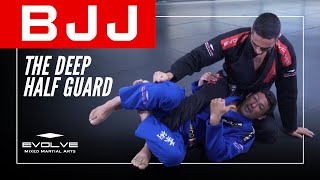 2:33Teco Shinzato · Evolve MMAgiI move my hips deep and I go through his hips close to my face; I feel that I'm controlling my opponent because he cannot control me
his stacking hand is the sleeve you want
His hand already on your top knee, pushing it toward the mat so he can stack and jump to the other side. Nogueira says the jump works if you let him establish that grip in the pants, and his answer to a grip that is already there is to take it: the hand that was scooping his leg goes to the sleeve, the other hand comes over the top and keeps it, the freed scoop arm hooks under his arm, and the leg kicks forward to break the grip. Now the arm he bases with on that side is yours, and he can be flipped in either direction. Tinoco's version forces the hands to the mat first and takes the sleeve with a four-finger grip; Osiander feeds the sleeve and keeps it the whole time so the man cannot stop the pass after the sweep.
3:29Leonardo Nogueira · Bernardo Faria BJJ Fanaticsgithis hand that's scooping this far leg, I want to go to the sleeve; but he's still having a strong grip in this leg; I want to use my arm under and hook his arm like this; keep my legs forward; now I have a great position to flip into each direction6:55Leonardo Nogueira · Bernardo Faria BJJ Fanaticsgihe's gonna try to get my underhook or he's gonna try to stack my leg; I switch this grip to the sleeve, and the way I try to break this, I wanna hook in and kick my leg forward; that's a good break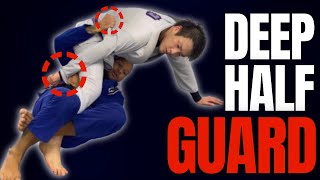 2:05Marcos Tinoco · BIG OSSgihe pulls his head up, I keep rolling, don't disconnect; when he touches I'm gonna go there, grab it, bridge; the back hand, four fingers grip; now I'm gonna try to break this grip, super hard, there's no leverage for him
 2:17Kurt OsiandergiI'm going to find the sleeve and feed it, and grab the back of his pants, and then sit up, pass; I like to keep the sleeve the whole time so he can't stop my pass
his reaction picks the direction
He leans forward, he sits his weight back to break the grip, or he puts his knee on the ground. Nogueira says everything depends on his reaction, and gives one sweep for each: if he leans forward, roll him over because you own the arm he bases with on that side; if he leans back, roll him the other way; if the knee goes down, come up. And he does not wait for the reaction: he makes it, by walking to the side and pulling the arm down, and reads which one comes. McCaghren, no-gi, frames the whole guard the same way, sweep back or sweep forward; McDonald teaches beginners to rock the legs and feel which way the base moves.
3:50Leonardo Nogueira · Bernardo Faria BJJ Fanaticsgieverything now is going to depend on his reaction: if he leans forward I can easily roll him over because I beat his base controlling his grip; if he leans back trying to break my grip, I roll him to the other way4:11Leonardo Nogueira · Bernardo Faria BJJ Fanaticsgiand also if he tries to put this knee down, I do the Turkish sweep; the sleeve deep half guard is a very complete position because I have all angles of sweep4:31Leonardo Nogueira · Bernardo Faria BJJ FanaticsgiI highly rely on Bernardo's reaction; I can create situations to make him react: I want to walk to the side and pull his arm down 0:43Brandon McCaghrenno-gino-gi: almost everything that you do from the deep half is going to be either sweep back or sweep forward
 2:48Ewan McDonald · Gracie Barra Shellharbourgiwhen we rock the legs we can feel Marcus's base start to move; if I feel his base is that way I'm just gonna pull; if Marcus is countering by putting it this way, then I pull and come up this way
the sweep is over on your knees, not at the fall
Him on his back and you up on your knees over him with the arm still held; three seconds. Nogueira's rolls land him on his side beside the man before he comes up, and he comes up to his knees still holding the arm before he lets go and resets. Tom Davey's rule is to learn when to let go: once the sweep has given its value, stop moving him and transition to the top. McCaghren, no-gi, wants sweep and pass as one movement. synthesis The three-second hold on the knees is this document's test; Nogueira comes up and talks, and does not count.
5:14Leonardo Nogueira · Bernardo Faria BJJ Fanaticsgihe's gonna put this knee down; I'm gonna come up and get the sweep; this position is very suited for every reaction that he has 2:23Tom Davey · The Grappling Academygionce I land here it's imperative that I learn when to let go; once I've got the value out of my sweep I now need to stop moving my partner; I now need to transition to the top and start passing5:16Brandon McCaghrenno-gino-gi: I want you to sweep-pass as one movement; don't think sweep, then come up, then look to pass
success means
synthesis On top held: you on your knees over him with his right arm still in your hands and his right leg between your legs, him on his back, and nothing happening for three seconds; after B2, on your knees inside his open guard with his back on the mat, three seconds. The count is the session's test, the author's; the stills show Nogueira on his knees for about two and a half seconds in the first pass and about a second in the second before he lets go. Tipping him and lying on your side beside him is the landing, not the endpoint; the pass after it is another document. B3 to B7 end where their coaches end them and do not claim this position.
the situation
You are already established in deep half guard: on your back under one of his legs, your head on his lap at his far thigh, your hand under his thigh and your other hand on his belt; he is on his knees with his weight up and forward, one hand posted and the other already gripping the pants at your top knee to stack it; you have not yet taken the sleeve (step 1); the entry from the knee shield and the waist-tight position is Nogueira's own and is a reference; the moment he has already stacked your knee and jumped over is the pass and a reset
the endpoint
On top: you on your knees over him with his right arm still in your hands and his right leg between your legs, him on his back, held for three seconds; the count is the session's test, the author's; the stills show Nogueira on his knees there for about two and a half seconds at 3:58 to 4:00.5, and for about a second at 4:57.5 to 4:58.75 before he turns to his side and resets; in the redo he lands on his side beside Faria (7:52 to 7:55.5) and is only starting to come up when Faria pulls him back; B2 lands on the knees inside his open guard (8:26.5 to 8:30) and has its own test
you start with
- His right leg between your legs
- Your head on his lap
- Your right hand on his belt
- His right hand on your left knee
not solved here · cooperative resets
- His knee already stacked to the mat and his hips over your head (the pass; a reset)
- His side switch completed, his leg freed, or his leg over your head (resets; a leg over your head with your arm inside is a triangle and a tap)
- The knee cut or the crossface before you are under his leg (the knee cut retention and flattened half guard documents)
- The kimura, the americana, the foot lock and the collar choke (taps)
- His weight driven onto your head and neck under a stack (a stop)
- The waiter sweep, the Faria sweep and the back door (B3, B4, B5, references)
Sides. One orientation throughout, Nogueira's own, mirrored when you play the other side: you are on your back under his right leg; your left leg is over his right thigh with the knee up and your right leg is under his leg; your head is on his lap at his left thigh; your left arm is the scoop under his right thigh and your right hand holds his belt at his hip; he kneels with his weight forward, his left hand posted on the mat by your head and his right hand gripping the pants at your left knee; your left hand takes his right cuff, your right hand comes over the top of his forearm and keeps the cuff, your left arm goes under his right arm and hooks it at the elbow; your left leg kicks forward to break his pants grip and your knees squeeze his leg; you walk your feet to the side so your hips turn under him, and pull his trapped arm down with your left elbow to the mat; if he leans forward he turns over the shoulder of the trapped arm and lands on his back; you land on your side beside him with his right arm still in your hands and his right leg between your legs, then come up onto your knees at his right side. Nogueira speaks in my head on his lap, the hip control, this hand that's scooping, the sleeve, my arm under, hook his arm, my legs forward, kick my leg forward, walk to the side, pull his arm down, my elbow to the ground, roll him over; which arm, which leg and which side are read from stills of his clip by tracing each arm to its shoulder, and the limitations say so.
what it is worth
The sweep scores 2 once you have inverted the position from guard or half guard and kept him on the bottom for 3 seconds (article 4.6.1); that is the endpoint, and it is the endpoint whether his leg is still between yours or you are on your knees in his open guard. A sweep that unbalances him and reaches the top without 3 seconds of stability is an advantage (5.6.6), and no advantage is given for a sweep begun and then deliberately given up to keep a defensive position (5.7.4). None of this is a referee's call in training: the session's success is the top held and counted.
Article 4.6.1: the athlete on bottom with the opponent in guard or half guard inverts the position, forcing the opponent who was on top to be on bottom, and maintains him in that position for 3 seconds; 5.6.6: an advantage when the athlete unbalances the opponent through a sweep attempt and reaches the top position but cannot maintain it for the required time; 5.7.4: no advantage for the athlete who initiates a sweep but deliberately gives up the top position to preserve a defensive position
Source: IBJJF Rule Book v6.1 (2024), articles 4.6.1, 5.6.6 and 5.7.4, read from the PDF
— the spine · learn this week
Leonardo Nogueira's sleeve deep half sweep
One coach's route from the established deep half, with his hand already on your knee, to the knees on top, in his own orientation: the left hand to his cuff, the right hand over the top to keep it, the left arm under his arm, the left leg kicked forward to break his grip and the squeeze, the walk to the side with the left elbow to the mat, and, when he leans forward, the turnover over the shoulder of the trapped arm, the landing on your side beside him with the arm and the leg kept, and the come-up onto the knees. Step 3 makes his reaction rather than waiting for it and reads which one comes; his other two answers, when he sits back and when he puts the knee down, are B1 and B2 and are drilled as reactions, B2 with its own landing. Niles, Davey, Tinoco and the no-gi coaches supply checks on what the position is and why the details matter, never a step; B3 to B7 are references from their own set-ups and B8 is the reset list.
-
GATE
Read it: you are under his leg with your head on his lap, and his hand is already on your top knee
You are on your back under his right leg: your left leg over his right thigh with the knee up, your right leg under his leg, your head on his lap at his left thigh, your left arm under his right thigh and your right hand on his belt at his hip. He is up on his knees with his weight forward, his left hand posted on the mat by your head and his right hand gripping the pants at your left knee. The stack and the jump are what that grip is for; the grip is what you will take.
This is the established deep half, after the entry, with his answer already started. At 3:17 to 3:29 and again at 7:02 to 7:08 Nogueira (white gi) is on his back under Faria's right leg: his left leg over Faria's right thigh with the knee up, his right leg beneath, his head at Faria's left thigh, Faria bent forward over him with his left hand posted on the mat by Nogueira's head and his right hand gripping the pants at Nogueira's left knee (.frames/entry-ojvH99btFYo-3.png at two seconds, .frames/h2-ojvH99btFYo-1..2.png at quarter seconds, .frames/up-ojvH99btFYo-1..2.png at one second); Nogueira's right hand is at the belt and his left hand is already on Faria's right cuff at 7:04.5 (.frames/arms-zoom-1-ojvH99btFYo.png), the first moment of step 1; the scoop before it, the left arm under Faria's thigh, is in the entry stills at 7:02 to 7:04 (.frames/entry-ojvH99btFYo-3.png at two seconds) and in Nogueira's words at 3:29, the hand that was scooping the far leg going to the sleeve. Nogueira says what the man on top wants from here: grab the knee, stack it to the ground and jump to the other side, and that he gets it if you let him establish the grip in the pants. The grip is established in this document's start; the hip control and the head on his lap are what keep him from finishing the stack while you take the sleeve. synthesis The knee shield, the waist-tight position, the scoop under his leg and the bottom leg carrying his leg are Nogueira's entry (1:02 to 2:53) and are B7, not this document's start. His detail for straightening the leg before the grip arrives (6:34 to 6:46) is in the grip notes; it is filmed without the grip and is not a step here.
2:48Leonardo Nogueira · Bernardo Faria BJJ Fanaticsgiwatch out, Bernardo wants to be flipped; probably he's gonna post when I start turning; my bottom leg is gonna carry his leg; a very common reaction for the top players is try to stack my leg on the ground: he's gonna grab my knee, stack and try to jump to the other side3:08Leonardo Nogueira · Bernardo Faria BJJ Fanaticsgihe's going to accomplish that if you let him establish this grip in the pants6:55Leonardo Nogueira · Bernardo Faria BJJ Fanaticsgihe's gonna try to get my underhook or he's gonna try to stack my leg; he's trying to attack my leg -
1
The exchange: your left hand to his cuff, your right hand over the top to keep it, your left arm under his arm
Your left hand, the scoop, comes off his thigh and closes on his right sleeve at the cuff, the hand that grips your knee. Your right hand leaves his belt, comes over the top of his forearm and takes the cuff for good. Your left hand lets go and goes under his right arm to hook it at the elbow, the fist in front of his chest.
Three moves, and control never lapses, because a hand is on the sleeve throughout. Each gripping arm is traced back to its shoulder in the large stills (.frames/arms-zoom-1-ojvH99btFYo.png, .frames/strip-zoom-1-ojvH99btFYo.png), with the yellow team strip on his left lapel as the mark. First pass (.frames/h1-ojvH99btFYo-1..5.png at half seconds; .frames/handsbig-ojvH99btFYo-1.png): at 3:33.5 the arm closed on Faria's right cuff runs back to the shoulder under the strip, his left, while Faria's hand is still on his knee; at 3:36 his right arm comes from the belt over the top of Faria's forearm and takes the cuff, and the left hand is free; at 3:41.5 the left arm threads under Faria's right arm and the fist comes up in front of Faria's chest, the right hand still on the cuff. Redo (.frames/h2-ojvH99btFYo-1..7.png at quarter seconds): the first cuff grip at 7:04.5 again runs back to the left shoulder; the right arm over the top at 7:09.5 to 7:10.75; the left arm under and the fist at Faria's chest at 7:10.75 to 7:12. At the pull (7:49.5) the cuff is in the right hand, its sleeve running from his right shoulder across Faria's forearm, and the left arm is under Faria's arm. Nogueira's words: the hand that's scooping goes to the sleeve, the arm goes under and hooks his arm; the exchange between the hands is read from the stills, not spoken.
3:29Leonardo Nogueira · Bernardo Faria BJJ Fanaticsgithis hand that's scooping this far leg, I want to go to the sleeve; he's still having a strong grip in this leg; I want to use my arm under and hook his arm like this6:55Leonardo Nogueira · Bernardo Faria BJJ FanaticsgiI switch this grip to the sleeve, and the way I try to break this, I wanna hook in -
2
Kick the leg forward to break his grip, keep the legs forward, squeeze
With his arm yours, kick your left leg forward to break his grip on your pants; keep your knees forward toward him and squeeze his leg between them; the legs never let go.
Now the break. Nogueira says it as one move: hook in and kick my leg forward, that's a good break. Then two things stay: the legs stay forward, knees toward him, and they never let go of his leg; he does not want Faria stepping over to the mount, because that goes to a triangle, so he keeps the traction and squeezes his legs together (7:18 to 7:33, .frames/up-ojvH99btFYo-1..2.png and .frames/legs2-ojvH99btFYo-1..2.png: both of Nogueira's legs closed on Faria's right thigh, the knees toward Faria). synthesis Which leg kicks is not read from a still at the moment of the break; the session kicks the top leg, the one his hand is on, and the limitation says so. Nogueira's detail for a straight leg, slide the heel down and rotate the hips so his knee extends, is filmed before the grip arrives (6:34 to 6:46) and is a grip note, not a step from this start.
7:15Leonardo Nogueira · Bernardo Faria BJJ FanaticsgiI wanna hook in and kick my leg forward, that's a good break; and now, like I said, they're going to create opportunities to sweep7:36Leonardo Nogueira · Bernardo Faria BJJ Fanaticsgimy legs never lose over here; I don't want Bernardo stepping over to the mount, otherwise it's gonna go for a triangle; so I'm gonna keep the traction over here, squeezing my legs together3:29Leonardo Nogueira · Bernardo Faria BJJ Fanaticsgikeep my legs forward; now I have a great position to flip into each direction -
3
Walk to the side and pull his arm down, your left elbow to the mat
Walk your feet to the side so your hips turn under him and he has to follow; put pressure on the sleeve, pulling his trapped arm down across you with your left elbow, the hooking arm's, going to the mat. If he leans forward, step 4; if he sits back, B1; if his knee goes down, B2.
This is how he makes the reaction instead of waiting for it. At 7:42 to 7:50 (.frames/walk-ojvH99btFYo-1..2.png at one second, .frames/elbow-ojvH99btFYo-1..4.png at half seconds) Nogueira's hips turn under Faria, who is held by the right arm and comes over him; the feet themselves move little in these samples, so the direction of the walk is his word, walk to the side, and not a displacement read from the stills. At 7:46.5 to 7:50 the left hand comes up under Faria's arm and its elbow drops toward the mat, while the cuff stays in the right hand, drawing Faria's elbow down. His words: walk to the side, put pressure on the sleeve, bring my elbow to the ground. In the first pass he says it as a plan: walk to the side and pull his arm down. What he does next depends on the man: if he leans forward, step 4; if he is well vaccinated to this position he will follow you as you walk and sit back, and that is B1; if he puts the knee down, B2.
-
4
When he leans forward, take him over and land on your side beside him, the arm and the leg kept
If he leans forward with his right arm yours, he turns over the shoulder of the trapped arm and lands on his back; you go with him and land on your side beside him, his right arm still held and his right leg still between your legs.
Two falls, read at quarter seconds, and they are not the same. First pass (.frames/end1-ojvH99btFYo-1..2.png): at 3:56 to 3:57.25 Faria, leaning forward, turns over the shoulder of his trapped right arm, his head going toward Nogueira's head side (image right, beside the mat logo) while Nogueira's legs extend the other way, and lands on his back with Nogueira turning onto him; his free left hand touches the mat during the turnover (3:56.5 to 3:57), and how much weight it bears is not read. Redo (.frames/end3-ojvH99btFYo-1..4.png): at 7:50.5 to 7:51.75 Faria stays more upright, sits and tips onto his side and back rather than rolling over the shoulder, and Nogueira goes with him; from 7:52 to 7:55.5 Nogueira is on his side beside Faria, the hooking arm underneath, the cuff still in his right hand and Faria's right leg between his legs. Nogueira's reason for the first: he leans forward, and you roll him over easily because you beat his base by controlling his grip. synthesis The session drills the forward lean and the turnover of the first pass, and treats the sit-and-tip of the redo as the same landing reached differently. What the sleeve removes is his right-hand post on the side he falls to; his left hand is free and can post, and in the first pass it touches the mat as he turns without stopping him. A rep where a post catches the fall is a stall: hold the arm and the leg and reset (B8), and the checks say what to inspect on the next rep.
-
5
Come up onto your knees over him and hold
From your side, come up onto your knees at his right side with his arm still held and his leg between your legs; count three.
The sweep is what you keep. First pass (.frames/end1-ojvH99btFYo-2..5.png): Nogueira is up on his knees over Faria from 3:58 to 4:00.5, about two and a half seconds, Faria on his back with his right leg between Nogueira's knees, before they reset at 4:00.75. Second pass (.frames/end2-ojvH99btFYo-2..3.png): on his knees at Faria's right side at 4:57.5 to 4:58.75, both hands on Faria's right arm, about a second, then he turns onto his side at 4:59 and sits into the reset by 4:59.75. Redo: the come-up from the side landing at 7:55.75 to 7:56 before Faria pulls him back down (.frames/end3-ojvH99btFYo-5.png). synthesis The three-second count is the session's test, the author's; Nogueira does not count and no still shows three seconds. What comes after, the pass from the top of his half guard, is another document; Davey's rule for it, let go once the sweep has given its value, is in the reference.
4:11Leonardo Nogueira · Bernardo Faria BJJ Fanaticsgithe sleeve deep half guard is a very complete position because I have all angles of sweep2:23Tom Davey · The Grappling Academygionce I've got the value out of my sweep I now need to stop moving my partner; I now need to transition to the top and start passing
— grip notes
- Which arm, which leg, which side, and how the camera side was settled.
Nogueira says my head on his lap, the hip control, this hand that's scooping, the sleeve, my arm under, hook his arm, my legs forward, kick my leg forward, walk to the side, pull his arm down, my elbow to the ground, roll him over, that knee, sit with him on my elbow. The stills add which: each gripping arm is traced back to its shoulder in the large stills (.frames/arms-zoom-1-ojvH99btFYo.png), with the yellow team strip on his left lapel as the mark (.frames/strip-zoom-1-ojvH99btFYo.png; the Alliance triangle is not used as a side mark because the seated frames show one on the left sleeve as well). From that: his right leg is between Nogueira's legs with Nogueira's left leg over it (7:27 to 7:33); Faria's left hand is posted and his right hand grips the pants at Nogueira's left knee (7:02 to 7:08); the left hand takes the cuff first, the right comes over the top and keeps it, the left goes under (3:33.5, 3:36, 3:41.5; 7:04.5 to 7:12); the left elbow drops at the pull (7:46.5 to 7:50); Faria turns over the trapped-arm shoulder in the first pass and sits and tips in the redo, the side landing, the come-up on the knees at Faria's right side (3:56 to 4:00.5; 4:56 to 4:58.75; 7:50.5 to 7:56). The walk in step 3 is Nogueira's word; the samples do not show the feet displacing. The convention: a step marked transcript reproduces the cited speech; a step marked frames reproduces the speech and adds those assignments, read from 1080p stills at one second through the whole clip and at half and quarter seconds through the hands, the walk and the three falls; the sheets are listed in qualification.json. The stills settle which hand and which leg are where at the sampled moments and the order, not the pressure and not the moments between samples; a side the reviewer reads differently is adopted, and was, twice: the round 1 draft had a direct right-hand transfer, the round 2 draft had this exchange with the sides mirrored, and this draft reads the arms from the patches.
3:29Leonardo Nogueira · Bernardo Faria BJJ Fanaticsgithis hand that's scooping this far leg, I want to go to the sleeve; I want to use my arm under and hook his arm like this7:36Leonardo Nogueira · Bernardo Faria BJJ Fanaticsgiwalk to the side and start putting pressure on the sleeve; bring my elbow to the ground- The hands under the leg, and the leg straightened, from the coaches.
Nogueira's hand under his leg is a scoop that reaches for the far leg, and his other hand is on the belt at the hip; both change jobs once the sleeve is there. His detail for the leg, filmed before the grip arrives, is to slide the heel down, keep the legs straight and rotate the hips so his knee extends with no fight; from this document's start the grip is already on and the sleeve comes first, so the straight leg is a detail to know, not a step. The gi gives the sleeve; Tinoco takes it with four fingers after forcing the hands to the mat, and Osiander feeds the sleeve and keeps it through the pass. Alternative placements for the hand under the leg: Niles, in the gi, pins the elbow to his ribs so nothing can be dug out; Davey, in the gi, hides the hand under his own butt behind the leg for the waiter sweep; McCaghren, no-gi, holds the inside of the knee with the elbow closed. synthesis None of those grips is this route's; they are what the same hand does in other routes.
6:34Leonardo Nogueira · Bernardo Faria BJJ FanaticsgiI slide my heel down, keep my legs straight, and now I'm gonna rotate my hip, that's gonna extend his knee; sometimes you have a fight to put this leg straight, and this way is no fight at all1:22Dallas Niles · BJJ FanaticsgiI'm sneaking my arm underneath the leg to prevent the underhook, and I don't just put my hand under and leave a hole here; I'm going to put it in where I can pin my elbow into my ribs1:43Tom Davey · The Grappling Academygiinstead of hiding my hand under here like I would for a traditional deep half guard sweep, I'm going to hide it under my butt; I lift my legs up and I hide my left hand under my butt behind his leg4:36Brandon McCaghrenno-gino-gi: all I did was just grip her like this on the inside of her knee and just close my elbow; her hands are on the floor and I want her to sit that way
— when the spine breaks
8 branches
Each one names the trigger you will feel, then the response. Learn the triggers; the responses are short.
- As you walk and pull, he follows you and sits his weight back to break the gripits own drillon top on your knees with him on his back, rolled to your right, his left side
Nogueira's second sweep, for the man who knows the first: if he leans back trying to break the grip, roll him the other way; when he follows you as you walk, pull him by the elbow and he gives the sweep without knowing. In the stills (8:02 to 8:06, .frames/r2-ojvH99btFYo-1..3.png at quarter seconds; 5:05 to 5:09, .frames/p2sw2-ojvH99btFYo-1.png) Faria, upright and following, is tipped toward the camera side, his own left, as Nogueira turns toward him with the arm still held; 8:04.5 is still the turnover, and Nogueira is on his knees on top from 8:05, Faria on his back under him. synthesis The tip goes to the side his weight has gone: the arm you hold is pulled toward you as you turn onto him, and his own sit-back finishes it. The second fall is read at quarter seconds from one camera that moves during the roll, so the landing side is read from 8:05 to 8:06 and 5:07.5 to 5:09 only; the limitation says so. The test is the same as the spine's: on your knees over him, three seconds.
3:50Leonardo Nogueira · Bernardo Faria BJJ Fanaticsgiif he leans back trying to break my grip, I roll him to the other way7:56Leonardo Nogueira · Bernardo Faria BJJ Fanaticsgiif he's well vaccinated to this position he already has an answer: as I walk he's gonna follow me, and I pull him by the elbow; I'm following him; he's gave me the sweep without knowing4:51Leonardo Nogueira · Bernardo Faria BJJ Fanaticsgifor the second position Bernardo is gonna follow me; as I walk he's gonna walk with me; I pull his arm, I roll him over- He puts his knee on the ground and sits, to kill the deep halfits own drillon top on your knees in his open guard, him on his back
Nogueira's third sweep: many try to beat the position by putting the knee on the ground, and as he sits you sit with him on your elbow, come up, and get the sweep; in the first pass he calls it the Turkish sweep. In the stills (8:18 to 8:31, .frames/sw3-ojvH99btFYo-1..2.png at half seconds and .frames/r3-ojvH99btFYo-1..3.png at quarter seconds; 5:14 to 5:25, .frames/p2sw3-ojvH99btFYo-1..2.png) Faria drops his base and sits back at 8:24 to 8:25.5; Nogueira comes up onto his elbow and over onto his knees at 8:25.5 to 8:26.5, and from 8:26.5 to 8:30 he is kneeling on top with Faria on his back and Faria's legs up around him, his open guard. synthesis Which elbow he sits up on is not read from a still; the session sits up on the left, the hooking arm that is already on the mat from the pull, with the right hand keeping the sleeve, and the limitation says so. This landing is not the spine's: its own test is on your knees inside his open guard, his back on the mat, three seconds; the session names it separately.
8:17Leonardo Nogueira · Bernardo Faria BJJ Fanaticsgimany guys try to beat this position putting this knee on the ground; check this out: as he's sitting I want to sit with him on my elbow; I come up and I get the sweep4:11Leonardo Nogueira · Bernardo Faria BJJ Fanaticsgiand also if he tries to put this knee down, I do the Turkish sweep5:14Leonardo Nogueira · Bernardo Faria BJJ Fanaticsgifor the third one, he sees everything coming, he's gonna put this knee down; I'm gonna come up and get the sweep- He bases wide and keeps his weight back, and his trapped leg, not his arm, is the handle you havereference onlythe waiter sweep, in Valle's, Davey's, McCaghren's, Tarik's and Knight's words, each with its own grip; and Valle's X guard when he keeps the leg straight; their own ends
The waiter sweep is the deep half answer to a wide base: his trapped leg lifted onto your shoulder and held at the ankle, then his knee cut across the angle he bases on. Each coach's grip is his own. Lucas Valle, gi: the legs go high, his leg is brought up to the shoulder, and the sleeve is held, the hand not posted behind. Tom Davey, gi: the whole body under the one leg, the belt held in the gi, the free hand hidden under your own butt behind his leg rather than under the leg, the body turned ninety degrees with the leg momentum, the belt pulled up like a waiter with a tray, both legs kicked out and down to bring the knee to the mat; then let go, rotate belly down with the hand on his knee and the elbow tucked against the kimura, and pass. McCaghren, no-gi: it is a low single from wrestling; hold the outside of the ankle and drive the knee over that angle. Tarik, no-gi: pass the leg to the arm with a crunch, the thigh up onto his thigh, the whole arm and bicep round the leg, tip him backward diagonally behind his butt cheek where he has no base, and come up with the forehead on the opposite side of his hip for the over-under pass. Eli Knight, no-gi: when he sits up and back, the leg slides up perpendicular and the hand reaches the ankle. Valle again, when the man keeps the leg straight and it cannot be bent: give up the waiter and go under to the X guard. synthesis None of these has its sides read from stills; references from the same door, each with the grip its coach names.
 1:03Lucas Valle · Bernardo Faria BJJ Fanaticsgimy legs get high, and then bringing his leg up to my shoulder, and I make sure I grab this sleeve; don't post the hand in the back here1:03Tom Davey · The Grappling AcademygiI'm trying to get all of my body under the one leg, and then my right hand can hold on to his opposite thigh or his belt; in the gi I like to hold the belt1:43Tom Davey · The Grappling AcademygiI'm going to hide it under my butt; I lift my legs up and I hide my left hand under my butt behind his leg; now all I'm going to do is rotate my body 90 degrees2:03Tom Davey · The Grappling AcademygiI need to keep pulling on his belt, pulling my hand up towards my head; and now I'm going to kick both legs out and down, not up, and bring that knee to the mat2:44Tom Davey · The Grappling AcademygiI'm going to rotate my belt knot to face down as my left hand here controls his knee; keep your elbow tucked inside to protect against the kimura4:50Tom Davey · The Grappling Academygiwhen you bring that hand up, it's like you're a fancy waiter holding a tray; I think that's why they call it that
 3:21Brandon McCaghrenno-gino-gi: the waiter sweep is the same thing as a low single mechanically: I'm holding the outside of the ankle and now I'm going to drop the knee across that same angle; if I go here there's no waiter sweep, all she has to do is balance
 1:06Tarik (Tarik BJJ)no-gino-gi: I have to crunch, bring my knees up towards my chest, and hook his leg; the foot is hooking the back of his heel and bringing the leg up towards you; I'm passing this leg to my arm1:47Tarik (Tarik BJJ)no-gino-gi: you're gonna grab with your whole arm here, using your bicep; if your arm is too stretched out it's gonna be super easy for him to stretch the leg back2:50Tarik (Tarik BJJ)no-gino-gi: I'm going to tip him backwards, making him fall, and now coming up to my knees; my forehead is going to go on the opposite side of his hip3:50Tarik (Tarik BJJ)no-gino-gi: make sure that you're not sweeping directly towards this leg; where he doesn't have base is right behind his butt cheek to the other side, so I'm chopping diagonally
 0:50Eli Knightno-gino-gi: if he right away starts to sit up and back, this leg is gonna slide up perpendicular, this hand's gonna reach down close to his ankle, and now I'm in a sweeping position for this waiter sweep
 0:21Lucas Valle · BJJ Fanaticsgipeople keep the leg tight and straight and you can't bend it; that's a defence they do a lot, and from that we gotta get the X guard0:43Lucas Valle · BJJ Fanaticsgiget the X guard: on the hook, pushing the leg, grab the collar
- You hold his lapel rather than his sleeve, or he changes his base so you cannot get all the way underreference onlythe Faria sweep: his lapel passed under his leg to the hand under it, both feet on the mat, the bridge, and side control or the double-under top; in Faria's, Iwasaki's, Shinzato's and Osiander's words; their own ends
The other gi handle is his own lapel. Bernardo Faria's sweep from the position he calls Faria half, between half and deep half because the man keeps changing his base: grab the pants over his knee so that arm cannot be opened, bring him to you to put the other arm between his legs, walk with him until you are half under, open his lapel and hand it to the left hand, take it again with the right hand under his leg, then the hardest step, the arm brought back out of his leg by pulling him to you again, and now both feet on the mat, the bridge, drive his legs and come up in side control; from the deep half proper he stays a little sideways with the arm bent, opens the lapel, gives it to the hand under the leg as tight as possible, controls the hip, goes flat, both feet on the ground, bridges and stops in the double under. Iwasaki's version on Faria's channel is the same lapel with the belt held and a bridge. Shinzato's is his lapel setup for the man who sits on his heels, and a second one for the man who changes base, the knee used to bring him, the lapel passed to the other hand, the palm down on his knee once his leg is up by your hips, and the pants controlled on the way up. Osiander's answer to the arm left out is to roll under and crunch so the arm hides, feed the sleeve, grab the back of the pants, keep the sleeve the whole time and sit up to pass. synthesis Sides and the lapel hand are not read from stills for any of them; references, and the reason the session's partner offers the sleeve rather than the lapel.
 0:31Bernardo Faria · Digitsugifirst thing I should do is grab his pants right here over his knee; if I let my arm free he can start to open my arm1:33Bernardo Faria · DigitsugiI'm going to start to walk with him until I come to this situation: this is not deep half but it's not half as well; this is the one I call Faria half2:14Bernardo Faria · DigitsugiI'm going to open his lapel, give to my left hand, take it again with my right hand under his leg; looks like I'm ready to sweep him but there is one more step, the hardest step of the position2:57Bernardo Faria · DigitsugiI just open half, put my both feet on the mat and at the same time I make a bridge; I drive his legs, come up and stop on his side control
 0:43Bernardo Faria · BJJ FanaticsgiI'm going to open up his lapel, give to this hand, and I'm going to get the underhook under his leg; now I'm going to stay flat, place my both feet on the ground, bridge and get the sweep1:25Bernardo Faria · BJJ Fanaticsgiopen up his collar, give to the other hand and take it again underneath his leg; make sure to get as much lapel as possible; I'm going to control his hip, stay flat, bridge, come up and get the sweep
 1:25Masahiro Iwasaki · Bernardo Faria BJJ Fanaticsgigo to out and connect this hand, then grab here, belt; then from here just a good bridge, then my body turn, and got the top10:05Teco Shinzato · Evolve MMAgiI come through the lapel and I pass to the opposite hand, under, in between my belly and his leg, and I go deep10:26Teco Shinzato · Evolve MMAgiI put my back flat and I come through his pants; I close my elbow; when I open, I bridge and extend my arm, and then I step11:13Teco Shinzato · Evolve MMAgiwhen the guy changes the base, I use my knee to bring and I open his lapel, the same, and I pass to the hand; now his leg is up close to my hips; I just put palm down and grab the knee1:56Kurt Osiandergiwhen I roll under, look, I roll, bring my knees to my chest so that it makes a hole here underneath his knee; now I can hide my arm; look how close my head is2:43Kurt OsiandergiI like to keep the sleeve the whole time so he can't stop my pass; once again, sit down like I'm supposed to, as I roll under
- His weight settles forward over you and the space is behind him, not in frontreference onlythe back door: out behind him to his back or to the top, in McCaghren's, Glick's, Knight's, Clingerman's, Chiriboga's, Lady's and the JiuJitsuMag coach's words; their own ends
When the weight goes forward, the sweep is behind you. McCaghren, no-gi, calls it probably the most common reaction, because most people do not go to their butt and a wrestler never will: bump everything forward as if pushing it over your head, punch his far hip with the shoulder, shrug out the back door, find the foot and come up on the knees. Brian Glick, no-gi, sweeps into the deep half from the scoop, elevates with the feet and comes out the back door to the back, and says what to do when the man leaves an arm or a leg behind: identify it, isolate it, attack it. Eli Knight, gi: hook behind his ankle and clamp so the knee cannot go down, lift the leg and pull the head out from underneath, then pull him back; the receiving instructor, feeling it, says the pull is perpendicular to the line between his own feet and body, which is what takes him over with the least effort. James Clingerman, gi: from the shin-on-shin entry, shoot under, keep the knee flexed and continue the momentum on over, coming up to the knees while ripping the knee. Chiriboga, no-gi, walks the feet until the weight transfers and rolls on top with the head toward his stomach; Mike Lady, no-gi, walks on the ground until he can turn back in and come on top to double unders, pinching the knees the whole time; the JiuJitsuMag coach, no-gi, walks the legs to pinch his knees together and pulls the kneecap to roll him. Jeff Glover named it the Homer Simpson, as Chiriboga says. synthesis Sides are not read from stills for any of them; references from the same door, and the reason a forward smash in the session is a reset rather than a chase.
1:04Brandon McCaghrenno-gino-gi: I bump everything forward like I'm pushing it over my head; I'm also going to do that on her other hip with my shoulder, so I punch that one forward, and then I shrug out the back door1:25Brandon McCaghrenno-gino-gi: when I feel her weight settle forward I pop out the back and I turn quickly and start to look for this leg; once I have that foot I can pop up, tap the knee and stay up2:53Brandon McCaghrenno-gino-gi: that's probably the most common reaction, because most people don't automatically go to their butt; if you're dealing with a wrestler he's not going to sit on his butt 1:01Brian Glickno-gino-gi: we can use our feet to hook underneath our partner's leg and begin the process of elevating; our left foot is gonna extend our partner's leg, we scissor, come up, and we're here on our partner's back2:23Brian Glickno-gino-gi: most times when people are resisting a sweep they will leave something behind; they'll leave an arm, they'll leave a leg; identify it, isolate it, and work to attack it
 6:36Eli KnightgiI'm gonna use my foot here and hook behind his ankle; as I do that I'm gonna clamp down too so that he can't put his knee on the floor; I have the leverage to lift this leg and then pull my head out from underneath7:38Eli Knightgithe pullback is gonna be perpendicular to the line between my feet and my body; that's gonna pull me up, pull me over with the least amount of effort
 3:41James Clingermangifirst sweep, I literally just come out the back door; I'm going to shoot under and then I just continue that momentum on over; I'm keeping that knee, flexing his knee in as I go
 1:26Scott Ryan Chiribogano-gino-gi: walking my feet until I feel his hips start to fall; when I feel that weight transfer I'm going to roll on top; I don't want my head to come to the outside because he's going to start taking my back
 1:05Mike Lady · Sandbox BJJno-gino-gi: this is the Homer Simpson part: walk on the ground and you eventually feel a point where you can turn back in and you can come on top; switch your hips and come on top
 0:21JiuJitsuMag (coach not named)no-gino-gi: I find the kneecap, now I walk my legs in this direction and it pinches my face in between his thighs; now I know his legs are close together so I can take him back; I pull his kneecap out, roll over, he falls down, I come on top
- The same deep half, other coaches' sleeve and roll sweeps from itreference onlythe top, in Tinoco's, Giles's, Glover's, Knight's and McDonald's words; their own ends
Marcos Tinoco's three, gi: force his hands to the mat with the pull, take the sleeve with the back hand, pinch the knees higher, push him that way and come up, the foot on the mat and the leg brought back before coming up so the weight is under you, into side control; second, both sleeves, swing the hip and roll him, keep the bottom grip, let go the leg and pass; third, the bait for the man who shoots to your back, come up on your elbow and take the top when he goes; and his answer for the man who hops over your head, slide, come up on the elbow and the knee, tackle him and drive into the mount. Lachlan Giles, no-gi, against the heavy whizzer: roll underneath again, change feet, the left hand on the hip and the right hand on the leg, the knee made ninety degrees and slid onto your thigh, then scoot the leg to the right and screw up onto him rather than pull him over. Glover, no-gi: the barrel roll, driving behind the thigh in the three-quarter position, and the pull of the knee to the ground that makes him pull it back and whips you up to a head-inside single leg, a good position to start taking him down. Knight, gi: when the man posts and corrects his posture, the tailbone shifted so you are hamstring to hamstring, pull the ankle and drive the foot to roll him up and over; and McDonald, gi, when he has the underhook and starts the kimura, the hand switched through the gap, the bridge and punch to the sky to come on top. synthesis None has its sides read from stills; references from the same door.
2:27Marcos Tinoco · BIG OSSgifirst detail right here: I want to pinch my knees, I want to bring my knees higher; now I'm gonna push him that way and come up2:59Marcos Tinoco · BIG OSSgiI want to put my foot on the mat, bring this leg back; I don't want to keep going up that way because my weight's not there; make sure you pull this knee back and then come up4:44Marcos Tinoco · BIG OSSgiI have the sleeves; I want to keep this one, and this one's gonna go a little bit far on his shoulders; I want to use my hip, swing, now this hand pull, I want to roll5:50Marcos Tinoco · BIG OSSgihe's falling that way; go up, go up; let go the leg, and then pass7:44Marcos Tinoco · BIG OSSgiI come up on my elbow; Matt can underhook my bottom arm, but he's not gonna have the hook; he's gonna shoot his knee; when he shoots, he falls back, I go up; it's more about timing11:16Marcos Tinoco · BIG OSSgiwhen he hops over the knee, all I have to do here is slide; I come up with my elbow, now I come up on my knee, and then from here tackle him13:00Marcos Tinoco · BIG OSSgiwhen you hop over I come up, grab, and then drive into mount 5:36Lachlan Giles · Bernardo Faria BJJ Fanaticsno-gino-gi: my left hand's holding the hip, my right hand is gonna hold the leg here; I'm gonna use a knee pressure to roll him over; I make his knee 90 degrees and then I slide my right leg until his knee sits on top of my thigh7:29Lachlan Giles · Bernardo Faria BJJ Fanaticsno-gino-gi: when I start screwing up to my right like this I start to roll on top; you're not going to pull them from one side; we're gonna move ourself underneath
 0:22Jeff Glover · BJJ Fanaticsno-gino-gi: find this three-quarter; get this guy through here; start to barrel roll, driving all of this behind his thigh in this direction
 1:25Jeff Glover · Bernardo Faria BJJ Fanaticsno-gino-gi: I start by pulling this knee and trying to make it touch the ground; when he pulls it back it pulls me to my single leg2:27Jeff Glover · Bernardo Faria BJJ Fanaticsno-gino-gi: it pulls me up; now I have to do head positioning and get up on my knees, and now you're in a pretty good position to start taking him down and getting on top5:36Eli KnightgiI'm gonna switch and shift my tailbone; I'm going hamstring to hamstring, perpendicular with him; pull the ankle like this and I drive my foot this direction, and then I roll him up and over4:11Ewan McDonald · Gracie Barra Shellharbourgiif Marcus is here in the kimura position, all I'm going to do is switch this hand in through the gap and I'm going to bridge and come on top
- One step earlier: the knee shield, the waist-tight position and the scoop that put you under his legreference onlythe established deep half, in Nogueira's, Valle's, McDonald's, Giles's, Faria's, Clingerman's, Shinzato's, Glick's, the Golden State, Daisy Fresh and Maryland coaches' words; their own ends
Nogueira's own entry: not the half guard most people picture, the man on top pressing down, but the knee shield high on his back at forty-five degrees, the hand deep in the collar for distance and the other hand on his arm against the grip and the crossface, the elbow protecting the leg, the man made uncomfortable and moved off balance; then the position he calls waist tight, his balance taken, the knee replaced with the shoulder and the head to his chest, and when he whizzers to save the back, the posting hand becomes the scoop under his leg while the bottom leg carries his leg. Faria's narration of the redo names the same stages: the knee shield, the space made to go to the waist control, the whizzer set up, the deep half instead. Valle: the underhook high, the hug at the armpit, his weight pushed with a grip on his back so the leg can be taken, the head close, the foot through and the legs swung. McDonald, against the knee cut: straighten and rotate the legs so his weight is forced onto the trapped side, the hand through between his legs and blocking the knee from the ground, the log carried up onto the shoulder. Giles and Tabak, from cross body: the leg tilted like a John Wayne sweep to make space, reach, bump, the knee to the head, and never give the underhook. Faria's warm-up drill: the lapel, under his leg, bring him to you and stop in the deep half with his knee at your head. Clingerman's shin-on-shin sit-up and fall to the inside; Shinzato's transitions, from the De La Riva hook released and the knee pressed behind his thigh, from the lasso with a kick and a pull, and from the leg drag with the hook under his foot and his hip pulled back; Glick's scoop sweep that becomes the deep half when he bases, no-gi; and, no-gi, the Golden State coach's whipping leg that puts his knee on your ear with the left hand hidden under the far knee, Alejandro Wagner's hidden elbow and the knuckles reaching for the far ankle, and the Maryland coach's pull to the half guard with the body shot underneath. synthesis These are the entry and are references; the session starts with the deep half established and his hand already on your knee.
1:02Leonardo Nogueira · Bernardo Faria BJJ Fanaticsgimany people when we talk about half guard associate the half guard with the guy on top putting pressure over here; that's not the half guard that we want to show you1:23Leonardo Nogueira · Bernardo Faria BJJ Fanaticsgimy knee shield must be high on his back, my hand in the collar to control the distance and my hand controlling his arm, avoiding the grip on the collar and avoiding the crossface; my knees must be angled 45 degrees2:05Leonardo Nogueira · Bernardo Faria BJJ Fanaticsgibefore I go to the deep half I must get his waist; I call the waist-tight position; I take his balance away and now I want to replace my knee with my shoulder2:28Leonardo Nogueira · Bernardo Faria BJJ Fanaticsgimy head is gonna go right to his chest; he's gonna put the whizzer right away; what I'm gonna do with my hand that's posting over here, I want to do the scoop grip, gonna go under his leg6:14Leonardo Nogueira · Bernardo Faria BJJ Fanaticsgihe's going to start in the knee shield; he's going to pretend that he's going to sweep me; create a space to go to the waist control, the dogfight; I'm gonna set up the whizzer and he's gonna go to the deep half instead 0:22Lucas Valle · BJJ Fanaticsgiwhen I hug he is like here, he's still on his base; I keep moving; I got a grip on his back and I push him; now his weight is on this side1:24Lucas Valle · BJJ Fanaticsgimy head has to be close, cannot give up any space; now my foot comes through; I kind of stretch his leg; then I just swing my legs; now you have the deep half guard position0:26Ewan McDonald · Gracie Barra Shellharbourgithe key for this is a straightening of the legs and then a rotation of the legs; as I straighten my legs and rotate, without doing anything with a hand, it's automatically forcing him into this position1:47Ewan McDonald · Gracie Barra Shellharbourgiit's like you're carrying a log on your shoulder; you're going to hook it up and then get it onto your shoulder; that's the exact same movement when we're getting into deep half
 0:35Lachlan Giles and Ariel Tabak · Absolute MMAgiif I put my foot on the ground and tilt my hips to the side, just like a John Wayne sweep, it's going to take Ari's weight really far forward; when I tilt Ari forward it starts to create space underneath the leg1:37Lachlan Giles and Ariel Tabak · Absolute MMAgidon't give your underhook when you're going to the deep half, because that does allow him to control that space; make sure that your elbow stays tight
 0:44Bernardo Faria · GraciemaggiI'm going to control his lapel, I'm going to control under his leg, and I'm going to bring him to me and I'm going to stop right here in the deep half, his knee around my head1:10James ClingermangiI'm going to fall to the inside and I'm going to go basically my head in his opposite leg; this foot, the one that goes through, crosses over the top, and this hand we're just going to hug his leg5:49Teco Shinzato · Evolve MMAgifrom the De La Riva control, I release my hook, my De La Riva hook, and this leg I put in between and my knee presses behind his thigh and I kick, and I am deep6:31Teco Shinzato · Evolve MMAgiI like to use it also from lasso; when I put the lasso guard here I lift a little bit, I kick, I pull and I go to my deep half guard, worried about his hips, controlling his knee7:13Teco Shinzato · Evolve MMAgiI put my hook under his foot and then I pull him to me a little bit, extend my leg and control his hip again, and then become easier to go and work my half0:40Brian Glickno-gino-gi: we get the reaction where our partner starts to base; we're going to now transition to a position called the deep half guard, where we keep turning in the direction of our partner and we pass our right arm to our partner's second leg
 1:08Golden State BJJ (coach not named)no-gino-gi: I'm going to use a whipping motion with my top leg; up, down, open, pull; as we pull we make sure that my partner's knee is connected to my ear1:50Golden State BJJ (coach not named)no-gino-gi: my left hand wants to get out of the way for any potential kimuras or underhooks; I'm gonna think about shooting my left hand right underneath my partner's far knee, so we just hide that arm
 0:22Alejandro Wagner (as heard in the clip) · Daisy Freshno-gino-gi: I have to really hide my left elbow and my left arm, because if he's any good he's gonna try to underhook it, and if he underhooks my arm while I'm going underneath I'm gonna get smashed1:27Alejandro Wagner (as heard in the clip) · Daisy Freshno-gino-gi: I'm hiding my arm underneath my body, trying to get the knuckle side of my hand underneath his ankle; that's all I'm reaching for
 1:03Maryland BJJ (coach not named)no-gino-gi: I'm going to time it when I feel him start to drive in; I'm going to shoot my legs underneath and catch him; once I catch him I lock up my half guard really tight
- The cooperative resets: he finishes the stack and jumps to the other side before the sleeve is yours; his free hand catches the fall and the roll stalls; he frees his leg from between yours; he switches his side or steps over your head from the established deep half; he attacks your arm with a kimura or an americana, or your neck with a lapel; a leg over your head becomes a triangle; he has beaten the entry with the knee cut or the crossface; he stands upcooperative resetrestart from the start position, or stop
synthesis Eight ends that are not this document's. He finishes the stack and jumps to the other side before the sleeve is yours: that is the pass Nogueira warns of and Tinoco counters (B6, a reference); reset. His free left hand posts and the roll stalls with him leaning on it: hold the arm and the leg, and reset; no second attempt is installed here. He kicks his leg free of your squeeze: the position is gone; reset, and drill the squeeze. He switches his side and slides the knee, Lepri's answer, or bases on the knee by your head, frees his leg and steps over your head, Fowler's and Tinoco's: reset; Tinoco's counter to the hop-over is a reference. He locks a kimura or an americana on an arm left out, or a lapel on the neck: tap, release, reset, and the arm goes back to the sleeve or under his arm where the route keeps it. His leg over your head with your arm inside becomes a triangle, Fowler's finish: tap at the first sign, release, reset. He has knee-cut or crossfaced before you were deep: the knee cut retention and flattened half guard documents; reset. He stands up out of the deep half: Valle's and Shinzato's X guard are references; reset.
3:08Leonardo Nogueira · Bernardo Faria BJJ Fanaticsgihe's going to accomplish that if you let him establish this grip in the pants 2:08Lucas Lepri · BJJ Fanaticsgiwhen the guy starts to try to grab my lapel, this is the time that I want to start to switch my side; he's gonna try to use his head to block my hips; I'm gonna put him flat on the mat and then start to slide my knee
 0:00Mason Fowlerno-gino-gi: he goes under my leg and he pulls me up; the first thing that I do is I base my weight on this knee that's close to his head10:31Marcos Tinoco · BIG OSSgithe person step over the head; that's gonna happen no matter what; that's one of his common reactions to destroy my deep half guard, stepping over2:44Tom Davey · The Grappling Academygikeep your elbow tucked inside to protect against the kimura here; we're worried about this kimura3:45Mason Fowlerno-gino-gi: if I have my knee really tight here it's almost like I have a triangle lock; I can grab the shin and lock the triangle; pull up on his head, hip down and get the tap4:43Teco Shinzato · Evolve MMAgiI use the lapel setup, my control, I go to the leg, and when I try to sweep him the guy stands up; I can change to X guard
— negate first
Threat map
Some of the clips on the left show the coach performing the attack; watch them once so you recognise it. The answer on the right is a spine step, a branch, or marked as synthesis.
- The stack and the jump to the other side
-
what they are doing
2:48Leonardo Nogueira · Bernardo Faria BJJ Fanaticsgia very common reaction for the top players is try to stack my leg on the ground; he's gonna grab my knee, stack and try to jump to the other side10:31Marcos Tinoco · BIG OSSgithe person step over the head, because that's gonna happen no matter what; one of his common reactions to destroy my deep half guard, stepping over1:46Lucas Valle · BJJ Fanaticsgiit's important you get this lapel nice and tight; my head has to be close; if you let your head get down too much he can jump overyour answer
Recognise it: his hand on your top knee driving it toward the mat, his weight lifting to hop over your head to the other side. His grip is the start of this document; Nogueira's answers to a grip that is already on are the hip control and the head on his lap, which he says make the jump hard, and the sleeve taken from the grip (step 1); Valle's is the head kept close. synthesis If he is already over, the rep is a reset; Tinoco's counter for the hop-over is a reference (B6), not tonight's.
- The kimura and the americana on an arm left out
-
what they are doing
2:44Tom Davey · The Grappling Academygikeep your elbow tucked inside to protect against the kimura here; we're worried about this kimura1:02Dallas Niles · BJJ Fanaticsgithis arm that's floating out here can get in trouble; this back arm is already hidden; I'm sneaking my arm underneath the leg to prevent the underhook1:12Kurt Osiandergihe's leaving his arm out when he's doing deep half; what do you think's going to happen3:17Teco Shinzato · Evolve MMAgibe careful because some guys like to attack americana here, some guys like to attack kimura here3:31Ewan McDonald · Gracie Barra ShellharbourgiMarcus uses this underhook and now he starts attacking a kimura; if my hands are separated here, this hand has to come insideyour answer
Recognise it: your hand under his leg dug out with an underhook, or your free hand caught with both of his. In this route both arms have a job the whole way: the left is under his thigh, then on his cuff, then under his arm; the right is on his belt, then on his cuff. Niles pins the elbow to the ribs; Davey tucks the elbow; Osiander rolls under and crunches to hide it; McDonald switches the hand through the gap and bridges. synthesis In the session no arm is attacked; a locked one is a tap, release and reset.
- The choke when you go flat with the neck open
-
what they are doing
your answer
Recognise it: his hand coming into your collar while your back is flat and your chin is up. Niles's rule for his own deep half is to stay on the side; Shinzato's is to go deeper under him when the choke starts. Nogueira's position has the head on his lap under his hip, and the sleeve and the walk come at once. synthesis That limits the collar he can reach; it does not close it. In the session the partner does not attack the collar; a locked choke is a tap, release and reset.
- His counters from the established deep half: the side switch, the leg freed, the step over your head
-
what they are doing
1:25Lucas Lepri · BJJ Fanaticsgiin case the guy's gonna start to put the hook, you cannot allow that; you have to start pushing his leg away and take the foot out; he can elevate you and go to your back2:08Lucas Lepri · BJJ Fanaticsgiwhen the guy starts to try to grab my lapel, this is the time that I want to start to switch my side; he's gonna try to use his head to block my hips; I'm gonna put him flat on the mat and then start to slide my knee0:21Mason Fowlerno-gino-gi: I can frame right here on his leg and I can start pulling my leg out; now it's only my foot that gets caught; I place my knee to the mat and step up with my other leg1:02Mason Fowlerno-gino-gi: I'm gonna step my leg over his head; what I don't want is to bring my leg over his head and then he has this underhook and starts taking my back; I have to dig the underhook or block his underhook2:07Jason Scully · The Grapplers Guideno-gino-gi: I don't want my legs open like this, because then he can just kick his foot back and take it out; I want to make sure I'm at least hovering my legs over his legyour answer
Recognise it: he bases his weight on the knee by your head, frames on your leg and pulls his leg out; or he switches his side and slides his knee across; or his leg comes over your head. Lepri's and Fowler's answers are the top man's, and they start from the deep half already established, inside this document's scope. The route's guards are the squeeze with the legs forward (step 2), the head on his lap and the belt hand (G), and the sleeve taken before he has both hands free. synthesis None of the three is countered here once it has happened: a freed leg, a completed side switch or his leg over your head is a reset, and Tinoco's answer to the hop-over is a reference (B6).
- The entry beaten before you are deep: the knee cut and the crossface
-
what they are doing
 0:19Lachlan Giles · Absolute MMAno-gino-gi: to prevent them from entering the deep half guard one of the best things you can get is a near side knee through; if I get my foot pummelled in here he can try all day to get into deep half1:04Lucas Lepri · BJJ Fanaticsgifirst of all you have to prevent that; you have to prevent the guy get underneath you; my back foot over here, my toes gonna be on the mat
 1:03Mica Galvao · BJJ Fanaticsgibefore it happens I'm going to place my hand on the ground; now this hand prevents my opponent from bringing me up
 0:41Scott Ryan Chiribogagias he's coming in I'm lowering my level and crossfacing; the knee shield's not going to be here anymore; I'm going to sprawl that back and then put that hip onto the ground; from here we're just going to hit a basic knee slice pass
your answer
Recognise it: his knee already through, his hand on the mat by your head, or the crossface with your shoulders flat before you are under his leg. Giles, Lepri, Galvao and Chiriboga are the top man's answers to the entry, and every one of them is decided before this document starts. synthesis If he has beaten the entry, that is the knee cut retention and flattened half guard documents; reset.
- The triangle when his leg comes over your head
-
what they are doing
7:36Leonardo Nogueira · Bernardo Faria BJJ Fanaticsgimy legs never lose over here; I don't want Bernardo stepping over to the mount, otherwise it's gonna go for a triangle3:45Mason Fowlerno-gino-gi: if I have my knee really tight here it's almost like I have a triangle lock; I can grab the shin and lock the triangle; pull up on his head, hip down and get the tapyour answer
Recognise it: his leg crossing over your head with your arm still inside, his knee tight on your shoulder. Nogueira's guard against it is the squeeze that keeps him from stepping over (step 2); Fowler shows the finish from the top when the bottom player is flat with the head high. synthesis In the session his leg never crosses your head: the moment it starts, tap, release and reset; nothing is fought from there.
- He kicks the leg free
-
what they are doing
0:21Mason Fowlerno-gino-gi: I can frame right here on his leg and I can start pulling my leg out; now it's only my foot that gets caught2:07Jason Scully · The Grapplers Guideno-gino-gi: I don't want my legs open like this, because then he can just kick his foot back and take it out; I want to make sure I'm at least hovering my legs over his legyour answer
Recognise it: his trapped leg pulling out as you take the sleeve or as you walk. The squeeze in step 2, the legs kept forward and never let go, is Nogueira's answer; Scully's is never to leave the legs open. synthesis A freed leg is a reset, not a chase.
- The toe hold and the foot lock on crossed feet
-
what they are doing
2:09Tarik (Tarik BJJ)no-gino-gi: if you're crossing your legs there are certain attacks, a foot block or a toe hold on this top leg; you have to be aware of these attacks3:45Tom Davey · The Grappling Academygia lot of people will triangle with their legs from here; the reason I don't triangle with my legs is that is called a gift; that toe hold does not bother me at all; this one it does, because I can't use my other foot to kick outyour answer
Recognise it: your feet crossed around his leg and his hand on your top foot. Tarik and Davey both keep the feet uncrossed for this reason. synthesis In the session the feet are never crossed; a caught foot is a tap, release and reset.
— 20 minutes · gi
Tonight
synthesis The session is the author's; the mechanics are Nogueira's, from one exact start: on your back under his right leg with your head on his lap, your left arm under his thigh, your right hand on his belt, and his right hand already on your left knee. Every rep ends at the spine's endpoint, the knees on top counted to three, or, when he puts the knee down, at B2's own endpoint, the knees inside his open guard counted to three, or at a named reset; the first block emphasises the exchange and the kick but every rep in it runs to the knees cooperatively; the third block lets him choose among Nogueira's three reactions and you answer with the spine, B1 or B2; no other route is played, and the other coaches' sweeps are references. Two kinds of stop: the block's own reset, cooperative and named under each block, and the hard boundaries the scope lists (the knee stacked and the hips over your head; his side switch or his leg over your head; the entry already beaten; a locked kimura, americana, foot lock or collar; a leg starting over your head; the neck loaded under a stack or in the roll), which stop everything; both restart only after the partner releases every control.
safety · stop here
No submission is attacked in this document. He turns over the shoulder of his trapped arm in step 4: the receiver must be able to follow that turnover, tucks his chin and goes with the pull, and it is done at half speed; if his head is trapped, his neck bears the load, or the fall has to be forced, stop at once. A leg of his coming over your head with your arm inside is a triangle in the making: tap at the first sign, release, reset. The kimura, the americana, the foot locks on crossed feet and the collar chokes that punish a flat back are taps, never fought; the feet are never crossed. The release rules are the author's.
- His neck and shoulder in the turnover (step 4, every block). Half speed; a receiver who can follow a shoulder turnover, chin tucked, going with the pull; if the head is trapped, the neck bears the load or the fall must be forced, stop at once and reset; a partner new to it does the first block at quarter speed
- His leg over your head with your arm inside, a head-and-arm entanglement (threats, B8). The partner does not bring a leg over your head in any block; the moment it starts, tap, release and reset; nothing is fought from there
- The kimura or the americana on an arm left out, the toe hold or foot lock on crossed feet, and the collar choke on a flat back (threats). Not attacked in the session; the feet never cross; a locked one is a tap, release and reset
- His weight driven onto your head and neck when he stacks your knee. The partner does not stack past half pressure; a loaded neck is a stop, not a position to fight from
- 1
The exchange and the break
5 minFrom the exact start, his hand already on your knee. Say the three out loud as you do them: left hand to his cuff; right hand over the top to the cuff; left arm under. Then kick your left leg forward once to break his pants grip and squeeze your knees on his leg; say it: kick, squeeze. Then finish the route cooperatively at half speed: walk your feet to the side, pull his arm down with your left elbow to the mat, he leans forward and goes over the shoulder of the trapped arm, you land on your side beside him and come up onto your knees over him, count three. He leans forward when you walk and offers nothing else. Eight reps, swap; then four each on the mirror side (on your back under his left leg, the right leg over his thigh and the left leg under, the head at his right thigh, the right arm under his thigh and the left hand on the belt, his right hand posted and his left hand on your right knee; right hand to his left cuff, left hand over the top to keep it, right arm under; the right leg kicks; the right elbow to the mat; he goes over his left shoulder; you land on your side and come up at his left side).
3:29Leonardo Nogueira · Bernardo Faria BJJ Fanaticsgithis hand that's scooping this far leg, I want to go to the sleeve; I want to use my arm under and hook his arm like this; keep my legs forward6:55Leonardo Nogueira · Bernardo Faria BJJ FanaticsgiI switch this grip to the sleeve, and the way I try to break this, I wanna hook in and kick my leg forward - 2
The forward roll to the knees, every time
6 minFrom the exact start, cooperatively: the exchange, the kick, the squeeze; walk your feet to the side so your hips turn under him; he leans forward to follow; pull his trapped arm down across you with your left elbow to the mat; he turns over the shoulder of the trapped arm and lands on his back; you land on your side beside him with his arm still in your hands and his leg still between yours, then come up onto your knees at his right side; count three out loud. He resists nothing tonight except by keeping his hand on your knee until the kick breaks it and by leaning forward as you walk, which is the reaction this block drills; he tucks his chin and rolls with the pull, and he does not post his free hand. Ten reps, swap, then the mirror side with every hand and leg swapped.
7:36Leonardo Nogueira · Bernardo Faria BJJ FanaticsgiI'm gonna walk to the side and start putting pressure on the sleeve; I want to bring my elbow to the ground3:50Leonardo Nogueira · Bernardo Faria BJJ Fanaticsgiif he leans forward I can easily roll him over, because I beat his base controlling his grip - 3
His reaction: forward, back, or the knee down
5 minThe same start and the same first two steps: the exchange, the kick, the squeeze. Then you walk to the side and pull, and he picks one of Nogueira's three, without telling you: he leans forward, and you take him over the shoulder of the trapped arm and come up on your knees (the spine); he follows you and sits his weight back to break the grip, and you pull him by the elbow the other way and turn onto him, coming up on your knees (B1); he puts his knee on the ground and sits, and you sit up with him on your left elbow and come up over him into his open guard (B2). Every rep ends on your knees on top, counted to three against the test that matches the landing, or in a named reset. He gives one honest reaction at half effort and no second one. Eight reps, swap; both sides.
3:50Leonardo Nogueira · Bernardo Faria BJJ Fanaticsgieverything now is going to depend on his reaction: if he leans forward I can easily roll him over; if he leans back trying to break my grip, I roll him to the other way8:17Leonardo Nogueira · Bernardo Faria BJJ Fanaticsgimany guys try to beat this position putting this knee on the ground; as he's sitting I want to sit with him on my elbow; I come up and I get the sweep - 4
Positional rounds
4 minFour one-minute rounds from the exact start, alternating who is underneath. He keeps his hand on your knee and his base honest, may lean forward, sit back or put his knee down, may try to finish the stack before the sleeve is yours, may try to kick his leg free, may post his free hand to stall the roll, may stand; he does not attack the arm, the collar or the feet, does not bring a leg over your head and does not drive his weight onto your head. You play the route and its two reactions only: the exchange, the kick, the squeeze, the walk, the pull, and whichever of the three falls he gives; land, come up, count three. A base that will not move is not fought with anything else tonight; after ten seconds of nothing, reset. The waiter sweep, the Faria sweep, the back door and the other coaches' sweeps are other nights' drills and are resets here.
— after the round
Check first
synthesis The author's table. Outcomes have more than one cause; check these in order.
| It happened | Check first |
|---|---|
| He stacked your knee and went over your head | First the hands: did the left hand reach his cuff, and did the right take it over the top, before his second hand joined the stack? Then the head and the belt: was your head on his lap, and was your right hand on his belt before it left for the cuff, which is the only time it is there? If the stack was finishing before you moved, that is the reset in B8, not this route. |
| You could not break his grip on your pants | First the arm: was the cuff in your right hand and your left arm under his arm before you kicked? A kick without the arm is a tug of war. Then the leg: did the top leg kick forward, and did the knees close on his leg straight after? |
| You walked and pulled and nothing happened | First the grip: cuff still in the right hand, left arm still under his elbow, left elbow going to the mat? Then the direction: did your hips turn under him as you walked? Then his reaction: forward, back (B1), or the knee down (B2)? Read which before you pull again. |
| He posted and stopped the roll | In order, and no one of them is proved by the post: first the cuff, still closed and pulled down; then the elbow, your left arm still under it and the elbow on the mat; then the direction of the walk and whether your hips were under him; then his reaction and your timing, whether you pulled before he had leaned. Hold the arm and the leg, reset (B8), and change one of those on the next rep. |
| You rolled him and landed on your side but could not come up | First the arm and the leg: still held, still between your knees? Then the hips: did you land beside him with your hips near his, or far down his leg? Come up with the arm and the leg kept; count from the knees, not the side. |
| You swept him and he came straight back up | Did you come up onto your knees with his arm still held and his leg still between yours, or let go at the fall? Count three before anything else; the pass is another night. |
| Your arm was caught, or your foot | Was a hand floating under his leg with a gap, or the feet crossed around his leg? In this route the left hand is under his thigh, then on his cuff, then under his arm; the right is on his belt, then on his cuff; the feet are never crossed. A lock is a tap and a reset. |
— the other doors · keep for later
Reference
Everything else read for this situation, grouped by door: the position and the leg from the coaches who teach the deep half, and the no-gi clips kept for their principles, cued as such.
The position and the legwhat the deep half is and why the details matter, from the coaches
- Leonardo Nogueira, with Bernardo Faria
The concept from the top of the clip: the half guard most people picture, the man on top pressing down, is not the one he wants; his is the knee shield high on the back, the collar for distance, the arm controlled, and the man kept uncomfortable and moved before the deep half; then the sleeve deep half as a complete position, with a sweep for each of his reactions. Faria's own remarks in the clip: he plays the lapel deep half, had tried the sleeve version without knowing the detail of walking with the man, and calls that the most important detail shown.
1:02Leonardo Nogueira · Bernardo Faria BJJ Fanaticsgimany people when we talk about half guard associate the half guard with the guy on top putting pressure over here; that's not the half guard that we want to show you5:34Leonardo Nogueira · Bernardo Faria BJJ FanaticsgiI see a lot of people very successful with the sleeve as well; I have tried this a couple of times but I didn't know these details of how we walk with the person and force the person7:15Leonardo Nogueira · Bernardo Faria BJJ Fanaticsgiguys, pay attention on this; I think it's probably the most important detail you've seen here, because you kind of force me to give you the reaction that you want - Dallas Niles
How he holds the position, in the gi: on the side, not flat, so the neck is not exposed; the front arm snuck under the leg with the elbow pinned to the ribs so nothing can be dug out; his weight kept on his own knee with a pull upward so he cannot drop it and switch his base.
0:21Dallas Niles · BJJ Fanaticsgiright away what you're going to notice is I'm on my side; some people tend to be a little flat; this can get you in trouble1:42Dallas Niles · BJJ FanaticsgiI'm going to put it in where I can pin my elbow into my ribs; now I'm very safe as long as I'm on my side2:44Dallas Niles · BJJ Fanaticsgikeep some pressure pulling up, making it hard for him to drop this knee down to the floor and switch his base - Teco Shinzato
The concept and the catalogue: the hips brought close to your face so he cannot control you; the four ways the top man defends, sitting on the heels, changing the base, the knee to the floor, and passing to the opposite side; a lapel answer for three of them and a different answer for the fourth; the transitions to the X guard and the fifty-fifty when the sweep is stopped.
2:33Teco Shinzato · Evolve MMAgiI move my hips deep and I go through his hips close to my face; I feel that I'm controlling my opponent because he cannot control me4:43Teco Shinzato · Evolve MMAgiwhen I try to sweep him the guy stands up, I can change to X guard; I can do different game8:18Teco Shinzato · Evolve MMAgithe first one, this posture to defend, keep controlling the hips; the second one, when the guy changes the base to block my space, the variation that the high level guys like to use8:58Teco Shinzato · Evolve MMAgianother one is when the guy puts the knee to the floor and opens his leg; and the last one, when I'm playing and the guy passes to opposite side and stabilizes it here16:32Teco Shinzato · Evolve MMAgihow to use the lapel; this is very important to do three of the four positions that I taught you - Jeff Glover
From his podcast on the deep half, no demonstration: the checklist is the same in the gi and no-gi, the grips are the waiter, the low, the high, the mixed and the arm trap, and the mistake is not knowing which one you have; and why the guard stops the mount for a smaller athlete.
 0:41Jeff Glover · BJJ Fanaticsno-githere's about four or five different grips that you can get when you're in deep half guard: a waiter type grip, the low grip, the high grip, a mixed grip, an arm trap; people not knowing which grip they're using is a problem2:25Jeff Glover · BJJ Fanaticsno-giit makes it so that you can't get mounted, and for smaller people against bigger people you can't afford to let these big people mount you
No-gi, kept for the principlesthe same door filmed without the gi, cued as no-gi
- Jason Scully
No-gi: the body under his whole leg, the head inside and in front, the thigh held with the elbows in, the legs never open so the foot cannot be kicked out, the forearm clamped on top of his knee to straighten the leg, and the feet worked under his ankle.
0:45Jason Scully · The Grapplers Guideno-gino-gi: ideally I want my body underneath his whole leg; I do not want my body all the way up here1:26Jason Scully · The Grapplers Guideno-gino-gi: I want my head on the inside, on the front of him; I don't want it underneath his leg, I don't want it on the outside2:07Jason Scully · The Grapplers Guideno-gino-gi: I don't want my legs open like this, because then he can just kick his foot back and take it out3:10Jason Scully · The Grapplers Guideno-gino-gi: I'm putting my forearm on top of his knee, I clamp my hands together, I push down and I turn his knee a little bit towards his back3:51Jason Scully · The Grapplers Guideno-gino-gi: I can start working my feet underneath his ankle; my front leg can come underneath his ankle; if I have trouble getting my foot underneath I'll hip out and then get my foot under - Brandon McCaghren
No-gi: the two base sweeps, back and forward, as the eighty-twenty of the deep half; the inside-knee grip with the elbow closed that makes him want to sit; the chest following as he sits rather than chasing; the waiter sweep as a low single, with the tip past the apex before the decision.
0:43Brandon McCaghrenno-gino-gi: almost everything that you do from the deep half is going to be either sweep back or sweep forward4:56Brandon McCaghrenno-gino-gi: I try to keep my shoulder under this hip; if it's back here it's not easy for her to sit down; there's a place for her to fall6:17Brandon McCaghrenno-gino-gi: as she sits I pull it this way with me; my first movement as I follow her is not to allow her to sit and then chase her; the movement is for me to follow with my chest3:21Brandon McCaghrenno-gino-gi: the waiter sweep is the same thing as a low single mechanically; I'm holding the outside of the ankle and now I'm going to drop the knee across that same angle11:02Brandon McCaghrenno-gino-gi: you have to tip her first, and once you feel your partner hit that apex of the mountain, they've passed the point of no return; when you feel that, you make a decision - Lachlan Giles
No-gi: the near-side knee through that stops the entry, the sprawl backwards with the crossface when it has started; and, against the heavy whizzer, rolling underneath, changing feet, the left hand on the hip and the right on the leg, the knee made ninety degrees onto the thigh and screwing up under him rather than pulling him over.
0:40Lachlan Giles · Absolute MMAno-gino-gi: I want to get my hips away from Jeremy's head; if I can reach a crossface and start to sprawl, my weight straight backwards5:36Lachlan Giles · Bernardo Faria BJJ Fanaticsno-gino-gi: my left hand's holding the hip, my right hand is gonna hold the leg here; I'm gonna use a knee pressure to roll him over; I make his knee 90 degrees7:49Lachlan Giles · Bernardo Faria BJJ Fanaticsno-gino-gi: it's important as you do this that you're squaring up as you get that; each time I do this my hips face a little more vertical, which helps the tilting - Brian Glick
No-gi: the scoop sweep from half guard that becomes the deep half when the man bases, the feet elevating him and the head out the back door to the back, and what to catch when he leaves an arm or a leg behind on the way out.
0:40Brian Glickno-gino-gi: we transition to a position called the deep half guard, where we keep turning in the direction of our partner and we pass our right arm to our partner's second leg2:23Brian Glickno-gino-gi: most times when people are resisting a sweep they will leave something behind; they'll leave an arm, they'll leave a leg; identify it, isolate it, and work to attack it - Tarik and Eli Knight
No-gi: Tarik's crunch to pass the leg to the arm, the thigh onto his thigh, the whole arm and bicep round the leg, the feet uncrossed against the toe hold, and the diagonal chop behind his butt cheek; Knight's dive inside with the hands scooping, the hook behind the leg above his knee, the hand hidden, and the waiter or the scissor depending on where his weight goes.
1:26Tarik (Tarik BJJ)no-gino-gi: I want to make sure to slide my thigh up towards his thigh; I don't want to be on top of his knee; I'm really pointing my leg over his thigh2:09Tarik (Tarik BJJ)no-gino-gi: if you're crossing your legs there are certain attacks, a foot block or a toe hold on this top leg; I don't like to cross my legs much3:50Tarik (Tarik BJJ)no-gino-gi: where he doesn't have base is right behind his butt cheek to the other side, so I'm chopping diagonally0:30Eli Knightno-gino-gi: I'm gonna hook here, the slope behind his leg; keep this leg up above his knee if I can, and I'm gonna hide this one here so long as he's not attacking it1:52Eli Knightno-gino-gi: instead he leaves the weight this way; I can move this post out of the way, sometimes just by smacking it, and then scissoring my legs this way - Mason Fowler
No-gi, from the top: the weight based on the knee by your head so the trapped leg is light, the frame on the leg and the leg pulled out, the underhook dug or blocked before the leg comes over the head; and the triangle from there when the bottom player keeps the head high and goes flat.
0:00Mason Fowlerno-gino-gi: the first thing that I do is I base my weight on this knee that's close to his head; that way there's no weight on the leg that's trapped0:41Mason Fowlerno-gino-gi: my goal here is to start digging this underhook; if I can't get a really good underhook then at the very least I want to block his underhook, because I'm gonna step my leg over his head2:44Mason Fowlerno-gino-gi: he has to be almost flat to do this; if he's on his side then it's going to be a lot easier for me to free my leg3:45Mason Fowlerno-gino-gi: if I have my knee really tight here it's almost like I have a triangle lock; I can grab the shin and lock the triangle; pull up on his head, hip down and get the tap - Glover, Chiriboga, Lady, Wagner, and the Maryland and Golden State coaches
No-gi: Glover's barrel roll and the knee pulled to the ground that whips you up to the single; Chiriboga's and Lady's Homer Simpson walk to the top; Alejandro Wagner's hidden elbow and the knuckles under the far ankle for a tornado from the bottom; the Maryland coach's pull to the half guard and pendulum to the waiter; the Golden State coach's whipping-leg entry with his knee on your ear and the hand hidden under the far knee.
0:22Jeff Glover · BJJ Fanaticsno-gino-gi: find this three-quarter; get this guy through here; start to barrel roll, driving all of this behind his thigh in this direction1:45Jeff Glover · BJJ Fanaticsno-gino-gi: I'm not getting up on my knees until he hits the ground, then I get up; now what happens is you get to here and you can't roll them2:27Jeff Glover · Bernardo Faria BJJ Fanaticsno-gino-gi: I take Bernardo's knee and I try with this grip to force his knee to the ground; he doesn't like that so he pulls it back, and you'll see it pulls me up1:26Scott Ryan Chiribogano-gino-gi: walking my feet until I feel his hips start to fall; when I feel that weight transfer I'm going to roll on top2:06Scott Ryan Chiribogano-gino-gi: Jeff Glover calls this the Homer Simpson, because kind of like running around; I'm keeping my legs crossed so that as I'm moving he can't just pull this out1:05Mike Lady · Sandbox BJJno-gino-gi: this is the Homer Simpson part: walk on the ground and you eventually feel a point where you can turn back in and you can come on top0:22Alejandro Wagner (as heard in the clip) · Daisy Freshno-gino-gi: I have to really hide my left elbow and my left arm, because if he's any good he's gonna try to underhook it2:08Alejandro Wagner (as heard in the clip) · Daisy Freshno-gino-gi: I like to get the crease of my knee in the crease of his knee; I push my leg forward and pull his leg back; now I have all his weight on top of my chest; I rock him backwards and then forwards0:43Maryland BJJ (coach not named)no-gino-gi: if he's a real strong wrestler he will keep driving; I'm going to time it when I feel him start to drive in; I'm going to shoot my legs underneath and catch him1:46Maryland BJJ (coach not named)no-gino-gi: my leg that's on the outside is going to reach and I'm going to go underneath of his knee; my hand should be close enough that I can grab his ankle; this leg is a pendulum1:08Golden State BJJ (coach not named)no-gino-gi: I'm going to use a whipping motion with my top leg; up, down, open, pull; as we pull we make sure that my partner's knee is connected to my ear1:50Golden State BJJ (coach not named)no-gino-gi: I'm gonna think about shooting my left hand right underneath my partner's far knee, so we just hide that arm
— 38 clips · verified 2026-09-10
Ledger
Every clip on this page. Each was resolved on YouTube, its uploader channel recorded and reviewed, and its transcript read before a second was cited. Source names whose channel it is: the coach's own, the coach's gym, or the instructional publisher that filmed them.
| Coach | Channel | Source | Kit | Video | Uploaded | Length |
|---|---|---|---|---|---|---|
| Leonardo Nogueira · Bernardo Faria BJJ Fanatics | Bernardo Faria BJJ Fanatics | publisher | gi | 3 Very Efficient Sweeps From Deep Half Guard by Leonardo Nogueira | 2021-03-27 | 9:36 |
| Lucas Valle · Bernardo Faria BJJ Fanatics | Bernardo Faria BJJ Fanatics | publisher | gi | The Waiter Sweep From Deep Half-Guard by Lucas Valle | 2018-08-06 | 3:02 |
| Lucas Valle · BJJ Fanatics | BJJ Fanatics | publisher | gi | Entry to Deep Half Guard by Lucas Valle | 2019-06-14 | 3:15 |
| Lucas Valle · BJJ Fanatics | BJJ Fanatics | publisher | gi | Deep Half Transitioning to X Guard by Lucas Valle | 2019-06-12 | 3:22 |
| Masahiro Iwasaki · Bernardo Faria BJJ Fanatics | Bernardo Faria BJJ Fanatics | publisher | gi | The Faria Sweep From Deep Half Guard by Masahiro Iwasaki | 2019-01-14 | 2:37 |
| Bernardo Faria · Digitsu | Digitsu | publisher | gi | Bernardo Faria The Faria Sweep | 2014-11-07 | 7:34 |
| Bernardo Faria · BJJ Fanatics | BJJ Fanatics | publisher | gi | Pulling Deep Half Guard TRANSITION TO the Faria Sweep by Bernardo Faria | 2019-03-12 | 3:34 |
| Bernardo Faria · Graciemag | GRACIEMAG - The original BJJ magazine. | publisher | gi | Bernardo Faria teaches two deep half guard drills | 2014-06-18 | 1:36 |
| Jeff Glover · BJJ Fanatics | BJJ Fanatics | publisher | no-gi | Deep Half Guard by Jeff Glover | 2024-07-07 | 5:36 |
| Jeff Glover · Bernardo Faria BJJ Fanatics | Bernardo Faria BJJ Fanatics | publisher | no-gi | Super Efficient BJJ Deep Half Guard Sweep No Gi by Jeff Glover | 2019-10-03 | 5:08 |
| Jeff Glover · BJJ Fanatics | BJJ Fanatics | publisher | no-gi | Jeff Glover on Why Deep Half is the BEST Position for Smaller People | 2022-08-29 | 2:55 |
| Dallas Niles · BJJ Fanatics | BJJ Fanatics | publisher | gi | Deep Half Guard Fundamentals by Dallas Niles | 2021-10-11 | 3:37 |
| Marcos Tinoco · BIG OSS | BIG OSS Jiu-Jitsu Channel | coach | gi | 3 Deep Half Guard Sweeps You're NOT Doing | But YOU Should | | 2023-09-03 | 14:05 |
| Lachlan Giles and Ariel Tabak · Absolute MMA | Absolute MMA St Kilda - Melbourne | gym | gi | Cross body half guard recovery to deep half (Lachlan Giles and Ariel Tabak) | 2020-10-04 | 3:42 |
| Lachlan Giles · Absolute MMA | Absolute MMA St Kilda - Melbourne | gym | no-gi | Avoid getting caught in deep half guard (Lachlan Giles) | 2019-04-19 | 1:59 |
| Lachlan Giles · Bernardo Faria BJJ Fanatics | Bernardo Faria BJJ Fanatics | publisher | no-gi | How To Sweep Wrestlers From BJJ Half Guard by Lachlan Giles | 2019-11-10 | 10:13 |
| Ewan McDonald · Gracie Barra Shellharbour | Gracie Barra Shellharbour | gym | gi | 3/5 | Deep Half Guard Entry from Knee Cut Defence - Ewan McDonald | 2020-05-07 | 5:54 |
| Brandon McCaghren | Brandon Mccaghren | coach | no-gi | (HOW TO) Waiter Sweep from Deep Half Guard | 2021-11-29 | 11:47 |
| Brandon McCaghren | Brandon Mccaghren | coach | no-gi | HOW TO use the DEEP HALF GUARD in BJJ | 2021-11-15 | 11:51 |
| Tarik (Tarik BJJ) | Tarik BJJ | coach | no-gi | Waiter Sweep from Deep Half Guard | 2021-03-02 | 5:47 |
| Tom Davey · The Grappling Academy | The Grappling Academy | coach | gi | From Deep Half Guard - Use The Waiter Sweep! | 2018-01-23 | 5:19 |
| Brian Glick | Brian Glick | coach | no-gi | Deep Half-Guard in BJJ: Expose the Back, Attack the Legs (Heel hook from Inside Ashi) | 2020-10-22 | 5:23 |
| Lucas Lepri · BJJ Fanatics | BJJ Fanatics | publisher | gi | Knee Cutting Against Deep Half Guard by Lucas Lepri | 2020-06-08 | 6:31 |
| Mica Galvao · BJJ Fanatics | BJJ Fanatics | publisher | gi | Preventing The Deep Half by Mica Galvao | 2021-06-13 | 3:37 |
| Mason Fowler | Mason Fowler | coach | no-gi | How to PASS and submit from the deep half guard every time! | 2023-06-29 | 4:37 |
| Jason Scully · The Grapplers Guide | The Grapplers Guide by Jason Scully | publisher | no-gi | Deep Half Guard Positional Tips and Concepts - Jason Scully | 2013-08-20 | 7:34 |
| JiuJitsuMag (coach not named) | JiuJitsuMag | publisher | no-gi | The Homer Simpson (sweep to behind) | 2012-01-25 | 1:08 |
| James Clingerman | James Clingerman | coach | gi | DEEP Half Guard — Beginner's Guide | 2024-04-27 | 9:24 |
| Eli Knight | Knight Jiu-Jitsu | coach | no-gi | Deep Half Guard Cliff’s Notes | 3 Useful Options for Deep Half | 2019-07-02 | 3:06 |
| Eli Knight | Knight Jiu-Jitsu | coach | gi | Jiu-Jitsu Mini-Seminar on Deep Half Guard Techniques | 2020-03-31 | 8:31 |
| Kurt Osiander | Kurt Osiander Move of the Week | coach | gi | Kurt Osiander's Move of the Week - Deep Half Guard Sweep | 2013-07-28 | 5:35 |
| Scott Ryan Chiriboga | Scott Ryan Chiriboga | coach | no-gi | Basic Deep Half Guard Sweep (the Homer Simpson) | 2022-10-05 | 3:03 |
| Scott Ryan Chiriboga | Scott Ryan Chiriboga | coach | gi | Knee Slide Pass Counter to Deep Half Guard Entry | 2022-10-21 | 2:13 |
| Mike Lady · Sandbox BJJ | Mike Lady ¦ Sandbox BJJ ¦ Learn By Doing | coach | no-gi | Deep Half - Homer Simpson Sweep | 2021-05-21 | 3:06 |
| Alejandro Wagner (as heard in the clip) · Daisy Fresh | Daisy Fresh | gym | no-gi | Basic Deep Half Guard Sweep BJJ | 2023-09-07 | 3:49 |
| Maryland BJJ (coach not named) | Maryland BJJ | gym | no-gi | deep half guard sweep | 2011-10-09 | 3:35 |
| Golden State BJJ (coach not named) | Golden State BJJ | gym | no-gi | Golden State BJJ- Basic Entry Into Deep Half Guard | 2020-04-02 | 4:02 |
| Teco Shinzato · Evolve MMA | Evolve Mixed Martial Arts | gym | gi | BJJ | An Introduction To The Deep Half Guard | 2020-03-15 | 17:51 |
what was not verified
- Evidence convention: a step marked transcript reproduces the cited speech; a step marked frames reproduces the speech and adds hand, arm, leg and side assignments read from 1080p stills of ojvH99btFYo (Nogueira in the white gi underneath, Faria in the blue gi on top). Each gripping arm is traced back to its shoulder in the large stills (.frames/arms-zoom-1-ojvH99btFYo.png), with the yellow team strip on Nogueira's left lapel as the mark (.frames/strip-zoom-1-ojvH99btFYo.png; the Alliance triangle is not used as a side mark, since the seated frames show one on the left sleeve as well as the right chest): at 3:33.5 the arm on the cuff runs back to the left shoulder; at 3:36 the right arm comes over the top and takes the cuff; at 3:41.5 the left arm goes under Faria's arm; at 7:04.5 the first cuff grip again runs back to the left shoulder; at 7:49.5 the cuff hand's sleeve runs from the right shoulder and the hooking arm is the left. The reviewer's independent reading of the same stills agrees. The decisive sheets otherwise: the start (.frames/h2-ojvH99btFYo-1..2.png, .frames/up-ojvH99btFYo-1..2.png), the exchange (.frames/h1-ojvH99btFYo-1..5.png at half seconds, .frames/h2-ojvH99btFYo-1..7.png at quarter seconds, .frames/handsbig-ojvH99btFYo-1.png), the pull (.frames/elbow-ojvH99btFYo-1..4.png), the three falls and landings (.frames/end1-, end2- and end3-ojvH99btFYo-*.png at quarter seconds), and the second and third sweeps (.frames/r2- and r3-ojvH99btFYo-*.png); the whole clip at one- or two-second steps and every other sheet are listed in qualification.json. The stills settle which hand and which leg are where at the sampled moments and the order, not the pressure and not the moments between samples. The round 1 draft had a direct right-hand transfer; the round 2 draft had the three-move exchange with the sides mirrored; the round 3 draft had the exchange right but argued it from which patch was nearer the camera, which the seated frames do not support; this draft traces the arms.
- Three assignments are the author's where the stills do not settle them, and the text says so where it uses them: which leg kicks to break the pants grip (the session kicks the top leg, the one his hand is on); which elbow Nogueira sits up on in the third sweep (the session uses the left, the hooking arm already on the mat from the pull, keeping the sleeve in the right hand); and the landing side of the second sweep, read at quarter seconds from one camera that moves during the roll (8:05 to 8:06 and 5:07.5 to 5:09). The walk in step 3 is Nogueira's spoken instruction, walk to the side; the samples at 7:43 to 7:48 show his hips turning under Faria but not the feet displacing, so no direction is asserted for it.
- The endpoint evidence: Nogueira on his knees over Faria at 3:58 to 4:00.5 (about two and a half seconds) and at Faria's right side at 4:57.5 to 4:58.75 (about a second) before he turns onto his side at 4:59 and sits into the reset; in the redo the fall lands him on his side beside Faria (7:52 to 7:55.5) and he is only starting to come up when Faria pulls him back down (7:55.75 to 7:56.25), so the redo is cited for the landing, not the hold. No still shows three seconds; the count is the session's test, the author's. The two falls differ: in the first pass Faria leans forward and turns over the shoulder of his trapped arm, his head going toward Nogueira's head side while Nogueira's legs extend the other way, his free left hand touching the mat as he turns (3:56 to 3:57.25); in the redo he stays more upright, sits and tips onto his side and back (7:50.5 to 7:51.75); the session drills the first and names the second as the same landing reached differently. B2 lands on the knees inside Faria's open guard (8:26.5 to 8:30) and has its own test. In every landing Faria's leg is still between Nogueira's legs or Faria's legs are up around him; the pass after it is filmed nowhere in this clip.
- The spine range covers Nogueira's sleeve deep half only, 2:05 to 8:40, demonstrated as a first pass with the three reactions (3:29 to 5:34) and a redo with the details (6:14 to 8:37) from one hand-held camera that moves; the first pass is read for the exchange and the kneeling finishes, the redo for the walk, the elbow and the side landing. His entry from the knee shield and the waist-tight position (1:02 to 2:53) is filmed before this document's start and is B7. The stack-and-jump he demonstrates at 2:55 to 3:15 is the threat the sleeve answers, not a step. His detail for straightening the leg (6:34 to 6:46) is filmed before the pants grip arrives (6:55) and is a grip note, not a step: from this document's start, with the grip already on, the demonstrated sequence is the exchange, the kick, the walk and the roll (3:28 to 4:00; 7:02 to 7:56).
- The spine is one clip by one coach on a publisher's channel (Bernardo Faria BJJ Fanatics), credited to Nogueira; the emitter credits each citation in Faria's windows (0:00 to 0:42, 5:34 to 6:34 and after 8:37) to Faria by name, and Faria's remark inside the 7:15 chunk carries its own speaker label, as does the receiving instructor's remark in Knight's clip at 7:38. B3 to B7 are references and B8 is the reset list: Tinoco's, Davey's, Valle's, Faria's, Iwasaki's, Shinzato's, Osiander's, Glick's, Knight's, Clingerman's, McDonald's, Giles's, Niles's, Scully's, McCaghren's, Tarik's, Glover's, Chiriboga's, Lady's, Wagner's, Fowler's, Lepri's, Galvao's and the gym coaches' sides and hand exchanges are not read from stills, and the session rehearses the spine and Nogueira's own two reactions (B1, B2) alone; the limitation is said in each.
- Nogueira's captions are automatic and garble his words in places (sweep rendered as sleep, deep half as deep heifer or halfway, whizzer as wizard, the waist-tight position as whis control); every cue is what the transcript says at that second with the obvious word restored, and a reader who checks the caption will find the garbled form. Valle's waiter sweep clip is garbled further and is cited only for its legible phrases; McDonald's caption renders a position as 50 Pascal and the document does not name it. Bueno's and Queixinho's clips and Vieira's machine-translated captions were unusable and are excluded, with the reasons in the ledger.
- Kit was read from frames for every clip: 20 gi, 17 no-gi, and Glover's podcast with no demonstration, cited for words only; Brian Glick's clip was first recorded as gi and is no-gi (T-shirts and grappling pants), corrected in round 2. The no-gi clips are listed in NOGI and every cue from them begins no-gi:. Faria's pulling deep half clip (zDD2ORNn_yw) shows Faria in a blue gi and a partner in a black top and black pants whose lapel is not resolved at 640p; it is cited for Faria's own words only.
- Channel ownership, as the ledger labels it: coach channels (Tinoco's BIG OSS, McCaghren, Fowler, Clingerman, Knight, Osiander, Chiriboga, Lady, Glick, Tarik BJJ, Tom Davey's The Grappling Academy), gyms (Absolute MMA, Gracie Barra Shellharbour, Daisy Fresh, Maryland BJJ, Golden State BJJ, Evolve MMA) cited where the coach is named in the clip or its description, and publishers (BJJ Fanatics, including Niles's and Glover's clips, Bernardo Faria BJJ Fanatics, Digitsu, Graciemag, Grapplers Guide, JiuJitsuMag) cited with the named instructor; the Daisy Fresh coach gives his name as Alejandro Wagner in the clip and is credited as heard; the Maryland, Golden State and JiuJitsuMag coaches are not named and are credited to the channel.
- Boundaries that are cooperative resets because no answer is qualified here: the stack completed and the jump over your head (Tinoco's counter is a reference), the roll stalled on his free hand, the leg kicked free, Lepri's side switch and Fowler's leg extraction from the established deep half, his leg over your head, and the man standing up (Valle's and Shinzato's X guard are references). The kimura, the americana, the foot locks, the collar chokes and the triangle are taps. B8 is the reset list, not a branch to play.
- Five clips were considered and excluded: three whose transcripts were read and found unusable (Vieira's machine translation, Queixinho's and Bueno's automatic captions) and two without captions (Giles's deep half to waiter, the Chrisos Academy pants-grab answer), which were not read.
- The system has not been tested on the mat by its editors.
Compiled and checked by the Randori editors at Way of Yawara: every citation read against the spoken transcript, sources reviewed 2026-09-10, last reviewed 2026-09-10.
In the library
Last updated 2026-09-10.
Framework: Ribeiro & Howell, Jiu-Jitsu University · the shipped learn-graph