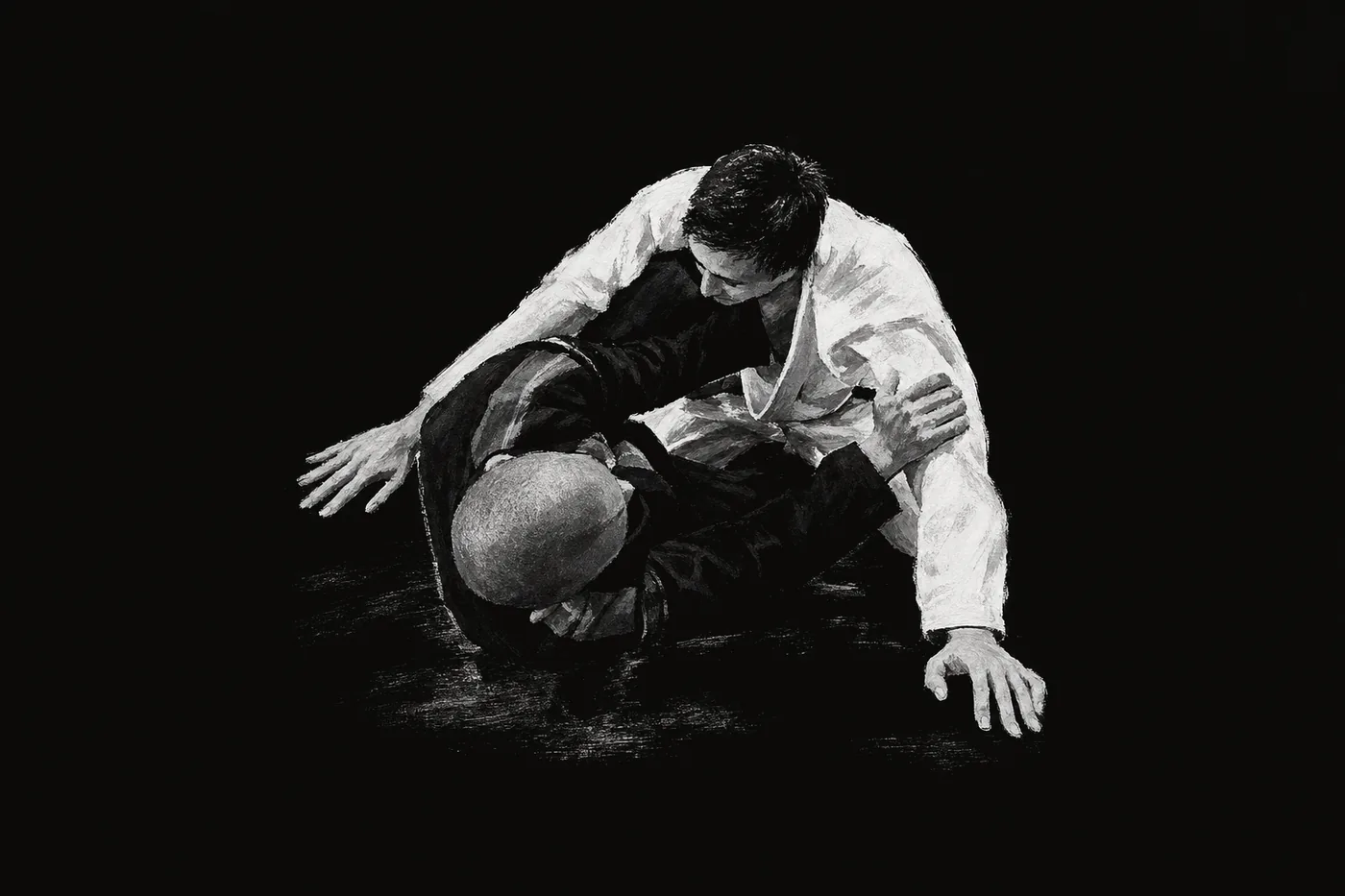
Learn / Jiu Jitsu / Systems / Sweeping from underhook half guard when they whizzer, in the gi
Half Guard · sweep it · gi
Sweeping from underhook half guard when they whizzer, in the gi
This is the gi system. The gi version has its own clips and its own spine.
Come up with the knee out and his leg hooked and squeezed, the underhook hand on his hip, the free hand to his far knee, twist his trapped leg back with your head in his chest and your hip forward, land with the hook and the hip, step the leg out, the collar, side control. You win the underhook in half guard and come up, and his whizzer stops you: you cannot reach his back and you cannot finish the sweep. The spine below is Lucas Leite's dogfight sweep in the gi, one coach and one route in his own orientation: come up to your knees with the knee out and his leg hooked and squeezed between your knees, the underhook hand on his hip bone and the free hand posted then on his far knee, then the twist, your foot hooked under his shin bringing his trapped leg back while your head pushes into his chest and your hip comes forward, the landing with the hip and the hook on so he cannot close a guard, the leg stepped out, his collar, and side control held three seconds. His back take when the man turtles, the no-whizzer back take, Tinoco's high underhook, O'Conaill's tackle and roll back, the knee tap, the slide down the leg, the roll under, Lister's ankle sweep and the entry from the knee shield are references from their own set-ups. Thirteen gi clips and three no-gi ones for the principles, every no-gi cue marked, transcripts read and cited to the transcript chunk, one orientation written out below.
Key takeaways
- Success means On top in side control, his leg out and the collar in hand, held three seconds.
- The spine is 5 steps after the gate, come up to your knees with the right knee out, the hook kept, and squeeze his leg, the hands: the underhook hand on his hip bone, the right hand posted, then to his far knee, the twist: your hook brings his shin back, your head pushes his chest, your hip comes forward, land and keep the pressure: hip and hook, so he cannot close a guard, step the leg back out, take his collar, and hold side control.
- When it breaks there are 8 named branches; learn the triggers, the responses are short.
- Evidence: 16 clips from 12 channels (6 clips from a coach's own channel, 6 from a gym's, 4 from an instructional publisher's), every timestamp checked against the spoken transcript. Sentences marked synthesis are the editors', not a coach's.
the whizzer closes the back, not the sweep
You have the underhook and have come up; his arm is over yours, clamping it, and your head cannot get behind him. Leite's frame for the position: with the underhook he wants the back, and the whizzer is the top man's natural answer that closes it; so the dogfight is where he goes, and the sweep is what the whizzer gives him. O'Conaill's version: identify whizzer or no whizzer, because everything from the dogfight depends on that one variable. Tinoco's rule is the same from the other end: most of the time whoever has the underhook wins the battle, and the whizzer is how the top man stops the underhook going round.
 0:41Lucas Leite · BJJ Fanaticsginow he knows I want to go to his back, so he is going to work the whizzer; I try to go to his back, I cannot because I have the whizzer; so we are going to go to the dog fight position
 1:02Darragh O'Conaillgidoes he have the over hook, people call this a whizzer; whizzer or no whizzer: if he does not have the whizzer we act a certain way, if he does we act a different way
 2:04Marcos Tinoco · BIG OSSgiwhoever has the underhook wins the battle most of the time; I have the underhook but he stopped me
his leg stays between your knees, hooked
His right leg trapped between your legs with your left foot hooked under his shin, kept there as you come up, and squeezed; the knee comes out, the foot does not. The whole sweep runs through his trapped leg. Leite's teaching drill is to forget the sweep and keep the leg: bring the knee out to base, never the foot, and squeeze so that when he tries to kick the leg out like a dog it stays; his Budo Videos words for the hook are find his ankle, slide the other hook, bring his ankle to your butt. O'Conaill calls the same thing the knee torque and warns against reaching for the sweep and losing control of the leg.
1:02Lucas Leite · BJJ Fanaticsgiwatch how I bring my knee out; it is very common people want to take that foot from between his legs; no, do not worry about your foot, worry just about your knee; and once I am doing that I need to squeeze; try to kick your leg out like a dog 16:30Lucas Leite · Budo Videosgiyou see how I open my hip for my ankle; find his ankle; now I slide another hook; very important, I bring my ankle to my butt, create the knee pressure here15:08Lucas Leite · Budo Videosgithe first position, I want to keep his legs between my legs; a good drill: do not worry about the sweep, worry about get here and control from here, try to escape your legs6:43Darragh O'Conaillgiwe do not want to just reach, try to roll them and lose control of the leg; if I can keep this leg hooked the whole way through
the sweep is a twist, not a lift
His trapped leg brought back by your hook while your head and hip drive forward: the knee is turned, and he falls over it. Leite does not lift him; he twists the trapped knee by bringing his own leg back and coming forward with the hip, and the man falls because his base leg is turned. The Budo Videos host, feeling it, names it from the other side: balanced until the knee is torqued out, then no balance at all. Leite's own history for it, told to Faria, is the Gordo hook switch that Leo Vieira showed him, and his own detail is that bending his knee makes the inside rotation easy to torque.
2:05Lucas Leite · BJJ Fanaticsgihold his knee; I am going to twist and bring his leg back and come forward with my hip19:27Lucas Leite · Budo Videosgithe Budo Videos host, from under the sweep: the very unique thing Lucas is doing is the footwork, the torquing of the knee; here I am pretty balanced, but when my knee is torqued out like this I lose all balance 3:10Lucas Leite · Bernardo Faria BJJ Fanaticsgibecause I have the hook behind his heel, behind his shin, I will bend his knee and turn my hip to the other side; when I bend his knee it is easier for me to torque the inside rotation4:13Lucas Leite · Bernardo Faria BJJ FanaticsgiGordo was one of the first ones that I saw; Leo told me about Gordo: using the underhook and instead just keeping the figure four, switching the hook, inside hip rotation
the landing is not the end
On top with your hip pressure and your hook still on, so he cannot close a guard; then the leg out, the collar, side control. Leite says it himself: once he lands he does not stop the sweep there; he keeps pressure with the hip and the hook, steps the leg back, takes the collar and settles side control, and if the man turns to turtle the back is there. synthesis The three-second hold in side control is this document's test; Leite lands and settles, and does not count.
2:05Lucas Leite · BJJ Fanaticsgionce I land I do not stop my sweep right here; he does not have guard, he tries to face me; I still put pressure with my hip and my hook; then I step that leg back, go on his collar and get on the side control3:32Lucas Leite · BJJ Fanaticsgiwhen I fall here I keep my hip, put a lot of pressure with my hip so he does not try to close the guard; step out, controlsuccess means
synthesis Side control held: your chest on his chest on his right side, your right hand on his collar, both your legs out from his legs, your hips heavy, and nothing happening for three seconds (the count is the session's test, the author's; the stills show Leite settled there for about four seconds while he talks). Landing on top with his leg still between yours is not the endpoint; him turned to turtle is B1, a reference; the whizzer released to post that stops the twist is a reset. B2 to B7 end where their coaches end them and do not claim this position.
the situation
You are on your right side in half guard with his right leg between your legs and your left foot hooked under his shin; you have the underhook, your left arm under his right armpit, and he has answered it with the whizzer, his right arm over your left arm; you are not yet flat under a crossface, he is not cross body, he has not caught your sleeve, and you have not yet come up (the come-up is step 1); the knee shield fight that wins the underhook and the hook switch itself are the entry and another document's, and the back take when he has no whizzer is a branch
the endpoint
Side control on his right side: you on top with your chest on his chest, your right hand on his collar, both your legs out from his legs, held for three seconds; the count is the session's test, the author's; the stills show Leite settled there for about four seconds at 2:31 to 2:34 while he talks; the second rep keeps the leg hooked through 3:44 to 3:49 and is not cited for the endpoint
you start with
- Your left underhook
- Your left foot hooked under his right shin
not solved here · cooperative resets
- The crossface or cross body before you are up (the flattened half guard, another document)
- The no-whizzer back take and the whizzer released to post (B2, a reference; a reset when it stops the twist)
- Your posting sleeve caught (no grip break is installed; a reset)
- The standing scramble (a reset)
- The darce, the guillotine and the whizzer cranked on the shoulder (taps)
- The knee loaded sideways with his foot fixed (a stop)
Sides. One orientation throughout, Leite's own, mirrored when you play the other side: you are on your right side; his right leg is between your legs with your left leg over his thigh, your left foot hooked under his right shin at the ankle and your right leg under his leg; your left arm is the underhook under his right armpit with the hand on his back at the hip bone; his right arm is the whizzer over your left arm; your head is under his chin against his right chest; your right knee comes out to base and your left knee squeezes his leg; your right hand posts and then holds his far (left) knee; the twist is your left foot hook bringing his right shin back and up while your head pushes into his chest and your hips come forward; he falls to his back and you land on his right side on your right knee with your left leg still hooked and your left arm still under his arm; your left leg steps back out and your right hand takes his collar; side control on his right side. Leite speaks in my hooks, my knee, my foot, squeeze, his knee, his hip bone, my head, my hip, my leg back, that leg back, his collar; which arm, which leg and which side are read from stills of his clip, and the limitations say so.
what it is worth
The sweep scores 2 once you have inverted the position from guard or half guard and kept him on the bottom for 3 seconds (article 4.6.1); that is the endpoint. If he turns to all fours as you sweep and you control his back without hooks for 3 seconds with a knee of his on the ground, that is also 2 (4.6.2), which is what O'Conaill means when he calls the rolled-away turtle a sweep. The back after it, with the hooks, is 4 (4.5). A sweep that unbalances him and reaches the top without 3 seconds of stability is an advantage (5.6.6). None of this is a referee's call in training: the session's success is side control held and counted.
Article 4.6.1: the athlete on bottom with the opponent in guard or half guard inverts the position and maintains the opponent on the bottom for 3 seconds; 4.6.2: the opponent turns to all fours and the athlete who initiated the reversal controls the back without hooks, keeping at least one of the opponent's knees on the ground for 3 seconds; 4.5: back control with the heels between the thighs, legs not crossed, at most one arm trapped and not above the shoulder line, 3 seconds; 5.6.6: an advantage when the athlete unbalances the opponent through a sweep attempt and reaches top position but cannot stabilise it for 3 seconds
Source: IBJJF Rules Book v6.1 2024 (the current PDF from ibjjf.com/books-videos, read from the ligabjj.com mirror), articles 4.5, 4.6.1, 4.6.2, 5.6.6; read 2026-09-10
— the spine · learn this week
Lucas Leite's dogfight sweep
One coach's route from the whizzer on to side control held, in his own orientation: on your right side with the left underhook and your left foot hooked under his right shin, his right leg between your legs; the right knee out and the squeeze with the head under his chin, the left hand on his hip bone and the right hand posted then on his far knee, the twist with the hook bringing his shin back and the head and hip forward, the landing with the hook and the hip, the left leg out, the collar, side control. Step 3 is the sweep and needs his weight on the trapped leg; the session names the resets when he releases the whizzer to post or stands. O'Conaill, Tinoco and Giles supply checks on what the position is and why the details matter, never a step; the other routes are branches from their own set-ups.
-
GATE
Read it: the underhook is in, his leg is hooked between yours, and his whizzer closes the back
You are on your right side in half guard with his right leg between your legs, your left leg over his thigh and your left foot hooked under his right shin; your left arm is under his right armpit with the hand on his back at the hip; his right arm has come over your left arm and clamped it. The back is closed; the dogfight is the answer.
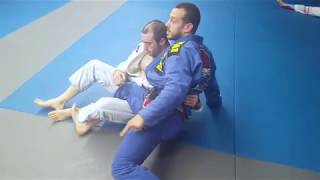
This is the position after you have won the underhook and he has answered it. At 0:41 to 0:48 Leite is on his right side under the partner: his left arm under the partner's right armpit with the hand gripping the partner's belt at the back; the partner's right leg between Leite's legs, Leite's left leg over the partner's right thigh and his left foot hooked under the partner's right shin at the ankle, his right leg beneath the partner's leg; the partner's right arm coming over Leite's left arm as the whizzer; Leite's head under the partner's chin against his chest (.frames/z-start-y1gHcs4aic8-1..2.png and .frames/legs-y1gHcs4aic8-1..3.png). The hook is the one he calls switching the hooks: the outside foot comes to the inside and hooks his ankle, and his ankle is brought toward your butt. He tries the back first and the whizzer stops him; that is the read: whizzer on, so the dogfight, not the back. synthesis The knee shield and the underhook fight that come before this, and the hook switch itself, are the entry (B7), not this document's start: the session begins with the hook already on.
0:20Lucas Leite · BJJ Fanaticsgiagain I am going to switch my hooks, one, and slide another arm and really bring me; but now he knows I want to go to his back, so he is going to work the whizzer0:41Lucas Leite · BJJ FanaticsgiI try to go to his back, I cannot because I have the whizzer; so what are we going to do, we are going to go to the dog fight position16:30Lucas Leite · Budo Videosgifind his ankle; now I slide another hook; very important, I bring my ankle to my butt, create the knee pressure here -
1
Come up to your knees with the right knee out, the hook kept, and squeeze his leg
Bring your right knee out and come up onto both knees with your right hand posted; his right leg stays hooked between your legs, your left foot still under his shin and your knees squeezing; the foot does not come out. Your head stays under his chin against his right chest.
Watch the knee, not the foot. Leite brings his right knee out, posts his right hand and comes up onto his knees with the partner's right leg still hooked between his legs (1:00 to 1:08 in the stills, .frames/legs-y1gHcs4aic8-4..7.png at half seconds: at 1:04.5 to 1:06 the right knee comes out and the right hand posts while the partner's right foot, lifted off the mat, stays caught behind Leite's left foot; at 1:06.5 to 1:08 he is on both knees at the partner's right side, the partner's right leg between his knees, his left arm still under the partner's right arm with the hand on the partner's back, his head under the partner's chin against the partner's right chest). The common mistake is trying to pull the foot out from between his legs; do not worry about the foot, worry about the knee, and once you are up, squeeze. That squeeze is the position: he calls it dog fight because he stays on the leg like a dog, and you can train it at home by asking your partner to kick the leg out. If you relax, he kicks out and the position is gone.
1:02Lucas Leite · BJJ Fanaticsgiwatch how I am going to bring my knee out; I am going to go on my knees; it is very common people want to take that foot from between his legs; no, worry just about your knee, and once I am doing that I need to squeeze; try to kick your leg out like a dog1:24Lucas Leite · BJJ Fanaticsgiyou stay high, try kick, you can train at home: you get on the dog fight and you ask your friend to try to escape your leg; if you are relaxing here he is going to kick out on you and you lose the position3:10Lucas Leite · BJJ FanaticsgiI try to go to his back but he has the whizzer; so do not try to bring your foot out, just bring your knee out and squeeze -
2
The hands: the underhook hand on his hip bone, the right hand posted, then to his far knee
Your left hand, the underhook, holds his hip bone at his back; your right hand stays posted on the mat for base and, just before the twist, goes to his far knee.
Two hands, two jobs. The underhook hand, your left, is on his back at the hip: Leite shows it in the second rep and says watch my hand right here on his hip bone (3:20.5 to 3:21.5, .frames/hands2-y1gHcs4aic8-1.png). The right hand is posted on the mat for base from the come-up through the dogfight (1:05 to 2:05; 3:20 to 3:29, .frames/hands2-y1gHcs4aic8-1..3.png), and only as the twist begins does it leave the mat for his far knee, the left: at 2:05 to 2:08.5 it reaches down and holds the partner's left knee (.frames/head-y1gHcs4aic8-1..2.png), and at 3:29 to 3:31 it comes off the mat toward the knee in the second rep (.frames/hands2-y1gHcs4aic8-3..4.png). Leite's words are hold his knee and, sometimes, block his knee, and at 3:10 that he cannot make a grip or just holds, as in no-gi, your option. synthesis Whether his right hand closes on the pants at the knee or stays open is not settled by the stills; the open hand on his knee in the session is the author's choice.
3:10Lucas Leite · BJJ Fanaticsgiwatch my hand right here on his hip bone; I cannot make a grip, or I just hold, as in no-gi, it is your option; control his knee1:44Lucas Leite · BJJ Fanaticsgiso once you are here you need to make sure you are going to use a lot of squeezing; sometimes I even block his knee; but let us use the hand to have a better base; and right here on the dog fight2:05Lucas Leite · BJJ FanaticsgiI am going to hold his knee -
3
The twist: your hook brings his shin back, your head pushes his chest, your hip comes forward
Hold his far knee; your left foot, hooked under his right shin, brings his leg back and up, twisting the knee, while your head pushes into his chest and your hips come forward; he falls over the turned leg onto his back.
Now the sweep. Hold his knee, and twist: your left leg, hooked under his right shin, brings his leg back and up while you push into his chest with your head and come forward with your hip (2:05 to 2:11.5 in the stills at half seconds, .frames/head-y1gHcs4aic8-1..3.png and .frames/z-sweep-y1gHcs4aic8-1..3.png: the head is under the partner's chin against his right chest through 2:04 to 2:09; at 2:09 to 2:09.5 the partner's right foot lifts as Leite drives; at 2:10 to 2:11.5 the partner goes over onto his back and Leite comes with him; 3:31 to 3:35 from the second angle, .frames/rep2-y1gHcs4aic8-5.png). Leite says it plainly in the second rep: push him with the head and bring the leg back, twisting his knee. He does not lift and he does not dive; the man falls because his base leg is turned. The third cue is the Budo Videos host's, felt from underneath, not Leite's.
2:05Lucas Leite · BJJ FanaticsgiI am going to hold his knee, and look, I am going to twist and bring his leg back and come forward with my hip3:32Lucas Leite · BJJ Fanaticsgiit is very important you understand how I am pushing him with my head and bring my leg back, twisting his knee19:27Lucas Leite · Budo Videosgithe Budo Videos host, from under the sweep: the footwork, the torquing of the knee; when my knee is torqued out like this I lose all balance -
4
Land and keep the pressure: hip and hook, so he cannot close a guard
You land on his right side, on your right knee, your left leg still hooked with his right leg and your left arm still under his right arm; keep the hip pressure and the hook until he cannot face you or close a guard.
Do not stop the sweep at the landing. At 2:12 to 2:23 (.frames/z-land-y1gHcs4aic8-1..2.png) Leite is on top on the partner's right side, on his right knee, his left leg still hooked with the partner's right leg (the partner's right foot up beside Leite's left foot), his left arm still under the partner's right arm, his right hand at the partner's belt and hip. The partner has no guard and tries to face him; Leite keeps the pressure with his hip and with the hook, so the guard cannot close. In the second rep he says why: when I fall here I keep my hip, a lot of pressure with the hip, so he does not try to close the guard.
2:05Lucas Leite · BJJ Fanaticsgionce I land I do not stop my sweep right here; that is why I like the sweep; he does not have guard, he tries to face me, I still put pressure with my hip and my hook3:32Lucas Leite · BJJ Fanaticsgiwhen I fall here I keep my hip, put a lot of pressure with my hip so he does not try to close the guard -
5
Step the leg back out, take his collar, and hold side control
Step your left leg back out of his legs, go to his collar with your right hand and settle side control on his right side; hold it three seconds.
Now the finish. Step the left leg back out of the entanglement (2:25, the leg swinging up and back, .frames/z-land-y1gHcs4aic8-2..3.png), go to his collar with the right hand and come down into side control on his right side, your chest on his chest (2:26 to 2:34, .frames/z-side-y1gHcs4aic8-1..2.png: the right hand on the collar at 2:28 to 2:30, side control settled with both legs out at 2:31 to 2:34, about four seconds while he talks). Hold it and count three. synthesis The count is the session's test, the author's; Leite settles and talks and does not count. In the second rep the leg is still hooked through 3:44 to 3:49 and only starts to step out at 3:51 before the partner turns to turtle, so that rep is not cited for the endpoint. What he does when the man turns to turtle is B1, his own continuation, and not the endpoint.
— grip notes
- Which arm, which leg, which knee, and what was read from the footage.
Leite says my hooks, my knee, my foot, squeeze, his knee, his hip bone, my hip, my head, my leg back, that leg back, his collar. The stills add which: you are on your right side (0:41 to 0:50); the underhook is your left arm under his right armpit with the hand on his back at the hip, and the whizzer is his right arm over it; his right leg is the leg between your legs, your left leg over his thigh and your left foot hooked under his right shin at the ankle, your right leg beneath (0:43 to 0:48; 1:04.5 to 1:08); your head is under his chin against his right chest from the come-up through the twist (1:06 to 1:08; 2:04 to 2:09); the knee that comes out to base is your right and the hand that posts is your right (1:04.5 to 1:08); the right hand goes to his far knee as the twist begins (2:05 to 2:08.5; 3:29 to 3:31) while the left hand is on his hip bone (3:20.5 to 3:21.5); the hook that brings his leg back is your left foot (2:09 to 2:11.5); you land on his right side on your right knee (2:12 to 2:23); the left leg steps out and the right hand takes the collar (2:25 to 2:30). The convention: a step marked transcript reproduces the cited speech; a step marked frames reproduces the speech and adds those assignments, read from 1080p stills at one-second steps through both reps (0:41 to 2:50 and 2:50 to 3:53, .frames/route-y1gHcs4aic8-*.png and .frames/rep2-y1gHcs4aic8-*.png) and at half seconds through the legs at the start and the come-up, the head and hands at the twist, and the hands in the second rep (.frames/legs-, head- and hands2-y1gHcs4aic8-*.png). The stills settle which hand and which leg are where at the sampled moments and the order, not the pressure and not the moments between samples; a side the reviewer reads differently is adopted, and was in round 2 (the two hands' jobs and the second rep's endpoint interval).
- The free hand and the underhook hand, gi or no-gi.
The underhook hand stays on his back at the hip bone; Leite points to it in the second rep. The right hand posts for base and leaves the mat for his far knee only as the twist begins; Leite says hold his knee and sometimes block his knee, and that in no-gi he cannot make a grip there and just holds. O'Conaill's version of the free hand in the dogfight is to bring his legs together with a pant grip or a reach under the leg while driving; that is his tackle, a reference (B4), not this route. synthesis Whether Leite's right hand closes on the pants at the knee is not settled by the stills; the open hand on the knee in the session is the author's choice.
3:10Lucas Leite · BJJ Fanaticsgiwatch my hand right here on his hip bone; I cannot make a grip, or I just hold, as in no-gi, it is your option; control his knee2:03Darragh O'ConaillgiI am using my free arm to try to bring his legs together, try to get a double leg; this could happen via an underhook on the leg, pulling his hips in, from a pant grip, or my hand could be free and then I reach
— when the spine breaks
8 branches
Each one names the trigger you will feel, then the response. Learn the triggers; the responses are short.
- After the sweep he turns to turtle rather than stay under side controlreference onlythe back, in Leite's own words: knee on the hip, the bottom hook, the top hook, the choke; his own end
Leite says that from his side control the man's only option is to turn to the turtle, and that gives him the back: knee on the hip, the bottom hook in, the top hook, and a choke (2:34 to 2:43; 3:50 to 3:53). It is the same finish he prefers in the Budo Videos clip, where one sweep wins the match because he lands in a better spot and sometimes lets the man turn to work the back. synthesis The hooks and the choke are not read contact by contact here (2:34 to 2:43 is a wide shot at speed), so this is a reference: the endpoint is side control held, and the turtle after it is another night.
2:25Lucas Leite · BJJ Fanaticsgithis position, the only option that he has is to go on the turtle; so knee on the hip, bottom hook, and I am in the back again3:53Lucas Leite · BJJ Fanaticsgihe turns, knee on his hip, bottom hook in, top hook, choke15:49Lucas Leite · Budo VideosgiI like this position because when I sweep he tries to recover; control the hips here; sometimes I let him turn but work the back attack; one sweep makes me win the match because I land in a better spot- You come up and there is no whizzer, or he lets the whizzer go to post that handreference onlythe back, from the dogfight without a whizzer, in O'Conaill's and Leite's words; their own ends
If he does not whizzer, or takes the whizzer arm out to post it, the back is open. O'Conaill's rule is to identify it at once: with the knee torque still on his leg, the near hook goes in and you climb, and even if he stays tight, the knee drives in and the hook follows. Leite shows the same door in the gi: without the whizzer he already has one hook, kicks it to the back and enters the next position; and when the man lets the whizzer go after the sweep is started, the leg comes inside and he swings to the back. Lister calls it a game of who can put the arm in and out faster. synthesis Sides and hooks are not read from stills for either coach; a reference, and the session's partner keeps the whizzer on. A post with his free hand is not this branch: in Leite's first rep the partner's free left hand is on the mat throughout and the twist goes through it.
 1:01Darragh O'Conaillgias soon as he does not have the whizzer his back is open; we want to go for the near hook, the side I am on1:43Darragh O'ConaillgiI have the knee torque, no whizzer, lots of space: put your hook in and then climb; if it is tight, not as much space for the hook, lots of space for my knee to drive in6:01Darragh O'Conaillgiwe can just work back and forth: in the dog fight your main goal is identify the whizzer or no whizzer5:18Darragh O'Conaillgior it makes him take the whizzer out and post the hand, and then we can look to take his back20:10Lucas Leite · Budo Videosgiif he does not have the whizzer I already have one hook, kick here on the back, and that already makes me enter the next position21:17Lucas Leite · Budo Videosgionce I am here he already let go the whizzer; I keep the pressure; I bring my leg inside and now I swing to the back, push the back, escaping my hip
 2:47Dean Lister · Gold BJJgiif they are whizzering me, we sweep them; if they take their arm out, I can go to their back; who can put their arm in and out faster
- His whizzer is heavy and he pushes your head away; you cannot go round and you cannot start the twistreference onlyTinoco's high underhook: cap his shoulder, make his hands busy, switch the hook, step up, and make him give up the whizzer; then the back; his own end
Tinoco's answer to the whizzer that stops you is to change where the underhook is. Going low on the hook is what lets him stop you and push your head away; go high instead and cap his shoulder, so that when he pushes your head you bump him and keep his hands busy. Then switch the hook on his legs without going over your own line, bring the foot inside, pick his foot off the mat, take the bottom leg out and build up on your base, stepping the free leg up. Connect a gable grip and put weight on that shoulder until he gives up the whizzer; knee in front, the first hook, the second hook, the back. synthesis His sides and the hook switch are not read from stills here; a reference, and the reason a heavy whizzer is a reset tonight rather than a fight.
1:22Marcos Tinoco · BIG OSSgionce I sit up he blocks me with the whizzer and pushes my head away, does not let me go around, and now he can re-pummel and flatten me2:25Marcos Tinoco · BIG OSSgiinstead I am going to go high on the hook; go all the way and cap the shoulders, it does not matter how strong he is3:05Marcos Tinoco · BIG OSSgiif you try to push my head, I bump him and keep his hands busy3:48Marcos Tinoco · BIG OSSgiswitch my hook; I do not want to go over my line and get stuck; place my foot as a hook, bring my foot inside, pick his foot off the mat, take my bottom leg out, build up on my base4:31Marcos Tinoco · BIG OSSgiconnect a gable grip, put weight, force him to give up on the whizzer; so much pressure on the shoulder5:15Marcos Tinoco · BIG OSSgiI place my first hook, I turn him, bring my second hook in; peel off his arm and go for the rear naked- He whizzers and keeps his base against your drive: you cannot run him overreference onlyO'Conaill's roll back: the knee torque lifts his knee off the mat, you fall to your shoulder and put your hips under his knee, a shelf, and you reach the top with him underneath, or he takes the whizzer out to post and gives the back; his own end
O'Conaill's two answers to the whizzer are the tackle and the roll back. The tackle is persistence: drive into him, bring his legs together, keep walking, and eventually someone caves, or they cave right away. The roll back is the accurate one: with the knee torque, get his knee off the mat, then fall to your shoulder and drop your hips under his knee so you have made a shelf; from there you sweep him all the way to the top and he lands underneath, or he takes the whizzer out to post the hand, and the back is there. He warns against diving under recklessly and losing the leg work. synthesis Neither the tackle nor the roll is read from stills here; both are references from the same door as Leite's twist, and the session plays Leite's route only.
2:03Darragh O'Conaillgionce he has the whizzer I cannot go to his back; the basic interplay will be working to drive into him, bring his legs together2:46Darragh O'Conaillgiwe can also try to roll in the other direction, because he has his arm locked up here, so he has no base underneath; his arm is stuck3:26Darragh O'Conaillgitackling over is usually quite easy through persistence: you keep your weight in and eventually someone can cave, or they cave right away; what is more tricky is rolling back; you do not want to just make a big round and dive underneath4:28Darragh O'ConaillgiI drop my hips in underneath his knee; I lift his knee, I fall to my shoulder and drop my hips underneath, so now I have made a shelf5:18Darragh O'Conaillgieither bring me right to sweep him all the way to the top, or it makes him take the whizzer out and post the hand, and then we look to take his back- The same dogfight, other coaches' sweeps from it: the knee tap, the slide down the leg, the roll underreference onlyside control, or the top beside his turtle with the back exposed, in their own words; their own ends
The knee tap, from Gracie Barra Roundhay's coach, who gives his name as Mike Coachley in the clip: low on the underhook so the whizzer is hard to take, the hip connection, the elbow hidden so a sleeve cannot be caught, dive through under to the far knee, block it and drive forward, re-grip the top knee to pin both knees, run round toward the back. Ross Nicholls, no-gi: come up, the lower grapevine leg off and the other leg over, straighten his back leg so the knee is light, slide backwards down the leg until your head is level with his hip, push sideways, step over into side control; if he readjusts his base, roll under him with the hand through under his shin; if he posts the hand as you roll, bounce back up to the top beside his turtle with the back exposed, and the back take is the work after that. The roll-under from Next Generation Martial Arts, gi, coach not named, has its own set-up and its own condition: he does not let the man trap his arm but traps the man's arm, regulating whether the whizzer can come in, and the sweep only works if the man is driving into him hard; then he dives everything under as if forward rolling over his shoulder and hugs the far leg. An already clamped whizzer, wrenched down onto the shoulder, is the position he says he does not want to have to recover from, and without the man's drive there is no dive. McCaghren, no-gi: go down his body until your shoulder is under his hip and he turns himself with his own weight. synthesis None of these has its sides read from stills; references from the same door.
 1:28Mike Coachley (as heard in the clip) · Gracie Barra Roundhay Leedsgiwhen I get to this position the risk is that our opponent can grab my sleeve here and stop me coming up, so as soon as I get here I hide my elbow2:10Mike Coachley (as heard in the clip) · Gracie Barra Roundhay Leedsgione leg in the middle covering my opponent's shin, chopping that leg; I have the advantage because I have the hip connection; because I am so low it is very hard for my opponent to take a whizzer here2:31Mike Coachley (as heard in the clip) · Gracie Barra Roundhay Leedsgiknee tap sweep; I dive through underneath, I am hunting for this far knee; we just need to block that knee; now I drive forward3:12Mike Coachley (as heard in the clip) · Gracie Barra Roundhay Leedsgiwherever my opponent's hip goes I will follow; dive through, knees right forward, take him down, keep my grips3:33Mike Coachley (as heard in the clip) · Gracie Barra Roundhay Leedsgire-grip to the top knee, that pins both of his knees to the floor, and I run round towards the back
 1:42Ross Nicholls · London Grappleno-gino-gi: the footwork at the back is key: my lower grapevine leg will come off and my left leg will step over; I drag his leg straight, so when I get up this knee will be light2:25Ross Nicholls · London Grappleno-gino-gi: I move backwards a long way so my head is level with the hip and I push sideways into them, getting their hips to drop; this leg will step over and I take side control4:11Ross Nicholls · London Grappleno-gino-gi: I fall forward, roll underneath them; this hand goes through under the shin and I open the hip as I roll4:52Ross Nicholls · London Grappleno-gino-gi: when we roll, this hand will come out and they will base; the moment we hear that hand hit, bounce back up and start looking at the threat in the back5:12Ross Nicholls · London Grappleno-gino-gi: because he has had to extract his whizzer his back is now open; so now we are finishing in turtle instead of side control
 0:21Next Generation Martial Arts, Thibodaux (coach not named)githe sweep is going to rely on me being able to push into him enough that he has to drive into me pretty hard; if he is not pushing into me hard enough the sweep will not work1:46Next Generation Martial Arts, Thibodaux (coach not named)giif I let him get the over hook, the whizzer, it allows me to trap his arm; if he has got it, then my arm is trapped; I do not let him trap my arm, I trap his arm2:06Next Generation Martial Arts, Thibodaux (coach not named)giif I gave him too much space and now he wrenches this down and he is heavy on my shoulder, now I am stuck, now I am in the bad position; I do not want to have to recover from this2:48Next Generation Martial Arts, Thibodaux (coach not named)githe sweep is going to happen because he is pushing into me; whenever I decide it is time to go, I dive everything underneath him as if I am doing a forward roll over my right shoulder and my right arm hugs his far leg
 0:21Brandon McCaghrenno-gino-gi: as he puts the pressure down on the whizzer I start to go down his body; I am looking to get my shoulder down here under his hip0:41Brandon McCaghrenno-gino-gi: as I go down the body look how easy it is to turn him; he turns himself with his weight
- He whizzers and bears down, and you are still on your side rather than up on your kneesreference onlyDean Lister's ankle sweep: hold his ankle, scoot under and take him over; and the hook shot to the back if his arms go to the ground; his own end
Lister, in the gi: when the man has a good whizzer and is bearing down, hold the belt, hold under, or better his ankle (not behind the hamstring, because if he sits back on it you are stuck), scoot in and take him right over; if he takes the arm out to stop it, the hook shot to the back is there, and it becomes a game of who puts the arm in and out faster, harder for him in the gi. synthesis Sides and the ankle hand are not read from stills; a reference.
0:44Dean Lister · Gold BJJgiI am going to hold the belt, I am going to hold under, I prefer to hold the ankle; the reason I do not reach behind the hamstring is if he sits back on it you might be stuck; when I scoot in, I take him right over1:45Dean Lister · Gold BJJginow I cannot go to his back, this is blocking me; so I hold the ankle, scoot under and take him right over; as he goes I take my leg out if I can, if not I am in the half guard2:47Dean Lister · Gold BJJgiif they are whizzering me, we sweep them; if they take their arm out, I can go to their back; who can put their arm in and out faster- One step earlier: you have the knee shield, not yet the underhook, or the underhook without the hook switch and the come-upreference onlythe come-up to the dogfight in Giles's, O'Conaill's, Leite's and Faria's words; their own ends
Giles's entry, gi: a high knee shield, hook the leg, sit up and reach under your own leg elbow first for the underhook, and take it high, because a low underhook is what lets him go cross body; then around the corner, posting on the hand and the elbow with the leg scooting round, attach to the far hip, and once round the corner be tight and drive the chest forward; change feet so the leg that traps his is the one that lets you drive, drag his foot to your butt, retract the other leg and come up; from the dogfight his main option is to keep the leg trapped, step up on the foot, head under his shoulder and circle in front as you drive. His class clip adds the reasons: the knee free at the right distance, the shoulder pulled back so the underhook has no gap, the foot used as a lever so his hips face away, the knee pointing up for the bridge, and his own rule that for his drive you get up on the foot, not the knee. O'Conaill's entry against the man who lifts a leg: toes up as he lifts, the same upper body, slide the heel down and scissor his leg to the mat while you swim in. Leite's own entry from the Budo Videos clip: block the underhook like MMA, sit up with the shoulder mattering more than the hand, hold his hip, bring his ankle to your butt, and then the drill of controlling before sweeping; his hook switch, the outside foot to the inside on his ankle, is the hook this document starts with. Faria's principle: from the knee shield keep two options, the underhook to the leg or the hip and the deep half under the leg, and use each to get the other. synthesis These are the entry and are references; sides are not read from stills here, and the session starts with the underhook and the hook already in. Giles's foot-up base belongs to his drive-through and is not a correction of Leite's two-knee base, which is what the spine uses.
 0:20Lachlan Giles · Absolute MMAgiwhen I have a high knee shield I can curl myself in and reach under my own leg to get the underhook; it is a battle for who underhooks first1:00Lachlan Giles · Absolute MMAgiwhen we underhook it should be high, because the worst thing that can happen is he goes cross body; if you reach around the waist, very easy to go cross body1:42Lachlan Giles · Absolute MMAgiget around the corner: posting on my hand, on my elbow, and my left leg scooting around2:23Lachlan Giles · Absolute MMAgionce you are around the corner, be tight; drive your chest forward; attached to those hips3:45Lachlan Giles · Absolute MMAgibefore we get up we want to change feet; drag the foot to my butt, so I have got some drive to get up4:25Lachlan Giles · Absolute MMAgiwhen I drag the foot, I can drive and retract my right leg; I drive, I can come up; now I am in the dog fight position4:45Lachlan Giles · Absolute MMAgimain one is just drive through them; I keep his leg trapped, I step up on my right leg, I put my head under the shoulder to lift his shoulder up, and I circle in front as I drive
 1:17Lachlan Giles · Absolute MMAgimy hips are as far away as possible and I am on my side; my knee should be free; if your knee gets trapped this makes you stuck2:40Lachlan Giles · Absolute MMAgipummel the underhook; make sure my shoulder: I am pulling back with my right arm, pushing my shoulder so there is no gap4:32Lachlan Giles · Absolute MMAgiI use this foot as a lever, I pull and his hips start to face away; that makes him not be able to put pressure on me5:36Lachlan Giles · Absolute MMAgiI need to have my knee pointing up and driving off that leg; get up on this foot, do not get up onto your knee, they can drive you back over
 0:21Darragh O'Conaillgihis knee is on the mat, my toes are down; when he lifts his leg my toes go up; the same work with my upper body, reaching underneath my knee and pummeling in1:01Darragh O'Conaillgislide your heel down, squat down, take his heel, then start scissoring, forcing his leg to the mat, and I am safely in on the underhook14:05Lucas Leite · Budo VideosgiI defend that; now I create the space with my leg to sit up; more important than my hand is my shoulder14:25Lucas Leite · Budo VideosgiI do not do a lazy underhook; look at my shoulder, more important than my hand is my shoulder14:47Lucas Leite · Budo Videosgiafter I involve his hip, do not worry about the grip, think about no-gi: I need to hold his hip; when I bring him I find his ankle and bring his ankle to my butt, coming outside
 1:20Bernardo Faria · Giancarlo Bodoni's channelgifrom the knee shield I have two options: the other hook going towards the leg or towards the hip, or the other hook under the leg into deep half2:21Bernardo Faria · Giancarlo Bodoni's channelgiwhen I try to go there he locks his elbow and I cannot get the underhook; I am going to get the other hook on the leg, my next option
- The cooperative resets: he flattens you with the crossface before you are up; he drives you back down off your knees; he kicks his leg out of the hook and the squeeze; he catches your posting sleeve; he stands up out of the dogfight; he lets the whizzer go to post and stays up; a choke or the whizzer crankedcooperative resetrestart from the start position, or stop
synthesis Seven ends that are not this document's. He gets cross body or the crossface before you are up on your knees: that is the flattened half guard, another document; reset. He drives you back down off your knees: hold the underhook and the hook, and if you are put back on your side, reset (Giles's lever and bridge are references, B7). He kicks his leg out of the hook and the squeeze: the position is gone; reset, and drill the squeeze (block 1). He catches the sleeve of your posting arm as you come up and holds it: no grip break is installed here, and Coachley's answer of hiding the elbow is a reference; reset. He stands up out of the dogfight: the standing scramble is another entry; reset. He lets the whizzer go to post that hand and stays up: the back is open and that is B2, a reference, not tonight's; reset. A darce, a guillotine or the whizzer cranked on your shoulder: tap, release, reset. A post with his free hand that does not stop the twist is not an end; the twist goes through it, as in Leite's first rep.
3:25Lachlan Giles · Absolute MMAgiif he just wants to keep his base and I am trying to drive him over, what have I got to actually do that; not much1:24Lucas Leite · BJJ Fanaticsgiif you are relaxing here he is going to kick out on you and then you lose the position1:28Mike Coachley (as heard in the clip) · Gracie Barra Roundhay Leedsgiour opponent can grab my sleeve here and stop me coming up; as soon as I get here I hide my elbow 0:42Lachlan Giles · Absolute MMAno-gino-gi: a high underhook is better for defence; if you go to the waist too early, he can drop that shoulder down and reach that arm through for the darce
— negate first
Threat map
Some of the clips on the left show the coach performing the attack; watch them once so you recognise it. The answer on the right is a spine step, a branch, or marked as synthesis.
- The darce and the guillotine as you come up
-
what they are doing
0:00Lachlan Giles · Absolute MMAno-gino-gi: for the darce he is going to come up and drop his right arm very deep, he has to drop his shoulder through; the other one is the guillotine, he swings this arm over the top, a little deeper, grabs the head1:03Lachlan Giles · Absolute MMAno-gino-gi: if I go to the waist early, he can drop that shoulder down and reach that arm through for the darce; if my arm is high he is going to find it hard to get to my head2:26Lachlan Giles · Absolute MMAno-gino-gi: head position: somewhere in front or really low is better; it is very hard to capture either of these if my head is here, I am tracking him3:30Lachlan Giles · Absolute MMAno-gino-gi: putting pressure on the knee; if I am able to trap his leg and really apply pressure to the knee I can often use that to still roll on top; it makes him face away18:45Lucas Leite · Budo Videosgiif you try the choke, you need to watch out with the choke; when you have confidence, you know where his hand is; forget the sweep, do not forget about the chokeyour answer
Recognise it: his whizzer arm dropping deep under your neck as you come up (the darce), or his other arm swinging over your head (the guillotine). Giles's four defences, taught no-gi: a high underhook rather than the waist, the head in front or very low, rolling under to make him post, and pressure on the knee so he faces away. Leite's own warning is that the choke is the thing to watch when you come up. synthesis In the session neither choke is attacked; a locked one is a tap, release, reset. The route's own answers are the head under his chin against his chest from the come-up on and the knee twist itself, which turns him away; the height of the underhook is Giles's rule for his own entry and is not a control this route installs.
- Cross body before you are up: the crossface and the flattening
-
what they are doing
1:00Lachlan Giles · Absolute MMAgithe worst thing that can happen right now is he goes cross body; when he goes cross body my underhook is squashed, it is really hard to bring him forward1:42Marcos Tinoco · BIG OSSginow he can re-pummel down the hook and flatten me down; a very common scenario when you play half guardyour answer
Recognise it: he drives his chest across you before you are on your knees and the underhook is squashed. Giles's rule for his entry is the high underhook and getting around the corner before going to the waist. synthesis Once you are flat under the crossface this is the flattened half guard document's problem, not this one's; reset.
- He drives you back down, or keeps his base against the drive
-
what they are doing
your answer
Recognise it: you are up but he is heavier, and a straight drive moves nothing, or he pushes you back down onto your side. The twist is the answer to a base that does not move (step 3): it turns his knee rather than pushing his chest, from Leite's base on both knees with the hook kept. synthesis If you are put back on your side, the rep resets; O'Conaill's roll back (B4) is the other answer and is a reference tonight. Giles's foot-up base belongs to his own drive-through (B7) and is not this route's correction.
- He kicks the leg out of your hook and squeeze
-
what they are doing
1:24Lucas Leite · BJJ Fanaticsgiyou ask your friend to try to escape your leg; if you are relaxing here he is going to kick out on you and then you lose the position6:43Darragh O'Conaillgiwe do not want to just reach, try to roll them and lose control of the leg; if I can keep this leg hooked the whole way throughyour answer
Recognise it: his trapped leg pulls free as you come up or as you twist. The hook under his shin, the knee out and the squeeze (step 1) are the whole answer, and Leite's drill for it is to let him try. synthesis A freed leg is a reset, not a chase.
- He lets the whizzer go to post, or stands up
-
what they are doing
2:06Dean Lister · Gold BJJgia guy who says, I am going to block him with the whizzer, and if he tries to sweep me I will put my hand on the ground; now we are at situation one5:18Darragh O'Conaillgior it makes him take the whizzer out and post the hand, and then we can look to take his back22:00Lucas Leite · Budo Videosgiif you post, I keep going into the sweep; I stretch my hip; sometimes I put my arm on his armpityour answer
Recognise it: as his knee turns he takes the whizzer arm out and posts it, and stays up; or his feet come under him and he stands. Every coach here says the whizzer taken out opens the back, and Leite keeps driving the sweep through a post. synthesis Neither is qualified in this document: the whizzer released to post, when it stops the twist, and a stand-up are resets tonight. A post with his free hand is the normal state of the dogfight (his free hand is on the mat in Leite's first rep) and is not a reset.
- He catches your posting sleeve as you come up
-
your answer
Recognise it: in the gi his free hand takes the sleeve of your right arm as it posts, and the come-up stalls. Coachley's answer is to hide the elbow as you arrive; Leite does not address it. synthesis No grip break is installed in this document: a held sleeve is a reset, and the partner in the session does not take it.
- The whizzer cranked on your shoulder
-
your answer
Recognise it: his whizzer arm wrenched down onto your underhooking shoulder with your arm clamped, the elbow lifted. The Next Generation coach names it as the position he does not want to recover from. synthesis That is a shoulder lock as much as a control: tap, release, reset; the session's partner keeps the whizzer at half pressure and never cranks it.
— 20 minutes · gi
Tonight
synthesis The session is the author's; the mechanics are Leite's, from one exact start: on your right side with the underhook in, his leg hooked between your legs and his whizzer on at half pressure. Every rep ends at the spine's endpoint, side control counted to three, or at a named reset; the first block emphasises the come-up and the squeeze but every rep in it runs to side control cooperatively; the whizzer is on from the start in every block; no other route is played, and the other coaches' routes are references. Two kinds of stop: the block's own reset, cooperative and named under each block, and the hard boundaries the scope lists (the crossface before you are up; the knee loaded with the foot fixed; a locked choke or a cranked whizzer; a caught sleeve; the whizzer released to post, or a stand-up), which stop everything; both restart only after the partner releases every control.
safety · stop here
No submission is attacked in this document. The twist turns his knee sideways by bringing his trapped leg back while his weight is on it: in the session the partner keeps his trapped foot free to turn, the twist is done at half speed, and a knee that loads while the foot is fixed is a stop at once. The darce and the guillotine that punish the come-up, and a whizzer cranked on the underhooking shoulder, are taps, never fought. The release rules are the author's.
- His knee loaded sideways by the twist with his foot fixed (step 3, every block). Half speed; the partner keeps the trapped foot free to turn; if the knee loads and the foot does not turn, stop at once and reset
- The darce or the guillotine as you come up (threats). Not attacked in the session; a locked one is a tap, release and reset
- The whizzer wrenched down onto your shoulder with the elbow lifted. The partner keeps the whizzer at half pressure; any shoulder pressure is a tap, release and reset
- The roll under and the roll back in the references (B4, B5). Not drilled; a foot left hooked while rolling is the knee hazard again
- 1
Up to the dogfight and the squeeze, then the sweep
5 minFrom the exact start, the whizzer already on at half pressure and his base kept. Bring the right knee out, post the right hand and come up to your knees with his right leg hooked and squeezed between your knees, the foot left where it is, your head under his chin against his chest, the left hand on his back at the hip. Say the two out loud: knee, squeeze. Then he tests it once, Leite's drill: he tries to kick his leg out like a dog, at half effort, and you hold. Then finish the route cooperatively at half speed: the right hand off the mat to his far knee, the twist (the left foot brings his shin back and up, head into his chest, hip forward), land on his right side with the hip and the hook, step the left leg out, collar, side control, count three. He gives an honest whizzer and no other resistance. Eight reps, swap; then four each on the mirror side (on your left side, the right arm the underhook under his left armpit with the hand on his back, his left arm the whizzer, his left leg between your legs with your right leg over it and your right foot hooked under his left shin, the left knee out and the left hand posted then to his far knee, the right foot the twist, landing on his left side).
- 2
The twist to side control, every time
7 minFrom the exact start, cooperatively: up to the knees with the hook kept and the squeeze, the left hand on his hip bone, the right hand posted; the right hand to his far knee; hold his knee and twist, the left foot hooked under his shin bringing his right leg back and up while your head pushes into his chest and your hips come forward; he falls to his back and you land on his right side on your right knee with the hook still on and your left arm still under his arm; keep the hip pressure until he cannot face you; step the left leg back out, right hand to his collar, chest on his chest, count three out loud. He resists nothing tonight except by keeping the whizzer on and his knee on the mat; he keeps his trapped foot free to turn, so the knee is never loaded with the foot fixed. Ten reps, swap, then the mirror side with every hand and leg swapped.
2:05Lucas Leite · BJJ Fanaticsgihold his knee; twist and bring his leg back and come forward with my hip; once I land I do not stop my sweep; I still put pressure with my hip and my hook; then I step that leg back, go on his collar and get on the side control3:32Lucas Leite · BJJ Fanaticsgipushing him with my head and bring my leg back, twisting his knee; when I fall here I keep my hip; step out, control - 3
His whizzer, his pressure, his timing
4 minThe same route with the whizzer on from the start, as in every block, but the pressure is his: you come up to the dogfight with the hook kept and the squeeze and hold; any time in the five seconds after, he drives forward into you once, the whizzer kept exactly as it is at half pressure, and you read the forward drive and go: the right hand to his knee, the twist, the landing, the collar, the count. The drive is forward only: he never wrenches the whizzer down onto your shoulder and never lifts your elbow; if he loads the shoulder instead of driving, that is the scope's tap, release and reset, never a sweep. If he does not drive in five seconds, that is a hold and a reset, not a chase. Eight reps, swap; both sides.
- 4
Positional rounds
4 minFour one-minute rounds from the exact start, alternating who is underneath. He keeps the whizzer on at half pressure, keeps his base, may drive you back down, may try to kick his leg out, may let the whizzer go to post, may stand; he does not take your sleeve, does not attack the darce or the guillotine and does not crank the whizzer. You play the route only: knee out with the hook kept and squeeze, the hands, the twist, the landing with the hip and the hook, the leg out, the collar, the count. A base that will not move is not fought with anything else tonight; after ten seconds of nothing, reset. The no-whizzer back take, Tinoco's high underhook, O'Conaill's roll back and the other coaches' sweeps are other nights' drills and are resets here.
— after the round
Check first
synthesis The author's table. Outcomes have more than one cause; check these in order.
| It happened | Check first |
|---|---|
| His leg came free as you came up | Was your left foot hooked under his shin before you moved, and did the knee come out while the foot stayed? Did you squeeze the knees once you were up? Leite's drill is the answer: let him try to kick it out and hold. |
| You are up and nothing moves him | Were you driving his chest, or twisting his knee? Was the left hand on his hip bone and the right hand on his far knee? Did the left foot bring his shin back and up while the head pushed his chest and the hip came forward? |
| He drove you back down | Were you up on both knees with the hook kept and the squeeze on, and your head under his chin? Did you come up under a whizzer at full pressure, or with him already cross body (a reset, not this route)? |
| You swept him and he closed guard or turned into you | Did you stop at the landing? The hip pressure and the hook stay on until he cannot face you, and only then does the leg step out. |
| The leg would not come out at the end | Did you keep the hip pressure first, then step the left leg back and out, or try to pull it while he still had a frame? Was the collar taken before the chest came down? |
| He let the whizzer go and posted, and stayed up | That is his choice and this document's boundary: the whizzer taken out opens the back in every coach's words, and it is a reference tonight. Reset; do not dive under. A post with his free hand is not this: the twist goes through that. |
| He caught your sleeve as you posted | No grip break is installed here; hiding the elbow as you arrive is Coachley's answer and a reference. Reset. |
| Your shoulder hurt under the whizzer | Was the whizzer wrenched down past half pressure with your elbow lifted? That is a tap and a release, not a position to fight from. |
— the other doors · keep for later
Reference
Everything else read for this situation, grouped by door: the position and the leg from the coaches who teach the dogfight, and the no-gi clips kept for their principles, cued as such.
The position and the legwhat the dogfight is and why the leg matters, from the coaches
- Lucas Leite
The concept of his half guard from the Budo Videos interview: block the underhook first like MMA, sit up with the shoulder rather than the hand, hold his hip and bring his ankle to your butt so his leg stays between yours; the drill is to control that before sweeping; sweep outside or inside by stepping on the mat, bringing the foot to the butt and entering with the hip; open the knee, never worry about taking the foot out, and squeeze; the sweep lands you in a better spot, and the back is there if he turns. To Faria he adds the mechanics of the twist: the hook behind his heel bends his knee and makes the inside rotation easy to torque.
13:23Lucas Leite · Budo Videosgithe best way to understand how it works, the knee trap, is from this position: the knee shield14:25Lucas Leite · Budo VideosgiI do not do a lazy underhook; look at my shoulder, more important than my hand is my shoulder; after I involve his hip15:28Lucas Leite · Budo Videosgiwe are going to sweep that way or inside; when I go inside I do not turn like that; I step on the mat, I bring my foot to my butt and I enter my hip16:30Lucas Leite · Budo Videosgiyou see how I open my hip for my ankle; find his ankle; now I slide another hook; very important, I bring my ankle to my butt, create the knee pressure here16:50Lucas Leite · Budo Videosgido not worry about taking your foot out, just worry about opening the knee; squeeze it, try escape17:11Lucas Leite · Budo Videosgiwhen I take him down, like a glute workout; pass on the other side, control the hip, or come back again on the dog fight3:10Lucas Leite · Bernardo Faria BJJ Fanaticsgibecause I have the hook behind his heel, behind his shin, I will bend his knee and turn my hip to the other side; when I bend his knee it is easier for me to torque the inside rotation - Darragh O'Conaill
The dogfight named and its two variables: the knee torque is what you come up with, the outside position with his leg still hooked between yours, and the only question is the whizzer; without the whizzer the back, with it the tackle or the roll back; to your knees without posting the hand or the elbow if you can, because when you post he pushes into you. When the man rolls away to his knees, he calls that a sweep; the scoring conditions are in this document's stakes, not here.
0:20Darragh O'Conaillgiour whole goal when we get close is to get our knee torque nice and tight so that we can start building ourselves up into the outside position; I still have his leg hooked0:41Darragh O'Conaillgithey call it the dog fight because it looks like two dogs pushing into each other; I have the advantage: I have the underhook and I have his leg hooked between mine1:22Darragh O'Conaillgiget our knees to work and bring ourselves to our knees; a quick mistake to eliminate: you can be on your elbow or your hand but you do not have to be; most of the time if you are posting he is going to be pushing into you a lot3:54Darragh O'Conaillgiif you have gotten to here without the whizzer and the knees are on the mat, this is a sweep, two points; someone has a knee down, it is a sweep - Lachlan Giles
The mechanics of the come-up in his class clip: the knee free, the shoulder pulled back on the underhook so there is no gap, the far foot used as a lever so his hips face away, the knee pointing up for the bridge and the drive off the leg, and the leg drag before getting up; and in the gi sweep clip, why the drive fails when the wrong leg is trapped and why you change feet before you get up. His base for the drive is the foot, not the knee; Leite's base for the twist is both knees, and the two are different finishes from the same dogfight.
1:17Lachlan Giles · Absolute MMAgimy hips are as far away as possible and I am on my side; my knee should be free; if your knee gets trapped this makes you stuck2:40Lachlan Giles · Absolute MMAgipummel the underhook; make sure my shoulder: I am pulling back with my right arm, pushing my shoulder so there is no gap4:52Lachlan Giles · Absolute MMAgiif I try and pull that leg and it is still stuck, I have my knee pointed up when I drag that leg; I bridge up on that leg so my hips push into him and his knee lifts off the ground6:21Lachlan Giles · Absolute MMAgidrag the leg, bridge, drive; get underneath, driving off my left leg, grab the pants and pull down and get on top3:25Lachlan Giles · Absolute MMAgiI want my left leg trapped in the leg and my right leg out to drive; now if he is driving against me I can actually put some pressure in
No-gi, kept for the principlesthe same door filmed without the gi, cued as no-gi
- Lachlan Giles
No-gi: why the underhook is kept high and the head in front or low as you come up, the darce and the guillotine that punish the waist and the head in no man's land, the roll under to make him post, and pressure on the knee so he faces away.
1:45Lachlan Giles · Absolute MMAno-gino-gi: they set this up by knee cutting and making you go down towards a low underhook to hang onto their hips; keep your underhook higher and it is hard to get caught in the darce2:48Lachlan Giles · Absolute MMAno-gino-gi: as soon as you recognise you are in trouble, roll under and make them post3:52Lachlan Giles · Absolute MMAno-gino-gi: rotate and pressure the knee; it makes him face away; he needs to face towards me to capture a guillotine - Ross Nicholls
No-gi: the shallow leg and the elbow that protects the hip, the pendulum kick past to come up with the head strong, the shoulder shrug to get weight onto the hand, the leg change at the back, and three ends from one dogfight: push him over, roll under, or bounce up to the top beside his turtle when he posts.
0:22Ross Nicholls · London Grappleno-gino-gi: I play this very shallow leg here; I do not punch it through deep, this is to keep my hip protected; my head will be close, elbow connected here to protect this hip1:02Ross Nicholls · London Grappleno-gino-gi: kick this leg past and use it as a pendulum to come up; head position is hugely important, my head should remain strong all the way through; if I am crumpled you will get on my neck5:33Ross Nicholls · London Grappleno-gino-gi: right leg off, left leg on; this is essential to make this knee light; get weight onto that hand by shoulder shrugging, driving his weight forward, straightening the back leg
— 16 clips · verified 2026-09-10
Ledger
Every clip on this page. Each was resolved on YouTube, its uploader channel recorded and reviewed, and its transcript read before a second was cited. Source names whose channel it is: the coach's own, the coach's gym, or the instructional publisher that filmed them.
| Coach | Channel | Source | Kit | Video | Uploaded | Length |
|---|---|---|---|---|---|---|
| Darragh O'Conaill | Darragh O Conaill BJJ | coach | gi | Underhook Half Guard - Dogfight vs Whizzer | 2021-02-08 | 7:22 |
| Darragh O'Conaill | Darragh O Conaill BJJ | coach | gi | Underhook Half Guard - Dogfight vs No Whizzer | 2021-02-08 | 10:37 |
| Darragh O'Conaill | Darragh O Conaill BJJ | coach | gi | Knee Shield Half Guard - Entering the Underhook vs 1 Leg Up | 2021-02-11 | 2:12 |
| Lucas Leite · BJJ Fanatics | BJJ Fanatics | publisher | gi | Half Guard Master Shows His Dogfight Sweep - Lucas Leite | 2017-02-20 | 4:05 |
| Lucas Leite · Budo Videos | BudoVideos.com | publisher | gi | TWIBJJ Episode 92 Lucas Leite Part 2 of 2 Half Guard variations | 2015-10-22 | 24:02 |
| Lachlan Giles · Absolute MMA | Absolute MMA St Kilda - Melbourne | gym | gi | The main sweep to know from half guard (Lachlan Giles) | 2023-01-25 | 6:09 |
| Lachlan Giles · Absolute MMA | Absolute MMA St Kilda - Melbourne | gym | gi | The most important half guard sweep (Lachlan Giles) | 2018-01-27 | 14:46 |
| Lachlan Giles · Absolute MMA | Absolute MMA St Kilda - Melbourne | gym | no-gi | Underhook Half Guard vs Darce and Guillotine | 2022-06-15 | 6:08 |
| Marcos Tinoco · BIG OSS | BIG OSS Jiu-Jitsu Channel | coach | gi | The Best Way To DESTROY Whizzer From Half Guard (YOU NEED THIS) | 2022-11-06 | 8:14 |
| Bernardo Faria · Giancarlo Bodoni's channel | Giancarlo Bodoni | coach | gi | One Of The Most Important Concepts For The Best BJJ Half Guard by Bernardo Faria | 2020-08-07 | 6:21 |
| Lucas Leite · Bernardo Faria BJJ Fanatics | Bernardo Faria BJJ Fanatics | publisher | gi | Why The Best Half Guard In The World Is Impossible To Pass | 2025-12-23 | 8:16 |
| Ross Nicholls · London Grapple | London Grapple | gym | no-gi | Underhook Half Guard to Dogfight Sweep - Ross Nicholls | 2021-10-27 | 6:25 |
| Mike Coachley (as heard in the clip) · Gracie Barra Roundhay Leeds | Gracie Barra Roundhay Leeds | gym | gi | Knee Tap Sweep From Half Guard | 2021-03-02 | 6:20 |
| Dean Lister · Gold BJJ | Gold BJJ | publisher | gi | Hookshot & Whizzer Sweep from Half Guard | with Dean Lister BJJ Black Belt | 2020-04-15 | 4:22 |
| Brandon McCaghren | Brandon Mccaghren | coach | no-gi | DOG FIGHT BASICS (Plan B & Oldschool Sweep) | 2020-10-15 | 2:24 |
| Next Generation Martial Arts, Thibodaux (coach not named) | Jiu Jitsu | Next Generation Martial Arts Thibodaux | gym | gi | Half Guard Roll Under Sweep – BJJ Tip from Thibodaux | 2020-04-22 | 4:19 |
what was not verified
- Evidence convention: a step marked transcript reproduces the cited speech; a step marked frames reproduces the speech and adds hand, arm, leg and side assignments read from 1080p stills of y1gHcs4aic8. G and steps 1 to 5 are marked frames for: you on your right side with the left underhook under his right armpit and the hand on his back, his right arm over it, his right leg between your legs with your left leg over his thigh and your left foot hooked under his shin at the ankle (0:41 to 0:50, .frames/z-start-y1gHcs4aic8-1..2.png and .frames/legs-y1gHcs4aic8-1..3.png at one-second steps), the come-up with the right knee out and the right hand posted, the hook kept and the head under his chin against his chest (1:00 to 1:09.5, .frames/legs-y1gHcs4aic8-4..7.png at half seconds; .frames/z-up-y1gHcs4aic8-1..2.png), the left hand on his hip bone and the right hand posted through the dogfight, then the right hand to his far knee (3:20 to 3:31.5, .frames/hands2-y1gHcs4aic8-1..5.png at half seconds; 2:05 to 2:08.5, .frames/head-y1gHcs4aic8-1..3.png at half seconds), the twist with the left foot hook bringing his shin back while the head pushes his chest and the hip drives (2:04 to 2:11.5 at half seconds, .frames/z-sweep-y1gHcs4aic8-1..3.png), the landing on his right side on the right knee with the left leg still hooked and the left arm still under his arm (2:12 to 2:23, .frames/z-land-y1gHcs4aic8-1..3.png), the left leg stepped out, the right hand on the collar and side control with both legs out (2:25 to 2:34, .frames/z-side-y1gHcs4aic8-1..2.png), with the whole clip at one-second steps in .frames/route-y1gHcs4aic8-1..15.png (0:41 to 2:50) and .frames/rep2-y1gHcs4aic8-1..8.png (2:50 to 3:53). The stills settle which hand and which leg are where at the sampled moments and the order, not the pressure and not the moments between samples; a side the reviewer reads differently is adopted.
- The first draft gave the free right hand two targets, the far knee or the hip bone; the reviewer's reading is adopted and checked in the second-rep stills: the hip bone is where the left, underhooking hand rests (3:20.5 to 3:21.5), the right hand stays posted through the dogfight (3:20 to 3:29) and reaches for the far knee only as the twist begins (3:29 to 3:31; 2:05 to 2:08.5 in the first rep). Leite says hold his knee and, at 3:10, that he cannot make a grip or just holds, as in no-gi; whether his right hand closes on the pants is not settled by the stills, and the open hand on the knee in the session is the author's choice. The head is read as under his chin against his right chest from the come-up (1:06 to 1:08) through the twist (2:04 to 2:09); Leite says push him with the head and does not name the contact.
- The endpoint is side control at 2:31 to 2:34 (about four seconds while Leite talks); the three-second count is the session's test, the author's, and Leite does not count. The second rep is not cited for the endpoint: the left leg stays hooked with the partner's right leg through 3:44 to 3:49 and only starts to step out at 3:51, and the partner turns to turtle at 3:53. His back take when the man turtles (2:34 to 2:43; 3:50 to 3:53) is his own continuation and is B1, a reference: the hooks are not read contact by contact from those wide, fast shots.
- The spine range covers Leite's dogfight sweep only, 0:20 to 4:00, demonstrated twice (0:41 to 2:50 and 2:50 to 3:53) from one camera at two positions; the first rep is read for the assignments and the endpoint, the second for the words that name the hip bone, the knee and the leg twist and for the hands' order. The hook under his shin is the one Leite calls switching the hooks (0:20) and, in the Budo Videos clip, finding his ankle and bringing it to his butt; the switch itself is filmed before this document's start and is the entry (B7).
- The spine is one clip by one coach on a publisher's channel (BJJ Fanatics), credited to Leite; his Budo Videos interview is cited as his own supporting words, with the host's remark about the torqued knee at 19:27 credited to the host in the cue itself, and his conversation on Bernardo Faria's channel is credited to Leite. O'Conaill's, Tinoco's, Giles's, Coachley's, Nicholls's, Lister's, McCaghren's and the Next Generation coach's sides and hand exchanges are not read from stills, so every branch is a reference and the session rehearses the spine alone; the limitation is said in each. Giles's foot-up base is his own drive-through and is kept in B7 and the reference, not imported as a correction of Leite's two-knee base.
- The ADCC sidebar is omitted: this is a gi document.
- Three no-gi clips are cited (Giles's darce and guillotine defences, Nicholls's dogfight sweep, McCaghren's plan B), in the threats, the branches and the reference, every cue prefixed no-gi; thirteen gi clips are cited. The rest of the thirty-nine clips considered are excluded with reasons.
- The system has not been tested on the mat by its editors.
- Two of the cited gi clips are from gyms: Gracie Barra Roundhay Leeds, whose coach gives his name as Mike Coachley in the clip (the spelling is the auto-caption's and is not confirmed), and Next Generation Martial Arts, Thibodaux, whose coach is not named; both are references and are credited through the gym with that note. Leite's main clip is on BJJ Fanatics and his interview on Budo Videos, both publishers; both are the coach's own instruction and are credited to the coach. Dean Lister's clip is on a gear brand's channel (Gold BJJ) that names him.
- Three boundaries were added in round 2 as cooperative resets because no answer is qualified here: the whizzer released to post that stops the twist (the back it opens is B2, a reference), the posting sleeve caught in the gi (Coachley's hidden elbow is a reference), and the whizzer wrenched onto the shoulder (a tap). A post with his free hand is not a reset: the partner's free hand is on the mat throughout Leite's first rep and the twist goes through it.
Compiled and checked by the Randori editors at Way of Yawara: every citation read against the spoken transcript, sources reviewed 2026-09-10, last reviewed 2026-09-10.
In the library
Last updated 2026-09-10.
Framework: Ribeiro & Howell, Jiu-Jitsu University · the shipped learn-graph